
Last reviewed: October 2026 · By the HVAC Brief Editorial Team · Our sourcing and editorial standards
This report ranks every state by the projected growth of HVAC technician jobs between 2024 and 2034, using the long-term occupational projections that state labor market agencies publish through Projections Central, alongside the US Bureau of Labor Statistics national projection. The occupation is SOC 49-9021, heating, air conditioning, and refrigeration mechanics and installers. For current pay and headcount, see HVAC technician salary by state and HVAC technicians per capita by state; for the training pipeline against these openings, see the HVAC training gap.
Nationally, BLS projects HVAC technician employment to grow 8.1 percent over the decade, from 425,200 to 459,700 jobs, with about 40,100 openings a year. By state, the range runs from +28.3 percent in Colorado to -0.5 percent in Alaska.
Executive summary
BLS projects 34,500 net new HVAC technician jobs between 2024 and 2034, growth of 8.1 percent, against 3.1 percent for all occupations. Total openings average 40,100 a year, about 91 percent of which come from workers retiring or leaving the occupation, not from growth.
Four Mountain West states lead the state projections: Colorado (+28.3%), Idaho (+28.0%), Arizona (+27.3%) and Wyoming (+26.3%). Florida adds the most jobs in absolute terms (+7,480), followed by California (+4,800) and Texas (+4,320). Alaska (-0.5%), New York (+1.6%) and Maine (+1.7%) are slowest.
Added together, the state projections forecast 51,950 new HVAC jobs over the decade, 51 percent more than the BLS national projection of 34,500. The states are not wrong to differ, since each uses its own industry outlook, but the sum is not a valid national forecast, and anyone citing state numbers for a national story should use the BLS figure.
HVAC is projected to outgrow the overall job market in 49 of 51 jurisdictions. It is not the fastest-growing construction trade, though: electricians are projected to grow faster than HVAC, plumbers and roofers in 40 states, and HVAC leads in 7.
Key findings
- US HVAC technician employment: 425,200 (2024) to 459,700 (2034), +8.1 percent (BLS).
- Annual openings, US: 40,100; about 91 percent are replacement openings (HVAC Brief calculation).
- All occupations: +3.1 percent. Electricians +9.5, roofers +5.9, plumbers +4.5.
- Fastest-growing state: Colorado, +28.3 percent (9,440 to 12,110).
- Slowest: Alaska, -0.5 percent, the only state projecting a decline.
- Most new jobs: Florida, +7,480, and 4,430 openings a year.
- Five states (Florida, California, Texas, New York, Pennsylvania) account for 36 percent of all state-projected openings.
- State projections sum to 51,950 new jobs, 51 percent above the national projection (HVAC Brief calculation).
- HVAC outgrows each state’s overall job market in 49 of 51 jurisdictions; largest premium: Wyoming, +16.4 points.
- State HVAC growth tracks overall state job growth closely (correlation 0.83).
- New York projects only +1.6 percent growth for HVAC despite having the fourth-largest workforce.
The national projection
The BLS Employment Projections program publishes a ten-year outlook for every occupation each September. The 2024 to 2034 projection puts HVAC technician employment growth at 8.1 percent, more than twice the 3.1 percent projected for all occupations. The projected annual openings, 40,100, combine three flows: new jobs from growth, workers leaving the labor force (mostly retirement), and workers transferring to other occupations.
| Occupation | 2024 | 2034 | Change | Growth | Annual openings |
|---|---|---|---|---|---|
| HVAC mechanics and installers | 425,200 | 459,700 | +34,500 | +8.1% | 40,100 |
| Electricians | 818,700 | 896,100 | +77,400 | +9.5% | 81,000 |
| Plumbers, pipefitters, steamfitters | 504,500 | 527,200 | +22,700 | +4.5% | 44,000 |
| Roofers | 166,700 | 176,500 | +9,800 | +5.9% | 12,700 |
| All occupations | 169,956,100 | 175,167,900 | +5,211,800 | +3.1% | 18,863,300 |
The projection base of 425,200 jobs is larger than the 409,670 wage-and-salary jobs in the OEWS survey because the projections include self-employed workers. The OEWS figure is the right one for pay; the projections base is the right one for growth.
HVAC job outlook by state, ranked
The table ranks 50 states and the District of Columbia by projected percentage growth. The all-occupations column shows each state’s projected growth for its whole job market, so HVAC can be read against local conditions.
| Rank | State | 2024 | 2034 | Change | HVAC growth | All jobs growth | Annual openings |
|---|---|---|---|---|---|---|---|
| 1 | Colorado | 9,440 | 12,110 | +2,670 | +28.3% | +14.3% | 1,120 |
| 2 | Idaho | 8,500 | 10,870 | +2,380 | +28.0% | +13.9% | 1,040 |
| 3 | Arizona | 11,460 | 14,600 | +3,140 | +27.3% | +12.8% | 1,390 |
| 4 | Wyoming | 610 | 770 | +160 | +26.3% | +9.9% | 70 |
| 5 | Utah | 5,620 | 6,820 | +1,200 | +21.3% | +13.3% | 640 |
| 6 | Tennessee | 10,780 | 13,020 | +2,230 | +20.7% | +8.3% | 1,210 |
| 7 | Florida | 40,700 | 48,180 | +7,480 | +18.4% | +11.3% | 4,430 |
| 8 | West Virginia | 1,740 | 2,030 | +290 | +16.8% | +5.0% | 180 |
| 9 | Montana | 1,310 | 1,520 | +210 | +16.3% | +6.0% | 140 |
| 10 | Delaware | 1,880 | 2,170 | +290 | +15.7% | +6.8% | 200 |
| 11 | Georgia | 12,490 | 14,340 | +1,840 | +14.8% | +8.3% | 1,290 |
| 12 | Oregon | 3,890 | 4,460 | +570 | +14.7% | +6.4% | 400 |
| 13 | Nevada | 4,390 | 5,020 | +630 | +14.3% | +10.5% | 450 |
| 14 | Nebraska | 3,260 | 3,720 | +460 | +14.2% | +4.2% | 330 |
| 15 | South Dakota | 1,210 | 1,370 | +170 | +13.8% | +7.4% | 120 |
| 16 | Mississippi | 3,170 | 3,600 | +440 | +13.7% | +7.3% | 320 |
| 17 | Wisconsin | 6,270 | 7,120 | +840 | +13.5% | +3.4% | 640 |
| 18 | Arkansas | 5,120 | 5,790 | +670 | +13.1% | +7.6% | 520 |
| 19 | Texas | 33,120 | 37,440 | +4,320 | +13.0% | +11.9% | 3,350 |
| 20 | Rhode Island | 1,420 | 1,600 | +180 | +12.8% | +3.6% | 140 |
| 21 | California | 37,400 | 42,200 | +4,800 | +12.8% | +8.0% | 3,770 |
| 22 | North Dakota | 1,170 | 1,310 | +140 | +12.4% | +5.3% | 120 |
| 23 | Iowa | 3,710 | 4,130 | +420 | +11.2% | +5.6% | 370 |
| 24 | Minnesota | 5,490 | 6,100 | +610 | +11.1% | +3.0% | 540 |
| 25 | Washington | 8,570 | 9,480 | +910 | +10.6% | +8.6% | 930 |
| 26 | Alabama | 8,000 | 8,810 | +810 | +10.2% | +6.5% | 780 |
| 27 | New Mexico | 1,930 | 2,120 | +190 | +10.0% | +6.1% | 190 |
| 28 | Massachusetts | 8,220 | 9,030 | +820 | +9.9% | +3.6% | 800 |
| 29 | South Carolina | 7,590 | 8,340 | +750 | +9.9% | +8.2% | 740 |
| 30 | Indiana | 8,220 | 9,020 | +800 | +9.8% | +3.2% | 790 |
| 31 | New Jersey | 11,290 | 12,380 | +1,090 | +9.7% | +4.1% | 1,090 |
| 32 | Virginia | 14,660 | 16,020 | +1,360 | +9.3% | +4.4% | 1,410 |
| 33 | North Carolina | 14,550 | 15,900 | +1,350 | +9.3% | +5.0% | 1,400 |
| 34 | Maryland | 9,130 | 9,970 | +840 | +9.2% | +4.0% | 880 |
| 35 | Illinois | 8,650 | 9,420 | +770 | +8.9% | +2.8% | 820 |
| 36 | Kansas | 4,360 | 4,740 | +380 | +8.6% | +2.3% | 420 |
| 37 | Oklahoma | 5,140 | 5,560 | +420 | +8.2% | +2.5% | 480 |
| 38 | Louisiana | 5,390 | 5,800 | +410 | +7.6% | +2.1% | 500 |
| 39 | Ohio | 14,620 | 15,690 | +1,080 | +7.4% | +0.5% | 1,360 |
| 40 | Connecticut | 4,730 | 5,080 | +350 | +7.3% | +6.4% | 440 |
| 41 | Hawaii | 1,200 | 1,280 | +90 | +7.2% | +4.0% | 110 |
| 42 | District of Columbia | 380 | 410 | +30 | +6.8% | +1.7% | 40 |
| 43 | New Hampshire | 2,200 | 2,350 | +150 | +6.7% | +3.6% | 200 |
| 44 | Michigan | 14,780 | 15,750 | +970 | +6.6% | +0.4% | 1,360 |
| 45 | Vermont | 1,280 | 1,370 | +80 | +6.5% | +2.0% | 120 |
| 46 | Pennsylvania | 17,890 | 19,030 | +1,140 | +6.4% | +2.8% | 1,640 |
| 47 | Missouri | 6,510 | 6,840 | +330 | +5.1% | +3.2% | 580 |
| 48 | Kentucky | 6,560 | 6,820 | +270 | +4.1% | +3.7% | 580 |
| 49 | Maine | 2,270 | 2,300 | +40 | +1.7% | -1.2% | 190 |
| 50 | New York | 24,210 | 24,590 | +380 | +1.6% | +1.8% | 2,060 |
| 51 | Alaska | 430 | 420 | +0 | -0.5% | +2.6% | 40 |
Source: Projections Central long-term projections, 2024 to 2034. HVAC Brief chart.
The fastest-growing states
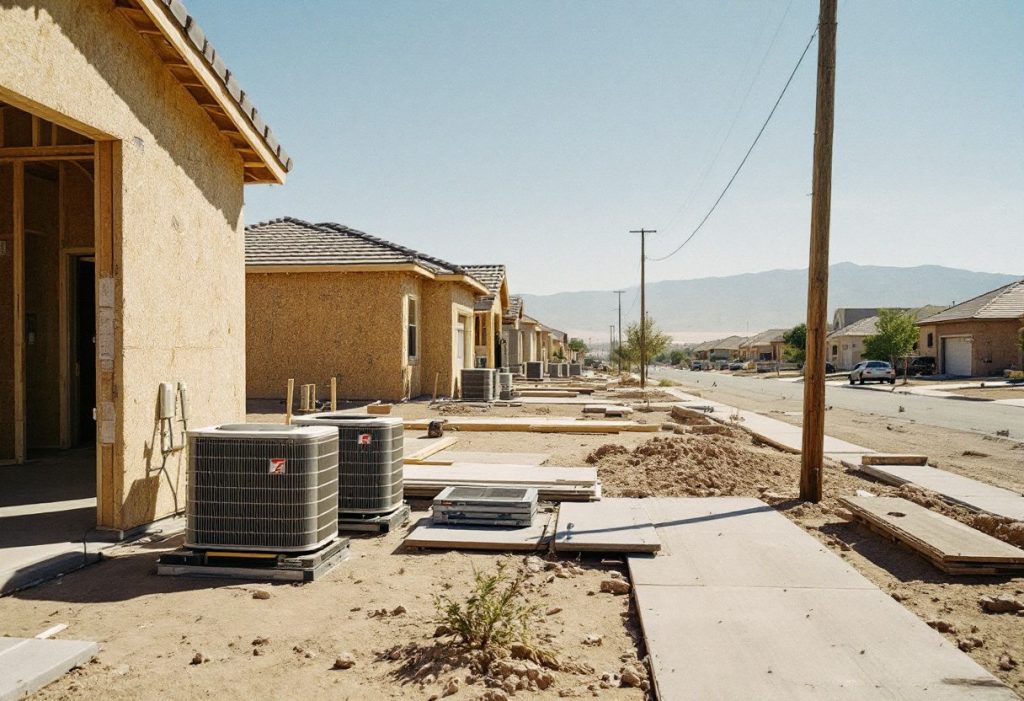
The top of the ranking is the Mountain West. Colorado, Idaho, Arizona, Wyoming all project growth above 25 percent, three times the national rate, and Utah and Montana are also in the top ten. Together, the eight Mountain states project +10,580 jobs, 20 percent of the state total, from 10 percent of the base. These states have had the fastest population growth in the country for a decade, and HVAC demand follows households.
Florida is the volume story. Its projected +18.4 percent on a base of 40,700 produces +7,480 jobs and 4,430 openings a year, more than any other state. Tennessee (+20.7%) is the fastest-growing state east of the Rockies.
The slowest-growing states
Alaska is the only state projecting a decline (-0.5 percent, on a base of 430). New York (+1.6%) projects almost no net growth despite a workforce of 24,210, and Maine (+1.7%) is close behind. Slow net growth is not the same as few jobs: New York still projects 2,060 openings a year, nearly all from replacement, the fourth-highest of any state.
| State | 2024 | Growth | All jobs growth | Annual openings |
|---|---|---|---|---|
| Alaska | 430 | -0.5% | +2.6% | 40 |
| New York | 24,210 | +1.6% | +1.8% | 2,060 |
| Maine | 2,270 | +1.7% | -1.2% | 190 |
| Kentucky | 6,560 | +4.1% | +3.7% | 580 |
| Missouri | 6,510 | +5.1% | +3.2% | 580 |
| Pennsylvania | 17,890 | +6.4% | +2.8% | 1,640 |
| Vermont | 1,280 | +6.5% | +2.0% | 120 |
| Michigan | 14,780 | +6.6% | +0.4% | 1,360 |
Where the openings are
For a job seeker or a training program, annual openings matter more than growth rates. Openings are concentrated in the largest states: Florida, California, Texas, New York, Pennsylvania together account for 36 percent of the 42,730 annual openings the states project.
| State | Annual openings | Openings per 100 jobs | Growth |
|---|---|---|---|
| Florida | 4,430 | 10.9 | +18.4% |
| California | 3,770 | 10.1 | +12.8% |
| Texas | 3,350 | 10.1 | +13.0% |
| New York | 2,060 | 8.5 | +1.6% |
| Pennsylvania | 1,640 | 9.2 | +6.4% |
| Virginia | 1,410 | 9.6 | +9.3% |
| North Carolina | 1,400 | 9.6 | +9.3% |
| Arizona | 1,390 | 12.1 | +27.3% |
| Michigan | 1,360 | 9.2 | +6.6% |
| Ohio | 1,360 | 9.3 | +7.4% |
| Georgia | 1,290 | 10.3 | +14.8% |
| Tennessee | 1,210 | 11.2 | +20.7% |
HVAC against the other trades in the largest states
Ranking the trades within each state shows where HVAC is gaining or losing ground for recruits. In the ten largest HVAC states, the four trades compare as follows.
| State | HVAC | Electricians | Plumbers | Roofers | Fastest |
|---|---|---|---|---|---|
| Florida | +18.4% | +19.4% | +14.1% | +18.8% | Electricians |
| California | +12.8% | +14.9% | +8.6% | +6.8% | Electricians |
| Texas | +13.0% | +14.4% | +8.9% | +9.9% | Electricians |
| New York | +1.6% | +3.3% | -1.3% | +0.5% | Electricians |
| Pennsylvania | +6.4% | +8.1% | +3.1% | +5.1% | Electricians |
| Michigan | +6.6% | +5.6% | +2.1% | +3.4% | HVAC |
| Virginia | +9.3% | +9.2% | +5.5% | +5.9% | HVAC |
| Ohio | +7.4% | +7.8% | +3.1% | +4.4% | Electricians |
| North Carolina | +9.3% | +10.4% | +5.6% | +6.5% | Electricians |
| Georgia | +14.8% | +14.9% | +10.1% | +11.5% | Electricians |
Electricians are the fastest-growing of the four in most large states. HVAC outgrows plumbing in all ten and roofing in nine (Florida’s roofers edge it), which matters because plumbing shares HVAC’s industry code (NAICS 238220) and much of its apprenticeship infrastructure.

What explains the state differences
Three patterns stand out. First, past growth predicts projected growth: states whose HVAC and plumbing contractor employment grew fastest from 2014 to 2024 project faster HVAC growth to 2034 (correlation 0.51), partly because projections extrapolate industry trends. Second, overall job-market growth explains most of the variation (correlation 0.83). Third, faster growth is associated with somewhat lower current pay (correlation with the May 2025 median wage -0.36): the faster-growing half of states has a median HVAC wage of $60,180, against $62,400 in the slower half.
What the projections do not model directly is equipment policy. The 2025 refrigerant transition to A2L systems, the 2029 HFC step-down and the end of the federal 25C heat pump tax credit after 2025 will change the mix of work (see HVAC compliance deadlines), and projections built on 2024 industry staffing patterns cannot capture that fully.
Original synthesis (HVAC Brief calculations)
1. The state projections add up to more than the nation
Summing the 51 state projections gives a 2024 base of 426,910, almost identical to the BLS national base of 425,200. But it gives projected growth of 51,950 jobs, against 34,500 nationally: 51 percent more. Annual openings sum to 42,730, 7 percent above the national 40,100.
States produce their projections independently, with their own industry outlooks, and the federal-state system does not require them to sum to the national total. A plausible reason the sum runs high is that several fast-growing states each assume continued in-migration and construction that cannot all happen at once. It matters for interpretation. A trade group or school that adds up state projections to claim a national HVAC job boom is overstating it. The BLS national figure is the consistent number.
2. HVAC growth is mostly local job-market growth
Across states, projected HVAC growth and projected growth of all jobs correlate at 0.83. States expecting fast overall growth expect fast HVAC growth; states expecting stagnation expect little HVAC growth. The HVAC-specific signal is the premium over the local market, which is positive in 49 of 51 jurisdictions.
| State | HVAC growth | All jobs growth | Premium (points) |
|---|---|---|---|
| Wyoming | +26.3% | +9.9% | +16.4 |
| Arizona | +27.3% | +12.8% | +14.5 |
| Idaho | +28.0% | +13.9% | +14.1 |
| Colorado | +28.3% | +14.3% | +14.0 |
| Tennessee | +20.7% | +8.3% | +12.4 |
| West Virginia | +16.8% | +5.0% | +11.8 |
| Montana | +16.3% | +6.0% | +10.3 |
| Wisconsin | +13.5% | +3.4% | +10.1 |
Wyoming, Arizona, Idaho and Colorado lead on premium as well as growth. West Virginia (+11.8 points) is an outlier: a slow-growing state whose HVAC projection is well above its overall outlook.
3. Nine in ten openings are replacements
Of the 40,100 national annual openings, growth accounts for about 3,450 a year (one-tenth of the decade’s 34,500 net change). The rest, about 91 percent, replaces workers who retire, leave the labor force or change occupations. Across states, openings run at about 9.8 per 100 existing jobs a year, from 8.4 to 12.2. Even the slowest-growing states need roughly one new technician for every eleven existing ones each year. This is why the training pipeline, not net growth, is the binding question for the trade (see the training gap).
4. HVAC is not the fastest-growing trade
Electricians are projected to grow 9.5 percent nationally, faster than HVAC’s 8.1, which BLS links in part to alternative energy installation and electrical system upgrades. By state, electricians are the fastest-growing of the four trades compared here in 40 jurisdictions. HVAC leads in 7: Arizona, Wyoming, Oregon, Washington, Indiana, Virginia, Michigan. Roofers lead in 3 and plumbers in 1.
Charts worth building from this data
- Choropleth of projected HVAC job growth by state, 2024 to 2034.
- Scatter plot of HVAC growth against all-jobs growth by state, with the diagonal.
- Bar chart of annual openings by state, split into growth and replacement.
- Grouped bars comparing HVAC, electrician, plumber and roofer growth.
- Waterfall of state projections summing above the national total.
Most quotable statistics
- BLS projects HVAC technician jobs to grow 8.1 percent from 2024 to 2034, more than twice the 3.1 percent for all jobs.
- About 40,100 HVAC technician jobs will open each year through 2034, about 91 percent from replacement (HVAC Brief calculation).
- Colorado is projected to grow HVAC technician jobs faster than any state, +28.3 percent by 2034.
- Florida will add the most HVAC technician jobs, +7,480 by 2034.
- State projections add up to 51 percent more HVAC job growth than the national forecast (HVAC Brief calculation).
- Electricians are projected to grow faster than HVAC technicians in 40 states.
Data limitations
- State projections are produced by each state’s labor market information office with a common methodology but their own assumptions; they are not constrained to sum to the national projection.
- Projections assume stable economic conditions and current policy. They do not model shocks such as recessions, refrigerant transitions or changes in federal tax credits.
- Projection bases include self-employed workers and differ from OEWS employment counts used elsewhere on this site.
- State figures are rounded by the publishing agency; small states’ projections rest on small bases and should be read cautiously.
- Openings estimates use BLS separations methodology, which models exits and transfers from survey data; they are estimates of need, not job postings.
Downloadable dataset: recommended fields
| Field | Description |
|---|---|
| state | State or DC |
| base_2024 | Projected base employment, 2024 |
| proj_2034 | Projected employment, 2034 |
| change | Numeric change |
| pct_change | Percent change |
| annual_openings | Average annual openings |
| all_occ_pct_change | All occupations percent change, same state |
| premium | HVAC minus all-occupations growth, points |
| electrician / plumber / roofer pct_change | Comparison trades |
| median_wage_2025 | OEWS May 2025 HVAC median, for context |
Press summary
HVAC technician jobs are projected to grow 8.1 percent nationally from 2024 to 2034, with about 40,100 openings a year, according to an HVAC Brief analysis of federal and state projections. Growth will be fastest in the Mountain West, led by Colorado (+28.3%), while Florida will add the most jobs. The analysis also found that state projections, summed, forecast 51 percent more growth than the national figure, and that most openings will come from retirements rather than growth.
Suggested headlines
- Colorado, Idaho and Arizona lead the nation in projected HVAC job growth
- About 40,100 HVAC jobs will open every year through 2034
- Most new HVAC jobs will come from retirements, not growth
- Add up the states and the HVAC job boom gets bigger than it really is
- Electricians, not HVAC techs, are the fastest-growing trade in most states
Source quality ranking
| Source | Tier | Why |
|---|---|---|
| BLS Employment Projections 2024 to 2034 | Tier 1 | Federal projections program, consistent national methodology |
| Projections Central (state LMI long-term projections) | Tier 1 | Official state agency projections under the federal-state partnership |
| BLS OEWS May 2025 | Tier 1 | Federal wage survey, for pay context only |
| Vendor workforce shortage estimates | Excluded | Methodology not disclosed |
Methodology
- State and national projections: Projections Central long-term occupational projections REST service, 2024 to 2034, SOC 49-9021, 47-2111, 47-2152, 47-2181 and 00-0000, retrieved October 2026. The United States row is the BLS national projection.
- Growth premium = HVAC percent change minus all-occupations percent change for the same state.
- Replacement share = 1 minus (decade change / 10) / annual openings.
- Sums across states use the 50 states and DC; Puerto Rico, Guam and the Virgin Islands are excluded.
- Correlations are unweighted Pearson coefficients across 51 jurisdictions.
Frequently asked questions
What is the job outlook for HVAC technicians?
BLS projects 8.1 percent growth from 2024 to 2034, from 425,200 to 459,700 jobs, with about 40,100 openings a year. That is much faster than the 3.1 percent projected for all occupations.
Which state has the best job outlook for HVAC technicians?
By growth rate, Colorado (+28.3%), Idaho (+28.0%) and Arizona (+27.3%). By number of openings, Florida, with 4,430 a year.
Which state has the worst job outlook for HVAC technicians?
Alaska projects a small decline (-0.5%). New York and Maine project under 2 percent growth, though New York still has about 2,060 openings a year from replacement.
How many HVAC jobs will there be in 2034?
BLS projects 459,700 HVAC technician jobs nationally in 2034, including self-employed workers.
Is HVAC a growing field?
Yes. HVAC is projected to grow faster than the overall job market in 49 of 51 jurisdictions, though electricians are projected to grow faster still (9.5% nationally).
Why are there so many HVAC job openings if growth is only 8 percent?
Most openings replace workers who retire or leave. Growth explains about 3,450 of the 40,100 openings a year; replacement explains about 91 percent.
Do state HVAC projections add up to the national number?
No. Summed, state projections forecast 51,950 new jobs against 34,500 nationally, because each state projects independently.
Is there an HVAC technician shortage?
Openings of about 40,100 a year are large relative to the workforce. Whether that becomes a shortage depends on the training pipeline; see our training gap analysis. Wage data do not yet show shortage-level pay growth (see salary by state).
Which trade has better job growth, HVAC or electrician?
Electricians: 9.5 percent nationally versus 8.1 for HVAC, and faster in 40 states. HVAC grows faster than plumbers (4.5%) and roofers (5.9%).
Where do these projections come from?
The national figure is from the BLS Employment Projections program. State figures are produced by state labor market information offices and published through Projections Central, funded by the US Department of Labor.
Cite this report
Sources
- Projections Central, Long-Term Occupational Projections, 2024 to 2034, state labor market information agencies.
- US Bureau of Labor Statistics, Employment Projections program, 2024 to 2034.
- BLS Occupational Outlook Handbook, HVAC mechanics and installers.
- BLS Occupational Employment and Wage Statistics, May 2025.
The HVAC Brief is an independent trade publication. We do not sell equipment, take manufacturer advertising, or accept payment for placement in our research. Corrections welcome.
Leave a Reply