Original data and independent reporting for the HVAC trade

Category: Business

Pricing, margin, hiring and operations for HVAC contractors.

  • Commercial HVAC Service: What Differs From Residential

    Commercial HVAC Service: What Differs From Residential

    Last reviewed: September 2026 · By the HVAC Brief Editorial Team · Our sourcing and editorial standards

    The short answer

    Commercial HVAC service differs from residential in four ways: the equipment is usually a packaged rooftop unit rather than a split system, the refrigerant charge is often large enough to trigger federal leak repair rules, downtime has a direct cost, and the work is governed by a contract rather than a call-out.

    The scale is substantial. EIA’s commercial buildings survey counted 5,918 thousand commercial buildings in 2018, of which 4,901 thousand used energy for space heating and 4,631 thousand for cooling.

    5,918kUS commercial buildings, 2018
    78%Use energy for cooling
    83%Use energy for space heating
    15 lbCharge at which federal leak repair rules apply

    What the equipment usually is

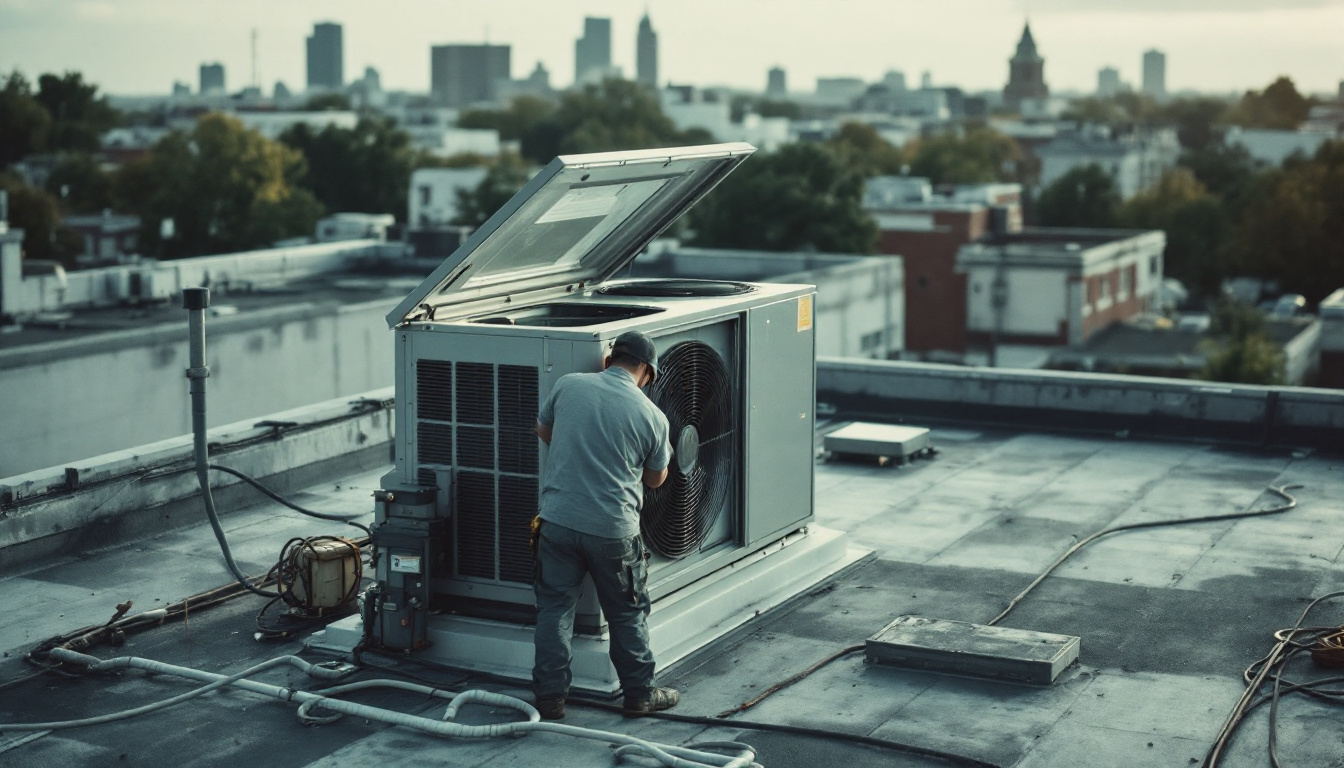
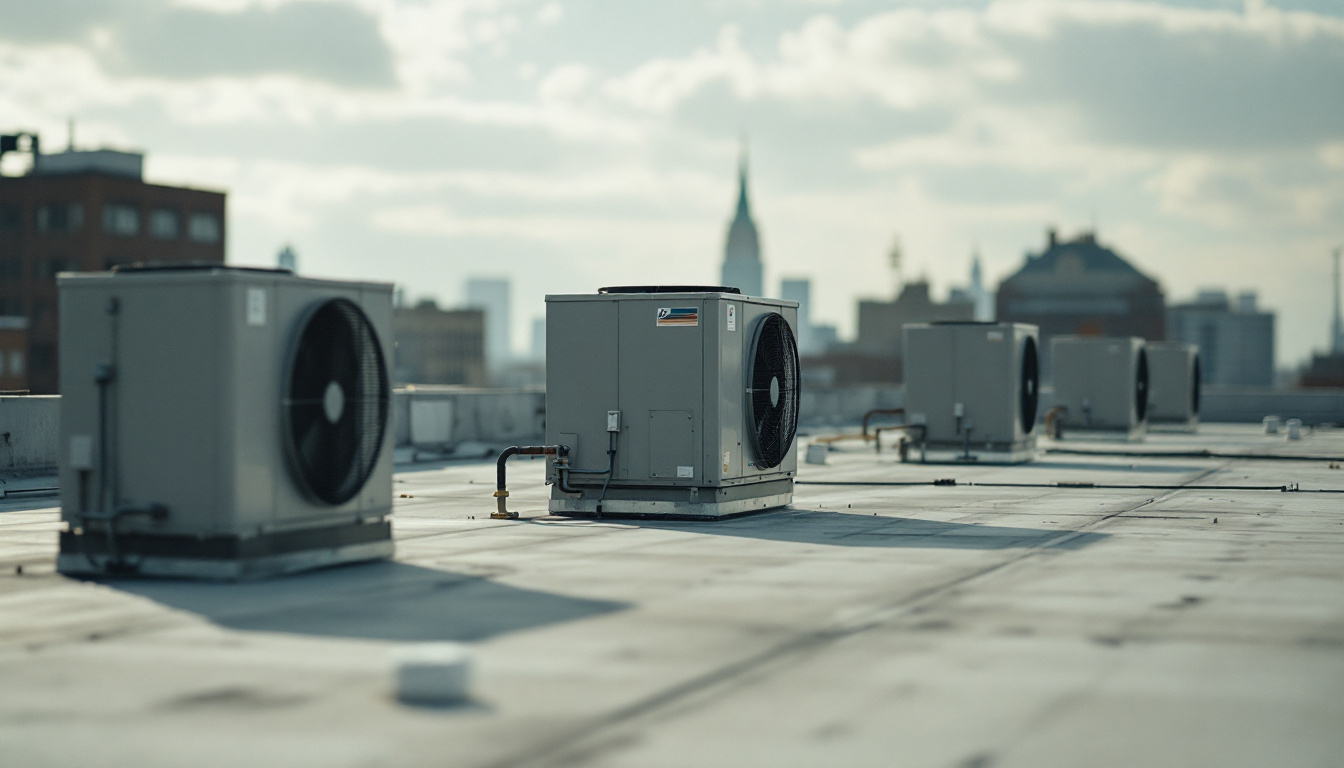
    Most commercial buildings are small, and small commercial buildings are mostly served by packaged rooftop units: heating, cooling and the blower in one cabinet on the roof, ducted straight down into the space.

    Equipment Typically found in Service implication
    Packaged rooftop unit Retail, restaurants, offices, small commercial Roof access, weather exposure, filters and belts on a schedule
    Split system Small offices and suites Closest to residential practice
    Variable refrigerant flow Multi-tenant and hospitality Controls expertise, larger refrigerant charge
    Chiller and air handler Large buildings, campuses, hospitals Water treatment, larger charges, planned shutdowns
    Boilers Older and northern buildings Combustion testing, controls, annual inspection

    For the underlying differences in equipment and duty, see commercial versus residential HVAC.

    What actually fails on a rooftop unit

    Rooftop units live outdoors, run long hours and are usually out of sight, so failures are found later than in a house.

    • Filters and belts. The routine items, and the ones neglect shows up in first.
    • Economizer dampers and actuators. A stuck economizer either wastes energy or brings in hot outdoor air during cooling. It is among the most common faults and one of the least noticed.
    • Contactors and capacitors. The same electrical wear parts as residential equipment.
    • Condenser coils. Exposed to weather and grease from kitchen exhaust in food service.
    • Refrigerant leaks. Larger systems hold larger charges, which brings federal rules into play.
    • Controls. Schedules, sensors and building automation faults that leave equipment running when the building is empty.
    Where federal refrigerant rules bite

    EPA’s leak repair requirements at 40 CFR 84.106 apply to appliances containing 15 or more pounds of regulated refrigerant, and they explicitly exclude residential and light commercial air conditioning and heat pumps. Plenty of commercial equipment sits above that threshold, which means leak inspections, repair deadlines and records. See what the leak repair rules require and the phasedown schedule that is tightening supply.

    Service contracts

    Commercial work is usually contracted rather than called in. The contract type decides who carries the risk.

    Contract Covers Watch for
    Inspection only Scheduled visits, findings reported Repairs billed separately at listed rates
    Preventive maintenance Scheduled tasks, filters and belts included What counts as a repair versus maintenance
    Full coverage Parts and labour, sometimes including compressors Exclusions, caps, and condition surveys before coverage starts

    Ask for the task list per visit, the response time commitment, whether after-hours calls are included, and how refrigerant is billed. Refrigerant cost is the line most likely to move under the phasedown.

    Why downtime is the real cost

    In a house, a failed system is uncomfortable. In a restaurant, a shop or a server room it stops trade or threatens stock, which is why commercial agreements are written around response times rather than around price alone.

    That also changes the maintenance calculation: scheduled visits are bought to reduce unplanned failures, not primarily to save energy. The tasks themselves are the same ones in a proper tune-up, performed to a schedule.

    Frequently asked questions

    How is commercial HVAC service different from residential?

    The equipment is usually a packaged rooftop unit rather than a split system, refrigerant charges are often above the 15 pound threshold that triggers federal leak repair rules, downtime carries a direct business cost, and the work is governed by a service contract with response times rather than by individual call-outs.

    What fails most on commercial rooftop units?

    Filters and belts through neglect, economizer dampers and actuators, contactors and capacitors, condenser coils fouled by weather or kitchen grease, refrigerant leaks, and control faults that leave equipment running out of hours.

    Do federal refrigerant rules apply to commercial systems?

    Yes, above a threshold. EPA’s leak repair requirements at 40 CFR 84.106 apply to appliances with 15 or more pounds of regulated refrigerant and exclude residential and light commercial air conditioning and heat pumps. Larger commercial equipment is commonly above that line.

    Is a commercial HVAC service contract worth it?

    The case rests on avoided downtime rather than on measured energy savings, which no federal source quantifies. Compare contracts on the task list per visit, response time, after-hours inclusion, exclusions and how refrigerant is billed.

    Methodology and limitations

    Building counts are EIA Commercial Buildings Energy Consumption Survey 2018, table B21, the current vintage. Refrigerant rules are quoted from 40 CFR 84.106.

    • CBECS counts buildings, not HVAC systems, and a building may hold many units.
    • We publish no service contract prices, because no federal source measures them.
    • Equipment mix by building type is described in general terms.

    Sources

    1. US Energy Information Administration, Commercial Buildings Energy Consumption Survey 2018, table B21.
    2. Code of Federal Regulations, 40 CFR 84.106, refrigerant leak repair requirements.

    The HVAC Brief is an independent trade publication. We do not sell equipment, take manufacturer advertising, or accept payment for placement in our research. Corrections welcome.

  • Starting an HVAC Business: What the Census Counts Show

    Starting an HVAC Business: What the Census Counts Show

    Last reviewed: September 2026 · By the HVAC Brief Editorial Team · Our sourcing and editorial standards

    The short answer

    There were 111,207 plumbing, heating and air conditioning contractor establishments with paid employees in the US in 2023, and 58.3% of them employed fewer than five people, according to the Census Bureau’s County Business Patterns.

    Starting one is federally simple and locally complicated. There is no federal contractor licence, but a business can only buy refrigerant if it employs an EPA certified technician, and licensing is set by states and localities.

    111,207Contractor establishments with payroll, 2023
    58%Employ fewer than five people
    $0.1kAnnual payroll per employee, 2023
    69%Organised as S corporations

    How big the trade is

    The contractor industry grew on every measure between 2022 and 2023, and payroll grew fastest: up 8.9% against 3.2% more employees.

    NAICS 238220 2022 2023 Change
    Establishments 109,601 111,207 +1.5%
    Employees, mid-March 1,176,759 1,214,761 +3.2%
    Annual payroll $82.24B $89.52B +8.9%
    Payroll per employee $69,883 $73,693 +5.5%
    Average employees per establishment 10.7 10.9

    One caveat shapes every number here. The federal industry code, NAICS 238220, covers plumbing, heating and air conditioning contractors together, and Census does not publish HVAC-only firms separately. County Business Patterns also counts only establishments with paid employees, so a one-person business with no payroll is not in these figures.

    Most firms are small

    A business with fewer than five employees is the typical contractor, not the exception. Only 1,656 establishments, 1.5%, employ 100 people or more.

    Employees Establishments, 2023 Share Cumulative
    Fewer than 5 64,871 58.3% 58.3%
    5 to 9 20,587 18.5% 76.8%
    10 to 19 13,148 11.8% 88.7%
    20 to 49 8,384 7.5% 96.2%
    50 to 99 2,561 2.3% 98.5%
    100 to 249 1,300 1.2% 99.7%
    250 to 499 256 0.2% 99.9%
    500 to 999 76 0.1% 100.0%
    1,000 or more 24 0.0% 100.0%

    For a new owner, that distribution cuts both ways. Small is a normal starting point, and most competitors are also small; but the few large operators have scale in purchasing, marketing and hiring that a start-up does not.

    How HVAC firms are organised

    More than two thirds of contractor establishments belong to S corporations, and the share of sole proprietorships is shrinking.

    Legal form 2022 2023 Change Share, 2023
    S corporation 73,280 76,190 +4.0% 68.5%
    C corporation 16,103 15,841 -1.6% 14.2%
    Sole proprietorship 12,858 11,821 -8.1% 10.6%
    Partnership 7,306 7,299 -0.1% 6.6%
    Nonprofit 43 42 -2.3% 0.0%
    Other 11 14 +27.3% 0.0%

    This shows what existing firms do, not what a new one should do. Entity choice is a tax and liability decision for an accountant or attorney who knows your state.

    What is required federally, and what is not

    Federal rules for an HVAC business are mostly about refrigerant and employment. Licensing to contract is not federal.

    1. Refrigerant purchasing. EPA’s sales restriction says “Only EPA-certified technicians are allowed to purchase” ozone-depleting refrigerants or their non-ozone-depleting substitutes, with limited exceptions. An employer can buy if it gives the wholesaler written evidence that it employs at least one properly certified technician.
    2. Technician certification. Technicians who maintain, service, repair or dispose of equipment that could release refrigerant need Section 608 certification. See what the EPA 608 certification covers.
    3. Employer registration. A business with employees needs an employer identification number from the IRS and has federal payroll tax obligations.
    4. Everything else is state or local. Contractor licensing, business registration, insurance and workers’ compensation requirements, and permits vary by state and often by city or county. No federal source consolidates them.

    Labour is the constraint to plan around

    Hiring costs more every year. Average hourly earnings at plumbing, heating and air conditioning contractors reached $42.61 in July 2026, a preliminary BLS figure, up 40.2% from $30.39 in 2019.

    Employment in the same industry was 1,355,400 in July 2026, also preliminary, up 18.8% from the 2019 average. More on pay in what HVAC contractors pay and the latest employment and wage readings.

    Why the two headcounts differ

    County Business Patterns counts 1,214,761 employees in the pay period including March 12, 2023. The BLS Current Employment Statistics survey puts the industry at 1,355,400 in July 2026. They are different surveys, three years apart, and both include plumbing. Use CBP for firm structure and CES for the current trend.

    Frequently asked questions

    How many HVAC companies are there in the US?

    Census County Business Patterns counted 111,207 plumbing, heating and air conditioning contractor establishments with paid employees in 2023. That code includes plumbing contractors, and it excludes businesses with no payroll, so no federal source gives an HVAC-only count.

    Do you need a license to start an HVAC business?

    There is no federal contractor licence. Licensing is set by states and often by cities or counties. Federally, technicians who handle refrigerant need EPA Section 608 certification, and a business can only buy refrigerant if it employs at least one certified technician.

    Can an HVAC company buy refrigerant without certification?

    Only with a certified technician on staff. EPA allows an employer to purchase refrigerant if it provides the wholesaler with written evidence that it employs at least one properly certified technician. Only Section 608 certified technicians can buy refrigerant intended for stationary air conditioning equipment.

    Are most HVAC businesses small?

    Yes. In 2023, 58.3% of plumbing, heating and air conditioning contractor establishments had fewer than five employees, and 1.5% had 100 or more, according to Census County Business Patterns.

    Methodology and limitations

    Establishment, employee, payroll, size and legal form figures are County Business Patterns 2023 and 2022 national files for NAICS 238220. Earnings and employment trends are BLS Current Employment Statistics series CEU2023822003 and CEU2023822001; July 2026 values are preliminary and subject to revision.

    • NAICS 238220 includes plumbing contractors, and CBP counts establishments, not firms.
    • Nonemployer businesses are excluded from CBP.
    • We publish no revenue, margin or start-up cost figures, because CBP does not measure them and we do not use vendor surveys.
    • Nothing here is legal, tax or licensing advice.

    Sources

    1. US Census Bureau, County Business Patterns, 2023 and 2022, NAICS 238220.
    2. US Environmental Protection Agency, Refrigerant Sales Restriction.
    3. US Bureau of Labor Statistics, Current Employment Statistics series CEU2023822001 and CEU2023822003.

    The HVAC Brief is an independent trade publication. We do not sell equipment, take manufacturer advertising, or accept payment for placement in our research. Corrections welcome.

  • Commercial HVAC vs Residential: The Three Real Differences

    Commercial HVAC vs Residential: The Three Real Differences

    Last reviewed: September 2026 · By the HVAC Brief Editorial Team · Our sourcing and editorial standards

    The short answer

    Commercial HVAC differs from residential in three ways that matter: equipment sits on the roof as packaged units, ventilation is code-driven rather than optional, and the regulatory treatment is different.

    That last point is concrete. The 2026 refrigerant leak repair rules at 40 CFR 84.106 apply at 15 or more pounds of charge and exclude residential and light commercial equipment, so larger commercial systems carry obligations a house never does.

    The three real differences

    Residential Commercial
    Typical equipment Split system, indoor and outdoor units Packaged rooftop units, or chillers at larger scale
    Ventilation Often incidental, through envelope leakage Specified outdoor air rates, code driven
    Zoning Optional, added with dampers Usually inherent, multiple units or VAV
    Refrigerant leak rules Excluded from 40 CFR 84.106 Apply at 15+ lb charge
    Access Ground level or basement Roof, with access and safety implications
    Downtime cost Comfort Often revenue, sometimes stock or process

    Why rooftop packaged units dominate

    1. No indoor plant space consumed, which is leasable floor area in a commercial building.
    2. Modularity. Several units serving zones is more resilient than one large machine, and a failure takes out part of the building rather than all of it.
    3. Service access without entering tenant space, which matters in multi-tenant buildings.
    4. Simpler outdoor air provision, since the unit is already outside.

    The trade-off is exposure: rooftop equipment weathers harder, and access requires fall protection and often a lift.

    The regulatory line that catches contractors

    The 15-pound charge threshold in 40 CFR 84.106 is what separates a system with leak rate calculation and record-keeping obligations from one without. Light commercial air conditioning and heat pumps are excluded alongside residential, but larger commercial and refrigeration systems are not. See who those rules cover.

    Where the VRF dates matter

    Variable refrigerant flow systems, common in commercial and light commercial work, have their own timetable under 40 CFR 84.54(c)(2): restricted from January 1, 2026, installable before January 1, 2027 where components were built before January 1, 2026, and before January 1, 2028 with a building permit issued prior to October 5, 2023. Our compliance calendar sets out the dated sequence.

    Frequently asked questions

    What is the difference between commercial and residential HVAC?

    Equipment is typically packaged rooftop units rather than split systems, ventilation rates are specified by code rather than incidental, and larger systems carry refrigerant obligations residential equipment does not. The 2026 leak repair rules apply at 15 or more pounds of charge and exclude residential and light commercial air conditioning.

    Why is commercial HVAC on the roof?

    Because indoor plant space is leasable floor area, several modular units are more resilient than one large machine, service access does not require entering tenant space, and outdoor air provision is simpler when the unit is already outside. The trade-off is weather exposure and access requirements.

    Do refrigerant leak rules apply to commercial systems?

    To larger ones, yes. 40 CFR 84.106 applies to appliances with a full charge of 15 or more pounds, with leak rate calculation, repair obligations and record keeping. Residential and light commercial air conditioning and heat pumps are explicitly excluded from the section.

    What is a VRF system?

    Variable refrigerant flow, a system where one outdoor unit serves multiple indoor units with modulating refrigerant flow, common in commercial and light commercial buildings. It has its own restriction timetable under 40 CFR 84.54(c)(2), separate from the rules covering residential split systems.

    Methodology and limitations

    Regulatory positions are quoted from 40 CFR 84.106 and 40 CFR 84.54. Equipment descriptions are general architecture rather than any specific manufacturer’s product.

    • Ventilation rate requirements are set by building and mechanical codes that vary by jurisdiction, and we do not summarise them.
    • We publish no commercial equipment or service costs, as no federal series measures them.
    • Nothing here is engineering or compliance advice for a specific building.

    Sources

    1. US Environmental Protection Agency, 40 CFR 84.106 and 40 CFR 84.54.

    The HVAC Brief is an independent trade publication. We do not sell equipment, take manufacturer advertising, or accept payment for placement in our research. Corrections welcome.

  • What an HVAC Warranty Actually Covers, and What It Does Not

    What an HVAC Warranty Actually Covers, and What It Does Not

    Last reviewed: September 2026 · By the HVAC Brief Editorial Team · Our sourcing and editorial standards

    The short answer

    An HVAC warranty usually covers the part and not the labour to fit it, and registration is often required within a set window after installation or the term drops. Those two details decide most of what a warranty is actually worth.

    Manufacturer parts warranty, contractor labour warranty and a third-party home warranty are three different products. They get discussed as one thing and they fail in different ways.

    The three things called a warranty

    Type Who provides it Typically covers Typically excludes
    Manufacturer parts warranty Equipment maker The failed component Labour, refrigerant, diagnostics, travel
    Contractor labour warranty The installing company Labour for a defined period Parts, and it ends if the company does
    Home warranty or service contract Third party Varies by contract Varies by contract, often pre-existing faults

    A parts warranty on a compressor sounds substantial until you price the labour, the refrigerant recovery and the recharge that fitting it requires, none of which the parts warranty pays.

    What most often voids or shortens coverage

    1. Not registering. Many manufacturers require registration within a window after installation, and the unregistered term is shorter.
    2. Unlicensed or DIY installation. Coverage commonly requires installation by a qualified contractor.
    3. No documented maintenance. Some terms require evidence of servicing, which is a contractual requirement rather than a federal one. See what the evidence says about intervals.
    4. Non-original parts. Substituting components can void remaining coverage.
    5. Transfer on sale. Some warranties transfer to a new owner, some do not, and some require a fee and a form within a window.
    The question that reveals the real value

    Ask what a covered compressor failure would cost you out of pocket. If the answer includes diagnostic time, labour, refrigerant recovery and recharge, you have learned what the warranty does not cover, which is the part that matters. On an R-410A system the refrigerant line of that answer gets less comfortable each year under the phasedown schedule.

    Frequently asked questions

    Does an HVAC warranty cover labour?

    Usually not. A manufacturer parts warranty typically covers the failed component only, leaving diagnostic time, labour, refrigerant recovery and recharge to the owner. Labour coverage normally comes separately from the installing contractor, for a shorter defined period, and it ends if that company ceases trading.

    Do I need to register my HVAC warranty?

    Often yes, and within a limited window after installation. Many manufacturers offer a longer term to registered owners and a shorter default term to everyone else. Registration is one of the most common reasons a warranty turns out to be shorter than the owner believed.

    What voids an HVAC warranty?

    Common causes are failing to register in time, installation by an unqualified party, absence of documented maintenance where the terms require it, and substituting non-original parts. Transfer rules on sale also vary, with some warranties requiring a fee and a form within a window.

    Is a home warranty worth it for HVAC?

    That depends entirely on the contract, and no federal source measures the value of these products. Read what is excluded rather than what is covered, check how pre-existing conditions are defined, and confirm who chooses the contractor and what the payout limits are per claim and per year.

    Methodology and limitations

    This page describes contract structures in general terms. Warranty terms are private contracts and vary by manufacturer, contractor and provider.

    • We name no manufacturers or warranty providers and rate none.
    • No federal source measures warranty claim rates or the value of service contracts.
    • Nothing here is legal advice. Your specific terms govern, and consumer protection rules vary by state.

    The HVAC Brief is an independent trade publication. We do not sell equipment, take manufacturer advertising, or accept payment for placement in our research. Corrections welcome.

  • HVAC Financing: What to Establish Before You Sign

    HVAC Financing: What to Establish Before You Sign

    Last reviewed: September 2026 · By the HVAC Brief Editorial Team · Our sourcing and editorial standards

    The short answer

    HVAC financing became a bigger part of the decision after the federal 25C tax credit expired for anything placed in service after December 31, 2025, removing up to $2,000 from a qualifying heat pump job.

    Equipment producer prices are also up 60% since 2019. A larger bill with no federal credit against it is why payment structure now comes up earlier in the conversation than it used to.

    We do not compare lenders or rate offers. What follows is what to establish before signing, and which numbers are documented.

    What changed on the incentive side

    Factor 2025 2026
    Federal 25C credit, qualifying heat pump Up to $2,000 $0
    What controls eligibility Placed in service by Dec 31, 2025 Not available
    State and utility rebates Unaffected Unaffected
    Equipment producer prices vs 2019 Up 60%, July 2026 the series high

    Details of the credit expiry are in what the 25C change costs, and the price trend in our price index analysis.

    What to establish before signing

    1. The total amount repayable, not the monthly figure. Two offers with the same monthly payment over different terms are not the same offer.
    2. The annual percentage rate, and whether any promotional rate expires into a higher one.
    3. Whether deferred interest applies. Some promotional structures charge interest retrospectively from day one if the balance is not cleared within the promotional window.
    4. Any dealer fee built into the price. A financed price and a cash price are sometimes different numbers for the same job.
    5. Whether the obligation attaches to you or the property. Some programmes secure the debt against the home, which affects sale and refinancing.
    6. Early repayment terms, including whether paying early reduces total interest.
    Check rebates before financing

    State and utility rebate programmes were not affected by the federal credit expiring, and they vary by utility rather than by state, so a neighbouring town can have a materially different offer. Establishing what is available reduces the amount financed, which changes every other number in the deal. Confirm with the specific utility rather than assuming.

    Frequently asked questions

    Is there still a tax credit for HVAC in 2026?

    Not federally. The Section 25C Energy Efficient Home Improvement Credit applied to property placed in service before December 31, 2025, and installation date controls rather than purchase date. State and utility rebate programmes are separate and were unaffected by that expiry.

    What should I check in an HVAC financing offer?

    The total amount repayable rather than the monthly payment, the annual percentage rate and whether a promotional rate expires, whether deferred interest applies retrospectively, any dealer fee built into the financed price, whether the obligation attaches to the property, and early repayment terms.

    What is deferred interest?

    A promotional structure where interest accrues from the start but is only charged if the balance is not cleared within the promotional period. Clearing it in time costs nothing; missing the window by a small amount can trigger interest calculated back to day one on the original balance.

    Why did HVAC costs rise so much?

    Equipment producer prices are up about 60% since 2019, roughly twice general consumer inflation, with August 2026 the highest reading in the BLS series. The federal 25C credit worth up to $2,000 also expired for installations after December 31, 2025.

    Methodology and limitations

    Credit terms are from the IRS. Equipment price movement is BLS series PCU333415333415 indexed to its 2019 annual average.

    • We name no lenders and compare no rate offers.
    • Nothing here is financial advice. Terms vary by provider, product and jurisdiction, and consumer credit rules differ by state.
    • We publish no installed costs, as no federal series measures them.

    Sources

    1. Internal Revenue Service, Energy Efficient Home Improvement Credit.
    2. US Bureau of Labor Statistics, Producer Price Index series PCU333415333415.

    The HVAC Brief is an independent trade publication. We do not sell equipment, take manufacturer advertising, or accept payment for placement in our research. Corrections welcome.

  • HVAC Contractor Employment Reaches 1,355,400, Wages Hit $42.61

    HVAC Contractor Employment Reaches 1,355,400, Wages Hit $42.61

    Last reviewed: September 2026 · By the HVAC Brief Editorial Team · Our sourcing and editorial standards

    The data

    Employment at plumbing, heating and air conditioning contractors reached about 1,355,400 in the latest reading, and average hourly earnings at those firms hit $42.61. Both are up substantially on 2019: employment by 18.8% and earnings by 40.2%.

    Separately, the Bureau of Labor Statistics counts 409,670 people in the narrower HVAC mechanic and installer occupation, at a median of $29.33 an hour.

    These are two different measures and they get conflated. The contractor employment series counts everyone on the payroll including office and supervisory staff. The occupation series counts people doing the installation and repair work.

    The latest readings

    Measure Latest 2019 Change
    Contractor employment, NAICS 238220 1,355,400 1,140,992 +18.8%
    Average hourly earnings, NAICS 238220 $42.61 $30.39 +40.2%
    HVAC mechanics and installers, SOC 49-9021 409,670 n/a median $29.33/hr

    What the combination says

    Employment and wages rising together is not the signature of a shrinking trade. It is the signature of competition for experienced people inside a growing one. A workforce that added roughly a fifth of its headcount while pay outpaced the wider private economy is expanding, whatever hiring difficulty individual firms report.

    That distinction matters for how a business responds. A genuine shortage argues for recruitment spending. Competition for experienced staff argues for retention and training economics. Our pay analysis compares the trajectory against construction overall and the whole private economy.

    The measure to quote carefully

    If you see a technician headcount and a wage figure quoted together, check they come from the same series. The contractor employment number and the occupation number differ by hundreds of thousands of people because they count different populations, and mixing them produces a wage per worker that describes nobody.

    Frequently asked questions

    How many people work in HVAC?

    About 1,355,400 people are employed by plumbing, heating and air conditioning contractors as of July 2026, a figure that includes office and supervisory staff. The narrower occupation of HVAC mechanics and installers, SOC 49-9021, counted 409,670 people in the May 2025 BLS release.

    Are HVAC wages still rising?

    Yes. Average hourly earnings at plumbing, heating and air conditioning contractors reached $42.61 as of July 2026, up 40.2% from $30.39 in 2019. The median for the mechanic and installer occupation specifically was $29.33 an hour in May 2025.

    Is there an HVAC labour shortage?

    The national data shows a growing workforce rather than a shrinking one: employment up 18.8% since 2019 with wages up 40.2% over the same period. Individual firms report real hiring difficulty, but that pattern describes competition for experienced people inside a growing trade.

    Sources

    1. US Bureau of Labor Statistics, Current Employment Statistics, NAICS 238220, series CEU2023822001 and CEU2023822003; Occupational Employment and Wage Statistics, SOC 49-9021, May 2025, via the BLS Public Data API v2.

    The HVAC Brief is an independent trade publication. We do not sell equipment, take manufacturer advertising, or accept payment for placement in our research. Corrections welcome.

  • EPA 608 Certification: Which Type HVAC Technicians Actually Need

    EPA 608 Certification: Which Type HVAC Technicians Actually Need

    Last reviewed: August 2026 · By the HVAC Brief Editorial Team · Our sourcing and editorial standards

    The short answer

    EPA Section 608 certification is federally required for anyone who maintains, services, repairs or disposes of appliances containing regulated refrigerants in a way that could violate the refrigerant circuit. Residential and light commercial HVAC work falls under Type II.

    There are four certifications, and they are defined by appliance pressure class rather than by job title. Apprentices are exempt while closely and continually supervised by a certified technician.

    The four certification types

    Certification Covers Typical residential relevance
    Type I Small appliances Window units, some packaged equipment
    Type II Medium, high and very high-pressure appliances, excluding small appliances and motor vehicle systems The one most residential HVAC work requires
    Type III Low-pressure appliances Chillers, rarely residential
    Universal All of the above Technicians working across equipment types

    Central residential air conditioners and heat pumps are medium or high-pressure appliances, which is why Type II is the practical requirement for most residential service work rather than Type I.

    Who is exempt, and who is not

    1. Apprentices are exempt while closely and continually supervised by a certified technician. Both the apprentice and the supervising technician carry responsibility for compliance.
    2. Disposal of small appliances and motor vehicle air conditioning does not require certification.
    3. Motor vehicle air conditioning service for consideration requires certification under 40 CFR part 82 subpart B, a separate scheme from 608.
    4. Everyone else performing work that could reasonably be expected to release refrigerant must hold the applicable certification.
    Certification is not a licence

    Section 608 is a federal environmental requirement about refrigerant handling. It is not a state contractor licence, does not authorise you to contract, and does not substitute for local licensing. The two are separate systems with separate requirements, and holding one says nothing about the other.

    Why the A2L transition raises the stakes

    The refrigerants replacing R-410A are classified A2L, meaning mildly flammable, which changes handling, storage and equipment requirements even though the certification framework is unchanged. A technician certified years ago holds a valid certification but may not have training on the refrigerants now shipping in new equipment. See our summary of the refrigerant rules.

    Frequently asked questions

    What EPA certification do HVAC technicians need?

    Type II for most residential and light commercial work, because central air conditioners and heat pumps are medium or high-pressure appliances. Type I covers small appliances, Type III covers low-pressure appliances, and Universal covers all three. The requirement is in 40 CFR 82.161.

    Do apprentices need EPA 608 certification?

    No, while closely and continually supervised by a certified technician. The regulation places responsibility for compliance on both the apprentice and the supervising technician. The exemption applies only during supervised work.

    Is EPA 608 the same as a contractor licence?

    No. Section 608 is a federal environmental certification covering refrigerant handling. Contractor licensing is set by states and municipalities and covers the right to contract for work. They are separate requirements and holding one does not satisfy the other.

    Does EPA 608 certification expire?

    The certification itself does not carry a federal renewal cycle in the way many state licences do. What changes is the equipment and refrigerants in the field: the A2L refrigerants now shipping have different handling requirements from R-410A, so currency of training matters separately from currency of certification.

    Methodology and limitations

    Requirements are quoted from 40 CFR 82.161, technician certification, paragraph (a), retrieved from the electronic CFR.

    • This covers the federal certification requirement only. State and local licensing is separate and varies.
    • We do not list exam providers, costs or study materials, as no federal source compiles them.
    • Nothing here is legal advice on compliance for a specific business.

    Sources

    1. US Environmental Protection Agency, 40 CFR 82.161, technician certification, via eCFR.

    The HVAC Brief is an independent trade publication. We do not sell equipment, take manufacturer advertising, or accept payment for placement in our research. Corrections welcome.

  • How to Become an HVAC Technician: Pay, Certification and Route In

    How to Become an HVAC Technician: Pay, Certification and Route In

    Last reviewed: September 2026 · By the HVAC Brief Editorial Team · Our sourcing and editorial standards

    The short answer

    409,670 people work as HVAC mechanics and installers in the US, at a median wage of $29.33 an hour or $61,010 a year. The trade is entered through apprenticeship or a trade programme, and EPA Section 608 certification is required by federal rule to handle refrigerants.

    The sector has been growing. Employment across plumbing, heating and air conditioning contractors rose to about 1,355,400 as of July 2026, and average hourly earnings at those firms reached $42.61.

    What the job pays

    Measure, SOC 49-9021, May 2025 Hourly Annual
    Median $29.33 $61,010
    Mean $31.14 $64,780

    State medians vary widely, from $23.26 in Alabama to $37.21 in Illinois across the large states we examined. Our state-by-state wage breakdown shows the states with the most jobs are not the best paid.

    The route in

    1. Apprenticeship or trade programme. Both routes exist. An apprenticeship pays while you train; a programme front-loads classroom time. Neither is federally mandated, and requirements are set by states and employers.
    2. EPA Section 608 certification. This one is federal. Under 40 CFR part 82 subpart F, technicians who maintain, service, repair or dispose of equipment containing regulated refrigerants must be certified. It is not optional.
    3. State or local licensing. Varies considerably. Some states license HVAC contractors at state level, others leave it to municipalities, and requirements differ for working as an employee versus contracting independently.
    4. Manufacturer and A2L training. Increasingly relevant as the refrigerant transition proceeds, because the new A2L refrigerants have different handling requirements from R-410A.
    What the data says about timing

    Employment in the sector grew about 18% since 2019 and average hourly earnings rose about 40%. Both rising together indicates competition for experienced people inside a growing trade rather than a shrinking one, which is a favourable entry condition.

    What the work actually involves

    SOC 49-9021 covers installing and repairing heating, air conditioning and refrigeration equipment. In practice that means diagnostics, refrigerant handling, electrical work, ductwork and increasingly controls. It is field work in occupied buildings, in attics and on roofs, with a seasonal load pattern that peaks in extreme weather.

    The occupation code is narrower than “works in HVAC”. Of the roughly 1,355,400 people employed by plumbing, heating and air conditioning contractors, 409,670 are counted in the mechanic and installer occupation. The rest are office, sales, supervisory and other roles.

    Frequently asked questions

    How do you become an HVAC technician?

    Through an apprenticeship or a trade programme, followed by EPA Section 608 certification, which federal rule requires for anyone servicing equipment with regulated refrigerants. State and local licensing requirements vary considerably and are separate from the federal certification.

    How much do HVAC technicians earn?

    The national median was $29.33 an hour, or $61,010 a year, in the BLS May 2025 release for SOC 49-9021, with 409,670 people employed. The mean was higher at $31.14 hourly, indicating higher earners pull the distribution upward.

    Is EPA 608 certification required?

    Yes, for handling regulated refrigerants. Under 40 CFR part 82 subpart F, technicians who maintain, service, repair or dispose of equipment containing regulated refrigerants must hold Section 608 certification. It is a federal requirement, separate from any state licence.

    Is HVAC a growing trade?

    By employment, yes. Plumbing, heating and air conditioning contractors employed about 1,355,400 people as of July 2026, up roughly 19% since 2019, while average hourly earnings rose about 40% over the same period.

    Methodology and limitations

    Wage and employment figures are BLS Occupational Employment and Wage Statistics, May 2025, SOC 49-9021, and BLS Current Employment Statistics for NAICS 238220. Certification requirements are from 40 CFR part 82 subpart F.

    • OEWS covers wage and salary employees and excludes self-employed contractors.
    • We do not list state licensing requirements, which change and vary by jurisdiction. Confirm with your state board.
    • We publish no training programme costs or durations, as no federal source compiles them.

    Sources

    1. US Bureau of Labor Statistics, Occupational Employment and Wage Statistics, May 2025, SOC 49-9021; Current Employment Statistics, NAICS 238220, via the BLS Public Data API v2.
    2. US Environmental Protection Agency, 40 CFR part 82 subpart F, refrigerant technician certification.

    The HVAC Brief is an independent trade publication. We do not sell equipment, take manufacturer advertising, or accept payment for placement in our research. Corrections welcome.

  • HVAC Technician Salary by State: What the Federal Data Shows

    HVAC Technician Salary by State: What the Federal Data Shows

    Last reviewed: September 2026 · By the HVAC Brief Editorial Team · Our sourcing and editorial standards

    The short answer

    The national median wage for HVAC mechanics and installers was $29.33 an hour, or $61,010 a year, in May 2025. Across the fifteen largest states we pulled, medians run from $23.26 in Alabama to $37.21 in Illinois.

    The states with the most HVAC jobs are not the best paid. Florida employs the most technicians of any state we examined, at 39,160, but its median of $27.24 sits near the bottom of the range.

    All figures are Bureau of Labor Statistics Occupational Employment and Wage Statistics for May 2025, occupation code SOC 49-9021, heating, air conditioning and refrigeration mechanics and installers. These are wages for the people who install and repair equipment, not for everyone employed by an HVAC business.

    Median wage by state

    State Employment Median hourly vs national median
    Illinois 9,740 $37.21 +26.9%
    Massachusetts 8,200 $37.16 +26.7%
    Washington 7,370 $36.38 +24.0%
    New York 24,430 $35.78 +22.0%
    California 35,130 $34.88 +18.9%
    Colorado 8,940 $31.35 +6.9%
    Ohio 14,150 $30.06 +2.5%
    Pennsylvania 15,880 $30.00 +2.3%
    Michigan 12,590 $29.26 -0.2%
    Arizona 10,860 $28.56 -2.6%
    Texas 34,730 $27.77 -5.3%
    North Carolina 15,230 $27.53 -6.1%
    Florida 39,160 $27.24 -7.1%
    Georgia 12,290 $27.11 -7.6%
    Alabama 8,260 $23.26 -20.7%

    The spread between the highest and lowest state median in this set is $13.95 an hour, about 60%. That is a wide band for the same occupation code and the same certification requirements.

    Where the jobs are versus where the pay is

    Florida, Texas and California hold the largest technician populations in this set. Two of those three sit below the national median wage. The northern and coastal states with smaller workforces, Illinois and Massachusetts among them, pay the most.

    What that pattern suggests

    Cooling-dominated states with long seasons and heavy residential construction employ the most technicians, and also have the deepest supply of them. Pay tracks local labour markets and cost of living rather than demand for cooling. A technician comparing offers across states should weigh the wage against local costs rather than treating the highest number as the best deal.

    National context

    Nationally, 409,670 people work in SOC 49-9021 at a median of $29.33 an hour. The mean is higher at $31.14, which indicates the distribution is pulled upward by higher earners rather than being symmetrical.

    Across all payroll staff at plumbing, heating and air conditioning contractors, a broader group including office and supervisory roles, average hourly earnings were $42.61 as of July 2026. Our analysis of contractor pay growth compares that trajectory against construction overall and the wider private economy.

    Frequently asked questions

    How much do HVAC technicians make?

    The national median for heating, air conditioning and refrigeration mechanics and installers was $29.33 an hour, or $61,010 a year, in the BLS May 2025 release. The mean was $31.14 hourly and $64,780 annually, with 409,670 people employed in the occupation.

    Which state pays HVAC technicians the most?

    Of the fifteen large states examined, Illinois had the highest median at $37.21 an hour, followed closely by Massachusetts and Washington. The lowest in the set was Alabama at $23.26. All figures are BLS OEWS May 2025 for SOC 49-9021.

    Which state has the most HVAC jobs?

    Florida employed 39,160 HVAC mechanics and installers, the largest of the states examined, ahead of California and Texas. Its median wage of $27.24 is below the national median, so the largest job markets are not the highest paying ones.

    Is HVAC a well paid trade?

    The national median of $29.33 an hour sits above the median for all occupations, and pay in the trade has grown faster than the wider private economy since 2019. State medians in this set range from $23.26 to $37.21, so local market matters as much as the trade itself.

    Methodology and limitations

    Figures are BLS Occupational Employment and Wage Statistics, May 2025 release, occupation SOC 49-9021, retrieved via the BLS Public Data API using state-level OEWS series. We pulled fifteen large states rather than all fifty; this is a sample of major markets, not a complete ranking.

    • OEWS covers wage and salary employees. It excludes self-employed contractors and business owners.
    • SOC 49-9021 covers mechanics and installers, a narrower group than everyone employed by an HVAC business.
    • State medians conceal wide metro variation within each state.
    • These are nominal wages, not adjusted for cost of living, which materially affects the state comparison.

    Sources

    1. US Bureau of Labor Statistics, Occupational Employment and Wage Statistics, May 2025, SOC 49-9021, national and state estimates, via the BLS Public Data API v2.
    2. US Bureau of Labor Statistics, Current Employment Statistics, NAICS 238220, series CEU2023822003.

    The HVAC Brief is an independent trade publication. We do not sell equipment, take manufacturer advertising, or accept payment for placement in our research. Corrections welcome.

  • HVAC Industry Statistics 2026: Verified Federal Data

    HVAC Industry Statistics 2026: Verified Federal Data

    Last reviewed: September 2026 · By the HVAC Brief Editorial Team · Our sourcing and editorial standards

    The short answer

    HVAC industry statistics for 2026, drawn only from federal primary sources with the exact data series named so you can reproduce every figure. HVAC equipment producer prices are up 60.0% since 2019. There were 409,670 heating, air conditioning and refrigeration mechanics employed at a median wage of $29.33 an hour. Contracting firms employed about 1,355,400 people.

    Most published HVAC statistics pages name a source but do not date it or link it. Five figures that circulate widely do not survive a check against the primary data, and we show which ones below.

    The headline numbers

    Every row below names the federal series it comes from and the month or year it describes. Where a figure is a share rather than a count, we show the numerator and denominator so the arithmetic is visible. Nothing in this table is an estimate, a projection, or a market-research forecast.

    Measure Value Series Vintage
    HVAC equipment producer prices, change since 2019 +60.0% BLS PCU333415333415 Aug 2026
    Consumer prices, change over the same period +30.6% BLS CUUR0000SA0 Jul 2026
    HVAC and refrigeration mechanics employed 409,670 BLS OEWS 49-9021 May 2025
    Median wage, HVAC mechanics $29.33/hr BLS OEWS 49-9021 May 2025
    Median annual wage, HVAC mechanics $61,010 BLS OEWS 49-9021 May 2025
    Employees of plumbing, heating and AC contractors 1,355,400 BLS CEU2023822001 2026-07
    Average hourly earnings at those firms $42.61 BLS CEU2023822003 2026-07
    US homes using air conditioning 109.51M of 123.53M (88.7%) EIA RECS HC7.1 2020
    US homes with a heat pump as main heat 16.13M (13.1%) EIA RECS HC6.1 2020

    How much have HVAC equipment prices actually risen?

    Producer prices for HVAC equipment manufacturing rose 60.0% between the 2019 annual average and August 2026, from an index of 203.0 to 324.8. Measured from 2020 instead, the increase is 56.9%. Consumer prices rose 30.6% over the same 2019 baseline, so equipment has risen at roughly twice the rate of general inflation.

    The series is BLS PCU333415333415, the producer price index for NAICS 333415, air conditioning, warm air heating and commercial and industrial refrigeration equipment manufacturing. It measures what manufacturers charge, not what a homeowner pays installed.

    August 2026 is the highest reading in the series since 2019. Prices rose in 21 of the 31 month-over-month comparisons from January 2024 onward, so the direction has been consistent rather than a single spike. Our analysis of what drove HVAC prices up breaks the increase down by cause and shows why the refrigerant transition is not the largest factor.

    How many HVAC technicians are there, and what do they earn?

    The Bureau of Labor Statistics counted 409,670 heating, air conditioning and refrigeration mechanics and installers in its May 2025 Occupational Employment and Wage Statistics release. Median pay was $29.33 an hour, or $61,010 a year. The mean was higher at $31.14 an hour and $64,780 a year.

    The occupation code is SOC 49-9021. It covers people who install and repair the equipment, which is a narrower group than everyone employed by an HVAC business.

    Wage measure, SOC 49-9021 Hourly Annual
    Median $29.33 $61,010
    Mean $31.14 $64,780

    The mean sitting above the median indicates the distribution is pulled upward by higher earners rather than being symmetrical. Metro-level wages vary widely around these national figures.

    How many people work for HVAC contracting firms?

    Employment at plumbing, heating and air conditioning contractors reached about 1,355,400 people as of July 2026, up 18.8% from a 2019 average of roughly 1,140,992. Average hourly earnings across those payrolls were $42.61, up 40.2% from $30.39 in 2019.

    This is a different measure from the technician count above. The series is BLS Current Employment Statistics for NAICS 238220, which covers everyone on the payroll including office and supervisory staff, and it groups plumbing with heating and air conditioning. BLS does not publish HVAC separately at this level.

    The growth matters because it complicates the labour shortage narrative. A sector that added roughly a fifth of its headcount in seven years is not a shrinking trade, whatever hiring difficulty individual firms report. Our breakdown of HVAC contractor pay compares this wage growth against construction overall and the wider private economy.

    How many US homes have air conditioning and heat pumps?

    Of 123.53 million US housing units, 109.51 million use air conditioning equipment, or 88.7%. Another 14.02 million do not. A heat pump is the main heating equipment in 16.13 million homes, 13.1% of the stock.

    These come from the Energy Information Administration’s Residential Energy Consumption Survey for 2020, tables HC7.1 and HC6.1, final data released March 2023. RECS runs every five or six years, so 2020 remains the current vintage and any 2026 figure you see attributed to RECS is either the 2020 survey or an estimate somebody built on top of it.

    Main heating equipment Homes (million) Share of stock
    Natural gas central warm-air furnace 53.26 43.1%
    Heat pump 16.13 13.1%
    Electric central warm-air furnace 13.82 11.2%

    Gas furnaces still heat more than four times as many homes as heat pumps do. Any claim that heat pumps have taken over residential heating is describing new installations in particular markets, not the installed base.

    What changed in the rules in 2025 and 2026?

    Two regulatory changes affect nearly every residential job priced in 2026. Refrigerant rules changed twice, and the federal tax credit that paid up to $2,000 toward a heat pump expired. Both are settled law and both are widely misreported.

    1. New R-410A equipment cannot be manufactured or imported. Under 40 CFR 84.54(a)(1), effective January 1, 2025, self-contained residential and light commercial equipment using refrigerant with a global warming potential of 700 or greater is out of production. R-410A has a GWP of 2,088.
    2. Existing R-410A inventory can still be installed. EPA’s final rule at 91 FR 31284, published May 26, 2026 and effective July 27, 2026, allows equipment manufactured or imported before January 1, 2025 to continue to be installed, with no federal end date. See what the R-410A rule actually says.
    3. The Section 25C credit expired. The Internal Revenue Service states the Energy Efficient Home Improvement Credit applies to property placed in service before December 31, 2025. Installation date controls, not purchase date. See what the 25C expiry costs a homeowner.

    State rules can be stricter than the federal position, and several states run their own hydrofluorocarbon programmes. Confirm current requirements for the jurisdiction before relying on the federal rule for a specific job.

    Five widely repeated HVAC statistics that do not hold up

    These five figures appear across most HVAC statistics pages. Each fails a check against the primary source, either because the number is stale, the attribution names the wrong agency, or the vintage is missing so a reader cannot tell what year it describes.

    Commonly published claim What the primary data shows
    “Equipment prices increased about 40% since 2020,” usually credited to trade press BLS PCU333415333415 puts the increase at 56.9% against the 2020 average and 60.0% against 2019. The circulating figure understates it.
    “441,000 HVAC technicians employed,” credited to BLS with no year OEWS May 2025 reports 409,670 for SOC 49-9021. A larger number is either an older vintage or a broader occupation grouping, and the claim does not say which.
    “Median technician wage $27.55 per hour” That is an earlier OEWS vintage. The May 2025 median is $29.33, about 6% higher.
    “70% of new HVAC businesses fail in the first year,” credited to Energy.gov Misattributed. The Department of Energy does not publish establishment survival statistics. Business Employment Dynamics at BLS is the federal series that does. We are not substituting a figure here because we could not verify one at the NAICS 238220 level.
    “About 90% of US households use air conditioning,” credited to EIA with no year Directionally right, imprecise. EIA RECS 2020 table HC7.1 gives 109.51 million of 123.53 million homes, 88.7%. RECS 2020 is still the current vintage.

    The pattern behind all five is the same. A figure gets published without a vintage, a second page copies it without checking, and within a few cycles the number is detached from any document that could confirm or refute it. Naming the series and the release date is what stops that.

    How to cite and reproduce these figures

    Every BLS number above is retrievable without a subscription. The public data API at api.bls.gov/publicAPI/v2/timeseries/data/ accepts a plain POST with a list of series IDs and a year range, and returns JSON. No key is needed for small requests.

    1. POST a JSON body of the form {"seriesid":["PCU333415333415"],"startyear":"2019","endyear":"2026"} to the timeseries endpoint.
    2. Read the monthly observations from Results.series[].data[], filtering to periods M01 through M12 and skipping suppressed cells, which BLS returns as a hyphen.
    3. Compute the 2019 baseline as the mean of that year’s twelve monthly values, then index later observations against it.

    EIA RECS tables are PDFs at eia.gov/consumption/residential/data/2020/hc/. OEWS occupation data uses series IDs of the form OEUN000000000000049902101, where the trailing digits select the data type.

    Cite this page

    The HVAC Brief. “HVAC Industry Statistics 2026: Verified Federal Data.” Compiled from BLS series PCU333415333415, CUUR0000SA0, CEU2023822001, CEU2023822003, OEWS 49-9021 and EIA RECS 2020. Last reviewed August 2026. https://thehvacbrief.com/hvac-industry-statistics-2026/

    Journalists and researchers may reproduce these figures with attribution. All underlying data is public.

    Methodology and limitations

    We include a figure only when it comes from a named federal series we retrieved ourselves, and we publish the series ID and vintage alongside it. We exclude market-research forecasts, vendor surveys and any figure whose original source we could not reach.

    What these numbers do not tell you

    • Producer prices measure what manufacturers charge. Installed prices add distributor margin, labour, permits and local conditions, so the direction is reliable but the pass-through to a specific quote is not.
    • PCU333415333415 covers commercial and industrial refrigeration alongside residential HVAC, so it is broader than residential equipment alone.
    • NAICS 238220 groups plumbing with heating and air conditioning contractors. No federal series isolates HVAC contracting at this level.
    • OEWS SOC 49-9021 counts installers and mechanics, not everyone employed by an HVAC business. The two employment figures on this page are not interchangeable.
    • EIA RECS 2020 remains the current vintage for equipment data; the 2024 survey’s heating and cooling tables are due in spring 2027 See what the 2024 survey release covers., released March 2023. Housing stock and equipment shares have moved since, and we do not extrapolate.
    • Wage figures are nominal. Against consumer inflation of 30.6% since 2019, real gains are considerably smaller than the headline.
    • Nothing here is legal, tax or engineering advice. Requirements vary by jurisdiction.

    Frequently asked questions

    How many HVAC technicians are there in the US?

    The Bureau of Labor Statistics counted 409,670 heating, air conditioning and refrigeration mechanics and installers in its May 2025 Occupational Employment and Wage Statistics release, occupation code SOC 49-9021. Separately, plumbing, heating and air conditioning contractors employed about 1,355,400 people in total, a broader measure that includes office and supervisory staff.

    What is the average HVAC technician salary in 2026?

    The most recent federal figures are from May 2025. Median pay for SOC 49-9021 was $29.33 an hour, or $61,010 a year. The mean was $31.14 an hour and $64,780 annually. The mean exceeding the median indicates higher earners pull the distribution upward. Metro-level pay varies widely around these national numbers.

    How much have HVAC prices increased?

    Producer prices for HVAC equipment manufacturing rose 60.0% between the 2019 annual average and July 2026, according to BLS series PCU333415333415. Measured from 2020 the increase is 56.9%. Consumer prices rose 30.6% over the same period, so equipment inflated at roughly twice the general rate.

    What percentage of US homes have air conditioning?

    88.7% of US homes use air conditioning equipment: 109.51 million of 123.53 million housing units, per EIA Residential Energy Consumption Survey table HC7.1 for 2020. Around 14.02 million homes do not. RECS runs every five or six years, so 2020 remains the current published vintage.

    How many homes use heat pumps?

    A heat pump is the main heating equipment in 16.13 million US homes, 13.1% of the housing stock, per EIA RECS 2020 table HC6.1. Natural gas central furnaces heat 53.26 million homes, more than four times as many. Claims that heat pumps dominate residential heating describe new installations in specific markets, not the installed base.

    Is the HVAC industry growing?

    By employment, yes. Plumbing, heating and air conditioning contractors employed about 1,355,400 people as of July 2026, up 18.8% from a 2019 average near 1,140,992. Average hourly earnings rose 40.2% over the same period. That combination argues for competition over experienced workers inside a growing trade.

    Can R-410A equipment still be installed in 2026?

    Under federal rules, yes, provided all components were manufactured or imported before January 1, 2025. EPA’s final rule at 91 FR 31284, effective July 27, 2026, allows that inventory to continue to be installed and removed the earlier cutoff. New R-410A equipment cannot be manufactured or imported. Some states impose stricter limits.

    Where do these HVAC statistics come from?

    All figures come from federal primary sources: the Bureau of Labor Statistics for prices, employment and wages, the Energy Information Administration for housing and equipment shares, and the Code of Federal Regulations and Federal Register for rules. Each figure on this page names its series ID and vintage so you can retrieve it yourself.

    Sources

    1. US Bureau of Labor Statistics, Producer Price Index by Industry: Air Conditioning, Warm Air Heating and Commercial and Industrial Refrigeration Equipment Manufacturing, series PCU333415333415, monthly through July 2026, via the BLS Public Data API v2.
    2. US Bureau of Labor Statistics, Consumer Price Index for All Urban Consumers, All Items, series CUUR0000SA0.
    3. US Bureau of Labor Statistics, Occupational Employment and Wage Statistics, SOC 49-9021, heating, air conditioning and refrigeration mechanics and installers, national estimates, May 2025.
    4. US Bureau of Labor Statistics, Current Employment Statistics, NAICS 238220, series CEU2023822001 and CEU2023822003.
    5. US Energy Information Administration, Residential Energy Consumption Survey 2020, tables HC6.1 and HC7.1, final data released March 2023.
    6. 40 CFR 84.54, via eCFR; EPA final rule 91 FR 31284, published May 26, 2026, RIN 2060-AW39.
    7. Internal Revenue Service, Energy Efficient Home Improvement Credit.

    By the HVAC Brief Editorial Team. The HVAC Brief is an independent trade publication: we do not sell equipment, take manufacturer advertising, or accept payment for placement in our research. If you find an error, tell us and we will correct it and note the change.