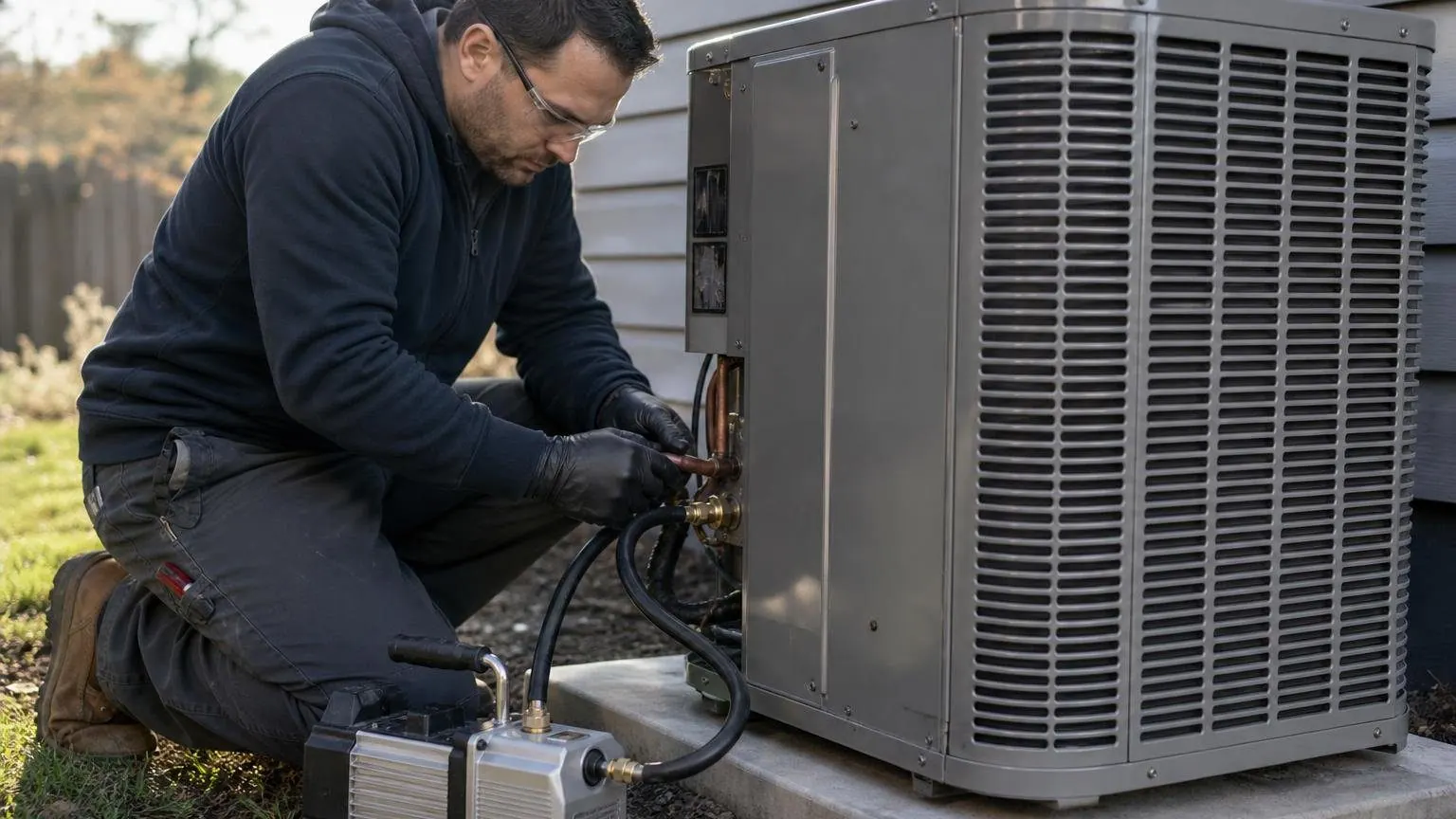
What does an HVAC vacuum pump do? An HVAC vacuum pump pulls air, nitrogen and moisture out of a sealed refrigerant circuit before it is charged. Carrier, Daikin and Mitsubishi installation documents call for 500 microns or lower, followed by a decay test that proves the system holds.
Key Takeaways
- Water boils at about 72°F at 20,000 microns; below about 4,588 microns liquid water cannot exist (NIST Chemistry WebBook).
- Daikin: pull below 500 microns, isolate 10 minutes; steady under 1,000 microns passes, above 2,000 microns is a leak (Daikin IOD-1063A).
- Mitsubishi’s MSZ-FS manual requires a micron gauge and a 500 micron hold of at least 1 hour (Mitsubishi Electric).
- Copeland’s June 2025 bulletin AE24-1105 R7 wants the pump on both the high and low sides through properly sized connections (Copeland).
- JB Industries’ rule of thumb: CFM squared equals maximum tonnage, so 3 CFM covers 9 tons (JB Industries).
- A vacuum pump is not a recovery machine: 40 CFR 82.154 bars knowingly venting refrigerant (eCFR).
What does an HVAC vacuum pump do?
An HVAC vacuum pump lowers the pressure inside a brazed, leak tested refrigerant circuit until air, nitrogen and water vapor leave through the pump. It sits between leak testing and charging on our tiered HVAC tools list.
Bryant’s installation instructions call the deep vacuum method “the most positive way of assuring a system is free of air and liquid water,” and warn: “Never use the system compressor as a vacuum pump.” It matters most after a new refrigerant line set is brazed, because the tubing was open to room air.
JB Industries recommends two stage rotary vane pumps with a gas ballast valve, which admits a little dry air so water vapor does not condense in the oil.
How many microns is a good vacuum for HVAC?
A good vacuum for a residential HVAC system is 500 microns or lower, held after the pump is isolated. Every Carrier, Bryant, Daikin and Mitsubishi document we read uses it. A micron is one thousandth of a millimeter of mercury, absolute; JB Industries puts one inch at 25,400 microns.
The number comes from boiling physics. In the NIST water saturation table, water boils at 212°F at atmospheric pressure, about 100°F at 50,000 microns, about 72°F at 20,000 microns and about 52°F at 10,000 microns. At about 4,588 microns water reaches its triple point, 32°F, and below that pressure any water left can only exist as vapor or ice.
Deeper is not automatically better at the system. JB Industries advises against evacuating a system below 200 microns because the refrigeration oil starts to degas; it still wants a pump able to reach at least 25 microns.
What do equipment manuals require for evacuation?
Makers agree on 500 microns but not on the hold. Bryant accepts 1,000 microns after about 7 minutes, Daikin’s DAQ instructions use a 10 minute isolation, and Mitsubishi wants a 1 hour hold. Follow the manual for the equipment on the job.
| Maker document | Vacuum target | Hold or decay rule | Other requirement |
|---|---|---|---|
| Bryant 113A/114C split AC, II114CNA-CNC-03 (2015) | 500 microns, deep vacuum method | “A tight dry system will hold a vacuum of 1000 microns after approximately 7 minutes” | Never use the compressor as a pump; break vacuum with dry nitrogen |
| Carrier Infinity 24VNA6/25VNA4 quick start | 500 microns, deep vacuum method | Not stated in the quick start | None stated |
| Daikin DAQ air handler, IOD-1063A (2024) | Less than 500 microns | Isolate 10 minutes; under 1,000 and steady passes | 450 PSIG nitrogen test first; both service valves; remove cores |
| Daikin VRV-S RXTA, R-32 | 500 microns after at least 2 hours | Below 500 microns for 1 hour, no rise | Pump from both liquid and gas pipes |
| Mitsubishi MSZ-FS ductless | Triple: 4,000, then 1,500, then 500 microns | 30 minute rise test; hold 500 microns at least 1 hour | Micron gauge required; manifold gauges must not measure vacuum |
| Copeland AE24-1105 R7 (2025) | Triple: twice to 1,500, finally 500 microns | Not specified | Connect to high and low sides |
The Mitsubishi steps apply to the ductless units covered in our mini split installation guide. Sources: Bryant, Daikin VRV-S manual and the documents linked above.
How do you pull a vacuum on an AC, step by step?
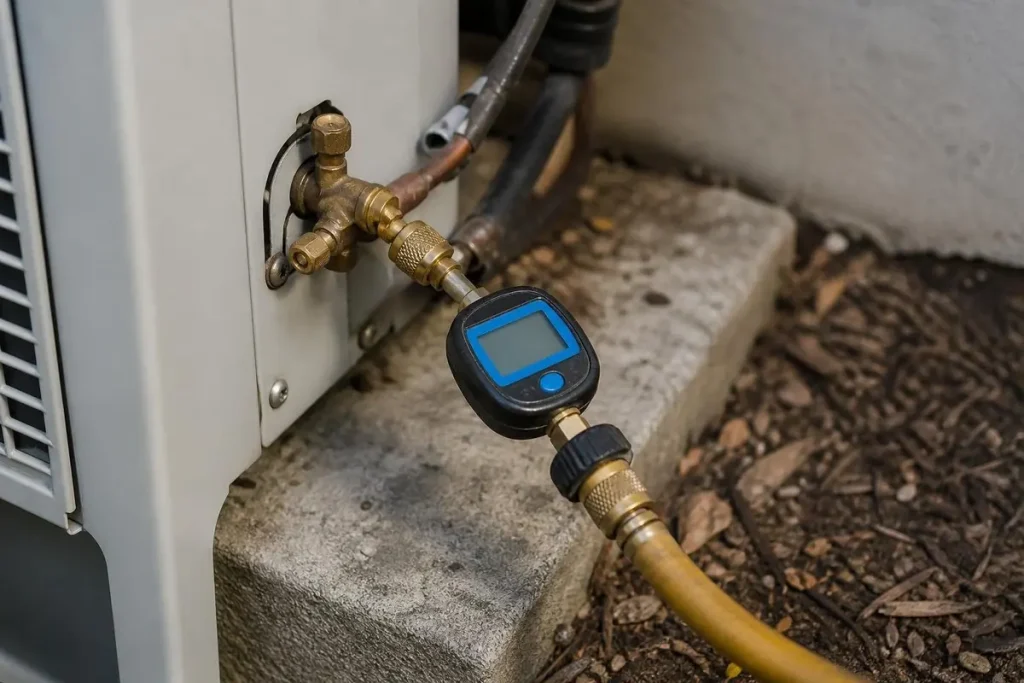
To pull a vacuum on an AC, connect the pump and a micron gauge to both service valves of an empty, leak tested circuit, run it below 500 microns, then isolate it and watch for a rise. Any new filter drier goes in before the pressure test, and leaks are found with nitrogen first, as our leak detection guide explains.
- Confirm the circuit holds no refrigerant; on a repair, recover it first.
- Pressure test with dry nitrogen to the manual’s figure; Daikin’s DAQ uses 450 PSIG for 15 minutes.
- Blank off the pump with the gauge attached. JB Industries says if it will not reach 50 microns, change the oil.
- Remove the valve cores with a core tool, as Daikin recommends, and connect short, vacuum rated hoses to both sides.
- Mount the micron gauge at the system end, away from the pump.
- Run below 500 microns, or follow your manual’s triple evacuation.
- Isolate the pump and run the decay test below.
- Break the vacuum with refrigerant or dry nitrogen, never air, then charge.
Core tools matter because a Schrader valve core sits in the flow path, and Mitsubishi says the manifold gauge must not be used to measure vacuum.
How long does it take to pull a vacuum on an AC?
No maker gives one time for every system. JB Industries notes that 1/4 inch flare ports have only a 3/16 inch orifice, so pump capacity “has very little to do with evacuation time.” Daikin’s VRV-S manual sets a floor of 2 hours. After the decay test passes, the charge is checked by superheat and subcooling.
How does a vacuum decay test work?
A vacuum decay test closes the valve between the pump and the system and watches the micron gauge. A rise that levels off points to moisture; a reading that keeps climbing points to a leak.
JB Industries gives the same pattern: wait 5 to 20 minutes, and treat a slow rise to around 1,500 microns as moisture and a rapid rise to atmosphere as a leak. JB also warns that charging hoses permeate, so with hoses in the test “the micron reading will slowly rise” even on a tight system.
What size HVAC vacuum pump do you need?
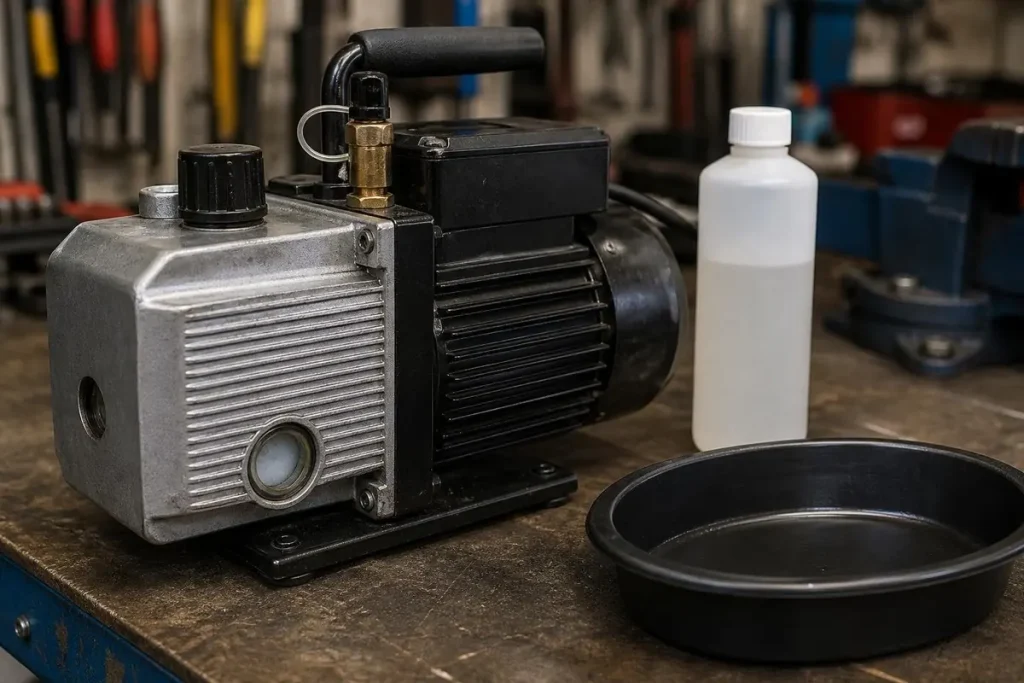
Most HVAC work needs a modest two stage pump. JB Industries says pumps in the 1-1/2 to 10 CFM class handle 99% of field work and offers a rule of thumb that CFM squared equals maximum tonnage: 3 CFM for 9 tons, 7 CFM for 49 tons. That is maker guidance, not a standard.
Hoses and fittings set the pace more than CFM. Copeland warns that restrictive service connections “may make the process so slow as to be unacceptable or may lead to false readings.” The table lists maker ratings, not independent tests.
| Pump (maker data) | CFM | Rated vacuum | Oil capacity | Notes |
|---|---|---|---|---|
| Fieldpiece VP67 / VP87 / VPX7 | 6 / 8 / 10 | 15 microns at input ports | 8 oz | Two stage; “A2L Ready Safety Certified” |
| Robinair VacuMaster 15800 | 8 | 35 microns factory rating | 18.6 oz | 2 stages; 1/4 and 3/8 inch flare inlets |
| Yellow Jacket SuperEvac PLUS II | 4 / 6 / 8 / 11 | Field rated to 15 microns | 36 oz (4, 6 CFM); 28 oz (8, 11 CFM) | “Designed for use with A2L systems” |
For R-454B and R-32 work, use a pump listed for A2L refrigerants. Specs: Fieldpiece manual, Robinair, Yellow Jacket.
How often should you change HVAC vacuum pump oil?
After every job, say the makers. JB Industries: “Pump oil should be changed after each use,” drained while warm, and pumps “need a fill or two for every job.” Fieldpiece says to drain oil after every job. A ranking buyer’s guide suggests every 3 to 4 jobs; no maker document we read supports that.
Can you recover refrigerant with an HVAC vacuum pump?
No. An HVAC vacuum pump exhausts to open air, so running it on a charged system would release the refrigerant. Fieldpiece’s VP87 manual says “Do not use to remove refrigerant from a system,” and warns that use on pressurized systems may damage or contaminate the pump.
The federal rule
Under 40 CFR 82.154, no person servicing an appliance “may knowingly vent or otherwise release into the environment any refrigerant.” Nitrogen is exempt, so venting test nitrogen is allowed. Section 82.156 requires a recovery machine certified under 82.158 before an appliance is opened, and 82.161 requires Type II certification for high-pressure systems.
Our refrigerant recovery guide covers recovery levels and machines; the EPA 608 certification explainer covers which technician type a job needs.
How we researched this
Researched October 14, 2026. We read 20 documents and cite 15: installation instructions from Bryant, Carrier, Daikin and Mitsubishi, Copeland AE24-1105 R7, JB Industries, Fieldpiece, Robinair and Yellow Jacket documents, NIST water data, and 40 CFR 82.154, 82.156 and 82.161. Maker figures are maker data, not independent tests.
Excluded: ranking pages as sources for numbers, unsourced oil intervals and sizing tables, and retail prices, because no federal series covers tool prices. Reddit was not used.
Frequently asked questions
How long should you pull a vacuum on an AC?
Until it is below 500 microns and passes the decay test, not for a set time. Daikin’s VRV-S manual requires at least 2 hours of pumping, Mitsubishi a 500 micron hold of at least 1 hour, and Bryant expects a tight, dry system to hold 1,000 microns after about 7 minutes.
Why won’t my vacuum pump get below 500 microns?
Usually a leak, moisture or dirty pump oil. JB Industries says a pump that cannot reach 50 microns when blanked off has contaminated oil. If the pump passes, check hose gaskets and core tools, then repeat the nitrogen pressure test.
Do you need a micron gauge to pull a vacuum?
Yes. Mitsubishi’s manual states that “a micron gauge must be used at all times” and that manifold gauges must not measure vacuum. Bryant’s deep vacuum method also calls for a gauge that accurately reads 500 microns.
What vacuum pump do I need for R-454B or R-32?
One the maker lists for A2L refrigerants. Fieldpiece’s VP87 manual lists a Class I, Division 2, Group D hazardous location rating, and Yellow Jacket says its SuperEvac PLUS II is designed for A2L systems. The 500 micron target does not change.
How much does an HVAC vacuum pump cost?
We do not quote one, because no federal price series covers HVAC tools. Compare rated CFM, rated vacuum and oil capacity on the maker’s specification sheet, and buy the size your jobs need.
Can a homeowner pull a vacuum on a mini split?
Under 40 CFR 82.161, anyone who could reasonably be expected to violate the integrity of the refrigerant circuit needs EPA 608 certification. Pre-charged quick-connect kits are a separate case, covered in our DIY mini split guide.
Sources
- Bryant. “113A/114C Installation Instructions, II114CNA-CNC-03.” https://resource.carrierenterprise.com/is/content/Watscocom/bryant_114cnc018000_article_1457429453457_en_ii1. Accessed October 2026.
- Carrier. “24VNA6/25VNA4 Quick Start Guide.” https://www.shareddocs.com/hvac/docs/1009/Public/0B/QSGCAC-01.pdf. Accessed October 2026.
- Daikin Comfort. “DAQ Series Installation Instructions, IOD-1063A.” https://daikincomfort.com/docs/default-source/daq-series-r-32/im-iod-1063a.pdf. Accessed October 2026.
- Daikin. “VRV-S RXTA Installation Manual, 3P778926-1D.” https://daikinac.com/docs/default-source/vrv-s-series-r-32/im-01_en_3p778926-1d.pdf. Accessed October 2026.
- Mitsubishi Electric. “MSZ-FS Installation Manual, JG79J820H01.” https://s1.img-b.com/build.com/mediabase/specifications/mitsubishi/1972912/mitsubishi-mxz-sm36namhz-2-msz-fs12na-msz-fs15na-installation-sheet.pdf. Accessed October 2026.
- Copeland. “AE24-1105 R7, Principles of Cleaning Refrigeration Systems.” https://webapps.copeland.com/online-product-information/Publication/LaunchPDF?Index=AEB&PDF=1105. Accessed October 2026.
- JB Industries. “Deep Vacuum Principles and Application.” https://trutechtools.com/content/brands/jb/documents/jb-principles-of-deep-vacuum.pdf. Accessed October 2026.
- JB Industries. “Keeping the Life in Your Pump.” https://www.jbind.com/wp-content/uploads/2022/04/Keeping-the-Life-in-your-Pump-2022.pdf. Accessed October 2026.
- Fieldpiece. “VPX7/VP87/VP67 Operator’s Manual.” https://www.globaltestsupply.com/pdfs/cache/www.globaltestsupply.com/vp87/manual/vp87-manual.pdf. Accessed October 2026.
- Robinair. “VacuMaster 8 CFM Vacuum Pump.” https://www.robinair.com/products/vacumaster-8-cfm-vacuum-pump. Accessed October 2026.
- Yellow Jacket. “SuperEvac PLUS II Vacuum Pumps.” https://yellowjacket.com/product/superevac-plus-ii-vacuum-pumps/. Accessed October 2026.
- NIST Chemistry WebBook. “Thermophysical Properties of Fluid Systems.” https://webbook.nist.gov/chemistry/fluid/. Accessed October 2026.
- eCFR. “40 CFR 82.154 Prohibitions.” https://www.ecfr.gov/current/title-40/chapter-I/subchapter-C/part-82/subpart-F/section-82.154. Accessed October 2026.
- eCFR. “40 CFR 82.156 Proper evacuation.” https://www.ecfr.gov/current/title-40/chapter-I/subchapter-C/part-82/subpart-F/section-82.156. Accessed October 2026.
- eCFR. “40 CFR 82.161 Technician certification.” https://www.ecfr.gov/current/title-40/chapter-I/subchapter-C/part-82/subpart-F/section-82.161. Accessed October 2026.
Leave a Reply