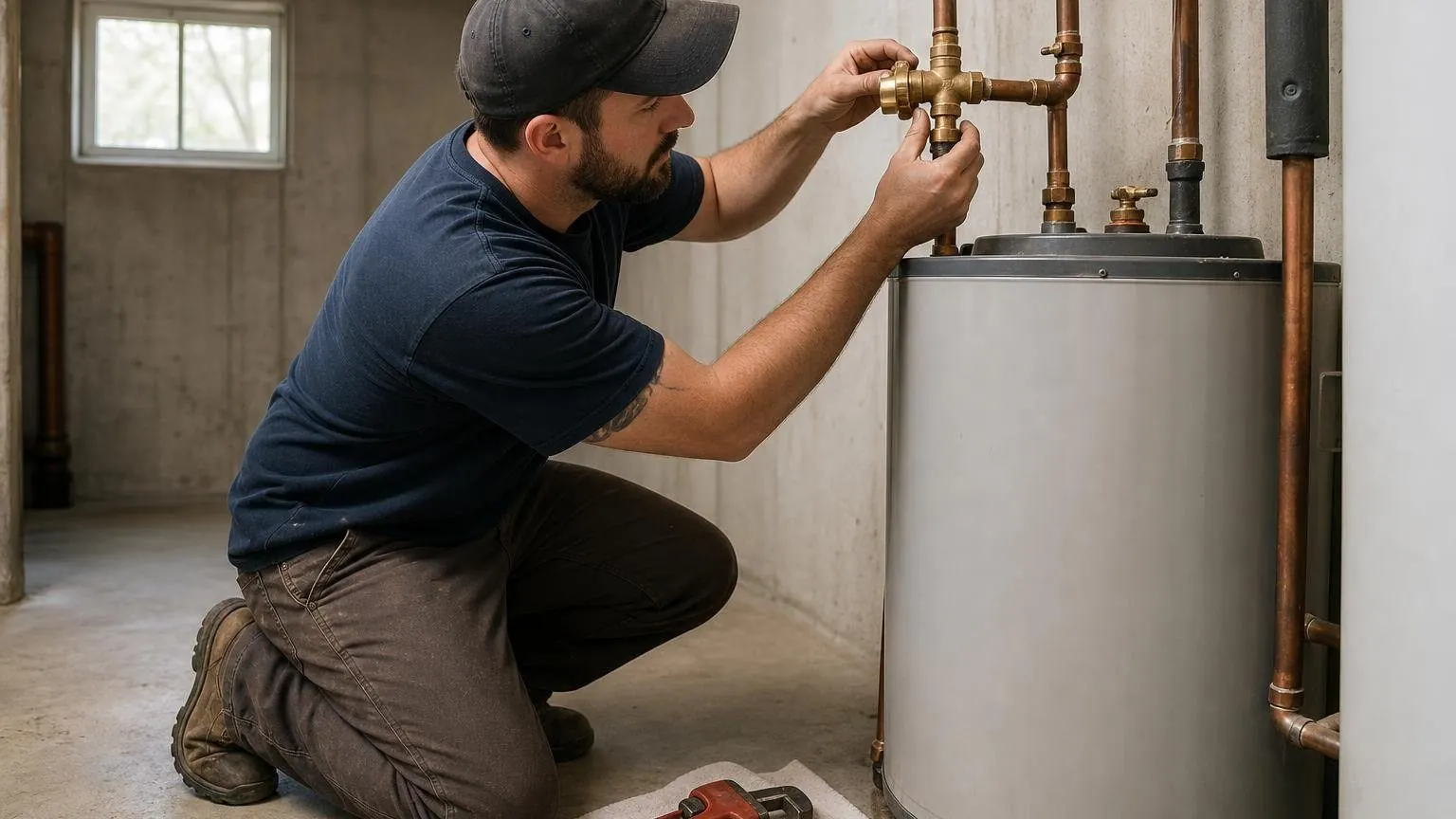
What is a thermostatic mixing valve? A thermostatic mixing valve blends hot and cold water through a temperature-sensing element so the outlet holds one set temperature, usually 120°F or lower. At the water heater it is an ASSE 1017 device; showers and tubs still need ASSE 1016 or 1070 protection.
Key Takeaways
- Shower valves must be ASSE 1016 class with a limit stop set at 120°F maximum, under IRC P2708.4 as adopted in South Carolina, which also bars in-line thermostatic valves for compliance.
- ASSE International says 1017 valves belong at the hot water source only and, used alone, give neither thermal shock nor adequate scald protection (ASSE white paper).
- CDC advises storing hot water above 140°F and placing mixing valves as close as possible to fixtures (CDC).
- Raising a tank from 125°F to 140°F adds hot water equal to about 10 to 15 gallons of capacity (ENERGY STAR, 2024).
- By our arithmetic, each gallon stored at 140°F delivers about 1.29 gallons at 120°F with 50°F inlet water.
- Watts and Caleffi call for testing at least once per year; their troubleshooting points mostly to debris in screens and check valves (maker data).
What is a thermostatic mixing valve?
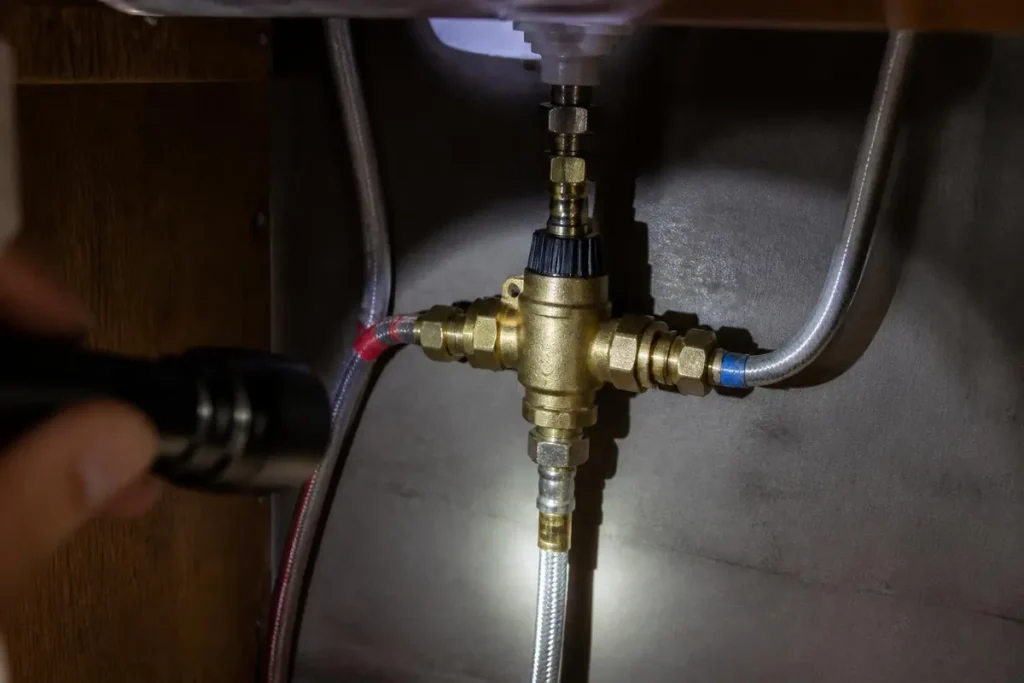
A thermostatic mixing valve, also called a tempering valve or anti scald valve, has a hot inlet, a cold inlet and a mixed outlet. It senses the mixed water and keeps adjusting the blend so the outlet holds its set point when supply pressure or temperature changes. A plain mixing valve, like a two-handle faucet, only mixes what you set by hand.
Placement defines the job. A point-of-source valve sits on the water heater and tempers the whole house. A point-of-use device sits at one fixture: the shower valve, or a limiting valve under a tub or sink. The standards and codes treat these as separate jobs.
How does a thermostatic mixing valve work?
A thermostatic mixing valve works by parking a heat-sensitive element in the mixed stream. In the Caleffi 521 manual, a sensor in the outlet expands or contracts and slides a piston between the hot and cold passages, throttling hot and opening cold as the mix warms.
The element needs a temperature gap. Caleffi lists a 27°F minimum difference between hot inlet and mixed outlet and a 1.3 GPM minimum flow; Watts lists a 5°F approach for its LFMMV-HTK (maker data).
The mixing math
Hot share equals (mixed minus cold) divided by (hot minus cold). With 50°F inlet water, a 120°F outlet draws 70/90, or 77.8%, from a 140°F tank, so each stored gallon delivers about 1.29 gallons at the tap. From a 150°F tank the share drops to 70% and the yield rises to about 1.43 gallons. Our arithmetic; it ignores stratification and recovery.
Why put a mixing valve on a water heater?
A water heater mixing valve lets you store water hot and deliver it cooler, which settles the conflict between Legionella control and scald risk. Our guide to choosing a tank temperature covers the 120 versus 140 decision; here is only what the valve adds.
The CDC toolkit puts the favorable Legionella range at 77 to 113°F and advises storing hot water above 140°F. CPSC Publication 5098 says most adults suffer third-degree burns after 2 seconds at 150°F, and burns occur after 6 seconds at 140°F.
ENERGY STAR says a TMV lets owners safely run a tank above 125°F, useful with a heat pump water heater on time-of-use rates. With a recirculation loop, CDC says circulating hot water should not fall below 120°F, so pipe the return per the valve maker.
ASSE 1016 vs 1017 vs 1070: which thermostatic mixing valve standard applies?
ASSE 1017 covers the thermostatic mixing valve at the water heater, ASSE 1016 the shower valve, and ASSE 1070 limiting devices for tubs, sinks and lavatories. The ASSE International white paper says a multi-listed device installed at the heater “is considered to be an ASSE 1017 device.”
| Standard | Device | Where it goes | Protects against |
|---|---|---|---|
| ASSE 1016 | Pressure balancing, thermostatic or combination shower valve | Point of use: individual shower or tub/shower | Scald and thermal shock |
| ASSE 1017 | Temperature actuated mixing valve for distribution | At or near the hot water source only | Distribution temperature only; not adequate scald protection alone |
| ASSE 1069 | Automatic temperature control mixing valve | Single tempered pipe to gang showers or sitz baths | Scald and thermal shock |
| ASSE 1070 | Water temperature limiting device, 120°F max | Point of use or distribution to tubs, sinks, lavatories, bidets | Scald only |
| ASSE 1066 | In-line pressure balancing valve | At an individual fixture fitting | Pressure swings only; no scald protection |
ASSE lets a 1017 valve swing 3°F at 0 to 5 gpm, 5°F at 5 to 40 gpm and 7°F above 40 gpm. Maker ranges vary:
Hotter-range valves are sold for radiant floor loops and boiler work; one with no ASSE listing cannot stand in where code names a listed device.
What does plumbing code require for a mixing valve?
In most US homes, code requires temperature control at the fixture, not the heater. Requirements vary by jurisdiction and code edition, so check what your state adopted.
- Showers, IRC P2708.4: ASSE 1016 class valve with a 120°F limit stop; “In-line thermostatic valves shall not be utilized for compliance” (South Carolina adoption). The 2021 IPC, Section 412.3, adds that the valve be installed at the point of use.
- Bathtubs and whirlpools, IRC P2713.3: 120°F maximum via ASSE 1070 or CSA B125.3, or a P2708.4 tub/shower valve (South Carolina adoption).
- Water heater as space heater, Section 501.2: where heating needs water above 140°F, an ASSE 1017 valve must limit potable hot water to 140°F or less (Florida Building Code, Plumbing, 2026). That rule reaches many combi boiler and indirect water heater jobs.
- Tankless heaters, Section 501.6 (same code): domestic water from a tankless water heater may not exceed 140°F, and that rule does not replace the shower valve requirement.
Myth check: “a mixing valve at the heater is enough”
It is not. The ASSE white paper says a 1017 valve at the water heater “will not provide adequate scald protection” for a child’s bath, and a multi-listed valve there “does NOT negate” the point-of-use requirement. Keep the shower and tub devices.
ASHRAE Standard 188-2021, the Legionella risk standard, excludes single-family homes, so storing water hotter at home follows CDC guidance, not a mandate.
How is a water heater mixing valve installed and adjusted?
A water heater mixing valve goes on the heater’s hot outlet, with cold teed from the cold inlet and the mixed port feeding the house. Watts and Caleffi say a licensed or qualified installer should fit and commission it; see the items an inspector checks on a tank install. Steps condensed from the Watts LFMMV-HTK instructions and Caleffi 521 manual (maker data):
- Flush debris from the piping; Caleffi says leftover dirt can affect performance.
- Pipe the valve’s hot port to the tank’s hot outlet and tee cold to both the tank and the valve.
- Use check valves: Caleffi says they “shall be used” in an ASSE 1017 application.
- Open cold, then hot, and check for leaks.
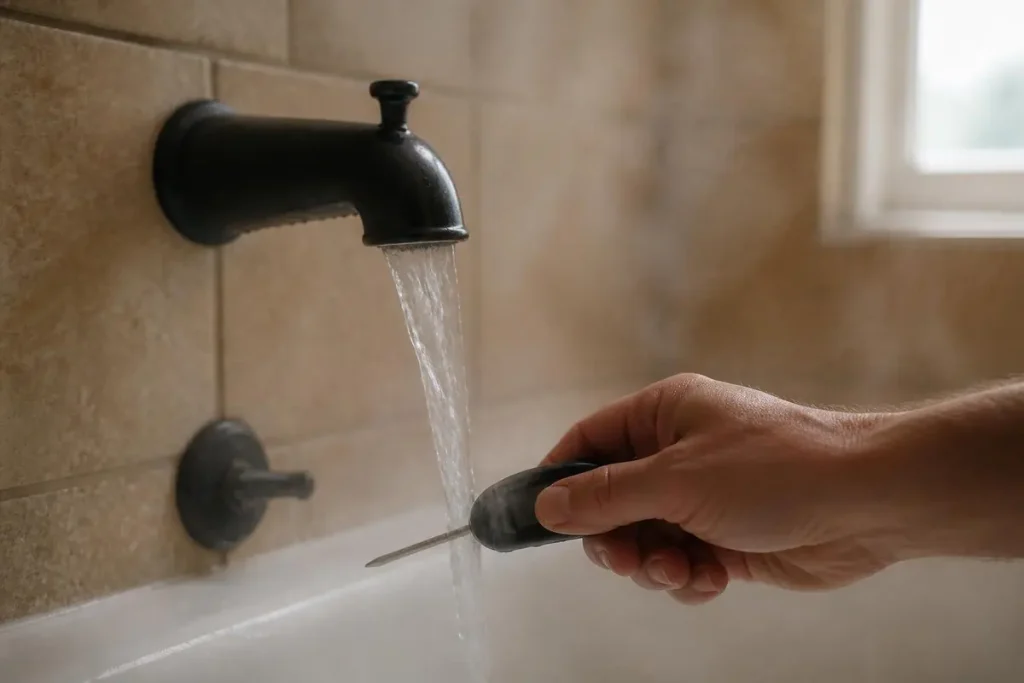
- Run the nearest fixture at least two minutes and read it with a thermometer (Watts).
- Set the outlet; Caleffi advises 120°F maximum. Its 27°F margin implies about 147°F at the hot inlet for a 120°F setting, by our arithmetic.
- Retest at least once per year and clean screens and check valves.
What are the common thermostatic mixing valve problems?
Most thermostatic mixing valve problems trace to debris, a reversed hookup or too little hot margin. Causes and fixes below come from the Watts troubleshooting guide and Caleffi maintenance schedule (maker data).
| Symptom | Likely cause | Maker fix |
|---|---|---|
| Lukewarm or cold shower | Hot supply too close to set point; ports reversed; blocked filters | Confirm hot margin; repipe; clean filters |
| Temperature creeps | Supply pressure swings; debris; scale | Stabilize pressure; clean; descale (Caleffi) |
| Weak or no flow | High pressure drop; blocked checks or filters | Check pressures against flow chart; clean |
| Noisy valve | Velocity too high; valve undersized | Pressure regulating valve; compare flow to rating |
| Hot water in cold lines | Cross-flow, no working check valves | Fit inlet check valves, as ASSE recommends |
Sizing matters: the Watts kit flows 13 gpm at a 45 psi drop, and ICC notes showerheads under the 2.5 gpm code limit may not give a shower valve enough flow to self-adjust. On boiler-fed tanks, a lowered aquastat setting can erase the hot margin.
How we researched this
Researched October 18, 2026. Beyond three ranking pages, we opened 13 documents and cite 12: state code adoptions (South Carolina IRC sections on Cornell LII; an ICC sample of the 2026 Florida plumbing code), the ICC summary of 2021 IPC 412.3, the 2017 ASSE white paper, CPSC, CDC, ASHRAE, ENERGY STAR, and Watts, Caleffi and Honeywell documents labelled maker data. Yield figures are our arithmetic.
Excluded: Reddit and forums (safety topic), contractor blogs, and a 2009 Watts chart of superseded standard editions. No price appears; no federal series publishes one. Your local code edition may differ.
Frequently asked questions
What is the difference between a mixing valve and a thermostatic mixing valve?
A plain mixing valve blends hot and cold at whatever position you set. A thermostatic mixing valve senses the outlet and keeps correcting; the Caleffi 521 manual describes a sensor moving a piston between the hot and cold passages to hold temperature through supply swings.
What temperature should a thermostatic mixing valve be set to?
For domestic hot water, 120°F or lower. Caleffi advises a 120°F maximum and IRC P2708.4 caps shower valves at 120°F. For a young child’s tub, the ASSE white paper uses a 110°F limit in its example. Verify with a thermometer at the fixture.
Is a mixing valve required on a water heater?
Usually not in a house. A common trigger is a combined space and water heating system needing water above 140°F; Florida’s 2026 plumbing code Section 501.2 then requires an ASSE 1017 valve limiting potable water to 140°F or less. Ask your building department.
Can one valve be listed to ASSE 1017 and 1070?
Yes. The Watts LFMMV-HTK is certified to ASSE 1017, 1069 and 1070, and Honeywell AM-1 C1070 models list 1017 and 1070. ASSE says such a valve at the water heater counts as a 1017 device only, so fixture protection is still required.
How often should a thermostatic mixing valve be tested?
At least once a year. Watts says its valve must be tested at least once per year or more often as service conditions warrant, and Caleffi says to check every 12 months at least: clean filters, check upstream check valves and descale internals where needed.
Does a thermostatic mixing valve help control Legionella?
Indirectly. It lets you store water above 140°F, as CDC advises, while delivering safer water at the tap. CDC puts the favorable growth range at 77 to 113°F. ASHRAE Standard 188 excludes single-family homes, so this is guidance for a house.
Sources
- Cornell LII. “S.C. Code Regs. 8-1243, IRC P2708.4 Shower control valves.” https://www.law.cornell.edu/regulations/south-carolina/R-8-1243. Accessed October 2026.
- Cornell LII. “S.C. Code Regs. 8-1244, IRC P2713.3 Bathtub and whirlpool bathtub valves.” https://www.law.cornell.edu/regulations/south-carolina/R-8-1244. Accessed October 2026.
- International Code Council. “Significant Changes to the IPC 2021 Edition: 412.3 Shower Control Valves.” https://www.iccsafe.org/wp-content/uploads/2021_SigChanges_IPC_412.3.pdf. Accessed October 2026.
- International Code Council. “Florida Building Code, Plumbing, 9th Edition (2026), Chapter 5 sample.” https://shop.iccsafe.org/media/wysiwyg/material/5621L26-Sample.pdf. Accessed October 2026.
- ASSE International. “Guidelines for Temperature Control Devices in Domestic Hot Water Systems.” https://iapmo.org/media/pbfltxqk/asse_guidelines_for_temp_control_devices.pdf. Accessed October 2026.
- U.S. Consumer Product Safety Commission. “Avoiding Tap Water Scalds,” Publication 5098. https://www.cpsc.gov/s3fs-public/5098.pdf. Accessed October 2026.
- Centers for Disease Control and Prevention. “Controlling Legionella in Potable Water Systems.” https://www.cdc.gov/control-legionella/php/toolkit/potable-water-systems-module.html. Accessed October 2026.
- ASHRAE. “Standard 188-2021 fact sheet.” https://www.ashrae.org/file%20library/about/government%20affairs/advocacy%20toolkit/virtual%20packet/standard-188_2021-fact-sheet.pdf. Accessed October 2026.
- ENERGY STAR. “Heat Pump Water Heater Guide,” June 2024. https://www.energystar.gov/sites/default/files/2024-07/ENERGY%20STAR%20Heat%20Pump%20Water%20Heater%20Technical%20Guide%20508C.pdf. Accessed October 2026.
- Watts. “IS-LFMMV-HTK Installation Instructions.” https://devsc10.watts.com/dfsmedia/0533dbba17714b1ab581ab07a4cbb521/21565-source/2915187-pdf. Accessed October 2026.
- Caleffi. “MixCal 521 Series installation, commissioning and service instructions.” https://res.cloudinary.com/consolidated-supply/resource/raw/caleffi_521409a_manual.pdf. Accessed October 2026.
- Honeywell (Resideo). “AM-1 Series Thermostatic Mixing Valves submittal sheet 68-3098.” https://customer.resideo.com/resources/Techlit/TechLitDocuments/68-0000s/68-3098.pdf. Accessed October 2026.
Leave a Reply