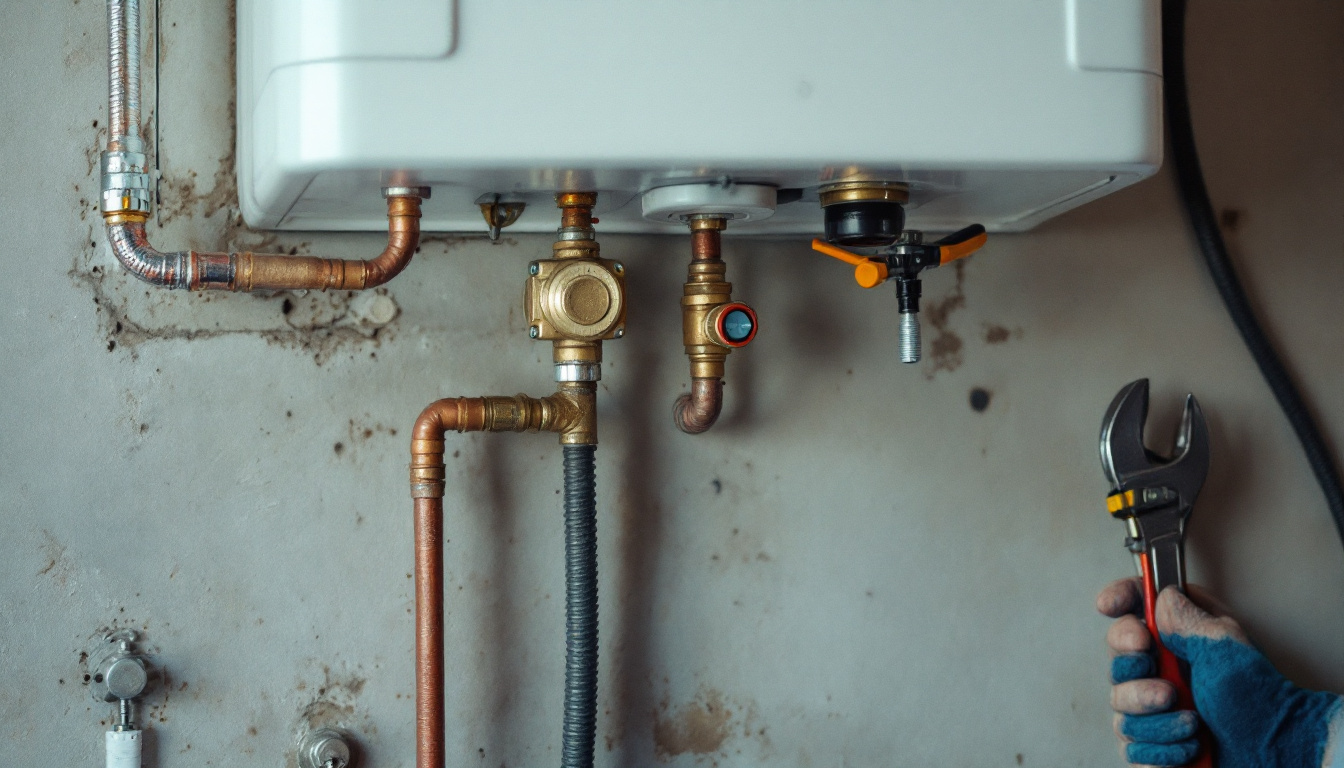
Tankless water heater or storage tank? A tankless water heater heats water only as it flows, so it never runs out, but its output caps flow at typically 2 to 5 gallons per minute. The federal minimum for gas models is still a UEF of 0.81, because DOE withdrew its stricter 2024 rule in May 2025.
Key Takeaways
- DOE withdrew its December 2024 gas tankless standard on May 20, 2025, per the withdrawal notice at 90 FR 21390.
- The federal minimum for gas tankless units above 50,000 Btu/h is a UEF of 0.81 on the medium draw pattern, under 10 CFR 430.32(d) in September 2026.
- ENERGY STAR gas tankless models need a UEF of at least 0.95 and 2.8 gallons per minute over a 67°F rise, per the ENERGY STAR key product criteria.
- DOE’s Energy Saver guidance says tankless units can be 24% to 34% more efficient than storage tanks in homes using 41 gallons a day or less (archived copy).
- About 8.03 million of 123.53 million US homes used a tankless main water heater in 2020, per EIA RECS table HC8.1.
- The 25C credit of up to $600 for qualifying gas water heaters covered improvements through December 31, 2025, per the IRS.
How does a tankless water heater work?
A tankless water heater has no reservoir: when a hot tap opens, cold water flows through a heat exchanger and a gas burner or electric element heats it on the way through. That avoids a tank’s standby heat loss, but output limits flow, typically 2 to 5 gallons per minute according to DOE.
Federal rules define the category by how little water the unit holds. Under the definitions in 10 CFR 430.2, a gas-fired instantaneous water heater has a nameplate input rating less than 200,000 Btu/h and contains no more than one gallon of water per 4,000 Btu per hour of input. An electric instantaneous water heater has a nameplate input rating of 12 kW or less.
What federal rules apply to a tankless water heater in 2026?
For gas tankless units, the older rule still applies in 2026: a minimum Uniform Energy Factor of 0.81 for units under 2 gallons and above 50,000 Btu/h on low, medium and high draw patterns, and 0.80 on very small. Electric instantaneous units must reach 0.91, or 0.92 on high draw.
DOE’s December 26, 2024 final rule at 89 FR 105188 would have raised the medium draw minimum to 0.91, with compliance from December 26, 2029. DOE’s analysis said only one-third of gas-fired instantaneous water heaters shipped in 2024 were non-condensing models.
On May 9, 2025, the President signed a joint resolution disapproving the rule, and DOE withdrew it on May 20, 2025, stating the amended standards “shall have no force or effect.” Our report on water heater shipments and efficiency rules tracks how the rest of the category is regulated.
The table in 10 CFR 430.32(d) for units manufactured on or after May 6, 2029 lists oil and electric instantaneous classes but no gas-fired instantaneous row. The storage changes arriving that year are covered in our guide to replacing a water heater.
How does a tankless water heater compare with a storage tank?
A tankless water heater wins on standby loss and lifespan; a storage tank wins on simultaneous demand and simpler installation.
| Attribute | Tankless (instantaneous) | Storage tank |
|---|---|---|
| How hot water is delivered | Heated as it flows; no reservoir | Heated and held in a tank |
| Capacity is rated by | Gallons per minute at a temperature rise | First hour rating in gallons |
| Standby heat loss | Avoided, per DOE | Present, from the stored water |
| Life expectancy, DOE Energy Saver | More than 20 years for most units | 10 to 15 years |
| Main limitation | Several fixtures at once can exceed output | Runs out, then recovers |
Both types are rated on Uniform Energy Factor, but the storage minimum is a formula that falls as volume rises, so a 50 gallon gas tank on a medium draw pattern needs only about 0.563.
| Product (medium draw where rated by draw) | Minimum UEF | Basis |
|---|---|---|
| Gas tankless, federal minimum | 0.81 | 10 CFR 430.32(d) |
| Gas tankless, ENERGY STAR | 0.95 | ENERGY STAR criteria |
| Gas tankless, withdrawn 2024 rule | 0.91 (withdrawn) | 89 FR 105188, withdrawn |
| Gas storage, 50 gallons, federal minimum | 0.563 | 0.6483 minus 0.0017 times volume |
| Gas storage, 20 to 55 gallons, ENERGY STAR | 0.81 | ENERGY STAR criteria |
| Integrated heat pump water heater, ENERGY STAR | 3.30 | ENERGY STAR criteria |
A heat pump moves heat rather than making it, which is how it clears 1.0; our explainer on heat pump water heaters covers where that works and where it does not.
How do you size a tankless water heater?
Size a tankless water heater on two numbers: the total flow of the fixtures you will run at the same time, and the temperature rise from your incoming water to the temperature you want.
- List the fixtures used at once. ENERGY STAR gives average figures of 2.5 GPM for a shower or bathtub, 3.3 GPM for a clothes washer, 2.2 GPM for a kitchen or bathroom sink and 1.3 GPM for a dishwasher.
- Add their flow rates. A shower and a dishwasher together come to 3.8 GPM.
- Work out the temperature rise. Subtract incoming water temperature from the output you want. DOE suggests assuming 50°F incoming water unless you know otherwise, and says most uses call for 120°F, a 70°F rise.
- Pick a unit rated for that flow at that rise, from the manufacturer’s flow chart rather than the headline maximum.
Incoming water temperature is the variable most people miss. DOE’s sizing guidance (archived copy) warns that cooler inlet temperatures can reduce the water temperature at the most distant faucet, so size to the coldest supply water you expect. A unit that shuts off at a trickle has a minimum flow issue, which our troubleshooting guide for water heaters that stop heating covers.
Gas or electric tankless: what changes?
Gas tankless units deliver far more flow. DOE’s rule of thumb is a 70°F rise at 5 gallons per minute through gas-fired units and 2 gallons per minute through electric ones.
Replacing a gas tank with a tankless unit can involve more than the heater. ENERGY STAR’s buying guidance says an installer should determine whether the existing natural gas line is sufficient, whether electricity is available near the heater for forced ventilation models, and how combustion gases will be vented.
Code point: gas line and venting
Whether your gas piping and vent can serve a tankless unit depends on its input rating, the run length and local code. DOE’s 2024 rule analysis describes non-condensing units as Category III appliances needing stainless steel vent, and condensing units as Category IV, able to vent through PVC, CPVC or polypropylene with a condensate drain.
The same condensing venting issues arrive with the coming 95% AFUE furnace floor. Get written quotes covering gas line, vent and drain work, and use our checklist for vetting a contractor. Electric units raise a different question, whether your electrical service can carry the load.
What does a tankless water heater cost to run?
No federal source publishes a running cost for a tankless water heater, because it depends on fuel price and hot water use. DOE publishes the relative saving instead: tankless units can be 24% to 34% more energy efficient than conventional storage tanks in homes using 41 gallons or less a day, and 8% to 14% more efficient in homes using around 86 gallons a day.
Our breakdown of what heat costs by fuel converts EIA gas and electricity prices into a cost per million Btu. For electric units, check your rate against our state electricity price table.
The IRS says the Section 25C credit covered improvements made through December 31, 2025. Our coverage of the expired 25C credit explains what that removes from a 2026 quote.
When is a tankless water heater the wrong choice?
A tankless water heater is the wrong choice when several high-flow fixtures routinely run at once. DOE says even the largest gas model sometimes cannot supply simultaneous uses in large households, such as a shower and a dishwasher together.
It is also harder where gas line or venting work is major, or there is no gas service. Natural gas was the main water heating fuel in 59.33 million homes in 2020 and electricity in 57.04 million, per EIA RECS; our look at how American homes are heated shows the fuel mix.
The 8.03 million homes with a tankless main water heater in 2020 were about 6.5% of occupied homes. If efficiency is the goal, price a heat pump water heater too; our compliance calendar through 2036 shows which equipment rules land during the life of whatever you install.
How we researched this
Research date: September 17, 2026. We consulted 12 sources and cited 10: eCFR (10 CFR 430.32 and 430.2), the Federal Register rule and withdrawal, ENERGY STAR, archived DOE Energy Saver pages, EIA RECS 2020 and the IRS.
Installed prices were excluded: no federal series publishes them, and vendor surveys are not data. Manufacturer flow claims were excluded because they use varying temperature rises. Reddit was skipped because gas tankless work involves combustion safety.
Frequently asked questions
How long does a tankless water heater last?
DOE’s Energy Saver guidance says most tankless water heaters have a life expectancy of more than 20 years, against 10 to 15 years for storage water heaters. DOE’s 2024 rule analysis also used a 20-year average lifetime for gas-fired instantaneous units. Actual life depends on water hardness and maintenance.
What size tankless water heater do I need?
Add the flow rates of fixtures you will run at once, then find the temperature rise. DOE’s example pairs a 0.75 GPM faucet and a 2.5 GPM shower for 3.25 GPM, and suggests assuming 50°F incoming water and 120°F output, a 70°F rise. Buy a unit rated for that flow at that rise.
Why does my tankless water heater struggle in winter?
Colder incoming water means a larger temperature rise, which reduces the flow the unit can deliver. DOE’s sizing guidance says cooler inlet temperatures or faster flow rates can reduce the water temperature at the most distant faucet. Size to the coldest supply water you expect.
Is there a new federal standard for gas tankless water heaters?
No. DOE’s December 2024 rule would have raised the medium draw minimum to a UEF of 0.91 from December 26, 2029, but Congress disapproved it and DOE withdrew it on May 20, 2025. The federal minimum under 10 CFR 430.32(d) remains 0.81 for gas units under 2 gallons and above 50,000 Btu/h on the medium draw pattern.
Do tankless water heaters qualify for a tax credit in 2026?
Not federally. The IRS says the Section 25C credit covered improvements made through December 31, 2025, including up to $600 per item for natural gas, propane or oil water heaters meeting the Consortium for Energy Efficiency’s highest non-advanced tier. A unit installed in 2026 earns no 25C credit.
Can an electric tankless water heater supply a whole house?
Sometimes, but its output is limited. DOE says a 70°F rise is typically possible at about 2 gallons per minute through electric units against 5 through gas units, and gas models produce higher flow rates generally. The federal consumer definition covers electric instantaneous units rated at 12 kW or less.
Sources
- National Archives, eCFR. “10 CFR 430.32.” https://www.ecfr.gov/current/title-10/chapter-II/subchapter-D/part-430/subpart-C/section-430.32. Accessed September 2026.
- National Archives, eCFR. “10 CFR 430.2.” https://www.ecfr.gov/current/title-10/chapter-II/subchapter-D/part-430/subpart-A/section-430.2. Accessed September 2026.
- U.S. Department of Energy, Federal Register. “Energy Conservation Standards for Consumer Gas-fired Instantaneous Water Heaters” (89 FR 105188). https://www.federalregister.gov/documents/2024/12/26/2024-30369/energy-conservation-program-energy-conservation-standards-for-consumer-gas-fired-instantaneous-water. Accessed September 2026.
- U.S. Department of Energy, Federal Register. “Final rule; withdrawal” (90 FR 21390). https://www.federalregister.gov/documents/2025/05/20/2025-09030/energy-conservation-program-energy-conservation-standards-for-consumer-gas-fired-instantaneous-water. Accessed September 2026.
- U.S. Department of Energy, Energy Saver. “Tankless or Demand-Type Water Heaters” (archived copy). https://web.archive.org/web/2025id_/https://www.energy.gov/energysaver/tankless-or-demand-type-water-heaters. Accessed September 2026.
- U.S. Department of Energy, Energy Saver. “Sizing a New Water Heater” (archived copy). https://web.archive.org/web/2025id_/https://www.energy.gov/energysaver/sizing-new-water-heater. Accessed September 2026.
- ENERGY STAR. “Water Heater Key Product Criteria.” https://www.energystar.gov/products/water_heaters/residential_water_heaters_key_product_criteria. Accessed September 2026.
- ENERGY STAR. “Whole Home Tankless Gas Water Heaters.” https://www.energystar.gov/products/whole_home_tankless_gas_water_heaters. Accessed September 2026.
- U.S. Energy Information Administration. “RECS 2020, Table HC8.1.” https://www.eia.gov/consumption/residential/data/2020/hc/xls/HC%208.1.xlsx. Accessed September 2026.
- Internal Revenue Service. “Energy Efficient Home Improvement Credit.” https://www.irs.gov/credits-deductions/energy-efficient-home-improvement-credit. Accessed September 2026.
Leave a Reply