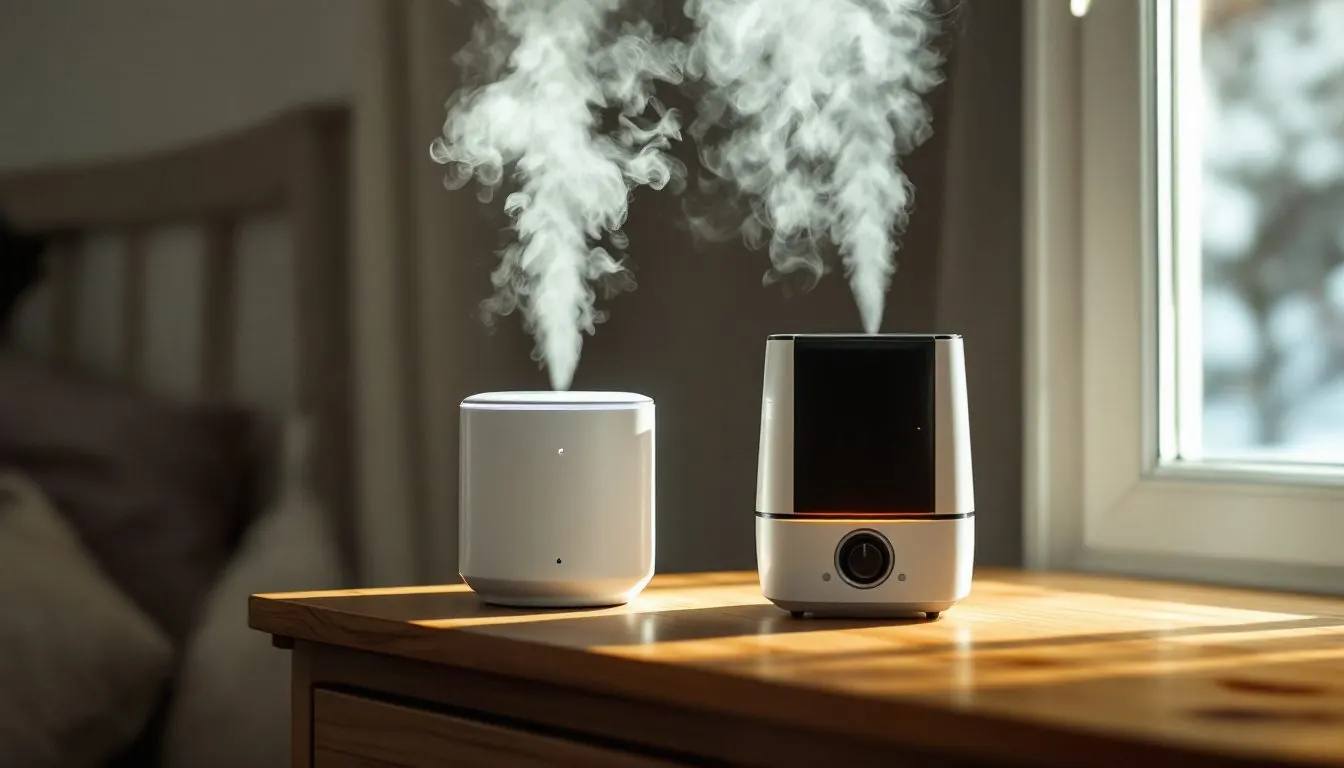
Cool mist vs warm mist humidifier: which is better? A cool mist humidifier is the safer default, because warm mist units heat water that can burn a child. The tradeoff is minerals: ultrasonic cool mist models spray tap water minerals into the air, so fill them with distilled water.
Key Takeaways
- EPA names ultrasonic and impeller (“cool mist”) humidifiers as the types that disperse the most microorganisms and minerals (EPA fact sheet, 2022).
- In a 2020 Virginia Tech test, one ultrasonic unit emitted 16 µg/m³ of particles on deionized water and 521 µg/m³ on high-mineral water (Yao et al.).
- A Melbourne hospital clinic treated 10 children for steam vaporizer burns in 10 months; mean age 1.6 years (Burns, 2016).
- Levoit rates its ultrasonic Classic 300S at 26 W and its warm and cool LV600HH at 280 W (Levoit specs).
- At the August 2026 US residential price of 18.16 cents per kWh, 30 nights of 8 hours cost $12.20 at 280 W and $1.13 at 26 W (EIA Table 5.6.A).
- CPSC says keep humidity between 30% and 50% and change the water daily, whatever the type (CPSC Publication 5046).
What is the difference between a cool mist and warm mist humidifier?
A cool mist humidifier adds moisture without heat, by ultrasonic vibration, a spinning impeller disk, or a fan blowing through a wet wick. A warm mist humidifier heats water into steam; EPA describes it as a steam vaporizer “in which the steam is cooled before exiting the machine.”
The useful split is droplets versus vapor: ultrasonic and impeller droplets carry dissolved minerals into the room, while steam and evaporative units leave most behind.
| Type | How it adds moisture | Minerals into the air | Burn risk | Example rated power |
|---|---|---|---|---|
| Ultrasonic (cool mist) | Vibration makes fine droplets | High: EPA says these disperse the most | None from heat | 26 W, Levoit Classic 300S |
| Impeller (cool mist) | Spinning disk throws droplets | High: grouped with ultrasonic by EPA | None from heat | No maker spec opened |
| Evaporative wick (cool mist) | Fan blows air through a wet wick | Low: EPA says not expected to be substantial | None from heat | 30 W, Levoit Superior 6000S |
| Steam vaporizer (warm mist) | Element or electrodes boil water | Low: EPA says not expected to be substantial | Steam and hot water | Not listed in the Vicks VWC775 manual |
| Hybrid (ultrasonic plus heater) | Ultrasonic mist from heated water | Still ultrasonic: its manual blames white dust on minerals in the water | Hot mist at the nozzle | 280 W, Levoit LV600HH |
Rows 1 to 4 follow the EPA “Use and Care of Home Humidifiers” fact sheet; wattages are maker ratings. A furnace-mounted whole house humidifier is a different tool not covered here.
Which is safer for kids: cool mist or warm mist?
Cool mist is safer for homes with young children, because a warm mist unit holds hot water and releases steam. EPA says: “Keep steam vaporizer humidifiers out of the reach of children. Steam and boiling water may cause burns.” The Children’s Hospital of Philadelphia says the American Academy of Pediatrics recommends a cool mist humidifier.
In a 2016 case series in the journal Burns, the Royal Children’s Hospital in Melbourne treated 10 children for vaporizer steam burns from November 2014 to August 2015. The mean age was 1.6 years, hands accounted for 80% of burns, and 50% of cases needed surgery.
In March 2026, Shriners Children’s Boston reported a nurse practitioner treated four to five children in one season for second-degree burns from pots of boiling water used as humidifiers.
Safety point
Even a cool mist unit belongs out of reach: CHOP advises keeping “around 3 feet” between the humidifier and your child. The Vicks VWC775 manual says its warm mode “PRODUCES HOT STEAM.”

Does a cool mist humidifier cause white dust that a warm mist one avoids?
Yes. Ultrasonic and impeller cool mist units can coat a room in white dust; true steam units mostly do not. EPA says ultrasonic and impeller units are “very efficient at dispersing minerals in tap water into the air.” EPA’s 1991 fact sheet added that “A steam vaporizer tested by EPA did not disperse measurable amounts of minerals.”
CPSC warns the dust “may contain particles that are small enough to enter the lungs,” with health effects that “are not clear.” Virginia Tech researchers ran one ultrasonic humidifier on four fill waters: particle mass rose from 16 µg/m³ on deionized water to 113 on low-mineral tap water, 438 on hard water and 521 on high-solids water. For context only, EPA’s 24-hour outdoor PM2.5 standard is 35 µg/m³, though a lab plume is not a daily outdoor average.
A 2022 systematic review in Indoor Air covering 27 articles found emissions rise in proportion to what is in the fill water, and listed case reports including hypersensitivity pneumonitis in a 6-month-old infant. A 2020 companion study in Water Research X modeled deposited particle mass in children’s lungs as 3.5-fold higher than in adults.
The fix is water, not a new machine. EPA says “Distillation is the most effective method for removing minerals”; deionization and reverse osmosis are “generally less effective,” and “spring,” “artesian” or “mineral” bottled water is untreated. If dust persists, our guide to tracing household dust sources covers other causes.
Cool mist or warm mist: which one grows more germs?
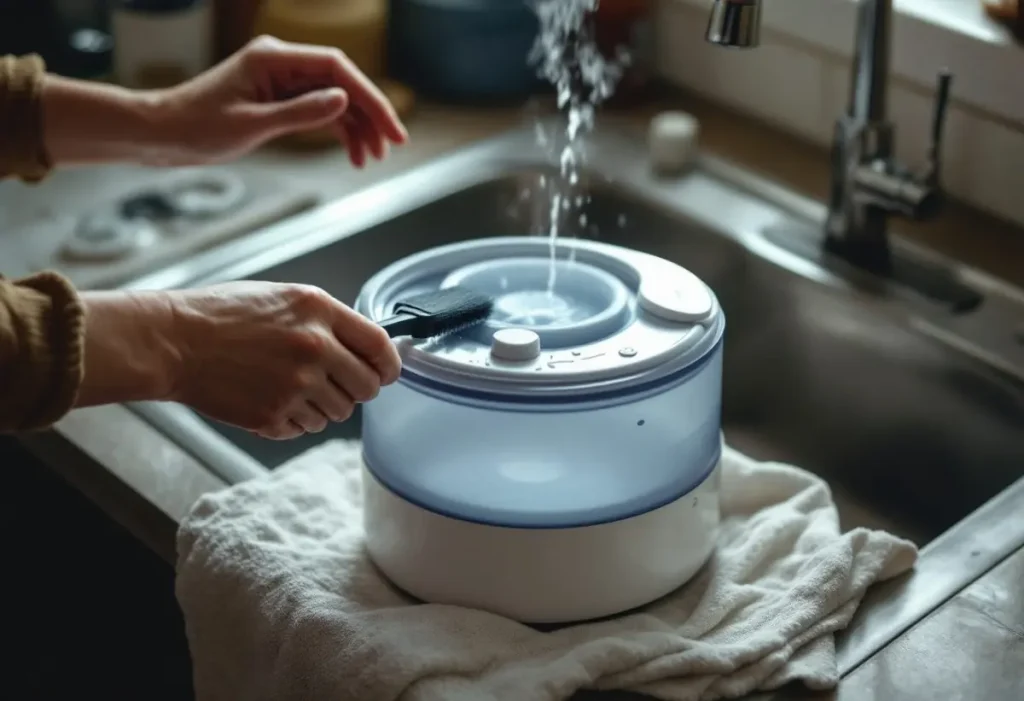
Any humidifier with a standing tank can grow bacteria and mold, but cool mist droplet units are the ones that spray them out. EPA says ultrasonic and impeller types produce “the greatest dispersions of both microorganisms and minerals,” while steam and evaporative units “generally disperse less, if any.”
CPSC says breathing dirty mist “may cause lung problems ranging from flu-like symptoms to serious infection.” Over-humidifying also feeds mold growth inside ductwork. EPA’s routine:
- Empty the tank, wipe it dry and refill it daily.
- Scrub portable units every third day to remove scale and film.
- Without maker instructions, clean with 3% hydrogen peroxide, then rinse with several changes of water.
- Drain, clean and dry before storage, and clean again before reuse.
Never add disinfectant to the water. South Korea withdrew humidifier disinfectants in 2011, and a 2026 meta-analysis of 17 studies linked exposure to respiratory disease with a pooled odds ratio of 7.02.
How much electricity does a warm mist humidifier use vs cool mist?
A warm mist humidifier draws roughly ten times the power of an ultrasonic cool mist model, because heating water takes far more energy than vibrating it. Levoit lists 280 W for its LV600HH hybrid, 26 W for the ultrasonic Classic 300S, and 30 W for its Superior 6000S evaporative unit.
Our math: 280 W for 8 hours is 2.24 kWh a night, or 67.2 kWh over 30 nights. At EIA’s preliminary August 2026 US residential average of 18.16 cents per kWh, that is $12.20. The 26 W unit uses 6.24 kWh, or $1.13.
Both are ceilings: a humidistat or cycling heater cuts real use. Do not count warm mist as room heating; if a room is cold, our space heater running cost breakdown covers that job.
Which type raises room humidity faster?
On the one machine that does both, warm mode puts out more water. Levoit’s LV600HH manual lists a maximum of 300 mL/h on cool mist and 500 mL/h on warm mist. Warm mode is slower to start: Levoit says it “may take 15 minutes to warm up,” and the Vicks VWC775 manual allows “up to 5 minutes or more for water to boil.”
EPA says not to humidify above 50 percent relative humidity, and CPSC warns that above 60% moisture can condense on surfaces. Check with a calibrated hygrometer, and see our indoor humidity targets by season.
Cool mist vs warm mist humidifier: which should you buy?
Buy cool mist for a child’s room or any home with toddlers or pets, and pick an evaporative wick model if you will not buy distilled water. Choose warm mist only for an adult space where the unit sits out of reach.
- Children or pets at home? Cool mist (EPA, CHOP, Shriners).
- Hard tap water? Evaporative, or distilled water in an ultrasonic unit (EPA).
- Windows already fogging? You may not need more moisture; see our window condensation limits.
- Damp in summer? That calls for a properly sized dehumidifier.
- Any type: budget a daily refill and an every-third-day clean.
If allergies drive the purchase, a HEPA air purifier sized to the room targets particles, which an ultrasonic humidifier can add.
How we researched this
Research date: October 31, 2026. We cite 16 sources; seven more were opened and excluded. Top ranking articles (Hunker, Levoit and Carepod blogs) cited no injury data, wattages or particle data. Federal guidance came from EPA and CPSC fact sheets read in full, health findings from PubMed abstracts, and power and output from Levoit and Vicks specifications. Running costs are our arithmetic at rated power.
Excluded: maker and retailer blog claims (unsourced), the Mayo Clinic page (blocked), CPSC NEISS downloads (blocked, so no US national burn estimate), and Reddit, skipped for a child safety topic.
Frequently asked questions
Is a cool mist or warm mist humidifier better for a baby?
Cool mist. EPA warns that steam and boiling water from steam vaporizers may cause burns, and CHOP says the American Academy of Pediatrics recommends a cool mist humidifier. Keep any unit about 3 feet from the crib.
Can I use tap water in a cool mist humidifier?
You can, but EPA says ultrasonic and impeller units are very efficient at dispersing tap water minerals, seen as white dust. CPSC advises distilled or demineralized water instead. Evaporative wick models avoid most of the problem because they release vapor, not droplets.
Does a warm mist humidifier kill bacteria?
Not in the tank. EPA says steam vaporizers with standing water can still grow microorganisms, though they generally disperse less of them than ultrasonic or impeller units. EPA still advises daily refills and cleaning portable units every third day, whatever the type.
Is warm mist better for a cold or congestion?
No primary source we read shows warm mist works better for a cold. EPA notes that warm mist units cool the steam before it exits, and lists relief of dry nose, throat, lips and skin as the reason to humidify. A clean cool mist unit adds that moisture without the burn risk.
How often should you clean a humidifier?
EPA says empty, wipe dry and refill portable humidifiers daily, and scrub them every third day. Without maker instructions, use 3% hydrogen peroxide and rinse with several changes of water. CHOP gives a similar schedule of every two to three days.
Can I put essential oils or disinfectant in the humidifier water?
Do not add disinfectant: South Korea withdrew humidifier disinfectants in 2011 over health risks, and a 2026 meta-analysis put the pooled odds ratio for respiratory disease at 7.02. For oils, follow the manual; Levoit’s LV600HH allows them only on the aroma pad, never in the tank.
What humidity should I set a humidifier to?
Between 30% and 50%, per CPSC, and EPA says not to exceed 50 percent. If water beads on windows or walls, EPA advises lowering the setting, moving the unit or using it less. A hygrometer confirms the level.
Sources
- U.S. EPA. “Use and Care of Home Humidifiers.” 2022. https://www.epa.gov/system/files/documents/2022-07/Use%20and%20Care%20of%20Home%20Humidifiers.pdf. Accessed October 2026.
- U.S. EPA. “Indoor Air Facts No. 8.” 1991. https://www.epa.gov/sites/production/files/2014-08/documents/humidifier_factsheet.pdf. Accessed October 2026.
- U.S. CPSC. “Dirty Humidifiers May Cause Health Problems.” https://www.cpsc.gov/s3fs-public/5046.pdf. Accessed October 2026.
- Yao et al. Environment International. 2020. https://pubmed.ncbi.nlm.nih.gov/32623220/. Accessed October 2026.
- Yao et al. Water Research X. 2020. https://pubmed.ncbi.nlm.nih.gov/32793876/. Accessed October 2026.
- Dietrich et al. Indoor Air. 2022. https://pubmed.ncbi.nlm.nih.gov/36437646/. Accessed October 2026.
- Lonie et al. “Steam vaporizers: A danger for paediatric burns.” Burns. 2016. https://pubmed.ncbi.nlm.nih.gov/27268009/. Accessed October 2026.
- Lee et al. J Expo Sci Environ Epidemiol. 2026. https://pubmed.ncbi.nlm.nih.gov/42928282/. Accessed October 2026.
- Shriners Children’s Boston. “DIY Humidifiers.” 2026. https://www.shrinerschildrens.org/en/news-and-media/news/2026/03/boston-diy-humidifiers. Accessed October 2026.
- CHOP. “Vaporizer or Humidifier: Which Is Best?” 2022. https://www.chop.edu/news/health-tip/vaporizer-or-humidifier-which-best. Accessed October 2026.
- Levoit. “LV600HH” specifications and manual. https://levoit.com/products/lv600hh-hybrid-ultrasonic-humidifier. Accessed October 2026.
- Levoit. “Classic 300S” specifications. https://levoit.com/products/classic-300s-smart-ultrasonic-top-fill-cool-mist-humidifier. Accessed October 2026.
- Levoit. “Superior 6000S” specifications. https://levoit.com/products/superior-6000s-smart-evaporative-humidifier-2026. Accessed October 2026.
- Kaz USA. “Vicks VWC775 Owner’s Manual.” https://static.pcrichard.com/docs/VWC775_Owners-Manual_01.pdf. Accessed October 2026.
- U.S. EIA. “Electric Power Monthly, Table 5.6.A.” https://www.eia.gov/electricity/monthly/epm_table_grapher.php?t=epmt_5_6_a. Accessed October 2026.
- U.S. EPA. “NAAQS Table.” https://www.epa.gov/criteria-air-pollutants/naaqs-table. Accessed October 2026.
Leave a Reply