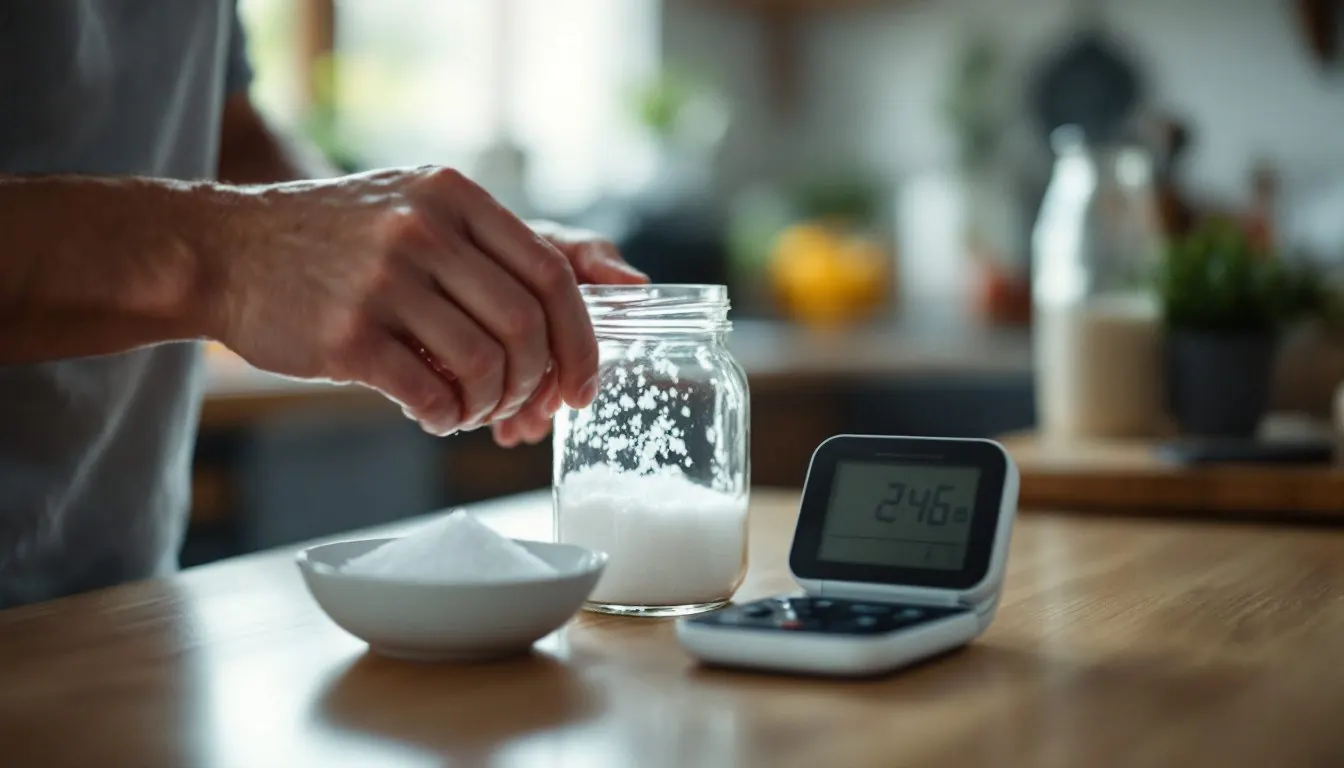
What is a hygrometer? A hygrometer is an instrument that measures humidity, almost always shown as percent relative humidity (RH). Most home units use a capacitive chip rated about ±2 to ±3% RH when new, and a sealed jar of damp table salt holds 75.3% RH at 77°F, so you can check yours for free.
Key Takeaways
- A saturated table salt solution holds 75.29% RH (±0.12) at 25°C (77°F), per the NBS compilation by Greenspan (1977).
- Saturated magnesium chloride holds 32.78% RH at 25°C, a second, dry-side check point.
- Sensirion’s SHT40 datasheet lists ±1.8 %RH typical accuracy and up to 0.5 %RH of drift per year.
- The WMO instrument guide rates a hair hygrograph in perfect condition at ±3 %rh.
- Placement matters: by the NWS vapor pressure formula, a sensor sitting 2°F warmer than a 70°F, 50% RH room reads 46.7%.
- EPA says to keep indoor humidity below 60 percent, ideally 30 to 50 percent, and calls the meter a $10 to $50 instrument.
What is a hygrometer and what does it measure?
A hygrometer measures how much water vapor is in the air. Nearly every home hygrometer reports relative humidity: the vapor present as a percentage of the most the air could hold at its current temperature. Most digital units add a thermometer and are sold as thermo hygrometers.
That temperature link is the whole story of hygrometer accuracy. The World Meteorological Organization’s instrument guide (WMO CIMO Guide, chapter 4, 2018 preliminary edition) notes that relative humidity “is strongly affected by temperature.” Warm the same air and RH falls; cool it and RH rises, with no water added or removed.
Because RH moves with temperature, technicians often convert the reading to a dew point, which stays fixed as air warms. By our calculation with the NWS formula, a room at 70°F and 50% RH has a dew point of about 50.5°F.
What types of hygrometer are there, and how accurate is each?
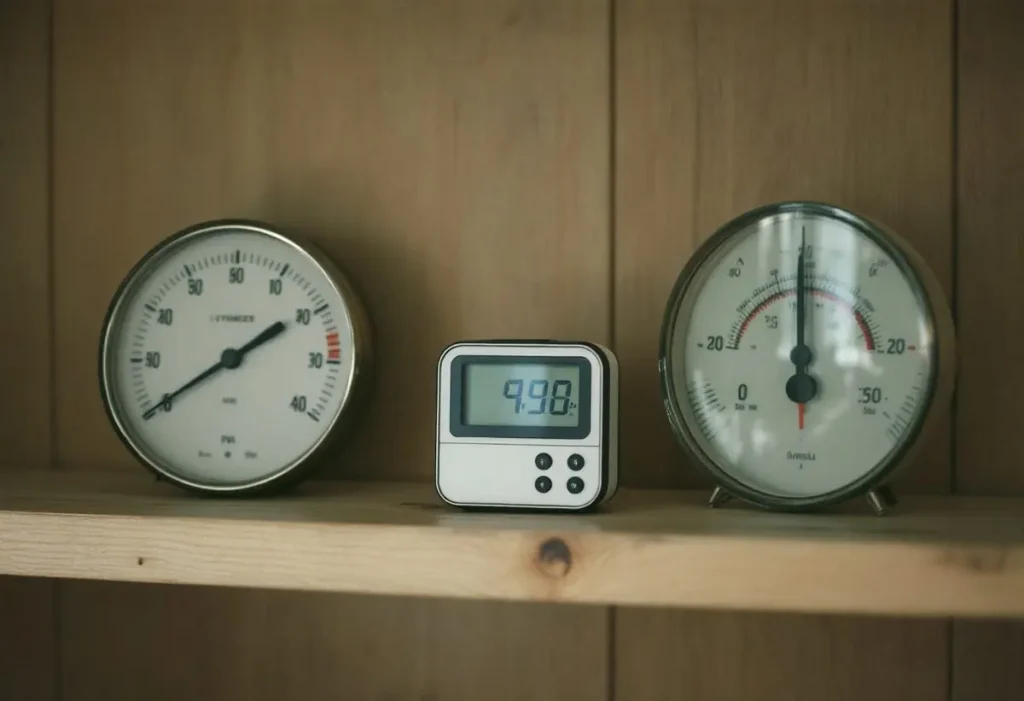
There are four families you will meet: mechanical hair or fiber dials, electronic capacitive or resistive chips, psychrometers that use a wet and a dry thermometer, and chilled-mirror dew point instruments. The WMO guide says capacitive polymer hygrometers are “the most convenient and leading technology for meteorological applications,” and they are what sits inside almost every digital home unit.
Accuracy below is the maker’s or WMO’s stated figure, not our test. “Response” is how fast the sensor follows a humidity step.
| Sensor or instrument | Stated accuracy | Response | Stated drift | Source |
|---|---|---|---|---|
| Hair hygrograph (mechanical) | ±3 %rh in perfect condition | 32 s at 20°C; 440 s at -20°C | Needs recalibration | WMO CIMO Guide, ch. 4 |
| Aosong DHT22 (polymer capacitor) | ±2 %RH typical, ±5 %RH max | 2 s sensing period | ±0.5 %RH per year | Aosong datasheet |
| Bosch BME280 (capacitive chip) | ±3 %RH (20 to 80 %RH, 25°C) | 1 s to 63% of a step | 0.5 %RH per year | Bosch Sensortec datasheet |
| Sensirion SHT40 (capacitive chip) | ±1.8 %RH typical | 6 s to 63% of a step | Under 0.25 %RH per year typical | Sensirion datasheet |
| Govee H5075 (finished home unit) | ±3% RH | “2s responsive speed” | Not stated | Govee product page |
| Assmann aspirated psychrometer | 1 %rh from 40 to 90 %rh | Not listed | Not applicable | WMO CIMO Guide, Table 4.2 |
| Chilled-mirror hygrometer | 0.15 K dew point | Not listed | Not applicable | WMO CIMO Guide, Table 4.2 |
Chip datasheets are maker data measured under the maker’s conditions; a finished hygrometer can do worse than its chip if the case traps heat.
How accurate is a cheap digital hygrometer?
Expect about ±3 points of RH from a typical home digital hygrometer when new. Govee lists its H5075 at ±3% RH, and the Bosch BME280 chip used in many devices is rated ±3 %RH between 20 and 80 %RH at 25°C. The Aosong DHT22 datasheet gives ±2 %RH typical but allows ±5 %RH at the maximum.
Tolerances stack: two hygrometers that each meet a ±3 point spec can sit 6 points apart in the same room and both be in spec.
How do you calibrate a hygrometer with the salt test?
Seal the hygrometer in a small container with damp table salt and wait until the reading stops moving; it should settle near 75%. The physics is fixed: a saturated salt solution, with undissolved salt still present, holds a vapor pressure that “depends only on temperature,” per the WMO guide.
The salt point barely moves with room temperature. Greenspan’s NBS Table 2 puts saturated sodium chloride at 75.61% at 15°C (59°F), 75.47% at 20°C, 75.29% at 25°C and 75.09% at 30°C (86°F). Any normal room lands within half a point of 75.3%.
- Cover the bottom of a bottle cap or small dish with table salt and add water a few drops at a time until it is a damp paste, with dry crystals still visible.
- Seal the dish and the hygrometer, not touching, in a zip bag or jar.
- Keep it away from sun and vents; the WMO guide says the container must reach ambient temperature and the salt “may need additional equilibration time.”
- Read it the next morning, then again an hour later; if they differ, wait longer.
- Note the offset: a final 72% means the unit reads 3 points low near 75%.
- For a two-point check, repeat with magnesium chloride, which Greenspan puts at 32.78% at 25°C and 33.07% at 20°C.
The two-point check matters because the error at 75% is not always the error at 35%: the WMO guide lists calibration error with “the character of non-linearity” among the main error sources for electronic RH sensors.
Greenspan’s 25°C list also gives lithium chloride at 11.30%, potassium carbonate at 43.16% and magnesium nitrate at 52.89%.
Why does a hygrometer drift, and how often should you check it?
Capacitive sensors absorb water into a polymer layer that slowly changes. Sensirion rates the SHT40 at under 0.25 %RH of drift per year typical and under 0.5 maximum, and warns the value “may be higher in environments with vaporized solvents, out-gassing tapes, adhesives.” Aosong lists ±0.5 %RH per year for the DHT22.
At the 0.5 point maximum, five years adds up to 2.5 points of drift on top of the original tolerance (our arithmetic). The WMO guide adds that drift “can be significant” for sensors exposed to high or condensing humidity, and is most often upward, so a unit that lived in a damp crawl space or bathroom deserves a salt test before you trust it.
A sensible routine: salt test a new unit, then once a year, and again after it has been wet. Hair and dial gauges need more attention; the WMO guide says hair elements need washing and recalibration.

Where should you put a hygrometer in a house?
Put it at breathing height on an interior wall, out of sun and away from supply registers, kitchens, showers and exterior walls. The same logic governs thermostat location: the device reads the air touching it.
A small temperature error turns into a large RH error. Using the NWS vapor pressure formula, a room at 70°F and 50% RH holds air with a vapor pressure of 12.52 hPa. A hygrometer 1°F warmer, on a sunny shelf, reads 48.3%; at 2°F warmer it reads 46.7%.
Correction: a low reading near a warm spot is not a broken hygrometer
Relative humidity is relative to the sensor’s own temperature. A unit in a sunbeam reads dry and one on a cold exterior wall reads wet, even with a perfect chip. Move it before you recalibrate it.
The humidity at a cold window or closet wall can be far higher than the room reading, which is why window condensation shows up first. A multi-sensor air quality monitor follows the same physics, so its humidity channel needs the same placement care.
What should your hygrometer read, and what do you do about it?
EPA’s mold guidance says to keep indoor humidity below 60 percent, ideally between 30 and 50 percent. Our guide to ideal indoor humidity breaks that down by season and by who sets each number.
If a checked hygrometer reads high in summer, the fixes are in our dehumidifier sizing guide and in why some homes stay cold but humid with the AC running. That page explains why a bigger AC can make the problem worse.
If it reads dry in winter, compare a whole house humidifier with a room unit, and see our sibling piece on cool mist versus warm mist models. Salt test the hygrometer before you buy either.
For deeper analysis, plot your temperature and RH on a psychrometric chart, or compare against wet bulb readings from a sling psychrometer. For a mold claim or other costly decision, a salt test is not enough. NIST calibrates thermohygrometers from 2% to 98% RH between -34°C and 85°C at an uncertainty of 0.5% of value, and accredited labs trace to that chain.
How we researched this
Research date: October 31, 2026. We read the top organic results (Wikipedia, RS Components; Britannica blocked our fetcher), then the primary sources: Greenspan’s 1977 NBS paper (Table 2 read from the PDF), the WMO CIMO Guide chapter 4, NIST, EPA, the NWS vapor pressure worksheet, and maker datasheets. Nine sources are cited; temperature-offset and drift figures are our calculations from them.
Excluded: humidor-vendor calibration claims, unsourced figures on Wikipedia and retailer pages, and a ThermoPro spec page that returned 404. WMO lists magnesium chloride at 33.0% at 25°C versus Greenspan’s 32.78%; we use Greenspan. Reddit was not used.
Frequently asked questions
How accurate are cheap hygrometers?
Most are rated around ±3 points of relative humidity when new. Govee lists its H5075 at ±3% RH, the Bosch BME280 chip is rated ±3 %RH from 20 to 80 %RH at 25°C, and the Aosong DHT22 is ±2 %RH typical with a ±5 %RH maximum. A salt test shows where yours sits.
How long does a hygrometer salt test take?
Plan on overnight. The WMO guide warns that a salt system must reach room temperature and the mixture may need additional equilibration time. The sensor itself is fast: Sensirion rates the SHT40 at 6 seconds to 63 percent of a step. The slow part is the sealed air settling.
Why do two hygrometers in the same room disagree?
Each can be in spec and still differ: two units rated ±3 points can sit 6 points apart. Placement adds more. By the NWS vapor pressure formula, a unit just 1°F warmer than a 70°F, 50 percent room reads 48.3 percent.
How often should I recalibrate a hygrometer?
Check a new unit, then once a year, and again after it gets wet. Sensirion rates SHT40 drift at under 0.5 %RH per year at most, and Aosong lists ±0.5 %RH per year for the DHT22. The WMO guide says drift can be significant after high or condensing humidity, usually upward.
Does a hygrometer measure dew point?
Most home units do not measure it; they calculate it from temperature and relative humidity. A chilled-mirror hygrometer measures dew point directly, and WMO lists it as a secondary standard at 0.15 K uncertainty. By the NWS formula, 70°F at 50 percent RH works out to a dew point of about 50.5°F.
Is an analog dial or hair hygrometer worth buying?
Only for a rough trend. The WMO guide says a good hair hygrograph in perfect condition reaches about ±3 %rh at moderate temperatures, worse in the cold, and its hairs need cleaning and recalibration. Ordinary human hair has a 32 second time constant at 20°C, so dials lag.
Sources
- Greenspan, L., National Bureau of Standards. “Humidity Fixed Points of Binary Saturated Aqueous Solutions.” Journal of Research of the NBS 81A(1), 1977. https://nvlpubs.nist.gov/nistpubs/jres/81A/jresv81An1p89_A1b.pdf. Accessed October 2026.
- World Meteorological Organization. “Guide to Instruments and Methods of Observation, Volume I, Chapter 4: Measurement of Humidity” (2018 preliminary edition). https://old.wmo.int/extranet/pages/prog/www/IMOP/publications/CIMO-Guide/Prelim_2018_ed/8_I_4_en_MR_clean.pdf. Accessed October 2026.
- National Institute of Standards and Technology. “Hygrometers.” https://www.nist.gov/thermodynamic-metrology-group/hygrometers. Accessed October 2026.
- U.S. Environmental Protection Agency. “A Brief Guide to Mold, Moisture and Your Home.” https://www.epa.gov/mold/brief-guide-mold-moisture-and-your-home. Accessed October 2026.
- National Weather Service, El Paso. “Vapor Pressure.” https://www.weather.gov/media/epz/wxcalc/vaporPressure.pdf. Accessed October 2026.
- Sensirion. “Datasheet SHT4x,” Version 1, October 2020. https://cdn.sparkfun.com/assets/d/5/f/d/6/SHT40_Datasheet.pdf. Accessed October 2026.
- Bosch Sensortec. “BME280 Data sheet,” Revision 1.23. https://www.bosch-sensortec.com/media/boschsensortec/downloads/datasheets/bst-bme280-ds002.pdf. Accessed October 2026.
- Aosong Electronics. “DHT22 Digital-output relative humidity and temperature sensor.” https://www.sparkfun.com/datasheets/Sensors/Temperature/DHT22.pdf. Accessed October 2026.
- Govee. “Govee Bluetooth Hygrometer Thermometer H5075.” https://us.govee.com/products/govee-bluetooth-hygrometer-thermometer-h5075. Accessed October 2026.
Leave a Reply