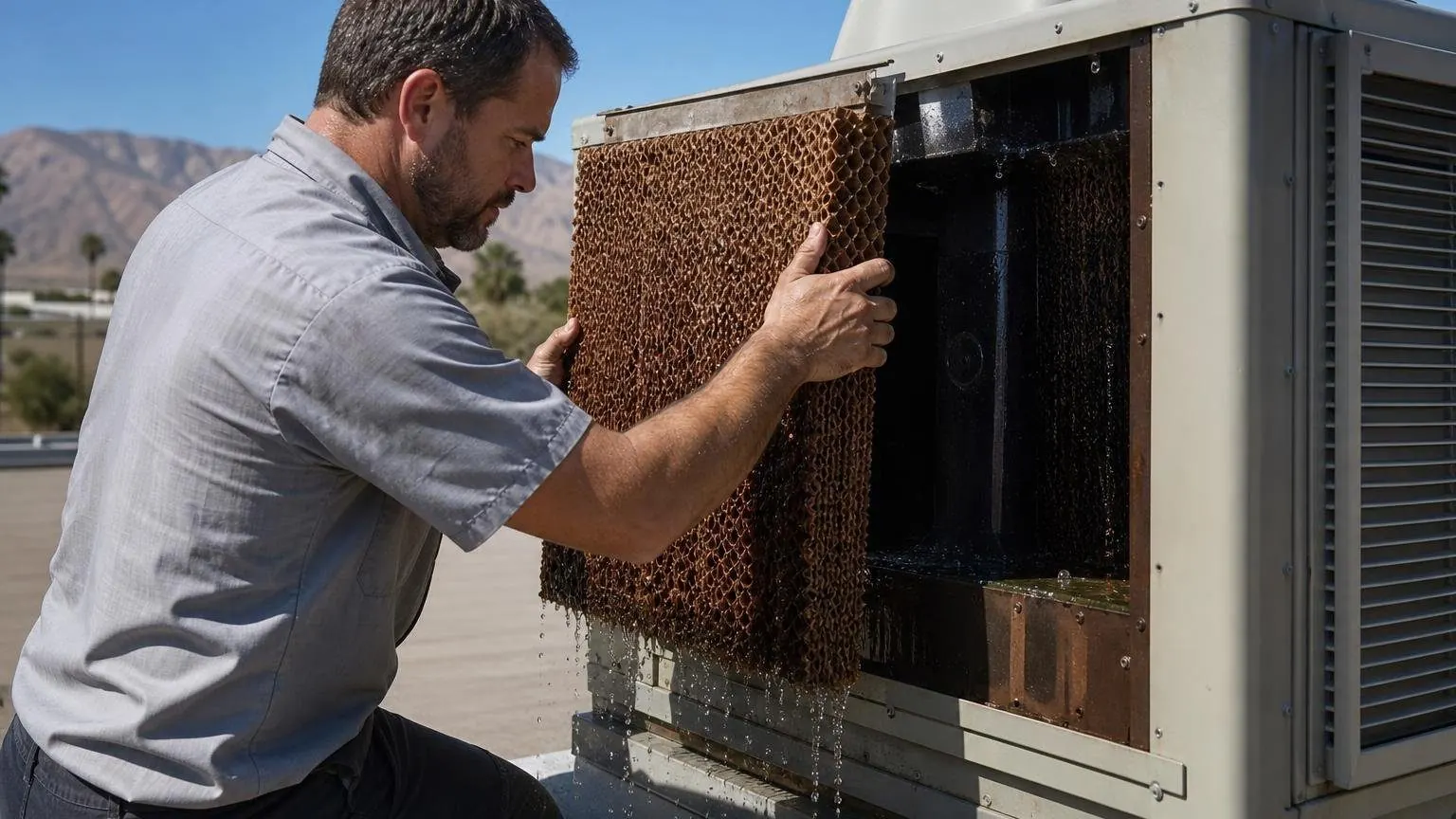
What is wet bulb temperature? Wet bulb temperature is the lowest temperature air can be cooled to by evaporating water into it. It packs heat and humidity into one number: a 95°F afternoon has a wet bulb near 60°F at 10 percent humidity but near 80°F at 50 percent.
Key Takeaways
- The National Weather Service defines wet bulb as the lowest temperature reachable by evaporating water into the air.
- Stull (2011) gives a one-line formula valid from 5% to 99% humidity, accurate to minus 1°C to plus 0.65°C.
- Swamp coolers suit places whose design wet bulb is 70°F or lower, per DOE Building America.
- Sherwood and Huber (2010) set 35°C (95°F) as the theoretical human limit.
- A 2022 Penn State study measured real limits averaging 30.55°C (87.0°F) in humid heat.
- OSHA’s Technical Manual weights natural wet bulb at 70% of WBGT.
What is wet bulb temperature?
Wet bulb temperature is the temperature a wetted thermometer settles at when moving air evaporates water from it. Evaporation pulls heat out, so the reading drops below air temperature, and how far it drops depends on how dry the air is.
Ordinary air temperature is called dry bulb, and the gap between the two is the wet-bulb depression. DOE’s Building America Solution Center notes that at 100% relative humidity the wet bulb equals the dry bulb, so evaporative cooling cannot occur; below saturation the wet bulb is always lower. Lines of constant wet bulb run diagonally across every psychrometric chart.
How is it measured?
The NWS glossary describes the sling psychrometer: wet and dry bulb thermometers on a frame whirled by hand to evaporate water from the wet bulb.
- Soak the wick on one thermometer with clean water.
- Whirl the sling, or run the fan on an aspirated psychrometer, so air moves across the wick.
- Read the wet bulb once it stops falling, and the dry bulb at the same moment.
- Convert the pair to humidity or dew point with a chart or the NWS equations.
Air movement matters. OSHA’s heat stress meters use a natural (static) wet bulb, whose reading shifts with wind the way sweat evaporation does. Bryant’s split system instructions tell installers to measure air entering the indoor coil with a sling psychrometer.
How do you calculate wet bulb temperature from humidity?
Most people calculate wet bulb temperature from air temperature and relative humidity using Roland Stull’s 2011 equation in the Journal of Applied Meteorology and Climatology. It is valid from 5% to 99% humidity and from minus 20°C to 50°C (minus 4°F to 122°F) at sea level pressure.
Tw = T·atan[0.151977·(RH + 8.313659)^0.5] + atan(T + RH) − atan(RH − 1.676331) + 0.00391838·RH^1.5·atan(0.023101·RH) − 4.686035, with T in °C, RH as a number such as 65.8, and arctangents in radians.
Stull reports errors from minus 1°C to plus 0.65°C, with mean absolute error under 0.3°C. It assumes sea level pressure, so at high elevation use a pressure-aware method. Below, one 95°F day at four humidity levels, checked against ASHRAE equations.
| Humidity at 95°F | Wet bulb (Stull) | Wet bulb (ASHRAE check) | Dew point | Wet-bulb depression | Swamp cooler air, 70% / 90% media |
|---|---|---|---|---|---|
| 10% RH | 60.1°F | 60.7°F | 30.0°F | 34.9°F | 70.6°F / 63.6°F |
| 30% RH | 71.9°F | 70.7°F | 58.8°F | 23.1°F | 78.8°F / 74.2°F |
| 50% RH | 79.9°F | 79.1°F | 73.5°F | 15.1°F | 84.4°F / 81.4°F |
| 70% RH | 86.5°F | 86.1°F | 83.7°F | 8.5°F | 89.0°F / 87.3°F |
The two methods agree within 1.2°F on every row, and the 50% row matches DOE’s Building America reading of 95°F at 50% humidity as 79°F wet bulb.
Wet bulb vs dew point vs dry bulb: what is the difference?
Dry bulb is air temperature, dew point is where the air’s moisture starts to condense, and wet bulb sits between them. Below saturation the order never changes: dew point, then wet bulb, then dry bulb. At 100% humidity all three are equal.
At 10% humidity, 95°F air has a dew point of 30.0°F but a wet bulb of 60.1°F. Dew point tracks moisture alone and predicts condensation on windows and ducts. Wet bulb tracks how much cooling evaporation can still do, so it governs coolers, towers and sweat. Indoors, the federal AC test point of 80°F dry bulb and 67°F wet bulb works out to about 51% relative humidity, useful context for indoor humidity targets.
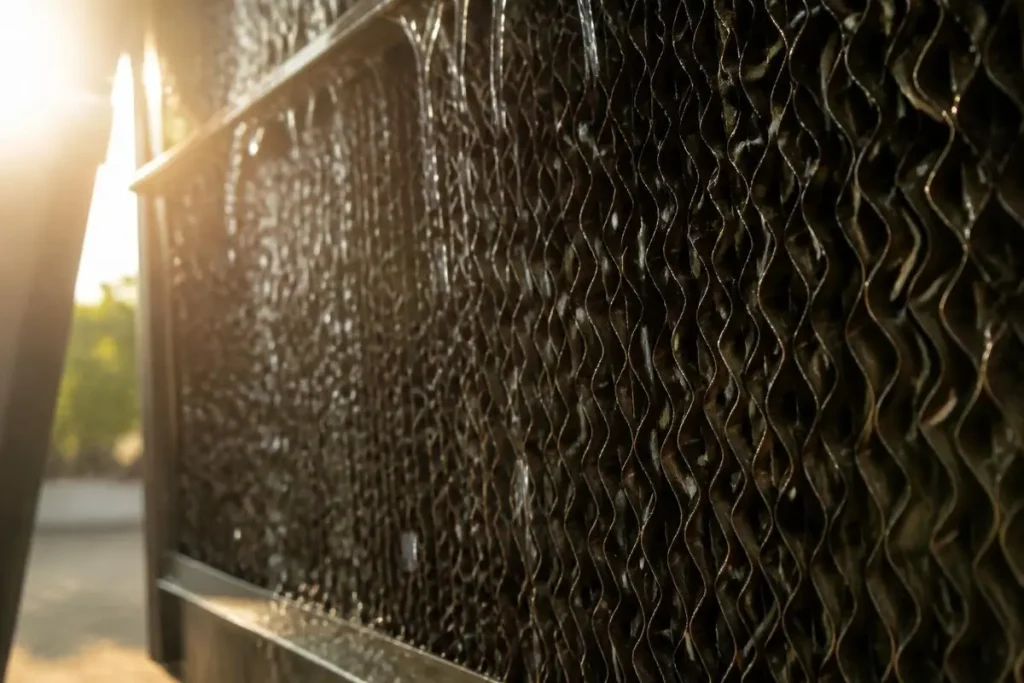
How does wet bulb temperature decide whether a swamp cooler works?
An evaporative cooler can push air toward the outdoor wet bulb but never below it. DOE’s Building America Solution Center gives leaving air as dry bulb minus effectiveness times the wet-bulb depression, and says areas with wet bulb of 70°F or lower suit evaporative cooling.
Phoenix, Arizona has a 1% cooling design condition of 108°F with a 70°F wet bulb, a 38°F depression where coolers “would work very well.” Sarasota, Florida, at 92°F and 79°F, has only a 13°F depression, and a cooler “would not work very well.”
DOE puts newer thick media at 75% to 93% effective and aspen pads at about 70%. Its chart puts a 95°F, 50% day at 84°F supply air; our 70% row gives 84.4°F. Coolers still help where coincident wet bulb reaches 74°F, with reduced performance. Our swamp cooler guide maps where that holds, and pad and pan upkeep keeps effectiveness from sliding.
Where else does HVAC use wet bulb temperature?
Cooling towers, AC charging and federal efficiency tests all key on wet bulb, because each depends on evaporation or on moisture the indoor coil removes. Stull notes that a lower wet bulb lets cooling towers and other evaporative coolers run more efficiently.
A tower cannot chill water below the entering air’s wet bulb. Washington’s energy code, Table C403.3.2(8), rates open towers at 95°F entering water, 85°F leaving and 75°F entering wet bulb, a 10°F gap the trade calls approach. Our cooling tower explainer covers range and approach, and the same limit binds towers behind water-cooled server halls, one input to data center PUE.
In Bryant’s superheat charging table, at 85°F outdoors the required superheat climbs from 8°F at 62°F indoor wet bulb to 15°F at 66°F and 33°F at 76°F. Skip the wet bulb reading and you are guessing at superheat targets.
DOE’s portable AC test procedure (10 CFR 430, Appendix CC) sets indoor air at 80°F dry bulb and 67°F wet bulb and, in test condition 1.A, outdoor air at 95°F and 75°F. Return wet bulb also sets the expected temperature split across the coil.

What wet bulb temperature is dangerous for humans?
There is no single safe line. Sherwood and Huber (PNAS, 2010) set 35°C (95°F) as the theoretical limit, and Penn State researchers measured real limits well below it in 2022, averaging 30.55°C (87.0°F) in humid heat.
Sherwood and Huber wrote that “any exceedence of 35 °C for extended periods should induce hyperthermia.” Their limit applies to a person out of the sun, in gale-force winds, doused with water, unclothed and not working. In reanalysis data they found present-day peak wet bulb never exceeds 31°C.
The Penn State team tested 24 young, healthy adults pedaling at about 10 W. No subject reached 35°C, and hot, dry trials failed lower still, at 25.75°C (78.3°F) to 27.82°C (82.1°F). The 70% row of our table, 86.5°F, sits about half a degree under the humid average.
A 2020 Science Advances study found two weather stations had already reported daily maximums above 35°C, mostly for 1 to 2 hours, and extreme humid heat more than doubling in frequency since 1979. Our counts of US heat deaths and the cooling degree day index track the domestic side.
Two corrections
Wet bulb is never higher than air temperature; at 100% humidity they are equal, and at any lower humidity wet bulb is lower. Some popular explainers state the reverse. And 35°C is not a safe threshold: it is a theoretical ceiling for a resting, wet, unclothed person in shade and wind.
Is wet bulb temperature the same as WBGT?
No. Wet bulb globe temperature (WBGT) is a heat stress index built mostly from wet bulb. The National Weather Service calls it an experimental forecast tool for heat stress in direct sunlight, combining a wet bulb, a black globe and a dry bulb.
OSHA’s outdoor formula is 0.7 times natural wet bulb plus 0.2 times globe plus 0.1 times dry bulb; indoors it is 0.7 wet bulb plus 0.3 globe. An indoor reading of 80°F wet bulb and 90°F globe gives 83°F WBGT. The NWS heat index, by contrast, estimates how temperature feels in shade.
How we researched this
Research date: October 30, 2026. After the top results (Wikipedia, Live Science, Mental Floss), we read NWS, DOE Building America, OSHA, 10 CFR 430, a Washington code table, a Bryant installation sheet and four peer-reviewed papers. Table values are our arithmetic: Stull’s equation, checked with ASHRAE equations via the PsychroLib library, and NWS dew point formulas.
Excluded: Wikipedia’s record table (failed verification), a popular 50°C, 10% example our math puts about 2°C high, and vendor blogs. Reddit was skipped: heat illness is a health topic.
Frequently asked questions
What wet bulb temperature is dangerous?
Danger starts well below the famous 35°C (95°F) line. In the 2022 Penn State chamber study, young, healthy adults doing light activity lost heat balance at an average wet bulb of 30.55°C (87.0°F) in humid heat, and as low as 25.75°C (78.3°F) in hot, dry air. The chamber had no sun, so outdoor limits could differ.
Can wet bulb temperature be higher than air temperature?
No. Wet bulb equals air temperature at 100% relative humidity and is lower at every other humidity, as DOE’s Building America Solution Center states. A meter showing wet bulb above dry bulb has a faulty sensor or a dry wick.
How do I measure wet bulb temperature at home?
Use a sling psychrometer, which the NWS describes as wet and dry bulb thermometers whirled by hand, or a digital psychrometer. Or apply the Stull (2011) equation to a temperature and humidity reading from any decent digital sensor; it lands within about 1°C.
What wet bulb temperature is too high for a swamp cooler?
DOE’s Building America Solution Center says evaporative coolers are appropriate where wet bulb is 70°F or lower and can still cool where coincident wet bulb reaches 74°F, with reduced performance. In that wetter band it says indirect evaporative cooling may be best.
Is wet bulb temperature the same as the heat index?
No. Wet bulb is a physical temperature read from a wetted thermometer. The NWS heat index estimates how hot it feels in the shade, and WBGT adds sun and wind. OSHA’s outdoor WBGT formula weights natural wet bulb 70%, globe 20% and dry bulb 10%.
Has a 35°C wet bulb ever been recorded?
Yes, briefly. Raymond and colleagues reported in Science Advances in 2020 that two weather stations had logged multiple daily maximum wet bulb readings above 35°C, mostly lasting 1 to 2 hours, concentrated in South Asia, the coastal Middle East and coastal southwest North America. Regional averages had not reached that level.
Sources
- NOAA National Weather Service. “Glossary: Wet-Bulb Temperature; Psychrometer.” https://forecast.weather.gov/glossary.php?word=wet-bulb%20temperature. Accessed October 2026.
- Stull R. “Wet-Bulb Temperature from Relative Humidity and Air Temperature.” Journal of Applied Meteorology and Climatology, 2011. https://journals.ametsoc.org/view/journals/apme/50/11/jamc-d-11-0143.1.xml. Accessed October 2026.
- Sherwood SC, Huber M. “An adaptability limit to climate change due to heat stress.” PNAS, 2010. https://pmc.ncbi.nlm.nih.gov/articles/PMC2906879/. Accessed October 2026.
- Vecellio DJ, et al. “Evaluating the 35°C wet-bulb temperature adaptability threshold for young, healthy subjects.” Journal of Applied Physiology, 2022. https://pmc.ncbi.nlm.nih.gov/articles/PMC8799385/. Accessed October 2026.
- Raymond C, et al. “The emergence of heat and humidity too severe for human tolerance.” Science Advances, 2020. https://pmc.ncbi.nlm.nih.gov/articles/PMC7209987/. Accessed October 2026.
- DOE Building America Solution Center. “Evaporative Cooling Systems.” https://basc.pnnl.gov/resource-guides/evaporative-cooling-systems. Accessed October 2026.
- OSHA. “Technical Manual, Section III, Chapter 4: Heat Stress.” https://www.osha.gov/otm/section-3-health-hazards/chapter-4. Accessed October 2026.
- NOAA National Weather Service. “Wet Bulb Globe Temperature: How and when to use it.” https://www.weather.gov/news/211009-WBGT. Accessed October 2026.
- eCFR. “10 CFR 430, Subpart B, Appendix CC (portable air conditioners).” https://www.ecfr.gov/current/title-10/chapter-II/subchapter-D/part-430/subpart-B/appendix-Appendix%20CC%20to%20Subpart%20B%20of%20Part%20430. Accessed October 2026.
- Bryant (manufacturer). “Split system wiring diagram and superheat charging table.” https://inspectapedia.com/aircond/Bryant-split-system-ac-wiring.pdf. Accessed October 2026.
- Washington State Legislature. “WAC 51-11C-403238 (2020 archive).” https://lawfilesext.leg.wa.gov/Law/WACArchive/2020/htm/WAC%20%2051%20%20TITLE/WAC%20%2051%20-%2011C%20CHAPTER/WAC%20%2051%20-%2011C-403238.htm. Accessed October 2026.
- NWS El Paso. “Relative Humidity and Dewpoint from Wet Bulb.” https://www.weather.gov/media/epz/wxcalc/rhTdFromWetBulb.pdf. Accessed October 2026.
Leave a Reply