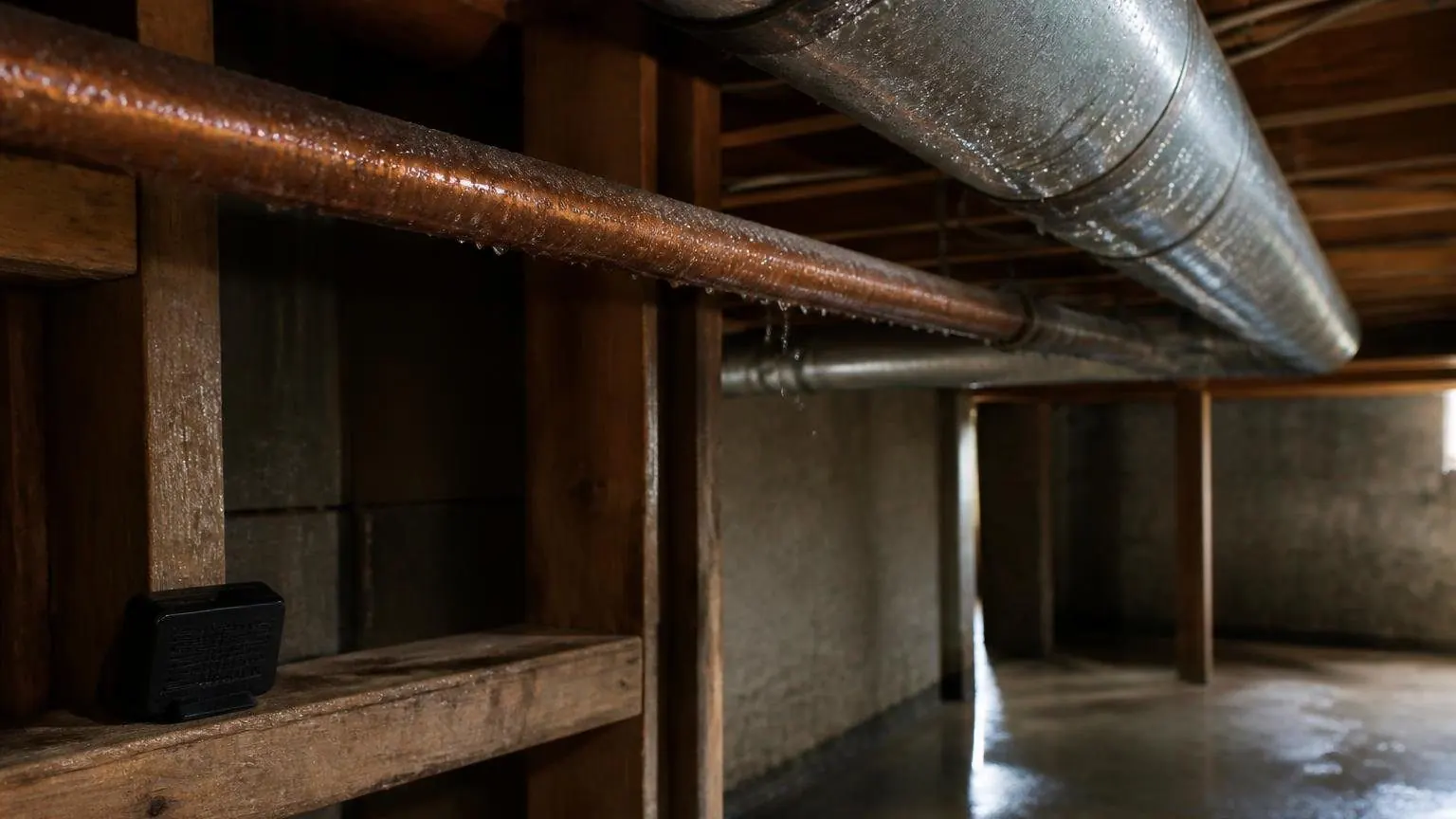
What is the dew point? The dew point is the temperature air must be cooled to before its water vapor condenses. Indoors it is the wet-surface line: at 70°F and 50% relative humidity the dew point is about 50.5°F, so any pipe, window or duct colder than that sweats.
Key Takeaways
- The National Weather Service defines dew point as the temperature air must be cooled to in order to reach saturation.
- The NWS La Crosse office rates summer dew points of 55 or below as dry and comfortable and 65 or above as becoming oppressive.
- EPA’s 2013 Moisture Control Guidance says to keep the indoor dew point below 55°F in cooling season, or a maximum of 50 percent RH at 75°F.
- EPA’s mold course says to keep indoor RH below 60 percent, ideally 30 to 50 percent.
- ASHRAE’s technical FAQ cites a 0.012 humidity ratio limit in Standard 55-2017, about a 62.3°F dew point at sea level.
- At 90 percent RH a surface only has to be 3°F cooler than the air to collect water; at 50 percent RH it takes around 20°F, per EPA.
What is the dew point?
The dew point is the temperature to which air must be cooled, with pressure and moisture content held constant, to reach saturation, per the NWS glossary. A higher dew point means more water vapor in the air. Cool the air below it and the extra vapor leaves as liquid: dew, fog, or water on a cold surface.
Dew point is an absolute moisture number. EPA’s 2013 moisture guidance states that, unlike relative humidity, “the dew point does not change with air temperature.” Warm a room without adding water and the RH reading falls, but the dew point stays put.
EPA notes that chilled mirror devices measure it directly, but most home hygrometers and thermostats read only temperature and RH, so you calculate it from those two readings. It is a different number from wet bulb temperature.
Why is dew point a better humidity number than relative humidity?
Relative humidity only says how full the air is compared with its capacity at the current temperature, so the same water content reads differently as a room warms or cools. Dew point tracks the water itself, which makes it the better predictor of comfort and condensation.
The NWS La Crosse office gives the standard example: 30°F air with a 30°F dew point is at 100% relative humidity, while 80°F air with a 60°F dew point is at 50%. The 80 degree day feels far more humid because its dew point is higher.
Indoors the trap shows up in winter: 30% RH is a 35.5°F dew point at 68°F but 41.5°F at 75°F. EPA says knowing only RH “is not much help in predicting condensation.” For seasonal RH targets, see our guide to ideal humidity levels for a home.
What dew point is comfortable indoors?
The only government comfort scale we found is an outdoor summer one: NWS La Crosse calls a dew point of 55 or below dry and comfortable, 55 to 65 “sticky” with muggy evenings, and 65 or above oppressive. EPA’s indoor condensation ceiling of a 55°F dew point sits at the top of the comfortable band.
| Dew point (NWS band) | NWS La Crosse label | RH at 70°F (our calculation) | RH at 75°F (our calculation) |
|---|---|---|---|
| 55°F or below | Dry and comfortable | 59.0% RH or less | 49.8% RH or less |
| 55 to 65°F | Becoming “sticky” with muggy evenings | 59.0% to 84.2% RH | 49.8% to 71.1% RH |
| 65°F or above | Lots of moisture in the air, becoming oppressive | 84.2% RH or more | 71.1% RH or more |
Correction: the popular “dew point comfort chart” has no primary source. The multi-band charts repeated across calculator sites (under 50°F “a bit dry”, 60 to 65°F “getting sticky”) carried no citation on the pages we checked, including Omni Calculator. The NWS La Crosse three-band list is the attributable version, and it describes outdoor summer weather.
How do you calculate dew point from temperature and humidity?
Convert to Celsius, find the saturation vapor pressure with the National Weather Service formula, scale it by RH, then run the formula backwards. The NWS vapor pressure sheet gives es = 6.11 × 10^(7.5T ÷ (237.3 + T)) in millibars, a Magnus-type equation.
- Convert the room temperature to Celsius: T = (°F minus 32) × 5 ÷ 9.
- Find saturation vapor pressure: es = 6.11 × 10^(7.5 × T ÷ (237.3 + T)) millibars.
- Find the actual vapor pressure: e = es × RH ÷ 100.
- Invert: x = log10(e ÷ 6.11), then dew point = 237.3 × x ÷ (7.5 minus x), in °C.
- Convert back: °F = °C × 9 ÷ 5 + 32.
Example 1: 70°F at 50% RH is 21.1°C, es is 25.0 mb, e is 12.5 mb, and the dew point is 10.3°C, or 50.5°F. Example 2: 68°F at 30% RH gives e of 7.0 mb and a 35.5°F dew point. Example 3: 75°F at 60% RH gives e of 17.8 mb and a 60.2°F dew point.
Checked against federal examples, the method returns 50.6% RH for the NWS 80°F and 60°F dew point case (NWS: 50%) and a 69.5°F dew point for EPA’s 85°F, 60 percent RH chart reading (EPA: 70°F). A psychrometric chart gives the same answer graphically.
| Indoor RH | Dew point at 65°F | Dew point at 70°F | Dew point at 75°F |
|---|---|---|---|
| 20% | 23.0°F | 27.1°F | 31.3°F |
| 30% | 32.9°F | 37.2°F | 41.5°F |
| 40% | 40.1°F | 44.6°F | 49.1°F |
| 50% | 45.9°F | 50.5°F | 55.1°F |
| 60% | 50.8°F | 55.5°F | 60.2°F |
| 70% | 55.0°F | 59.8°F | 64.5°F |
| 80% | 58.7°F | 63.5°F | 68.4°F |
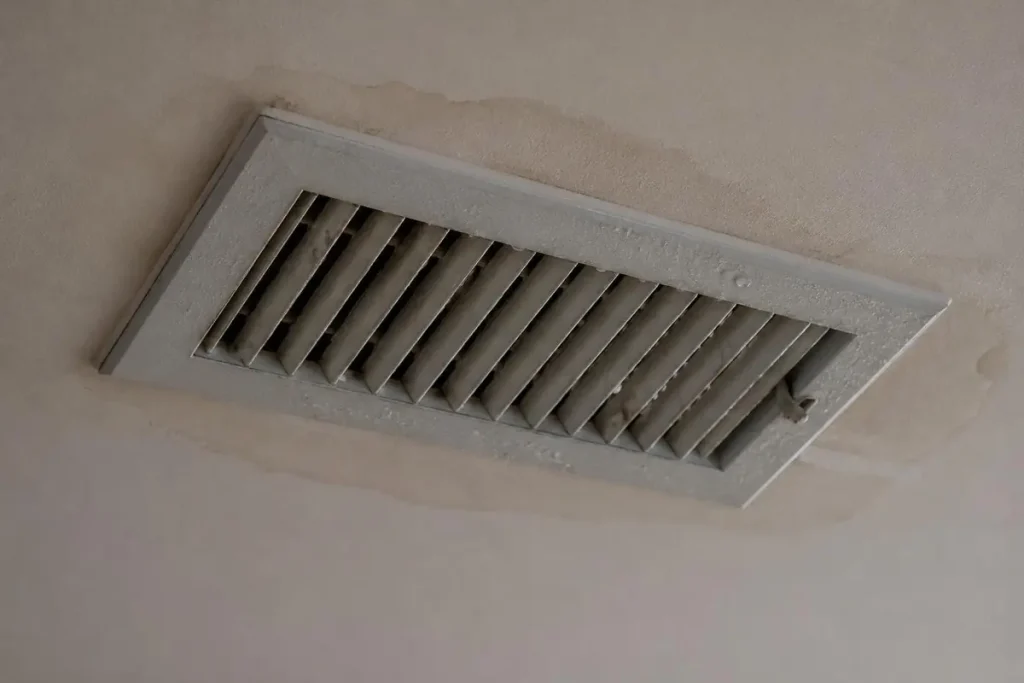
Where does the dew point cause condensation in a house?
Any surface at or below the dew point of the air touching it collects water. EPA’s rule: if the dew point is above a surface’s temperature, vapor condenses on it; if below, it will not.
EPA says that at 90 percent RH a surface only has to be 3°F cooler than the air, while at 50 percent RH it must be around 20°F cooler. Our formula gives 3.1°F and 19.5°F at 70°F.
Windows are the winter case. At 70°F and 35% RH the dew point is 41.1°F, so glass at or below that fogs; see our window condensation explainer. Pipes are the summer case: EPA’s mold course shows rust on a drainpipe as a sign of condensation and says the pipe should be insulated. EPA’s homeowner guide says to dry such condensation quickly and reduce the moisture source.
EPA’s duct example: humid outdoor air leaking into a Miami building has a dew point above 70°F for most of the year, a supply duct carrying 55°F air sits near 55°F, and the moisture condenses on the duct and possibly the diffuser. Ducts in a humid attic face the same physics, which is why insulating and sealing supply ducts matters; EPA lists condensation on an uninsulated AC duct as a moisture source for mold inside ductwork.
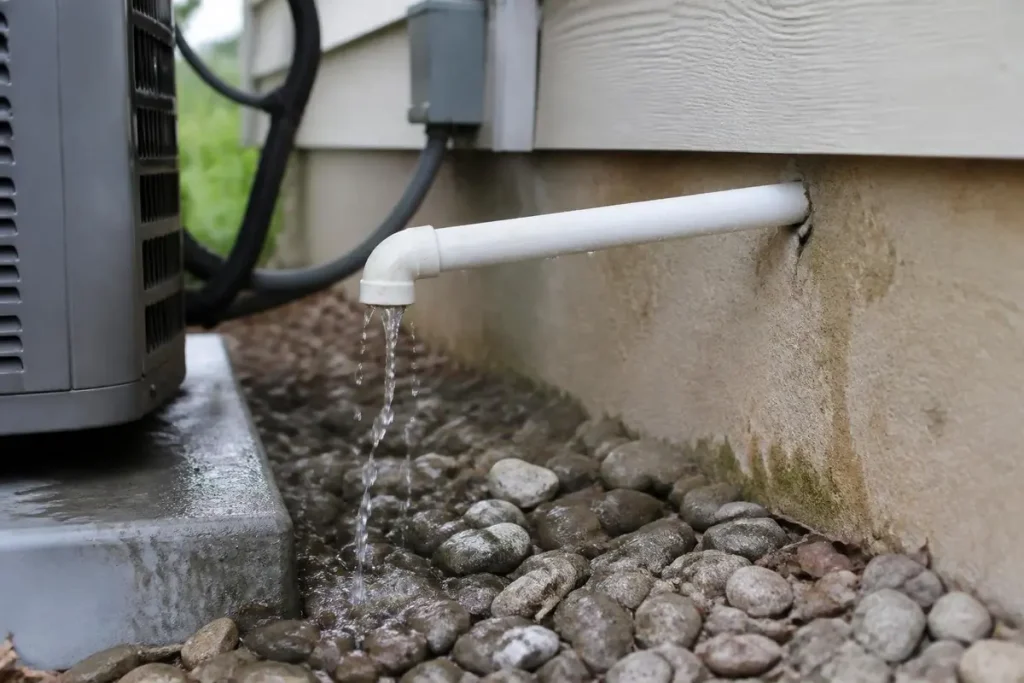
How does an air conditioner use the dew point to remove humidity?
An air conditioner dries air by running its evaporator coil colder than the entering air’s dew point, so vapor condenses on the fins and drains away. Lawrence Berkeley National Laboratory’s DX coil models compute the split between sensible and latent cooling from the coil’s “apparatus dew point”.
Run time decides how much water leaves. The LBNL user’s guide notes that a dehumidifying coil builds a water film, that the film evaporates back into the air stream when the compressor is off, and that for coils that short-cycle this “significantly” reduces dehumidification. EPA adds that air conditioners that run too briefly cool the air without removing moisture, raising the indoor dew point.
That is the mechanism behind an oversized system that leaves a house cold but clammy. It is also why the blower setting matters (see fan ON versus AUTO).
Moisture removal also changes the dry-bulb drop across the coil, which is why the supply and return temperature split shifts with indoor humidity.
What indoor dew point prevents mold and condensation?
Keep the indoor dew point under about 55°F in cooling season. That is EPA’s 2013 design target for air-conditioned buildings, which it equates to 50 percent RH at 75°F, and it fits inside EPA’s mold advice to hold RH below 60 percent.
| Guidance | Stated limit | Dew point equivalent (our calculation) |
|---|---|---|
| EPA mold guidance | RH below 60 percent | 55.5°F at 70°F; 60.2°F at 75°F |
| EPA mold guidance, ideal | RH 30 to 50 percent | 38.9 to 52.4°F at 72°F |
| EPA moisture guidance, cooling season | Dew point below 55°F | Equals 49.8% RH at 75°F (EPA: 50 percent) |
| EPA moisture guidance, winter (commercial) | 35°F dew point maximum | Equals 27.5% RH at 70°F |
| ASHRAE Standard 55-2017 (per ASHRAE FAQ) | Humidity ratio at or below 0.012 | 62.3°F at sea level |
| ASHRAE Standard 62.1-2016 (per ASHRAE FAQ) | RH less than 65% | 62.4°F at 75°F |
EPA notes that low humidity may also discourage dust mites, though it gives no number. In a humid climate, a properly sized dehumidifier is the usual tool when the AC alone cannot hold the line; EPA’s guidance names dedicated dehumidifiers for ventilation air whenever the outdoor dew point is above 55°F.
How we researched this
Research date: October 30, 2026. We opened the top three results (NWS La Crosse, Wikipedia, Omni Calculator), then read the primary sources listed below: eight cited, plus the ASHRAE 55 summary pages, Lawrence (2005) and contractor pages consulted and not cited. Every conversion is our calculation with the NWS formula at sea level pressure, checked against NWS and EPA examples.
Excluded: unsourced comfort charts, contractor blogs, patents and untraceable trade press figures. The current ASHRAE standard text and the Lawrence (2005) journal paper were not readable, so we use neither. Reddit was not used.
Frequently asked questions
Is a dew point of 60 comfortable indoors?
Not really. NWS La Crosse puts 55 to 65 in its “sticky” band, and EPA’s 2013 moisture guidance sets a 55°F indoor dew point ceiling in cooling season to prevent condensation. A 75°F room at 60% RH carries a 60.2°F dew point by our calculation.
Why are my AC vents and ducts sweating?
The duct or register is colder than the dew point of the air around it. EPA’s example is a duct carrying 55°F air surrounded by air with a dew point above 70°F, which condenses water on the duct and possibly the diffuser. Drier air, sealed ducts and continuous insulation fix it.
Does the dew point change when I turn up the heat?
No. EPA states that unlike relative humidity, the dew point does not change with air temperature. Heating a room lowers its RH reading but leaves the dew point alone unless water is added, by cooking, showers or a humidifier, or removed.
What dew point causes window condensation in winter?
Condensation forms on any glass at or below the room’s dew point. By our calculation with the NWS formula, a 70°F room at 35% RH has a 41.1°F dew point. Lower indoor humidity lowers the temperature the glass must reach before it fogs.
Is a low indoor dew point a problem in winter?
It can be uncomfortable. ASHRAE’s FAQ says Standard 55 sets no lower humidity limit but notes skin drying, dry eyes and static electricity may limit acceptability. For commercial buildings EPA calls a 35°F winter dew point maximum a prudent compromise between comfort and wall condensation.
Does ASHRAE set a maximum indoor dew point?
Not as a dew point. ASHRAE’s FAQ says Standard 55-2017 requires HVAC systems able to hold a humidity ratio at or below 0.012, about a 62.3°F dew point at sea level by our calculation. Later editions are not free to read, so treat 0.012 as the 2017 text.
Sources
- National Weather Service. “Glossary: Dew Point.” https://forecast.weather.gov/glossary.php?word=dew%20point. Accessed October 2026.
- National Weather Service, La Crosse, WI. “Dew Point vs Humidity.” https://www.weather.gov/arx/why_dewpoint_vs_humidity. Accessed October 2026.
- National Weather Service, El Paso. “Vapor Pressure.” https://www.weather.gov/media/epz/wxcalc/vaporPressure.pdf. Accessed October 2026.
- U.S. EPA. “Moisture Control Guidance for Building Design, Construction and Maintenance” (EPA 402-F-13053, December 2013). https://www.epa.gov/sites/default/files/2014-08/documents/moisture-control.pdf. Accessed October 2026.
- U.S. EPA. “Mold Course Chapter 2.” https://www.epa.gov/mold/mold-course-chapter-2. Accessed October 2026.
- U.S. EPA. “A Brief Guide to Mold, Moisture and Your Home.” https://www.epa.gov/mold/brief-guide-mold-moisture-and-your-home. Accessed October 2026.
- ASHRAE. “Technical FAQ ID 92: Recommended indoor temperature and humidity levels for homes” (archived copy). https://web.archive.org/web/2025id_/https://www.ashrae.org/File%20Library/Technical%20Resources/Technical%20FAQs/TC-02.01-FAQ-92.pdf. Accessed October 2026.
- Lawrence Berkeley National Laboratory. “Buildings.Fluid.HeatExchangers.DXCoils User’s Guide.” https://simulationresearch.lbl.gov/modelica/releases/v3.0.0/help/Buildings_Fluid_HeatExchangers_DXCoils_UsersGuide.html. Accessed October 2026.
Leave a Reply