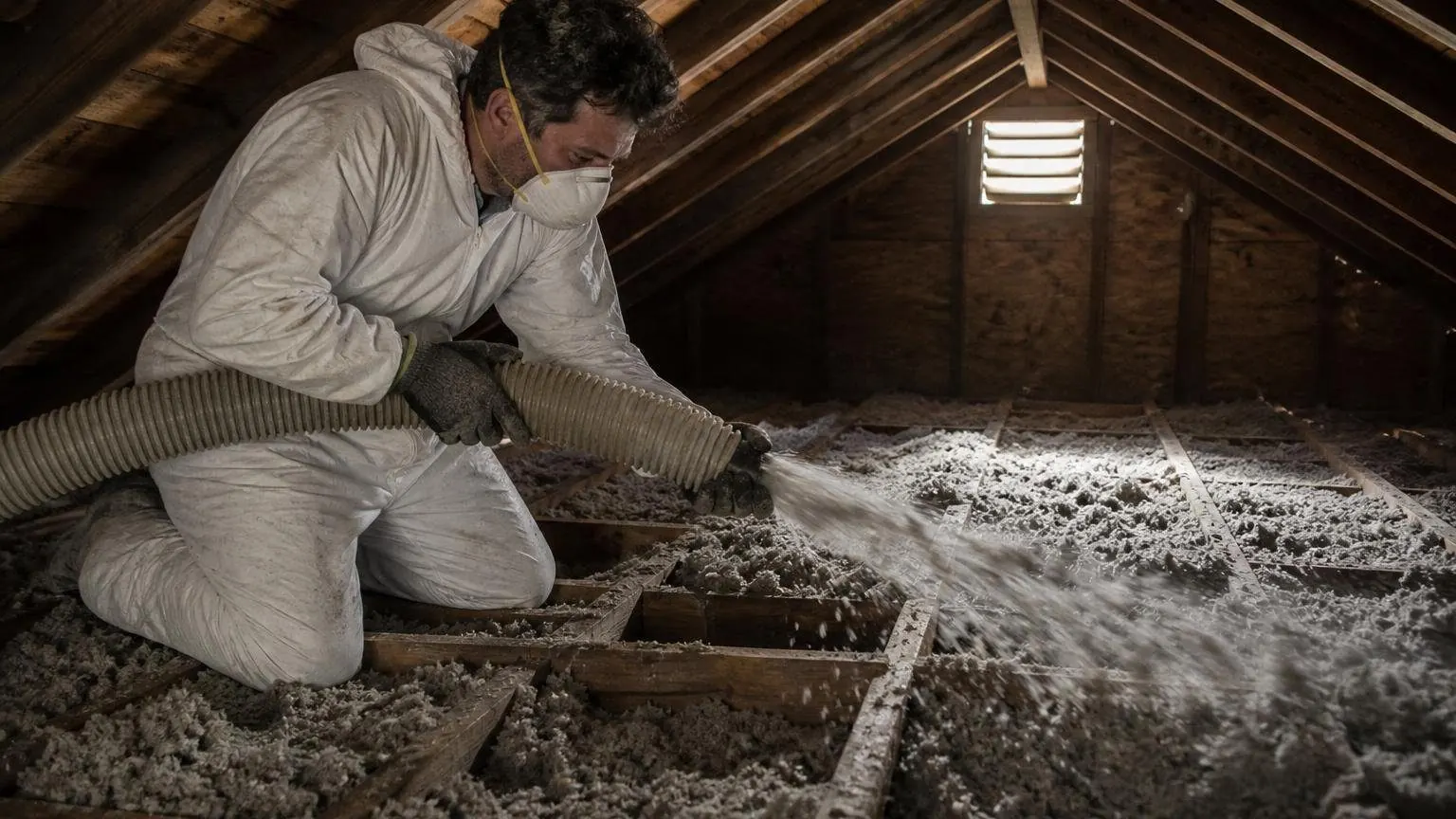
What is the weatherization assistance program? It is a U.S. Department of Energy grant program that pays local agencies to air seal, insulate and repair or replace unsafe heating in homes of households at or below 200% of poverty, with an average cap of $8,813 per home in 2026.
Key Takeaways
- Households at or below 200% of poverty qualify, as do households with an SSI recipient in the prior 12 months (10 CFR 440.22).
- For a family of four, 200% of the 2026 HHS guideline of $33,000 is $66,000 (HHS).
- The program year 2026 average cost cap is $8,813 per home (WPN 26-1).
- Congress provided $369 million for WAP in fiscal 2026 (WPN 26-2).
- CO alarms are required in every home that lacks working ones (WPN 22-7 Table of Issues).
- In program year 2008, single-family homes saved $283 a year, 12% of energy costs (DOE/ORNL evaluation).
What is the weatherization assistance program?
The weatherization assistance program (WAP) is a federal grant program that lowers energy costs for low-income households by making their homes more efficient while protecting health and safety. DOE says it supports 8,500 jobs and weatherizes about 32,000 homes a year with DOE funds (DOE program page).
It began in 1976 and has served more than 7.2 million families. Formula grants go to states, territories and tribes, and states contract with nearly 800 local agencies, says DOE’s June 2022 fact sheet.
WAP does not pay utility bills; that is LIHEAP, the HHS bill assistance program. Citing ORNL, the fact sheet says low-income households spend 13.9% of income on energy, against 3.0% for others; see our household energy insecurity analysis.
Who qualifies for the weatherization assistance program in 2026?
A household qualifies if its income is at or below 200% of the federal poverty level, if a member received SSI or other Social Security Act cash assistance in the past 12 months, or, where the state elects, if it is eligible for LIHEAP (10 CFR 440.22).
DOE says states using LIHEAP rules apply 60% of state median income (DOE, How to Apply). Priority goes to elderly people, people with disabilities, families with children, high energy users and households with a high energy burden (10 CFR 440.16).
| Household size | 2026 HHS poverty guideline (48 states and DC) | 200% of guideline (WAP ceiling) |
|---|---|---|
| 1 | $15,960 | $31,920 |
| 2 | $21,640 | $43,280 |
| 3 | $27,320 | $54,640 |
| 4 | $33,000 | $66,000 |
| 5 | $38,680 | $77,360 |
The 200% column is our arithmetic on the HHS guidelines; Alaska and Hawaii use higher ones. DOE tells applicants to confirm their own state’s rules. Renters qualify too (see the FAQ).
How does weatherization work, from application to final inspection?
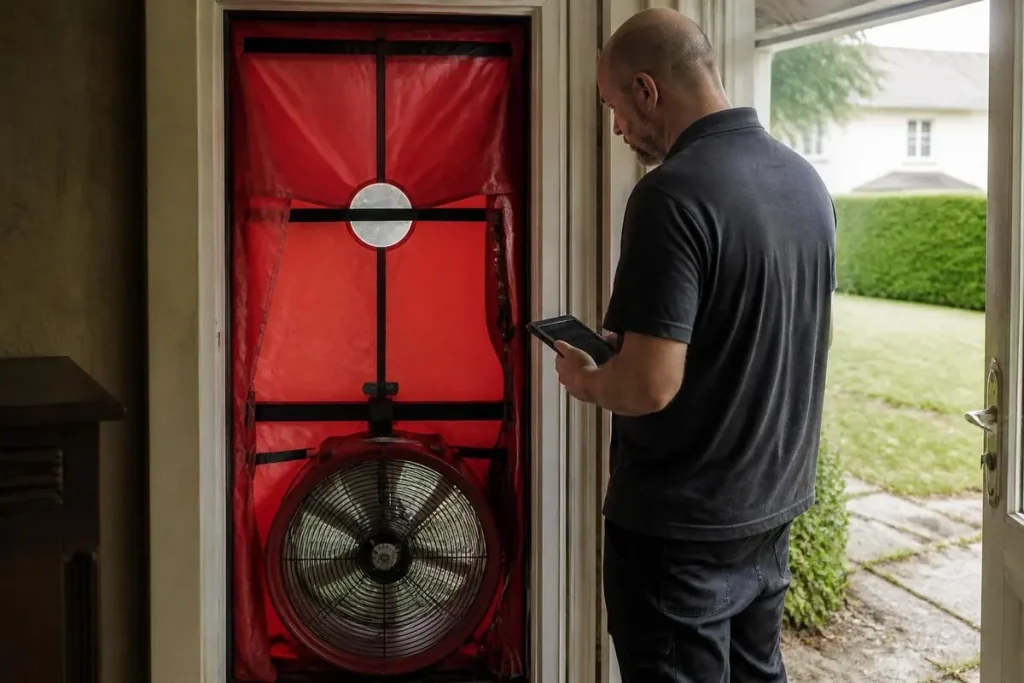
You apply through a local provider, prove income, wait your turn, get an energy audit with a blower door test, and crews install the cost-effective measures before an inspector signs off (DOE, How to Apply).
- Find your state weatherization administrator on DOE’s map, then your county’s local provider.
- Apply with proof of the prior year’s income, such as pay stubs or Social Security statements.
- If eligible, your name goes on a waitlist. Renters also need landlord permission.
- An auditor analyzes your bills, runs a blower door test and inspects the house and its energy equipment for savings and safety problems.
- Crews or contractors install the most cost-effective measures on the scope of work.
- An inspector checks the work against the Standard Work Specifications and confirms equipment runs safely.
DOE publishes no national wait time; households outside the priority groups can wait longer. Our guide to what a blower door test measures explains the test the auditor will run.
What does the weatherization assistance program pay for?
It pays for energy measures that pass a cost test, plus health and safety fixes needed to do the work safely. Each material must save at least its installed cost over its life, discounted to present value, which DOE expresses as a savings-to-investment ratio (SIR) of 1.0 or higher (10 CFR 440.21).
The audit ranks measures by cost-effectiveness, trims the savings of measures that overlap, and drops anything below the line. WPN 26-1 names air sealing, insulation and heating and cooling upgrades as the proven core, the same order we argue for in insulating before resizing a system.
Spending is capped as a state average, not per house. The statute sets $6,500 per dwelling, raised yearly by the lesser of CPI or 3%, so the program year 2026 average is $8,813 (WPN 26-1). In program year 2008 the average home cost $4,695 in total, of which DOE paid $2,301.
| Measure | How WAP treats it | Rule |
|---|---|---|
| Air sealing and insulation | Core energy measure | SIR of 1.0 or more, 10 CFR 440.21(d) |
| Furnace, boiler or heat pump | Energy measure if SIR passes; health and safety if unsafe, inoperable or missing | WPN 22-7 |
| Unvented heater as primary heat | Replaced with a vented unit sized for the whole home | WPN 22-7 |
| Carbon monoxide alarms | Required where none work | WPN 22-7; ASHRAE 62.2-2016 |
| Primary air conditioning | Health and safety money only for at-risk occupants | WPN 22-7 |
| Window and door replacement | Not payable from health and safety money | WPN 22-7 |
| Solar panels | Not permitted from PY 2026 | WPN 26-1, section 3.8 |
Correction: WAP is not a free furnace program
A new furnace comes only two ways: the audit shows an SIR of 1.0 or more, or the old system is unsafe, inoperable or missing and the state’s health and safety plan covers it. Materials must be on Appendix A to 10 CFR 440 unless DOE approves an exception.
If you earn too much for WAP, our review of what federal records say attic insulation costs covers the most common measure, and our insulation statistics show how common the gaps are.
Will weatherization fix my furnace or add carbon monoxide alarms?
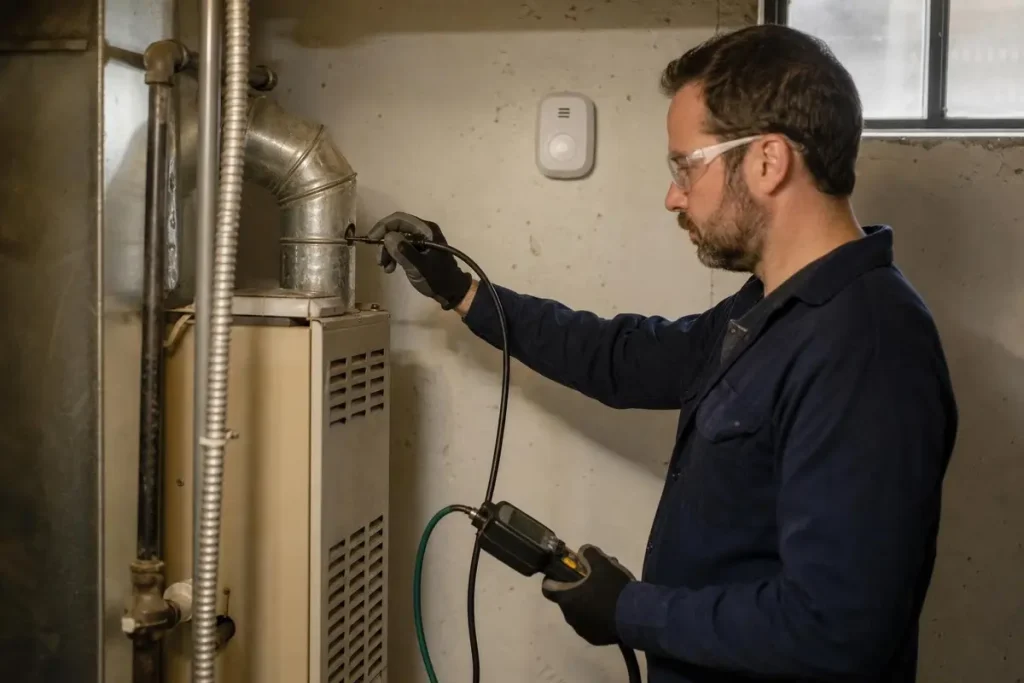
Often, yes. DOE’s health and safety rules require crews to replace, repair or install a primary heating system that is unsafe, inoperable or missing, and to install CO alarms in every home where none are present or working (WPN 22-7 Table of Issues).
No home may be left without safe primary heat in any ASHRAE climate zone except zone 1; if that cannot be met, the home is deferred. No DOE-funded work proceeds if an unvented combustion heater will be the primary heat source.
A secondary unvented heater counts as unsafe if rated above 40,000 Btu per hour, above 10,000 Btu per hour in a bedroom or above 6,000 Btu per hour in a bathroom. Our ventless gas heater explainer covers the state laws.
CO alarms must comply with ASHRAE 62.2-2016; see our CO alarm placement rules. In manufactured homes no unvented fuel-burning space heater may remain, a rule our mobile home furnace guide puts in context.
How much does the weatherization assistance program save?
DOE puts the average at $372 or more a year per household, in 2022 dollars, citing its national evaluation (DOE program page). That evaluation, led by Oak Ridge National Laboratory, covers program years 2008 and 2010.
In program year 2008, a typical year, single-family homes saved $283 a year, or 12% of energy costs, with gas use down 18% and electricity down 7%. The program-wide SIR was 1.4, from a sample of 30,000 dwelling units (DOE/ORNL summary).
The Recovery Act year differed. Across 340,158 homes at an average cost of $6,812, the program-wide energy SIR was 0.9, while single-family homes held at 1.01. DOE notes those ratios include non-DOE money not bound by its SIR rule.
How is the weatherization assistance program funded in 2026?
By annual appropriation. The fiscal 2026 act, signed January 23, 2026, gave WAP $369 million: $328 million in formula grants, $10 million for training and technical assistance, $30 million for the Weatherization Readiness Fund and $1 million in other costs (WPN 26-2).
The WPN 26-2 cover text says $329 million for retrofit, while its table and WPN 26-1 say $328 million; the separate $1 million line explains the gap. New York gets the largest share, $28,945,471.
The Infrastructure Investment and Jobs Act of November 15, 2021 added $3.5 billion, available until expended (DOE WPN BIL-1). In July 2025 DOE rescinded WPN 22-10, which had let states count the social cost of carbon in audits.
States may also move up to 15% of their LIHEAP funds into weatherization, or 25% with a waiver, under 42 U.S.C. 8624(k). Above the income line, our heat pump rebate tracker lists what still pays in 2026.
How we researched this
Researched October 30, 2026. We read 10 CFR 440.16, 440.18, 440.21 and 440.22 (eCFR as of October 1, 2026), 42 U.S.C. 6865 and 8624, WPN 26-1 and 26-2 (issued July 9, 2026), WPN 22-7, WPN BIL-1, DOE’s program pages and July 2025 release, the 2022 fact sheet, the 2015 DOE/ORNL evaluation summary and the 2026 HHS guidelines: 17 sources consulted, 15 cited.
Excluded: state income charts (they vary), a 2002 CRS report (outdated) and contractor pages. No Reddit, given the combustion and CO safety content. Discrepancies: DOE’s page says 32,000 homes a year, the 2022 fact sheet said 35,000; 10 CFR 440.18(f)(2) still carries older reweatherization text, while the statute sets 15 years.
Frequently asked questions
Can renters get help from the weatherization assistance program?
Yes. Renters qualify on the same income test, but the agency needs the owner’s written permission. In a rental building at least 66% of units must be eligible, or 50% in duplexes and four-unit buildings, and states must shield tenants from rent increases caused by the work (10 CFR 440.22).
How often can a home be weatherized?
Once every 15 years with federal money. Under 42 U.S.C. 6865(c)(2), a home weatherized under WAP or another federal program cannot get further WAP weatherization until 15 years after that work was completed. Energy education and non-federal help are still allowed in the meantime.
Does the weatherization program install solar panels?
No. WPN 26-1 says that beginning in program year 2026, renewable electricity generation not listed in Appendix A to 10 CFR 440 is no longer permitted, and DOE is not considering new approvals. Solar water heating is still listed in Appendix A and can qualify if it passes the cost test.
What income qualifies for weatherization in 2026?
The federal ceiling is 200% of the HHS poverty guideline. For 2026 that is $66,000 for a family of four in the 48 contiguous states and the District of Columbia. A household with a member who received SSI in the past 12 months also qualifies, whatever its income.
Why is there a waiting list for weatherization?
DOE’s application guide says income-eligible households go on a waitlist once the provider confirms their paperwork. The program weatherizes about 32,000 homes a year with DOE funds, and federal rules put elderly residents, people with disabilities, families with children and high energy users first, so waits differ by agency.
Is weatherization the same as LIHEAP?
No. LIHEAP is an HHS program that helps pay heating and cooling bills, while WAP is a DOE program that makes the home use less energy. They connect: a state may move up to 15% of its LIHEAP money into weatherization, or 25% with a federal waiver, under 42 U.S.C. 8624(k).
Sources
- U.S. DOE. “Weatherization Assistance Program.” https://www.energy.gov/scep/wap/weatherization-assistance-program. Accessed October 2026.
- U.S. DOE. “How to Apply for Weatherization Assistance.” https://www.energy.gov/cmei/scep/wap/how-apply-weatherization-assistance. Accessed October 2026.
- U.S. DOE. “WPN 26-1: Program Year 2026 Weatherization Grant Application.” https://www.energy.gov/sites/default/files/2026-07/wap-wpn-26-1.pdf. Accessed October 2026.
- U.S. DOE. “WPN 26-2: Program Year 2026 Grantee Allocations.” https://www.energy.gov/sites/default/files/2026-07/wap-wpn-26-2.pdf. Accessed October 2026.
- eCFR. “10 CFR 440.22.” https://www.ecfr.gov/current/title-10/section-440.22. Accessed October 2026.
- eCFR. “10 CFR 440.21.” https://www.ecfr.gov/current/title-10/section-440.21. Accessed October 2026.
- eCFR. “10 CFR Part 440 (440.16, 440.18).” https://www.ecfr.gov/current/title-10/part-440. Accessed October 2026.
- LII. “42 U.S. Code 6865.” https://www.law.cornell.edu/uscode/text/42/6865. Accessed October 2026.
- LII. “42 U.S. Code 8624.” https://www.law.cornell.edu/uscode/text/42/8624. Accessed October 2026.
- U.S. DOE and ORNL. “National Evaluations: Summary of Results.” energy.gov PDF, August 2015. Accessed October 2026.
- U.S. DOE. “WPN 22-7 Table of Issues.” https://www.energy.gov/sites/default/files/2022-06/wpn-22-7-table-of-issues_0622.pdf. Accessed October 2026.
- U.S. DOE. “Weatherization Assistance Program” fact sheet, June 2022. https://www.energy.gov/sites/default/files/2022-06/wap-fact-sheet%5F0622.pdf. Accessed October 2026.
- U.S. DOE. “WPN BIL-1” (archived copy). https://web.archive.org/web/2025id_/https://www.energy.gov/sites/default/files/2024-02/wpn-bil-1_022124.pdf. Accessed October 2026.
- U.S. DOE. “Energy Department Announces Over $400 Million in Funding and Removes Burdensome Policy.” July 8, 2025. https://www.energy.gov/cmei/scep/articles/energy-department-announces-over-400-million-funding-and-removes-burdensome. Accessed October 2026.
- HHS ASPE. “Poverty Guidelines.” https://aspe.hhs.gov/topics/poverty-economic-mobility/poverty-guidelines. Accessed October 2026.
Leave a Reply