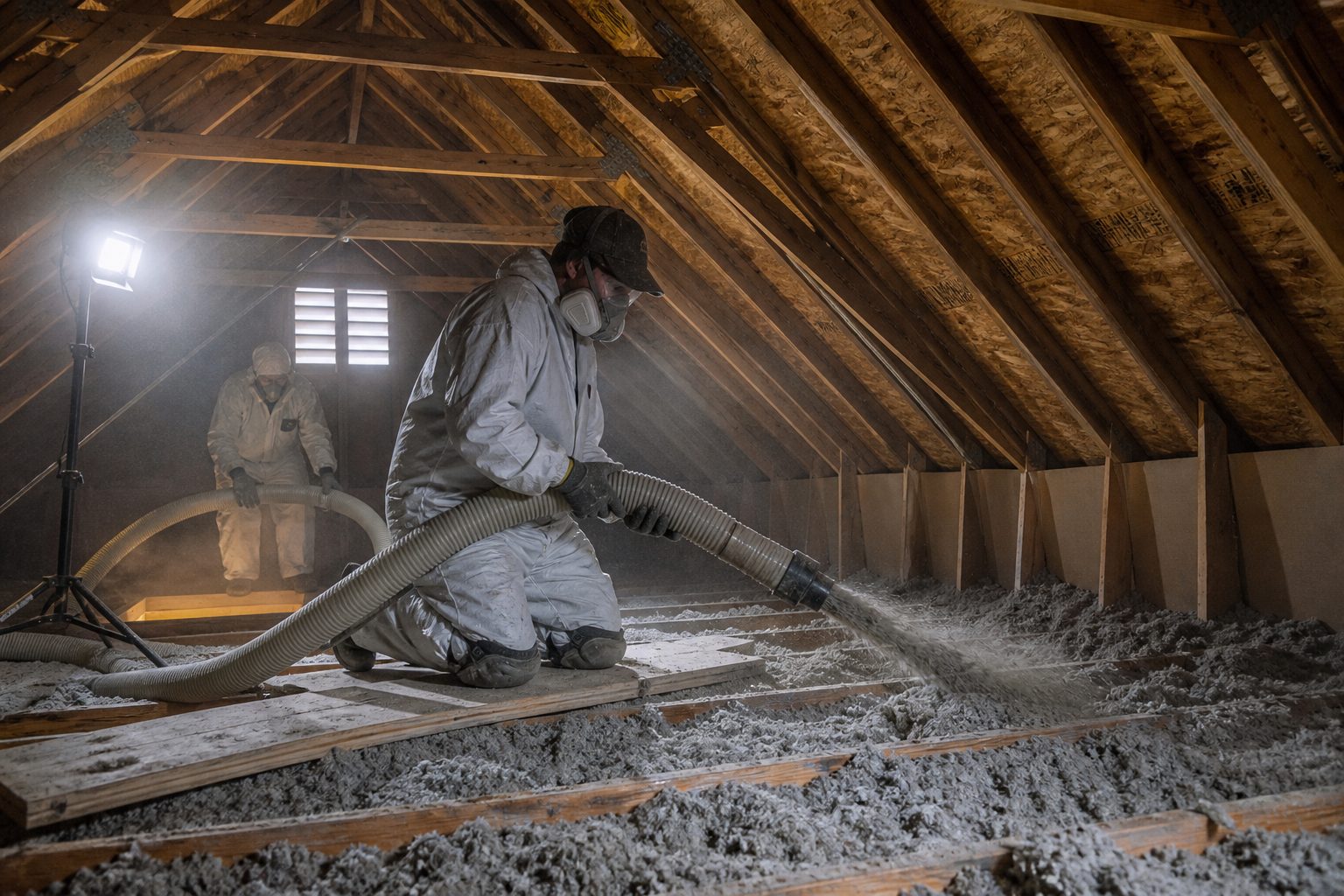
What is the attic insulation cost per square foot? No federal agency publishes installed insulation prices. But federal cost-effectiveness analysis does: Pacific Northwest National Laboratory assumes R-60 blown cellulose installs at $2.85 per square foot of ceiling area, in 2024 dollars.
Key Takeaways
- No federal price series exists for installed attic insulation. The closest public figures are cost assumptions inside DOE energy code analysis (PNNL-35986, January 2025).
- PNNL puts installed blown cellulose at $1.84 per square foot at R-38, $2.32 at R-49 and $2.85 at R-60, in 2024 dollars from RS Means 2024 (PNNL-35986, Sec. 3.2.3).
- Stepping a ceiling to R-49 or R-60 carries an incremental $0.52 per square foot in the same analysis (PNNL-35986, Sec. 3.2.3).
- Air sealing is priced separately, at $0.28 per square foot of floor for a 5.0 to 4.0 ACH50 tightening, or $665 on PNNL’s 2,376 square foot prototype (PNNL-35986, Sec. 3.2.4).
- DOE’s Weatherization Assistance Program may average $8,813 per dwelling unit in Program Year 2026, across all measures (WPN 26-1, Sec. 4.2).
- Simple payback in that analysis runs 0 to 9 years by climate zone, national weighted average 2.5 years (PNNL-35986, Table ES.2).
- Section 25C is gone: the credit covers only property placed in service before December 31, 2025 (IRS).
Is there a federal attic insulation cost figure?
Not a price. No federal statistical agency collects installed insulation prices the way EIA collects fuel prices. What exists is cost-effectiveness analysis: DOE pays Pacific Northwest National Laboratory to price code changes, and those studies publish installed cost assumptions with a dollar year attached.
A cost assumption inside a code study is a national modelling input from a construction cost database, not a survey of what contractors charged in your county. We treat it as a planning anchor, the same way we treat the modelled figures behind the equipment numbers we track through the year. The second genuinely federal number is a spending ceiling: what DOE’s weatherization program may average per dwelling unit.
What does PNNL assume attic insulation cost per square foot?
PNNL’s January 2025 national analysis of the 2024 IECC prices blown cellulose over ceiling area at three R-values. R-38 installs at $1.84 per square foot, R-49 at $2.32 and R-60 at $2.85, all in 2024 dollars derived from RS Means 2024. The R-49 and R-60 figures are extrapolations from the R-38 data point.
The analysis also gives the step cost: moving a ceiling from R-38 to R-49 in climate zones 2 and 3, or from R-49 to R-60 in zones 4 through 8, is put at $0.52 per square foot of ceiling area. PNNL assumed cellulose “would be used as a lower cost alternative to fiberglass” when pricing that step, which gives the direction of the material difference without a fiberglass number.
How much R-value you should be aiming for varies by climate zone and lives on its own page: the target R-values and the depth conversions that go with them. This page is only about cost.
| What is priced | Value | Dollar year | Source |
|---|---|---|---|
| Installed blown cellulose, R-38, per ft² of ceiling | $1.84 | 2024 | PNNL-35986, Sec. 3.2.3 |
| Installed blown cellulose, R-49, per ft² of ceiling | $2.32 | 2024 | PNNL-35986, Sec. 3.2.3 |
| Installed blown cellulose, R-60, per ft² of ceiling | $2.85 | 2024 | PNNL-35986, Sec. 3.2.3 |
| Incremental step to R-49 or R-60, per ft² | $0.52 | 2024 | PNNL-35986, Sec. 3.2.3 |
| Air sealing, 5.0 to 4.0 ACH50, per ft² of floor | $0.28 | 2024 | PNNL-35986, Sec. 3.2.4 |
| Air sealing, 3.0 to 2.5 ACH50, per ft² of floor | $0.13 | 2024 | PNNL-35986, Sec. 3.2.5 |
| WAP average spend limit per dwelling unit, PY 2026 | $8,813 | 2026 | DOE WPN 26-1, Sec. 4.2 |
Two rows carry an older basis. PNNL took the air sealing costs from the NREL National Residential Efficiency Measures Database, dated 2013, then converted them to 2024 dollars itself. The cellulose lines come from a 2024 database.
What drives attic insulation cost on a real house?
Six things move the number, and only the first two sit in the PNNL model. The rest are job-specific with no federal price attached.
- Ceiling square footage. Priced per square foot of ceiling, not of house. PNNL’s single-family prototype is 2,376 square feet over two stories; dividing its $618 ceiling cost delta by the $0.52 step rate gives about 1,188 square feet of ceiling, our arithmetic.
- The delta from what is already up there. You pay for the added inches, not the finished R-value. The $0.52 step rate expresses that.
- Material. PNNL treats cellulose as cheaper than fiberglass. Loose fill of either kind covers irregular framing better than batts, which get cut around every wire and truss.
- Air sealing first. Priced separately, and not optional. See the next section.
- Baffles, access and obstructions. Every vented rafter bay needs a baffle, and knob and tube wiring stops the job.
- Removal. Insulation contaminated by rodents, a leak or fire comes out first. No federal source prices removal, so we quote none.
The arithmetic below is ours. The BLS producer price index for final demand construction averaged 175.949 across 2024 and stood at 188.083 in August 2026, a rise of 6.9 percent. Applied to PNNL’s 2024 figures that gives $1.97 per square foot at R-38, $2.48 at R-49 and $3.05 at R-60. On a 1,188 square foot ceiling, R-49 works out to $2,946 and R-60 to $3,619.
What changes if you rent the blower and do it yourself
The PNNL figures bundle material and labor into one per square foot rate and never split them, so there is no federal basis for saying what share of $2.32 is labor. Retailers commonly lend or discount blowing machines with a bag purchase, but that is a vendor promotion, not a number we will publish. A DIY job does not remove the sequence, and a blower door test is what tells you whether the sealing worked.
Why does air sealing come before insulation?
Because insulation does not stop air, and once it is down you cannot reach the leaks. DOE’s Building America Solution Center states the ceiling air barrier should be continuous with all holes through it thoroughly air-sealed before insulation is installed, naming wiring, electrical boxes, light fixtures, flue pipes and duct chases.
The same guidance puts two conditions ahead of both steps. Ventilation issues are to be addressed first, and where active knob and tube wiring is present, insulation is not to be installed until the wiring is replaced or properly boxed. Baffles go in each vented rafter bay to hold a 2 inch gap under the roof deck so the soffit intake keeps working after the depth goes up.
The myth worth correcting
Adding depth does not fix a leaky ceiling. EPA’s savings estimate assumes both halves: a 25 percent reduction in total air infiltration and insulation brought up to 2012 IECC levels. Insulation alone was never the modelled case, so a contractor who skips the sealing is not delivering the job the federal estimate describes.
What does the federal weatherization program spend per home?
DOE’s Weatherization Assistance Program publishes an average spending limit per dwelling unit, and for Program Year 2026 it is $8,813. The statutory base is $6,500 as adjusted, escalated yearly by the lesser of the prior year’s CPI increase or 3 percent. DOE applied 3 percent for PY 2026, the January to December 2024 CPI increase.
Read that as a ceiling on the average, across every measure in the house. DOE says the program reaches roughly 32,000 homes a year with its own funds and puts average household savings at $372 or more a year.
How is payback on attic insulation actually estimated?
Simple payback is the incremental construction cost divided by the first-year energy cost saving, and PNNL warns it is reported for information only. In the 2024 IECC analysis it runs 0 to 9 years across the eight climate zones, national weighted average 2.5 years. Life-cycle cost savings over 30 years averaged $2,954 per dwelling unit.
That spread is the point. The same package pays back in zero years in zone 4 and nine years in zone 1 in one study, because the saving depends on load, fuel price and what the ceiling started at. Anyone quoting a single national payback figure is hiding the climate term. EPA frames it as a percentage instead: homeowners can save an average of 15 percent on heating and cooling costs, or 11 percent on total energy costs, by air sealing and adding insulation in attics, floors over crawl spaces and basements.
The bigger money sits downstream. A tighter envelope lowers the design load, which is why we argue for sequencing shell work ahead of the equipment order and running the load calculation on the house you will actually have.
Does a tax credit still cut attic insulation cost in 2026?
No. The Energy Efficient Home Improvement Credit under section 25C is allowed only for qualifying property placed in service on or after January 1, 2023 and before December 31, 2025, per the IRS. Public Law 119-21, enacted July 4, 2025, accelerated the termination. Work placed in service in 2026 gets nothing from 25C.
Two details matter for anyone still filing for 2025 work. Insulation and air sealing materials were the one building envelope category exempt from the qualified manufacturer and product identification number requirements, and labor for installing envelope components never qualified. The same repeal caught heat pumps, which is what the expiry costs on the equipment side. Utility and state programs run on a separate track, worth raising with whoever you are getting quotes from.
How we researched this
Research date: September 29, 2026. We found no federal installed-price series for attic insulation, so we worked from cost-effectiveness analysis instead. Cited: PNNL-35986 (January 2025, cost basis RS Means 2024 and NREL data from 2013), DOE Weatherization Program Notice 26-1 (July 2026), two DOE Building America Solution Center guides, IRS section 25C guidance, EPA ENERGY STAR savings methodology, and BLS series WPUFD43 (August 2026, preliminary).
Excluded: contractor cost calculators, lead-generation price pages and vendor surveys, none of which discloses a sample basis; any figure for removing contaminated insulation, which no federal source prices; and Reddit or forum threads. Freshness: four cited sources carry a 2025 or 2026 date, one a 2024 dollar year, one a 2013 measure database converted by PNNL. Our restatement to August 2026 dollars is labelled as ours. Update schedule: quarterly, or sooner if PNNL publishes a new national code analysis or DOE publishes a new program year ACPU.
Frequently asked questions
Is there an official attic insulation cost per square foot?
No official price exists. The nearest figure is a modelling assumption: PNNL puts installed blown cellulose at $2.32 per square foot of ceiling at R-49 in 2024 dollars, taken from RS Means 2024 for a code analysis, not a price survey.
Does blown cellulose cost less than fiberglass?
PNNL assumed cellulose “would be used as a lower cost alternative to fiberglass” when pricing the 2024 IECC ceiling change, so the direction is in the federal record. The report publishes no fiberglass figure, so we state no gap.
How much does air sealing add?
PNNL prices a 5.0 to 4.0 ACH50 tightening at $0.28 per square foot of finished floor area in 2024 dollars, $665 on its 2,376 square foot prototype. A 3.0 to 2.5 ACH50 step is put at $0.13 per square foot.
Can I claim a tax credit for attic insulation in 2026?
No. The IRS states the section 25C credit is allowed for property placed in service on or after January 1, 2023 and before December 31, 2025. Labor for installing envelope components never qualified anyway.
How long does attic insulation take to pay back?
It depends on climate zone. PNNL’s simple payback for the 2024 IECC package runs 0 to 9 years across the eight zones, national weighted average 2.5 years. Older housing has more to gain, and the median US home is decades old.
Will insulation let me buy a smaller HVAC system?
Often yes, because a tighter, better insulated shell lowers the design load. That is a load calculation question, not a rule of thumb. It is also why powered attic ventilation is a poor substitute: whether an attic fan helps depends on the ceiling below it.
Sources
- Pacific Northwest National Laboratory. “National Cost-Effectiveness of the Residential Provisions of the 2024 IECC (PNNL-35986).” https://www.pnnl.gov/main/publications/external/technical_reports/PNNL-35986.pdf. Accessed September 2026.
- DOE. “Weatherization Program Notice 26-1, Program Year 2026 Grant Application Information.” https://www.energy.gov/sites/default/files/2026-07/wap-wpn-26-1.pdf. Accessed September 2026.
- DOE. “Weatherization Assistance Program.” https://www.energy.gov/scep/wap/weatherization-assistance-program. Accessed September 2026.
- DOE Building America Solution Center. “Air Sealing and Insulating Ceilings in Vented Attics.” https://basc.pnnl.gov/resource-guides/air-sealing-and-insulating-ceilings-vented-attics. Accessed September 2026.
- DOE Building America Solution Center. “Attic Air Sealing and Insulation checklist.” https://basc.pnnl.gov/home-improvement-expert/checklists/attic-air-sealing-and-insulation. Accessed September 2026.
- Internal Revenue Service. “Energy Efficient Home Improvement Credit.” https://www.irs.gov/credits-deductions/energy-efficient-home-improvement-credit. Accessed September 2026.
- EPA ENERGY STAR. “Methodology for Estimated Energy Savings.” https://www.energystar.gov/saveathome/seal_insulate/methodology. Accessed September 2026.
- US Bureau of Labor Statistics. “PPI Commodity data for Final demand construction, not seasonally adjusted (WPUFD43).” https://data.bls.gov/timeseries/WPUFD43. Accessed September 2026.
Leave a Reply