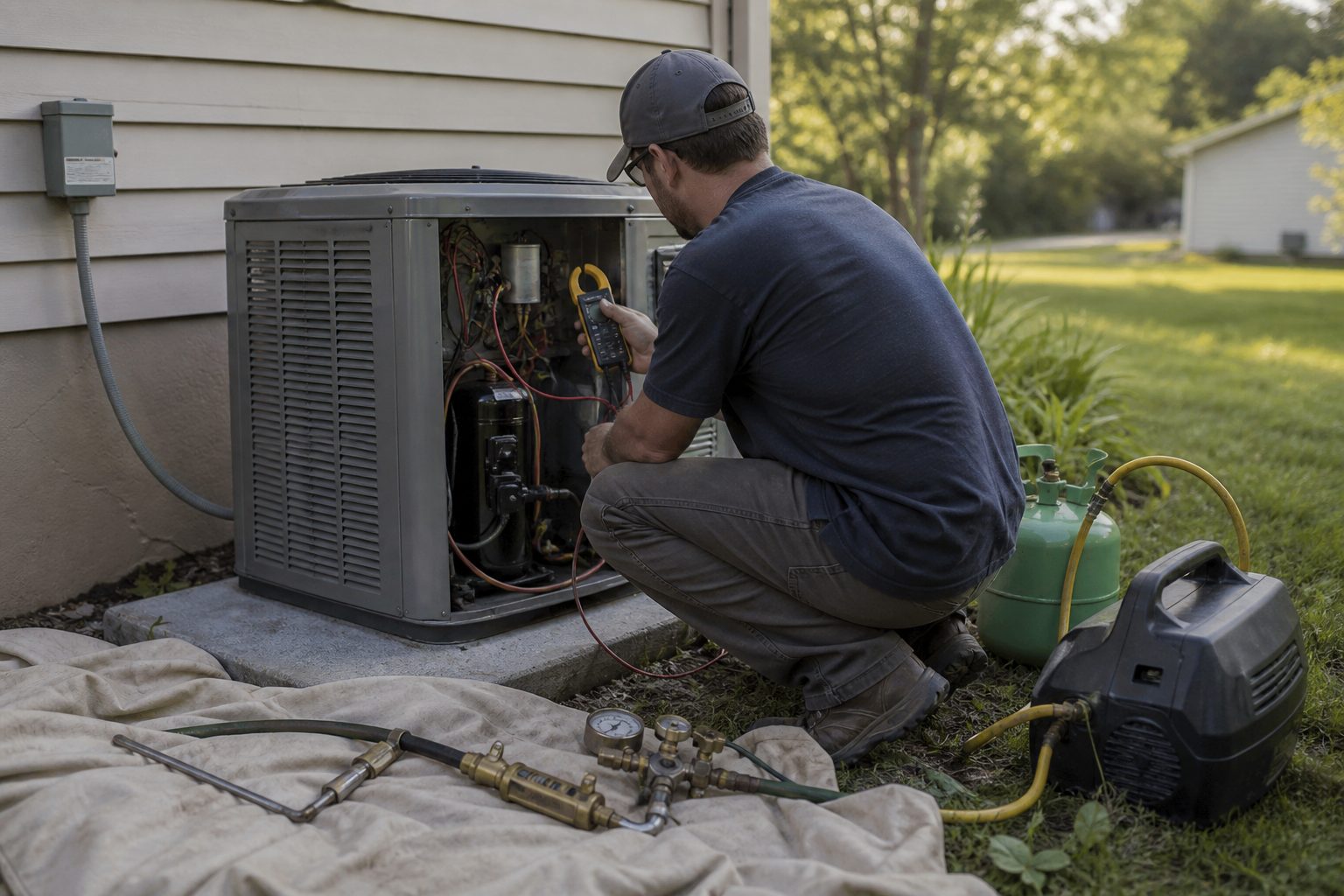
Is AC compressor replacement worth it? Sometimes. The compressor is the most expensive single part in a home cooling system, and the answer turns on three things: whether the motor burned out, whether the warranty is live, and whether you can still buy the refrigerant.
Key Takeaways
- Pulling a compressor is major maintenance, service, or repair under 40 CFR 82.152, which names the component.
- 40 CFR 82.156(a) requires recovery with certified equipment, and verification, before the circuit is opened.
- Copeland says a burnout breaks refrigerant and oil into “carbonaceous sludge, corrosive acid, and water”, so a flush and new filter driers go with the part.
- Copeland puts the megohmmeter condemning limit at 0.5 megohms, so one low insulation reading is a data point, not a verdict.
- EPA bars new residential AC systems using refrigerant at 700 GWP or above from January 1, 2025, but not servicing an R-410A system you own.
- EIA puts a 3-ton split central AC at $2,680 retail equipment and $5,310 total installed, both in 2022 dollars.
What does the AC compressor do, and why is AC compressor replacement the biggest part bill?
The compressor is the pump that raises refrigerant pressure so the outdoor coil can shed heat. It is welded into the sealed circuit, and it is the only part combining a motor, a pump and the charge in one body.
Swapping it means recovering the charge, cutting brazed joints, fitting a new hermetic body, pulling a vacuum and weighing in a fresh charge. The cabinet around it is covered in our explainer on what the outdoor half does, and the indoor side in replacing a failed indoor coil alone.
It is also misdiagnosed often: a unit that hums and trips the breaker is usually a dead run capacitor or a burnt contactor.
How does an AC compressor actually fail?
Four patterns cover most of it: a locked rotor that draws heavy current and will not turn, an open winding that draws none, valve or scroll damage that leaves the motor running while pumping little, and a burnout that contaminates the oil and refrigerant. Only the last changes the scope.
The first three stay inside the compressor body; a burnout is a chemical event in the whole circuit. Copeland states that when a motor burnout occurs, “the resulting high temperature arc causes a portion of the refrigerant/oil mixture to break down into carbonaceous sludge, corrosive acid, and water”.
| Failure mode | What the technician sees | Scope of work |
|---|---|---|
| Locked rotor | Loud hum, high current, overload cuts out in seconds, no start | Compressor only |
| Open winding | No current on one leg, no continuity across a winding pair | Compressor only, once a hot overload is ruled out |
| Valve or scroll damage | Motor runs, pressures pull together, little capacity | Compressor only, after airflow and charge checks |
| Motor burnout | Winding shorted to the shell, acrid smell, acid test positive | Compressor plus flush, filter driers, often the accumulator and capacitor |
How does a technician confirm an AC compressor is dead rather than guessing?
By measurement: current on each leg against the rated load amps stamped on the nameplate, then resistance across the terminals and to the shell, with the power off. A quote written without those readings is a guess.
- Confirm supply voltage at the contactor while the unit is calling. A compressor starved of voltage draws locked rotor current and trips, and the fault is upstream.
- Clamp each leg against the nameplate rated load amps. Current far above it with no rotation means a locked rotor; zero current means an open circuit.
- With the power off, read winding resistance between common, start and run, then each terminal to the shell. A dead short there is a grounded winding, usually a burnout.
- Treat a borderline insulation reading as a trend. Copeland says “for simplicity, Copeland has set the limit at 0.5 megohms before a compressor is condemned”, and that one megohmmeter reading gives little insight.
Three of the four modes are cheap to rule out and one is expensive to get wrong. Our survey of which parts fail puts compressors well down the list.
Ask for the numbers
A compressor diagnosis should arrive with three figures written down: measured amps per leg, the nameplate rated load amps, and the terminal to shell reading. If nobody can produce them, get a second opinion.
Why does a burnout turn AC compressor replacement into a system cleanup?
Because the contamination does not stay in the compressor. Copeland says contamination from a burnout “can result in repeat failures if the contaminants are allowed to reach and remain in the crankcase of the replacement compressor”. A new compressor in a dirty circuit fails again.
The fix is a filter drier cleaning procedure, using driers with an adequate desiccant in both the liquid and suction lines, with access valves so the pressure drop can be watched and the drier changed until the oil runs clean and acid free. Manufacturer guidance also treats the accumulator, contactor and run capacitor as suspect.
Does the warranty decide the job?
Often, yes. Manufacturers commonly cover the compressor for longer than other parts, so a system out of general parts coverage can still carry a live compressor claim. Goodman lists a lifetime compressor limited warranty on several premium split system models alongside a 10-year parts limited warranty across the line.
Two conditions do the damage. That chart requires online registration within 60 days of installation for those terms, except in California and Quebec. Labour sits outside the parts warranty in most residential terms, so a claim supplies the compressor while the invoice carries recovery, brazing, vacuum, driers and charge. See what an HVAC warranty covers.
Warranty status doubles as an age signal, because EIA carries an average life of 11 to 25 years for this class: see how long HVAC equipment lasts.
Can you still get the refrigerant the system needs?
An R-410A system needs R-410A, and that is a supply question rather than a legal one. The phasedown limits how much refrigerant may be produced and imported, not whether you may service equipment you own, but a shrinking pool shows up as price.
Under 40 CFR 84.54, no person may install a residential or light commercial air conditioning or heat pump system using refrigerant with a global warming potential of 700 or greater, effective January 1, 2025, unless every specified component was made before that date. R-410A blends HFC-32 and HFC-125, which appendix A to part 84 lists at 675 and 3,500, so it sits above the cap. See what the R-410A rule actually says.
The second lever is volume: the table at 40 CFR 84.7 holds US production and consumption of regulated substances at 60 percent of baseline for 2024 through 2028, then 30 percent for 2029 through 2033: the 2029 step of the phasedown.
One correction worth making
A compressor swap is not a system installation, so it does not trigger the 700 GWP cap. Paragraph (e) of 40 CFR 84.54 counts as installation only first assembly of a system from new or used components, increasing an existing system’s cooling capacity, or replacing 75 percent or more of evaporators by number together with 100 percent of the compressor racks, condensers and connected evaporator loads. Note the middle one: fitting a larger compressor to raise capacity can cross that line.
What does EPA Section 608 require before the compressor comes out?
Recovery, with certified equipment, by a certified technician, and verified. Pulling a compressor is major service by regulation, so the Table 1 evacuation level applies rather than the lighter rule for minor jobs.
40 CFR 82.154(a)(1) states that “no person maintaining, servicing, repairing, or disposing of an appliance … may knowingly vent or otherwise release into the environment any refrigerant”. 40 CFR 82.156(a) then requires that “before opening appliances … technicians must evacuate the refrigerant, including all the liquid refrigerant, to the levels in Table 1”, and that “a technician must verify that the applicable level of evacuation has been reached”.
For a residential split system, a high-pressure appliance charged under 200 pounds, that level is 0 inches of mercury vacuum. Which certification applies is covered in our explainer on Section 608 technician types. Refrigerant recovered from a burnout must be reclaimed to the AHRI Standard 700-2016 specifications in 40 CFR 82.164 before resale, so contaminated gas leaves the site rather than going back in. The thresholds in the 2026 leak rules do not reach this job.
How does AC compressor replacement compare with a new outdoor unit or a whole system?
No federal series prices a compressor swap, so the comparison runs against published costs for the whole machine. EIA puts a 36 kBtu/h split central air conditioner at the 2023 federal standard at $2,680 retail equipment and $5,310 total installed, in 2022 dollars, in the North. The table below is our own subtraction, not a quote.
| EIA figure, 3-ton split system, 2022 dollars | Central AC | Heat pump |
|---|---|---|
| Retail equipment cost, 2023 standard | $2,680 | $4,110 |
| Total installed cost, 2023 standard | $5,310 | $6,810 |
| Difference, our subtraction: everything not equipment | $2,630 | $2,700 |
| Non-equipment share, our calculation | 50 percent | 40 percent |
A compressor is one component inside that $2,680 equipment package, and fitting it involves the same recovery, brazing, vacuum and charge as fitting the whole machine. That is why compressor and new outdoor unit quotes often land close together, and why the step up to a full system is the indoor coil and air handler. See our review of new AC unit costs.
How we researched this
Cited: eCFR for 40 CFR 82.152, 82.154, 82.156, 82.164, 84.7, 84.54 and appendix A to part 84; the EIA equipment cost study, appendix A, for cost in 2022 dollars; Copeland bulletins AE24-1105 and AE4-1294; the Goodman warranty chart. Manufacturer material is named, never presented as federal data.
Excluded: contractor and lead-generation price surveys, because no federal or national lab source publishes an installed price for a compressor replacement. The cost comparison is our own subtraction from EIA figures. Reddit threads shaped the questions and were used for no number or quote. Research date: September 2026.
Frequently asked questions
How long does an AC compressor replacement take?
Most jobs run a few hours once the part is on the van, because recovery, brazing, evacuation and recharging are sequential. A burnout adds a cleanup stage: Copeland’s procedure runs the system on filter driers and rechecks the oil, often needing a return visit.
Can a homeowner replace an AC compressor?
No. 40 CFR 82.154(b) bars servicing an appliance holding a non-exempt substitute refrigerant without the recovery practices and certified equipment, and refrigerant sales are restricted to certified technicians. Cutting into a sealed circuit is a venting violation.
Is it worth replacing a compressor on a 15-year-old AC?
Usually it goes against the repair. EIA carries an average life range of 11 to 25 years for split central air conditioners, so a 15-year-old unit is mid-band, and the labour repeats in full if the machine fails again.
Does a new compressor come with new refrigerant?
After a burnout it should. Used refrigerant can only be resold once reclaimed to the AHRI Standard 700-2016 specifications in 40 CFR 82.164. On a clean failure the original charge is recovered and weighed back in.
Will replacing the compressor force a switch away from R-410A?
No. The 700 GWP restriction in 40 CFR 84.54 applies to manufacturing products and installing systems, not repairing one you own. An R-410A system stays on R-410A after a compressor swap.
Does a compressor warranty cover the labour?
Rarely. Parts warranties commonly supply the compressor and leave recovery, brazing, evacuation, driers and refrigerant on the invoice. Goodman also requires registration within 60 days of installation for its longer terms.
Sources
- eCFR. “40 CFR 82.152.” https://www.ecfr.gov/current/title-40/section-82.152. Accessed September 2026.
- eCFR. “40 CFR 82.154.” https://www.ecfr.gov/current/title-40/section-82.154. Accessed September 2026.
- eCFR. “40 CFR 82.156.” https://www.ecfr.gov/current/title-40/section-82.156. Accessed September 2026.
- eCFR. “40 CFR 82.164.” https://www.ecfr.gov/current/title-40/section-82.164. Accessed September 2026.
- eCFR. “40 CFR 84.7.” https://www.ecfr.gov/current/title-40/section-84.7. Accessed September 2026.
- eCFR. “40 CFR 84.54.” https://www.ecfr.gov/current/title-40/section-84.54. Accessed September 2026.
- eCFR. “Appendix A to Part 84.” https://www.ecfr.gov/current/title-40/appendix-Appendix%20A%20to%20Part%2084. Accessed September 2026.
- EIA. “Updated Buildings Sector Appliance and Equipment Costs and Efficiencies.” https://www.eia.gov/analysis/studies/buildings/equipcosts/. Accessed September 2026.
- Copeland. “Bulletin AE24-1105 R7.” https://webapps.copeland.com/online-product-information/Publication/LaunchPDF?Index=AEB&PDF=1105. Accessed September 2026.
- Copeland. “Bulletin AE4-1294 R1.” https://webapps.copeland.com/online-product-information/Publication/LaunchPDF?Index=aeb&PDF=AE4-1294_R1.pdf. Accessed September 2026.
- Goodman. “Product Warranty Overview, PM-WARRCHRT-G.” https://apps.goodmanmfg.com/brochures/files/63d17d8d95eb1PM-WARRCHRT-G_12-22.pdf. Accessed September 2026.
Leave a Reply