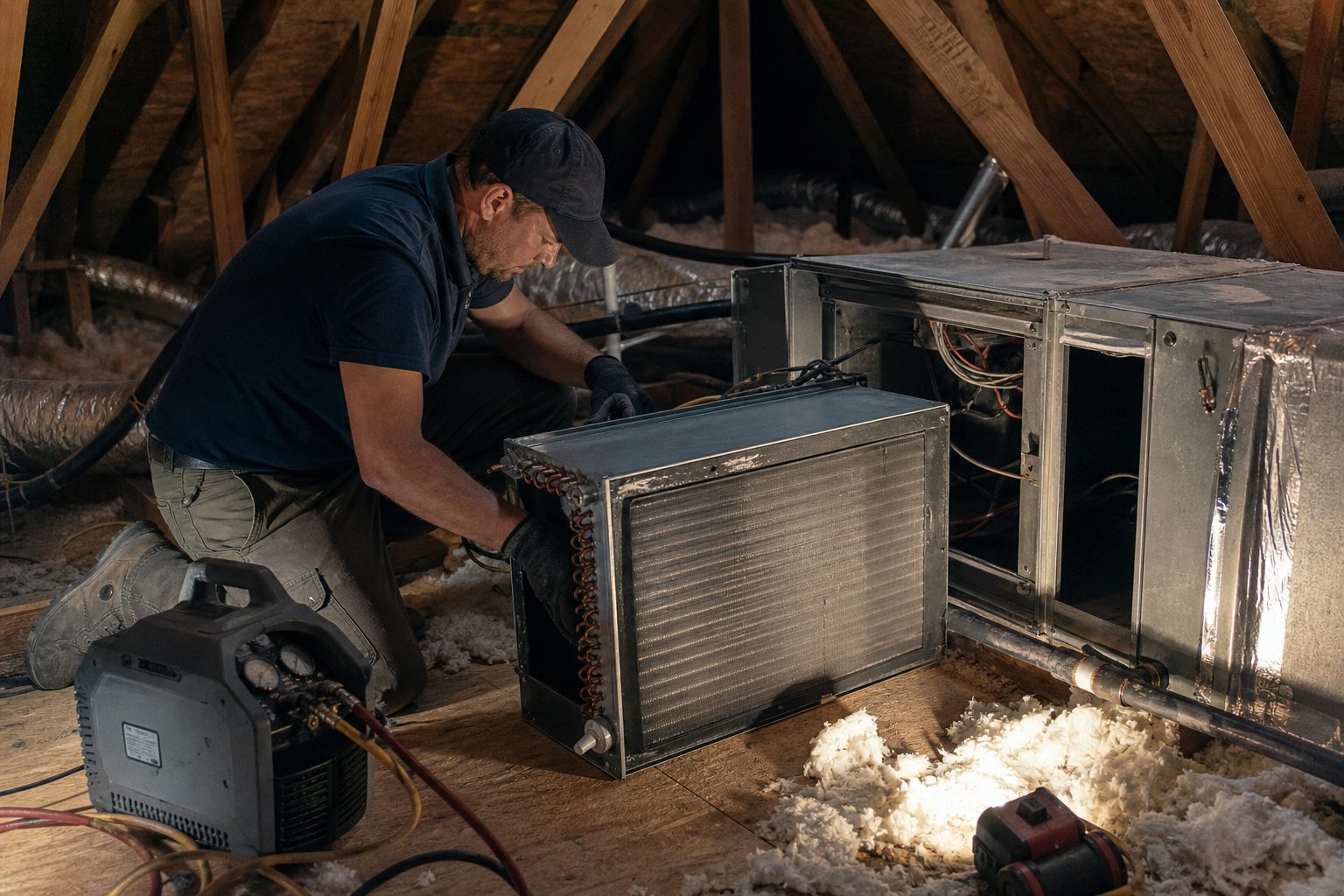
Evaporator coil replacement: swap the coil or replace the system? Replace the coil when the outdoor unit is young and an AHRI certified combination exists for that pairing. Replace both when it does not, because the efficiency rating applies only to the tested pair.
Key Takeaways
- A 2005 report for the Air-Conditioning and Refrigeration Technology Institute, archived by DOE, put the formic acid threshold for attack below twenty parts per million.
- DOE Building America tells installers to replace indoor and outdoor units together on split systems.
- 40 CFR 82.156 Table 1 requires evacuation to 0 inches of mercury vacuum before a residential coil is opened.
- EPA removed the January 1, 2026 installation date for residential AC above 700 GWP built before January 1, 2025, in a rule signed May 21, 2026.
- EIA put the installed cost of a 3 ton split central air conditioner at $5,310 in the North, in 2022 dollars.
What does the evaporator coil do, and why do coils leak?
The evaporator coil is the indoor heat exchanger where liquid refrigerant boils and pulls heat out of the air the blower pushes across it. DOE Building America places it, with the expansion valve, inside the air handler.
Coils leak for three ordinary reasons. Copper tube walls are thin, so a pinhole bleeds a charge. Vibration from the blower and from refrigerant flow works brazed joints over years. And the coil sits wet through the cooling season, the condition corrosion needs.
A slow leak rarely announces itself. It shows as long run times, then as ice, one of the two mechanisms that freeze a coil. Topping up without finding the hole is not a repair, as our recharging piece sets out. The outdoor half fails differently, in our condenser explainer.
What causes formicary corrosion in an evaporator coil?
Organic acids in the air around the coil, chiefly formic and acetic acid. The pits are invisible at the surface and branch into a tunnel network underneath that looks like an ant nest. It is the mechanism behind most pinhole evaporator coil leaks on young equipment.
The clearest public account is a February 2005 report by Corrosion Testing Laboratories for the Air-Conditioning and Refrigeration Technology Institute, archived in the DOE OSTI library. It states that “formic acid causes a branch-like tunneling that initiates in grain boundaries of the copper metal.” The report is trade funded, so we attribute it rather than treat it as a federal finding.
Two findings matter here. The threshold for attack from formic acid was below twenty parts per million, and the vapor phase, not liquid contact, was the most critical factor. The report also quotes Notoya: “In Japan, this type of corrosion is found in approximately 10% of cases of premature failure of copper tubes.”
The myth worth correcting
A pinhole coil leak is not proof that a technician undercharged the system. The 2005 report records failures before installation, shortly after, and within several years, and ranks acid concentration and exposure time above temperature as drivers of pit depth.
Why evaporator coil replacement must be an AHRI certified match
A split system is rated as a combination, not as two independent boxes. AHRI certifies specific pairings of outdoor unit, indoor coil and fan type, and DOE Building America tells installers to “confirm that the selected system is a matched system, as certified according to the Air-Conditioning, Heating, & Refrigeration Institute.” An unlisted pairing has no published SEER2 or HSPF2 rating at all.
DOE guidance of December 16, 2022 says a basic model is certified to a regional standard “only if all individual combinations within that basic model meet the regional standard,” and requires a coil-only combination representative of the least-efficient combination sold. Its examples show the swing: one outdoor unit rates 13.4 SEER2 coil-only, while a blower coil pairing reaches 14.3 SEER2 and 11.7 EER2.
It also fixes where equipment may go: since January 1, 2023, only models meeting the amended regional standards may be installed in the Southeast or Southwest. National floors sit in our SEER2 minimums reference, and new air handlers in our air handler guide.
Does the refrigerant decide the job?
Usually, yes. An R-410A system needs an R-410A rated coil and an R-410A charge, both under the AIM Act HFC phasedown at 40 CFR part 84. EPA set a 700 global warming potential limit for new residential and light commercial air conditioning, with a manufacture and import date of January 1, 2025. R-410A sits above that limit; the A2L blend that replaced it sits below.
The rule is forward looking. EPA says the restrictions “apply only to new products and systems manufactured, imported, or installed after the compliance date for each subsector,” and that companies may keep servicing existing systems, including replacing major components. A replacement coil is that kind of component.
Installation moved again this year. In a final rule signed May 21, 2026, EPA removed the January 1, 2026 installation date for equipment above 700 GWP built before January 1, 2025, as our R-410A piece covers. Bulk HFC allowances still fall to 60% of baseline for 2024 through 2028 and 30% for 2029 through 2033, and the price effect is in our refrigerant price tracking.
What does EPA require when the refrigerant circuit is opened?
Recovery, by a certified technician, with certified equipment. EPA rules under Section 608 “prohibit individuals from intentionally venting ozone-depleting substances (ODS) or their substitutes while maintaining, servicing, repairing, or disposing of air-conditioning or refrigeration equipment.”
The level is written down. Under 40 CFR 82.156(a), “technicians must evacuate the refrigerant, including all the liquid refrigerant, to the levels in Table 1 using a recovery and/or recycling machine certified pursuant to 82.158.” A residential split system is a high pressure appliance under 200 pounds of charge, and Table 1 sets that level at 0 inches of mercury vacuum, verified before opening.
A leaking coil gets its own paragraph. Where leaks make that level unattainable, 82.156(a)(2) requires evacuating the leaking part “to the lowest level that can be attained without substantially contaminating the refrigerant,” which “may not exceed 0 psig.” Certification types are in our EPA 608 guide, the leak repair regime in our 2026 leak rules explainer.
What pulling a cased coil actually involves
- Recover the charge to the level above, verify it, document it.
- Unbraze the suction and liquid lines, break the condensate drain, open the plenum.
- Slide the cased coil out. In an attic that means a catwalk in summer heat; in a closet there is often less clearance than the case is wide.
- Fit the matched coil, change the metering device if the combination calls for one.
- Reseal the plenum, pressure test, pull a deep vacuum, weigh in the charge.
- Verify airflow and charge, and record the AHRI reference number.
Steps two and three carry the hours, and they are why two quotes for the same part number differ by a day of labour.
What evaporator coil replacement costs against a full system: our arithmetic
No federal series publishes a coil-only replacement price, so we will not invent one. What is published is the split between hardware and everything else on a full system, which shows how much of a coil job you cannot avoid. Figures below: EIA equipment cost study, March 2023, 3 ton split system, 2022 dollars.
| Equipment, 3 ton split system | Retail equipment | Total installed | Non-equipment share |
|---|---|---|---|
| Central AC, North, 2023 standard | $2,680 | $5,310 | $2,630, or 49.5% |
| Central AC, South, 2023 standard | $3,110 | $5,520 | $2,410, or 43.7% |
| Air-source heat pump, 2023 standard | $4,110 | $6,810 | $2,700, or 39.6% |
| Central AC, North, ENERGY STAR V. 6.1 | $3,750 | $5,880 | $2,130, or 36.2% |
The last column is our arithmetic on EIA figures, not an EIA published number, and these are 2022 dollars, not a 2026 quote.
Roughly 40 to 50 cents of every dollar in a full replacement is not equipment, and a coil swap keeps almost all of that work: recovery, brazing, vacuum, charge, commissioning. You save the outdoor hardware, not the refrigerant work.
Then apply the clock. EIA gives central air conditioners an average life range of 11 to 25 years and air-source heat pumps 15.3 years. A coil fitted to an outdoor unit past the bottom of that range buys time on hardware already inside its own replacement window. The wider trade sits in the 2026 replacement cost analysis and the piece on replacing now or waiting.
How we researched this
Research date: September 22 and 23, 2026. Cited: EPA on Section 608 venting and service practice, EPA Technology Transitions and the May 2026 final rule fact sheet, EPA questions on the HFC phasedown, 40 CFR 82.156 on eCFR, DOE regional standards guidance of December 16, 2022, DOE Building America, and the EIA equipment cost study of March 2023.
Excluded: contractor and distributor pages quoting coil prices, and manufacturer marketing on coated coils. No federal or national lab series publishes an installed price for a replacement coil, so this article gives none. The share column is our arithmetic on EIA figures and is labelled as such.
The corrosion mechanism rests on a trade funded report, ARTI-21CR/611-50055-01 of February 2005, reached through DOE OSTI and attributed by name. Reddit was not mined: the job turns on federal handling rules and certification records, so anecdotes were excluded.
Frequently asked questions
Can I replace just the evaporator coil and keep my outdoor unit?
Yes, if an AHRI certified combination exists for that outdoor unit and the replacement coil. DOE Building America still advises replacing indoor and outdoor units together on split systems. Without a listed combination the system carries no certified SEER2 number.
Does a new coil have to match the old refrigerant?
Yes. An R-410A system needs an R-410A rated coil and an R-410A charge. EPA says its Technology Transitions restrictions apply to new products and systems, and that companies may keep servicing existing ones, including replacing major components.
Is R-410A still available in 2026?
Yes, with pressure on supply. HFC allowances fall to 60% of baseline for 2024 through 2028 and 30% for 2029 through 2033. EPA also removed the January 1, 2026 installation date for pre-2025 equipment above 700 GWP on May 21, 2026.
What must a technician do before opening my coil?
Recover the refrigerant. Under 40 CFR 82.156 Table 1, a high pressure appliance holding under 200 pounds of refrigerant must be evacuated to 0 inches of mercury vacuum with certified equipment, verified before opening. Venting is prohibited under Section 608.
Why did my coil leak after only a few years?
Most likely formicary corrosion. The 2005 ARTI report put the formic acid threshold for attack below twenty parts per million and recorded failures before installation, shortly after, or within several years. It is not proof of a bad installation.
How much of a full replacement is labour and overhead?
EIA figures imply 49.5% for a 3 ton central air conditioner in the North and 43.7% in the South at the 2023 standard, in 2022 dollars. That share is our arithmetic on EIA columns, not a published EIA percentage.
Can a new coil change where the system may be installed?
It can. DOE guidance of December 16, 2022 says a basic model is certified to a regional standard only if all individual combinations comply, and that since January 1, 2023 only compliant models may be installed in the Southeast or Southwest.
Sources
- Corrosion Testing Laboratories for ARTI. “Organic Acids and the Corrosion of Aluminum-Finned Copper-Tube Heat Exchange Coils.” ARTI-21CR/611-50055-01, February 2005, via DOE OSTI. https://www.osti.gov/servlets/purl/877662.
- DOE Building America Solution Center. “Air Conditioning.” https://basc.pnnl.gov/resource-guides/air-conditioning.
- U.S. Department of Energy. “Central Air Conditioner Regional Standards Guidance.” December 16, 2022. https://www.energy.gov/sites/default/files/2021-12/cac-regional-guidance.pdf.
- Office of the Federal Register. “40 CFR 82.156.” https://www.ecfr.gov/current/title-40/section-82.156.
- U.S. EPA. “Stationary Refrigeration Service Practice Requirements.” https://www.epa.gov/section608/stationary-refrigeration-service-practice-requirements.
- U.S. EPA. “Prohibition on Venting Refrigerants.” https://www.epa.gov/section608/stationary-refrigeration-prohibition-venting-refrigerants.
- U.S. EPA. “Technology Transitions HFC Restrictions by Sector.” https://www.epa.gov/hfcs/technology-transitions-hfc-restrictions-sector.
- U.S. EPA. “Fact Sheet: Technology Transitions Final Rule.” May 2026. https://www.epa.gov/system/files/documents/2026-05/fact-sheet-san-12166-technology-transitions-frm.pdf.
- U.S. EPA. “Frequent Questions on the Phasedown of Hydrofluorocarbons.” https://www.epa.gov/hfcs/frequent-questions-phasedown-hydrofluorocarbons.
- U.S. EIA. “Updated Buildings Sector Appliance and Equipment Costs and Efficiency.” March 2023. https://www.eia.gov/analysis/studies/buildings/equipcosts/pdf/full.pdf.
All sources accessed September 2026.
Leave a Reply