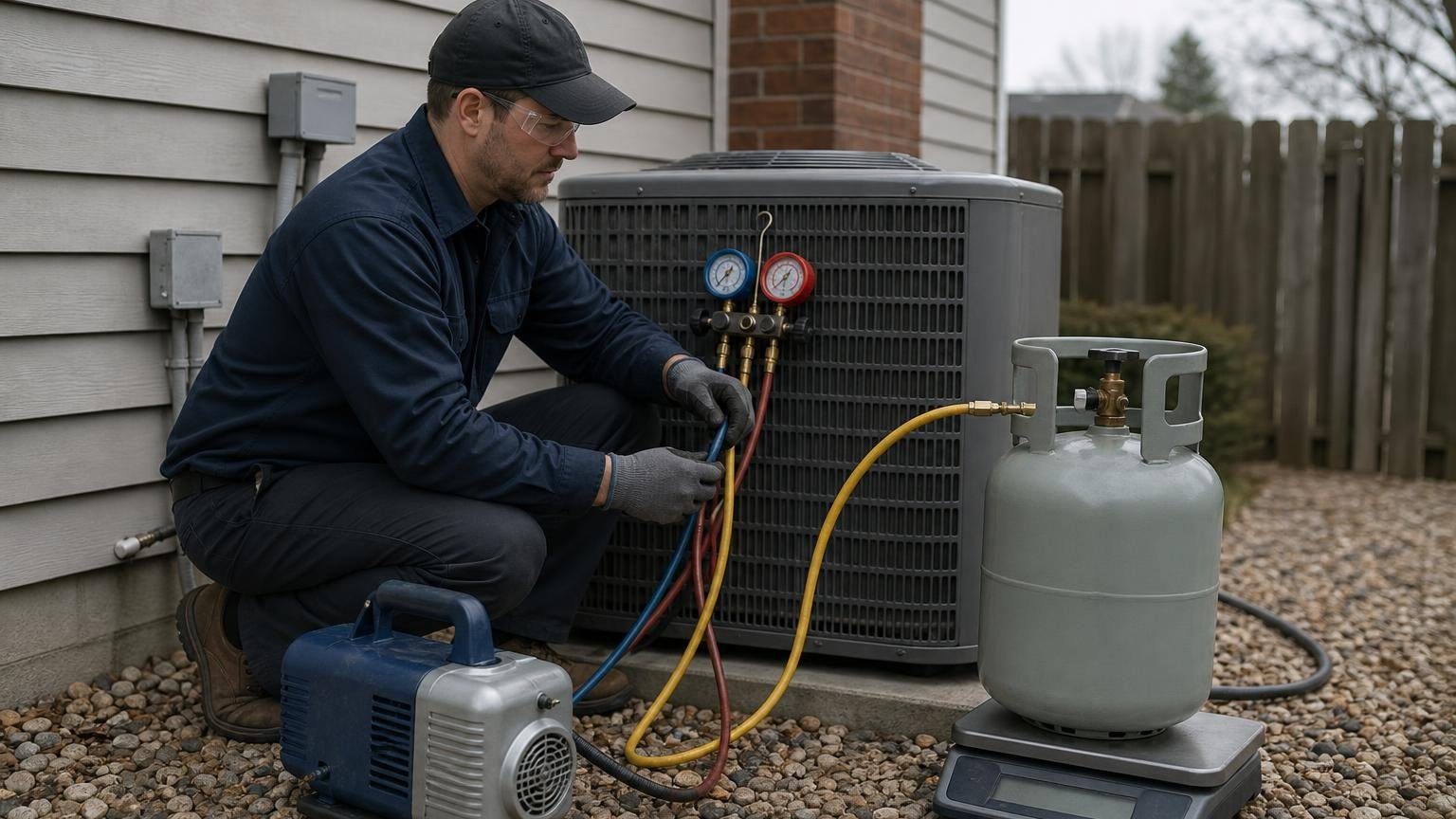
What is refrigerant recovery? Refrigerant recovery is removing refrigerant from an appliance into an external container without testing or processing it. Federal law requires it, with an EPA certified machine and a certified technician, before most systems are opened or scrapped, down to vacuum levels set by appliance type.
Key Takeaways
- A high-pressure system such as R-410A holding under 200 pounds must be pulled to 0 inches of mercury before opening (40 CFR 82.156, Table 1).
- Small appliances use percentages: 90 percent recovered with a working compressor, 80 percent without (82.156(b)).
- Machines made since January 1, 2017 are certified to AHRI Standard 740-2016; flammable-refrigerant units add UL 1963 (40 CFR 82.158).
- INFICON caps a recovery tank at 80% of capacity by weight (Vortex Dual manual): about 22.3 lb of R-410A in a 30 lb cylinder.
- Only reclaimed refrigerant meets the AHRI Standard 700-2016 purity spec (40 CFR 82.152).
- From January 1, 2029, three commercial subsectors must be serviced with reclaimed HFCs; home AC is not one (40 CFR 84.112).
What is refrigerant recovery?
Refrigerant recovery is the first of three federally defined steps. Under 40 CFR 82.152, to recover means to remove refrigerant “in any condition from an appliance and to store it in an external container without necessarily testing or processing it in any way.” Our refrigerant primer covers the gases themselves.
| Term (82.152) | What it means | Who can reuse it |
|---|---|---|
| Recover | Remove and store in an external container, no testing or processing | Same appliance or same owner (82.156(h)) |
| Recycle | Clean by oil separation and filter-driers, short of reclaim specs | Equipment of the same owner |
| Reclaim | Reprocess to AHRI Standard 700-2016 specs and verify by lab analysis | Anyone; the only recovered HFC that may be sold to a new owner (84.104) |
What do the federal refrigerant recovery requirements say?
Three rules carry the load. 40 CFR 82.154 bans knowingly venting refrigerant. 40 CFR 82.156 requires evacuation to set levels with a certified machine before opening or disposal. 82.161 limits the work to certified technicians.
The target depends on pressure class. A high-pressure appliance has a liquid saturation pressure between 170 psia and 355 psia at 104°F; the rule names R-22 and R-410A (82.152). The vacuum levels, by machine age:
| Type of appliance (Table 1) | Machine made before Nov 15, 1993 | Machine made on or after Nov 15, 1993 |
|---|---|---|
| Very high-pressure appliance | 0 in. Hg | 0 in. Hg |
| High-pressure, full charge under 200 lb | 0 in. Hg | 0 in. Hg |
| High-pressure, full charge 200 lb or more | 4 in. Hg | 10 in. Hg |
| Medium-pressure, full charge under 200 lb | 4 in. Hg | 10 in. Hg |
| Medium-pressure, full charge 200 lb or more | 4 in. Hg | 15 in. Hg |
| Low-pressure appliance | 25 mm Hg absolute | 25 mm Hg absolute |
Small appliances (factory sealed, five pounds or less) use percentages: with post-1993 equipment, recover 90 percent with the compressor working, 80 percent without, or reach a four inch vacuum. A minor repair needs only 0 psig before opening.
Disposing of an appliance holding more than 5 and less than 50 pounds triggers records kept three years. Under 40 CFR 82.161, high-pressure work needs Type II, and apprentices must be “closely and continually supervised.” See our EPA 608 certification types guide and the separate 2026 leak repair thresholds.
What makes a refrigerant recovery machine EPA certified?
A refrigerant recovery machine is legal when an EPA approved testing body has certified its model line and the label says so. Under 40 CFR 82.158, machines made on or after January 1, 2017 are tested to AHRI Standard 740-2016, or to appendix B4 for flammable refrigerants. The section also requires:
- Low-loss fittings on all hoses.
- A noncondensables purge that releases no more than 3 percent of the refrigerant processed.
- A permanent label with the testing body, appliance category and date of manufacture.
- Retests or factory inspections at least once every three years.
The Fieldpiece MR45 manual label cites Underwriters Laboratories certification for Category III, IV and V refrigerants in AHRI 740. System-dependent recovery, using the appliance’s own compressor, is barred above 15 pounds of charge (82.156(e)), and a dead unit on a compressor replacement rules it out anyway. Fieldpiece adds that recovery machines “are not vacuum pumps,” which is why our HVAC tool list counts them separately.
How do you recover refrigerant, step by step?
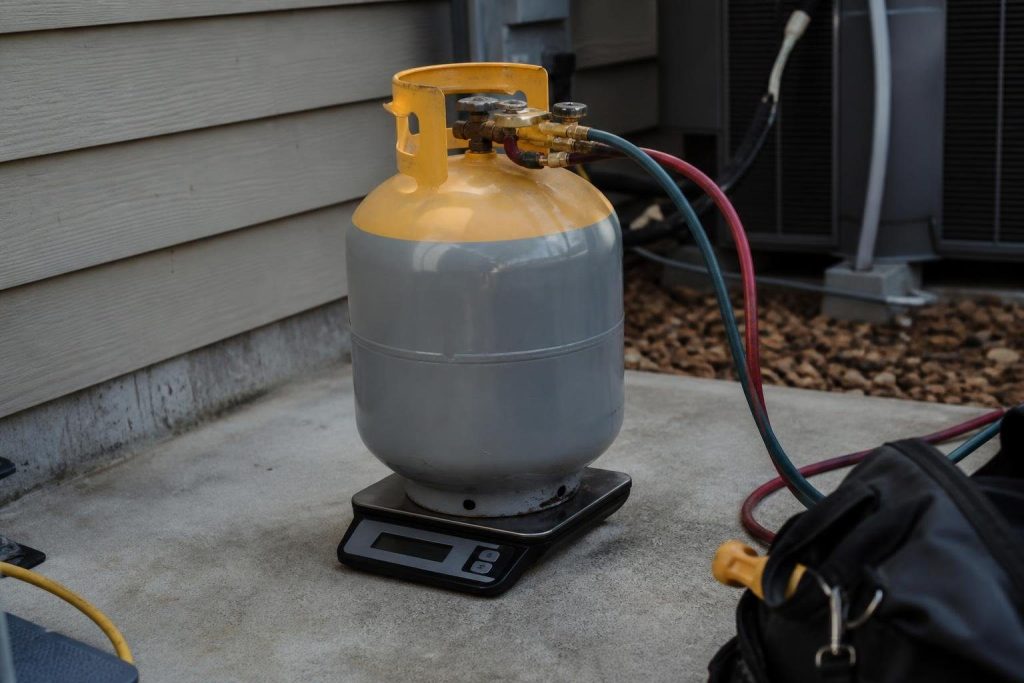
Recover liquid first, then vapor, until the gauge holds the required level. Machines must be used per the “manufacturer’s directions” (82.156(g)), so these steps follow two maker manuals. Direct recovery, the usual residential method:
- Use a recovery cylinder dedicated to the system’s refrigerant. Never mix refrigerants.
- Evacuate the empty cylinder (Fieldpiece specifies -29.6 inHg) and set it on a scale.
- Connect manifold to system, machine inlet to manifold, machine outlet to cylinder. Purge air by briefly unseating each hose fitting.
- Open the high side for liquid. If the compressor knocks, throttle the inlet.
- Open the low side and recover vapor to the Table 1 level. The MR45 auto-stops at 0 psig, -10 inHg or -20 inHg.
- Wait five minutes. Per the INFICON Vortex Dual manual, a rise above 0 psig means refrigerant remains; run again.
- Purge the machine into the cylinder, close valves and log the weight.
Push-pull moves big liquid charges faster: the machine pulls vapor off the cylinder and pushes it into the system, driving liquid out.
- Confirm the charge: INFICON requires at least 15 pounds of isolatable liquid; Fieldpiece recommends push-pull over 30 lbs.
- Connect system liquid port to cylinder liquid port, cylinder vapor port to machine inlet, machine outlet to system vapor port.
- Run and watch the scale. INFICON reports rates above 15 pounds per minute, so 80% arrives fast.
- When a sight glass shows vapor only, stop and finish with direct vapor recovery.
How full can a refrigerant recovery cylinder be?
A refrigerant recovery cylinder should never pass 80% of capacity by weight, the limit INFICON and Fieldpiece both print. The 80% is a liquid-volume margin, so the pound limit varies by refrigerant; “30 lb” on the cylinder is not what it holds.
The Worthington cylinder spec sheet gives the formula: maximum gross fill equals 0.8 x water capacity x specific gravity at 77°F, plus tare. Its 30 lb cylinder has a 26.1 lb water capacity (11.9 liters) and a 16.9 lb tare. R-410A liquid is 1062.4 kg/m3 at 77°F (Chemours Freon 410A tables).
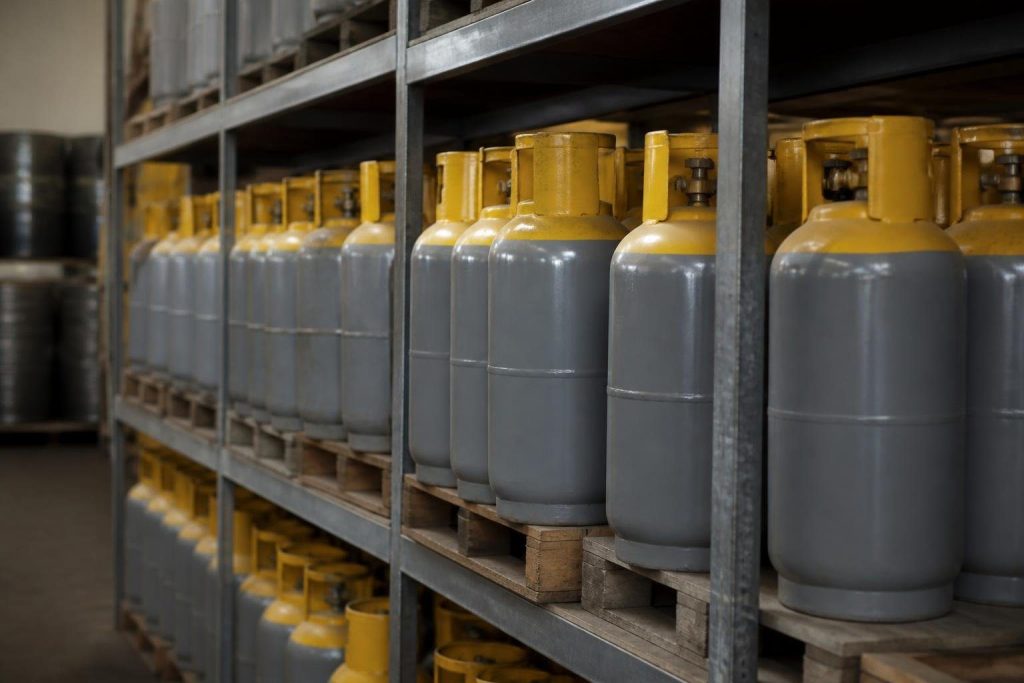
Many cylinders take a float switch that stops the machine at 80%; Mastercool’s 30 lb models have a port for one. The Worthington cylinder is DOT-4BA, 400 psig service and 800 psig test. 49 CFR 180.209 sets 4BA requalification at 5, 7, 10 or 12 years depending on service, so check the stamped retest date. Under AHRI Guideline K, as Worthington restates it, recovery cylinders are gray with a yellow collar.
What changes when you recover A2L refrigerants?
A2L refrigerants such as R-32 and R-454B need a machine certified for flammable refrigerants, an A2L cylinder and a controlled work zone. EPA’s appendix B4 for that equipment rests on AHRI Standard 740-2016 and UL 1963, Supplement SB (82.158). Our R-454B explainer covers its flammability class.
The Fieldpiece MR45, rated for A1 and A2L only and never hydrocarbons, lists these A2L steps:
- Set a Temporary Flammable Zone with a 3-meter perimeter and disable ignition sources in it.
- Monitor it with a flammable refrigerant leak detector and keep at least 5 air exchanges per hour.
- Bond the machine outlet to the cylinder with a grounding strap.
Worthington’s A2L cylinders carry left-hand threads and a red stripe. Detector options are in our leak detection comparison, and line reuse on A2L systems in our line set guide.
What happens to recovered refrigerant after the job?
Recovered refrigerant goes back into the same owner’s equipment or to an EPA certified reclaimer. Under the AIM Act rule at 40 CFR 84.104, a recovered HFC may be sold to a new owner only after reclamation by a reclaimer certified under 82.164, or for reclamation or destruction.
Since January 1, 2026, refrigerant sold as reclaimed may contain no more than 15 percent virgin HFC by weight, and containers must be labeled (40 CFR 84.112). That reclaimed pool keeps older systems running, as our R-22 availability explainer shows.
Correction: the 2029 reclaim rule is not a home AC rule
From January 1, 2029, 84.112(e) requires reclaimed refrigerant for servicing only supermarket systems, refrigerated transport and automatic commercial ice makers. Residential split systems are not listed. The “5 to 50 pound” band some guides quote is a disposal recordkeeping trigger, not a recovery exemption.
From January 1, 2028, used disposable cylinders must go to a reclaimer, supplier or final processor that removes the heel, or a certified technician evacuates them to 15 in-Hg and signs a statement (40 CFR 84.116).
How we researched this
We read the regulation text of 40 CFR 82.152 through 82.161 and 40 CFR 84.104, 84.112 and 84.116 from the eCFR (version dated October 1, 2026), plus 49 CFR 180.209. Field practice comes from the maker documents listed below. We consulted 19 sources and cite 14. Excluded: contractor blogs, retailer pages, vendor price lists (no federal price series exists) and Reddit (a pressure and flammability safety topic). Research date: October 9, 2026.
Frequently asked questions
Can you recover refrigerant without a recovery machine?
No. Federal rules require evacuation with a recovery machine certified under 40 CFR 82.158 before an appliance is opened or scrapped, and knowingly venting refrigerant is prohibited by 40 CFR 82.154. Systems holding more than 15 pounds cannot use system-dependent recovery either.
Can a homeowner recover refrigerant legally?
Generally no. Under 40 CFR 82.161, anyone who could be expected to open the refrigerant circuit must pass an EPA approved certification exam, and the gas cannot be vented. Homeowners installing pre-charged kits face narrower rules, covered in our DIY mini split rules explainer.
What vacuum level is required to recover R-410A?
R-410A is a high-pressure refrigerant. With a recovery machine made on or after November 15, 1993, a system holding under 200 pounds must reach 0 inches of mercury, and one holding 200 pounds or more must reach 10 inches, per Table 1 of 40 CFR 82.156.
How full can a refrigerant recovery tank be?
No more than 80% of capacity by weight, per the INFICON Vortex Dual manual. The pound limit depends on the refrigerant: by the Worthington formula, a 30 lb cylinder holds about 22.3 lb of R-410A, for a gross weight near 39.2 lb on the scale.
Should you pull a vacuum on a recovery cylinder before use?
Yes. Fieldpiece’s MR45 manual tells technicians to evacuate empty recovery cylinders to -29.6 inHg before use. INFICON lists air in the recovery tank as a cause of excessive head pressure, which slows recovery and can open the machine’s high pressure switch.
Can recovered refrigerant go back into the same system?
Yes. Under 40 CFR 82.156(h), refrigerant may be returned to the appliance it came from, or to another appliance owned by the same person, without recycling or reclaiming, except in motor vehicle systems. Selling it to a new owner requires reclamation first under 40 CFR 84.104.
Sources
- eCFR. “40 CFR 82.152, Definitions.” https://www.ecfr.gov/current/title-40/chapter-I/subchapter-C/part-82/subpart-F/section-82.152. Accessed October 2026.
- eCFR. “40 CFR 82.154, Prohibitions.” https://www.ecfr.gov/current/title-40/chapter-I/subchapter-C/part-82/subpart-F/section-82.154. Accessed October 2026.
- eCFR. “40 CFR 82.156, Proper evacuation of refrigerant from appliances.” https://www.ecfr.gov/current/title-40/chapter-I/subchapter-C/part-82/subpart-F/section-82.156. Accessed October 2026.
- eCFR. “40 CFR 82.158, Standards for recovery and/or recycling equipment.” https://www.ecfr.gov/current/title-40/chapter-I/subchapter-C/part-82/subpart-F/section-82.158. Accessed October 2026.
- eCFR. “40 CFR 82.161, Technician certification.” https://www.ecfr.gov/current/title-40/chapter-I/subchapter-C/part-82/subpart-F/section-82.161. Accessed October 2026.
- eCFR. “40 CFR 84.104, Prohibitions.” https://www.ecfr.gov/current/title-40/chapter-I/subchapter-C/part-84/subpart-C/section-84.104. Accessed October 2026.
- eCFR. “40 CFR 84.112, Reclamation.” https://www.ecfr.gov/current/title-40/chapter-I/subchapter-C/part-84/subpart-C/section-84.112. Accessed October 2026.
- eCFR. “40 CFR 84.116, Requirements for disposable cylinders.” https://www.ecfr.gov/current/title-40/chapter-I/subchapter-C/part-84/subpart-C/section-84.116. Accessed October 2026.
- eCFR. “49 CFR 180.209, Requirements for requalification of specification cylinders.” https://www.ecfr.gov/current/title-49/subtitle-B/chapter-I/subchapter-C/part-180/subpart-C/section-180.209. Accessed October 2026.
- INFICON. “Vortex Dual Operating Manual (hosted copy).” https://cdn.byggtjeneste.no/nobb/3755d512-9b2b-48e1-962b-6d6e32bdd174. Accessed October 2026.
- Fieldpiece. “MR45 Operator’s Manual, v39.” https://resources.fieldpiece.com/wp-content/uploads/2025/10/Opman-MR45-v39.pdf. Accessed October 2026.
- Worthington Enterprises. “Steel Cylinders for Refrigerant Recovery.” https://buildingproducts.worthingtonenterprises.com/docs/default-source/default-document-library/went_recoveryspecsheet_032025.pdf. Accessed October 2026.
- Mastercool. “30 lb and 50 lb DOT-Approved Recovery Cylinders (62010 flier).” https://www.mastercool.com/wp-content/uploads/2015/03/62010-FLIER-1.pdf. Accessed October 2026.
- Chemours. “Freon 410A Thermodynamic Properties (SI).” https://www.freon.com/en/-/media/files/freon/freon-410a-si-thermodynamic-properties.pdf. Accessed October 2026.
Leave a Reply