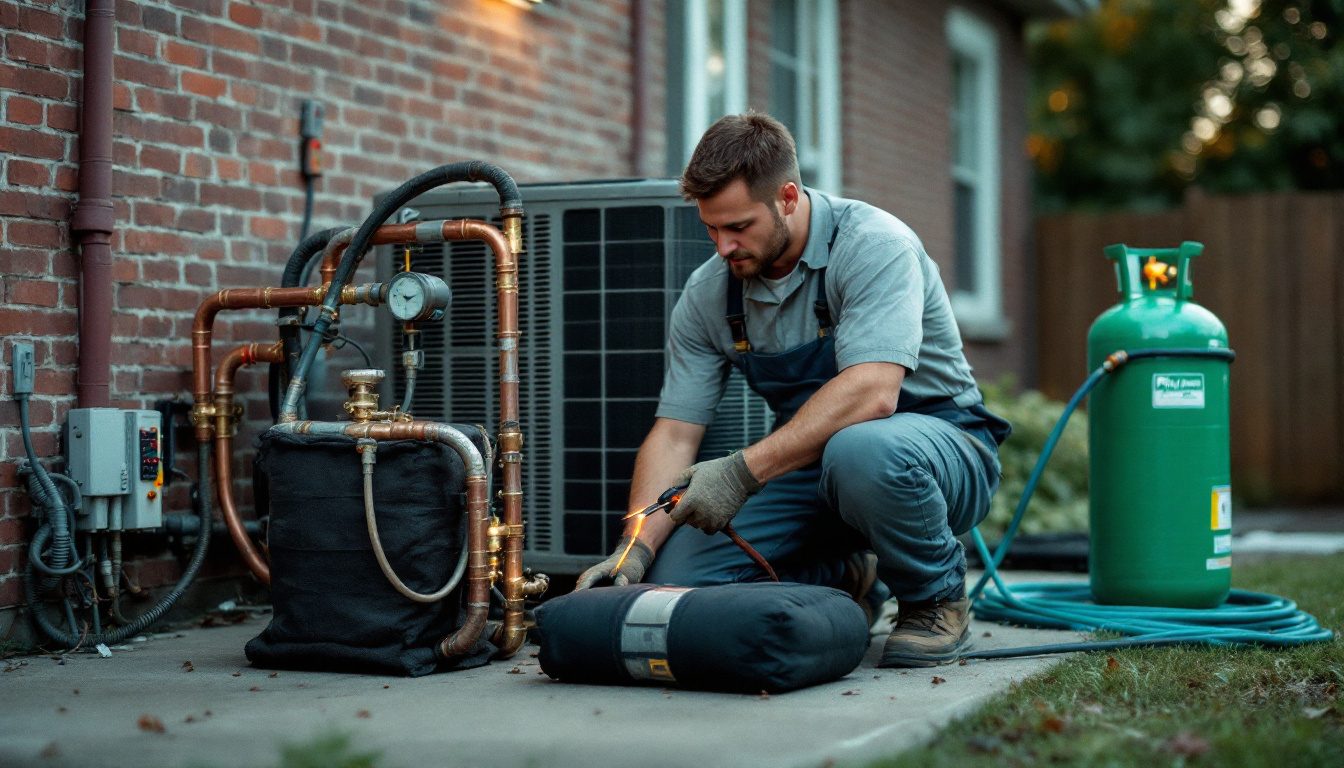
What is a refrigerant line set? A refrigerant line set is the pair of copper tubes, a small liquid line and a larger insulated suction line, that joins the outdoor unit to the indoor coil. Its size comes from the manufacturer’s table for your tonnage and length, not a rule of thumb.
Key Takeaways
- Goodman’s TP-107M guideline treats any run over 80 feet of actual length as a long line set, capped at 250 equivalent feet for single stage scroll units.
- In Rheem/Ruud’s R-454B table, a 3-ton system at 226 to 250 equivalent feet keeps 0.87 of capacity on 5/8 inch suction and 0.98 on 7/8 inch.
- DOE’s Standard Work Specifications call for suction line insulation of at least R-4 with a class II vapor retarder.
- Rheem requires a reused R-410A or R-22 line set to be purged and flushed with nitrogen before R-454B service.
- EPA’s SNAP listing allows R-454B only in new equipment built for it, never as a retrofit refrigerant.
What is a refrigerant line set?
A refrigerant line set is the two field-installed copper tubes between a split system’s outdoor unit and its indoor coil. The smaller liquid line carries warm, high-pressure liquid to the metering device; the larger suction (vapor) line returns cool, low-pressure gas to the compressor. Outside, the lines end at the service valves on the outdoor condensing unit. Inside, they are brazed to the indoor evaporator coil on the furnace or air handler.
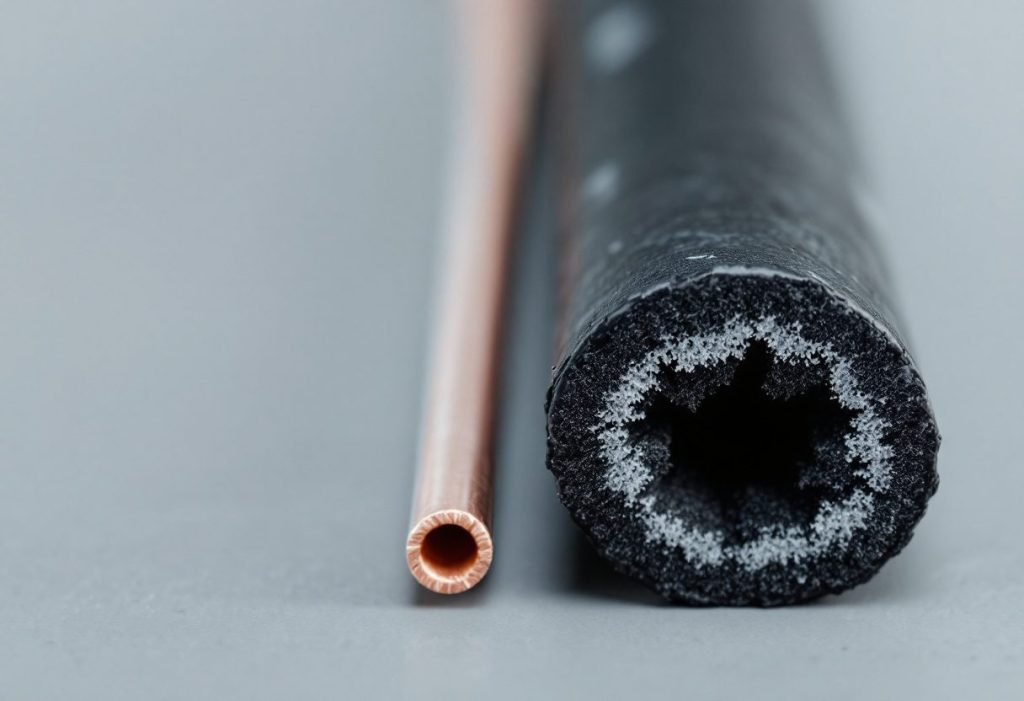
The tubing is ACR copper made to ASTM B280, the standard for field air conditioning and refrigeration tube. Line sets are sold by outside diameter, liquid first: a 3/8 x 3/4 set pairs a 3/8 inch liquid line with a 3/4 inch suction line.
What size refrigerant line set do you need?
Size comes from the outdoor unit’s instructions, read against nominal tons and equivalent length. The tonnage itself should come from a proper load calculation. In Rheem/Ruud’s R-454B heat pump chart, a 3/8 inch liquid line is allowed at every size from 1.5 to 5 tons, while the suction line steps up from 1/2 to 7/8 inch.
| Nominal tons | Liquid line OD allowed | Suction line OD allowed | Capacity at 226 to 250 ft, smallest / largest suction | Max rise at 226 to 250 ft |
|---|---|---|---|---|
| 1.5 | 1/4, 5/16, 3/8 in | 1/2, 5/8, 3/4 in | 0.87 / 0.99 | 110 ft |
| 2 | 1/4, 5/16, 3/8 in | 5/8, 3/4 in | 0.94 / 0.98 | 95 ft |
| 2.5 | 1/4, 5/16, 3/8 in | 5/8, 3/4 in | 0.90 / 0.96 | 80 ft |
| 3 | 5/16, 3/8, 1/2 in | 5/8, 3/4, 7/8 in | 0.87 / 0.98 | 62 ft |
| 3.5 | 3/8, 1/2 in | 3/4, 7/8 in | 0.93 / 0.97 | 42 ft |
| 4 | 3/8, 1/2 in | 3/4, 7/8 in | 0.91 / 0.96 | 19 ft |
| 5 | 3/8, 1/2 in | 3/4, 7/8 in | 0.86 / 0.94 | 0 ft (94 ft on 1/2 in liquid) |
Source: Rheem/Ruud (-)P14AY/(-)P15AY R-454B installation instructions, Table 2A; capacity and rise assume a 3/8 inch liquid line.
Undersizing the suction line costs capacity on long runs: at 3 tons and 226 to 250 feet, 5/8 inch keeps 0.87, 3/4 inch 0.95 and 7/8 inch 0.98. Oversizing slows refrigerant too much to return oil to the compressor, so Rheem’s rule is “Do not oversize the vapor line.”
Correction: residential liquid lines are not 3/4 inch
One top-ranking line set guide lists a 3/4 inch liquid line for home systems. No liquid line in Rheem’s 1.5 to 5 ton table is larger than 1/2 inch, and Goodman’s TP-107M requires 3/8 inch on any residential long line set.
How long can a refrigerant line set be?
Goodman’s TP-107M caps 1.5 to 5 ton split systems at 250 equivalent feet and 200 actual feet with single stage scroll compressors, and 150 feet for two stage or rotary units. Past 80 feet of actual length, long line rules apply.
On a long line set, Goodman requires a crankcase heater, a hard start kit and a TXV at the indoor coil, charged to 7 to 9 F subcooling. Daikin Comfort’s TP-110 guideline for R-32 (May 2024) says fixed orifice (piston) indoor units are not approved past 80 feet.
Equivalent length adds the pressure loss of every fitting to the straight footage. TP-107M rates a 90 degree short radius elbow on 3/4 inch suction line at 1.7 equivalent feet, so ten of them add 17 feet.
With the outdoor unit below the coil, TP-107M allows 80 feet of rise and requires an inverted suction loop at the indoor unit. Rheem’s R-454B table tightens rise as runs lengthen: a 4-ton system at 226 to 250 feet may rise only 19 feet.
Oil traps are where documents disagree. DOE’s work specifications call for P-traps on suction risers over 10 feet in height; Rheem’s R-454B instructions say not to put traps in the suction riser; Goodman wants an oil trap only when the outdoor unit sits more than 80 feet above the coil. The installed unit’s own document governs.
How much refrigerant does a longer line set need?
Goodman and Rheem outdoor units ship charged for 15 feet of line set; longer runs need more, weighed in and then verified. Rheem’s R-454B rate for 3/8 inch liquid line is 0.6 oz per foot, the same rate Goodman’s TP-107M gives for R-410A.
- Multiply the total linear length by the liquid line rate: 0.3 oz per foot for 1/4 inch, 0.4 oz for 5/16 inch, 0.6 oz for 3/8 inch, 1.2 oz for 1/2 inch.
- Subtract the factory allowance for 15 feet at the same rate.
- Add 6 oz if a filter drier is installed in the field.
Worked example: 50 feet of 3/8 inch liquid line is 30 oz. Subtract the 9 oz factory allowance and add 6 oz for the drier, and the starting adjustment is 27 oz.
Rheem calls charging by weight a starting point only. The final charge is set from the charging chart using superheat and subcooling readings. Charge uses linear length; sizing uses equivalent length.
What insulation does a refrigerant line set need?
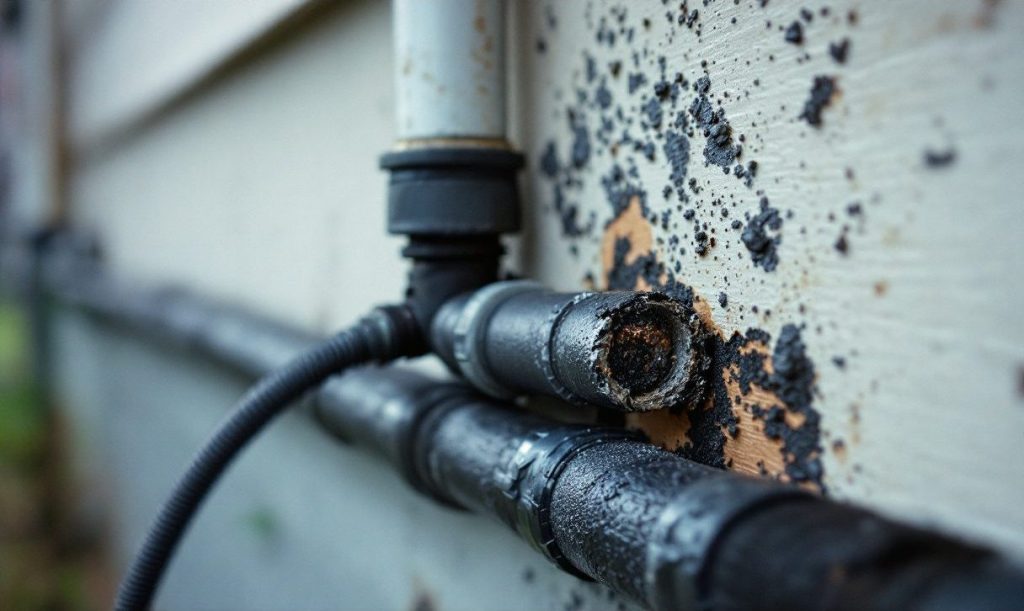
Insulate the suction line for its full length. DOE’s Standard Work Specifications set a minimum of R-4 with a class II or better vapor retarder, with sealed seams and UV-resistant or protected insulation outdoors. Rheem’s R-454B instructions ask for closed-cell foam at least 1/2 inch thick.
Goodman requires 1/2 inch on long line sets through a high ambient zone; most kits ship with 3/8 inch. The liquid line usually stays bare, but Rheem requires insulating it where it crosses a very hot area.
A line set cover is mostly about looks and protection. The DOE specification asks for a rigid sleeve or pipe duct wherever people, vehicles or tree limbs could hit the lines. Local codes may set their own minimums, depending on the edition adopted.
Can you reuse an old refrigerant line set with an A2L system?
Often yes, if the manufacturer’s conditions are met. In a June 6, 2025 interpretation, North Carolina’s State Fire Marshal said existing line sets are typically permitted to stay when A1 equipment is replaced with A2L equipment, if they meet the manufacturer’s requirements. If not, new lines are required.
Rheem’s R-454B requirements for a line set that last served R-410A or R-22:
- Confirm both lines are sizes listed for the new unit.
- Purge and flush with nitrogen, blowing out as much leftover mineral oil as possible and draining low spots.
- Test the oil for acid; if positive, a suction line filter drier is mandatory. A liquid line drier is always required.
- Use only brazed or welded joints, or mechanical fittings listed to UL 207.
- Leak test field joints with an A2L-compatible detector rated 0.2 oz per year or better.
Even then, Rheem recommends replacing the line set if possible, and a reused set deserves careful refrigerant leak detection. The old indoor coil cannot stay: the North Carolina interpretation says an existing A1 air handler or coil must be replaced.
EPA’s SNAP listing allows R-454B only in new equipment meeting UL 60335-2-40, never as a retrofit. Whether a new R-410A system is still an option is covered in our R-410A installation rules explainer.
How is a line set brazed, pressure tested and evacuated?
Braze with nitrogen flowing, pressure test, then pull a deep vacuum, in Rheem’s R-454B sequence:
- Flow dry nitrogen through the tubing while brazing, without letting it build pressure. Never use oxygen. Braze copper to copper with 5% silver alloy minimum, on type L tubing.
- Pressurize the line set and coil with dry nitrogen to the nameplate design pressure, close the tank and wait 60 minutes. If pressure drops, find the leak with soap bubbles and repeat.
- Evacuate through both service ports to 500 microns, and hold 500 microns or less for at least 15 minutes.
- Open the service valves and check every joint with an A2L-compatible leak detector.
40 CFR 82.154 bars anyone servicing an appliance from knowingly venting refrigerant, so recovery and charging belong to a technician holding the right EPA 608 certification. Ductless systems follow their own manufacturer’s line set limits; see what a mini split installation involves.
How we researched this
Researched October 8, 2026. We consulted ten primary documents and cited the eight listed below. Manufacturer limits apply to the named products; your unit’s instructions govern.
Excluded: retail listings and prices (no federal price series exists), untraceable content-farm length claims, and Reddit, since manufacturer documents answered every reader question we found. The Copper Development Association handbook was blocked; ASTM’s abstract is cited instead.
Frequently asked questions
Where is the refrigerant line on an AC?
Two copper lines run from the service valves on the outdoor unit to the indoor coil above the furnace or inside the air handler. The larger, insulated one is the suction line; DOE’s work specifications set its insulation at R-4 or better. The smaller, usually bare one is the liquid line.
What size line set does a 3 ton system need?
Rheem/Ruud’s R-454B two-stage heat pump chart allows a 3-ton unit a 5/16, 3/8 or 1/2 inch liquid line and a 5/8, 3/4 or 7/8 inch suction line. At 226 to 250 equivalent feet, 3/4 inch suction keeps 0.95 of capacity.
Do both refrigerant lines need insulation?
The suction line always does, full length, in closed-cell foam at least 1/2 inch thick per Rheem. The liquid line usually does not, but Rheem requires insulating it through very hot areas, and DOE adds high pressure lines in spaces where condensation may occur.
What does a line set flush do?
It removes residue from the old system. Rheem’s R-454B instructions require an existing R-410A or R-22 line set to be purged and flushed with nitrogen, low spots drained of mineral oil, and the oil tested for acid. A positive test makes a suction line filter drier mandatory.
Do I need a line set cover?
Codes focus on insulation, not covers. DOE’s Standard Work Specifications require UV-resistant or protected insulation outdoors, and a rigid sleeve or pipe duct where people, vehicles or tree limbs could strike the lines. Whether a decorative cover qualifies depends on local code.
Can a homeowner replace a refrigerant line set?
Routing tubing is carpentry; opening the refrigerant circuit is regulated work. Federal rule 40 CFR 82.154 bars knowingly venting refrigerant, and the manufacturer steps of nitrogen brazing, a 60 minute pressure test and a 500 micron vacuum need recovery equipment, gauges and a certified technician.
Sources
- Goodman Manufacturing. “TP-107M Long Line Set Application R-410A” (September 2020). https://securenet.goodmanmfg.com/Toolkit/LongsetGuideLines/TP-107%20LONG%20LINE%20SET%20APPLICATION.pdf. Accessed October 2026.
- Daikin Comfort Technologies. “TP-110 Long Line Set Application R-32” (May 2024). https://daikincomfort.com/docs/default-source/dx3sq/ag-tp-110.pdf. Accessed October 2026.
- Rheem/Ruud. “R-454B Heat Pump Outdoor Units Installation Instructions, (-)P14AY and (-)P15AY,” form 92-104921-51-03. https://www.budgetheating.com/content/files/downloadables/rp14ay%20wp14ay%20rp15ay%20installation%20instructions.pdf. Accessed October 2026.
- US Department of Energy. “Standard Work Specifications 5.0103.1, Refrigerant Lines.” https://sws.nlr.gov/spec/501031. Accessed October 2026.
- ASTM International. “B280-20, copper tube for air conditioning and refrigeration field service.” https://store.astm.org/b0280-20.html. Accessed October 2026.
- eCFR. “40 CFR 82.154, Prohibitions.” https://www.ecfr.gov/current/title-40/chapter-I/subchapter-C/part-82/subpart-F/section-82.154. Accessed October 2026.
- eCFR. “40 CFR Part 82, Subpart G, Appendix W.” https://www.ecfr.gov/current/title-40/chapter-I/subchapter-C/part-82/subpart-G/appendix-Appendix%20W%20to%20Subpart%20G%20of%20Part%2082. Accessed October 2026.
- North Carolina Office of the State Fire Marshal. “Partial Replacement of a Split System: A2L Refrigerant Considerations” (June 6, 2025). https://www.ncosfm.gov/mechanical/03041-properly-matched-partial-replacement-split-system-heat-pump-or-air-conditioner-a2l-refrigerant/open. Accessed October 2026.
Leave a Reply