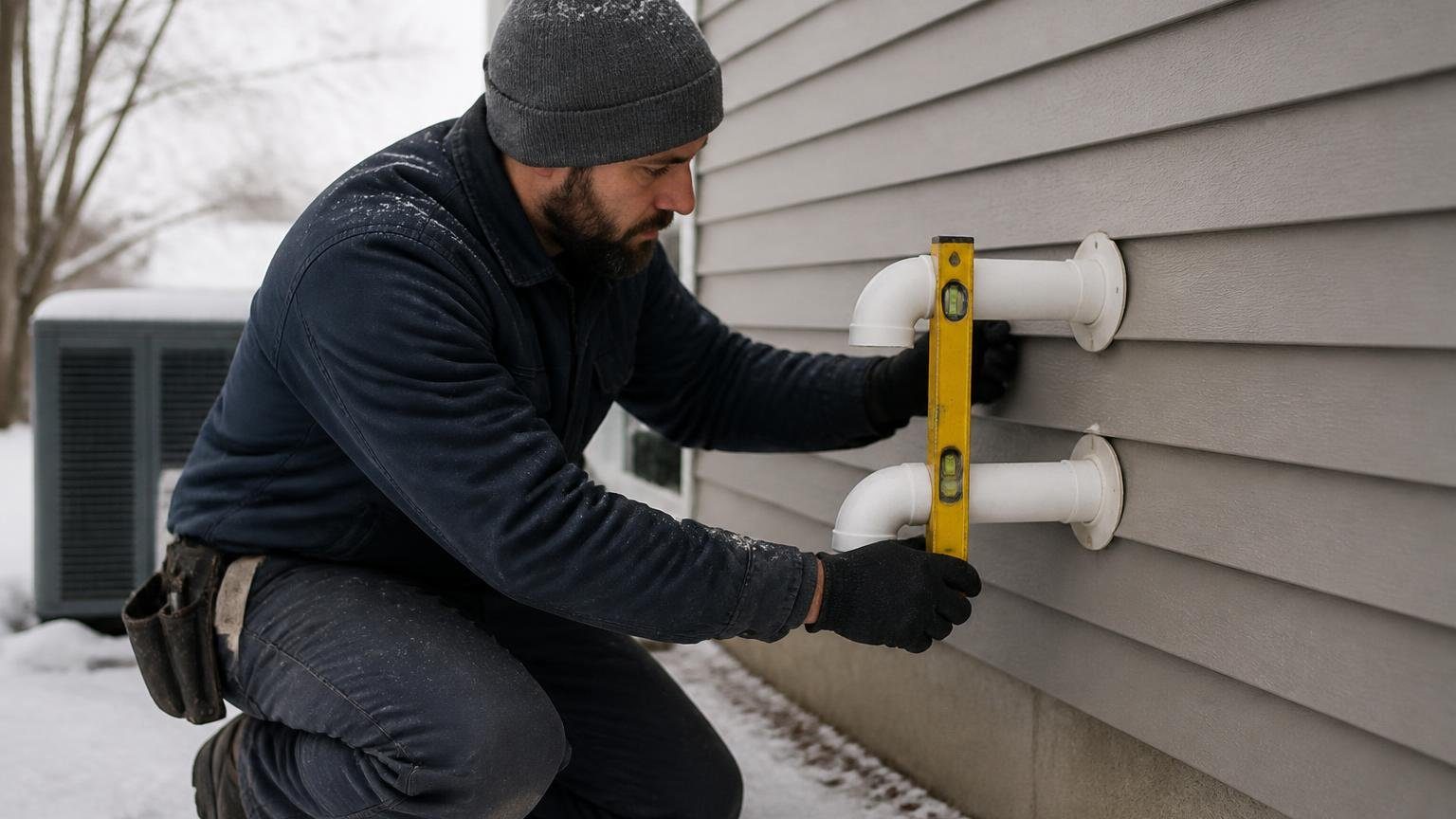
What is a furnace vent pipe? A furnace vent pipe carries combustion gases outdoors, and the furnace’s vent category sets its material: Type B metal vent or a lined chimney for most 80% furnaces, and only the plastic named in the maker’s manual for 90%+ condensing furnaces.
Key Takeaways
- Fuel gas codes define four vent categories by pressure and condensation, and the category picks the pipe (2021 Seattle Fuel Gas Code, an IFGC adoption).
- Plastic venting is allowed only where the furnace manual identifies “the specific plastic piping material” (Section 503.4.1).
- Makers disagree on cellular core: Goodman’s 2018 GCVC96 manual accepts F891 cellular core PVC, while Lennox’s 2024 ML196UHE pipe list leaves it out (Goodman GCVC96).
- Both vent types slope 1/4 inch per foot: up toward the chimney on Category I, back toward the furnace on condensing units (Lennox SL280UHV).
- A nondirect-vent terminal sits 4 feet below or beside, or 1 foot above, an openable window or door, and 12 inches above grade (Table 503.8).
- DOE warns that after a 90+ AFUE upgrade, a water heater left in the old chimney vents through an oversized flue (DOE Energy Saver, archived copy).
What is a furnace vent pipe called, and which type does your furnace need?
A furnace vent pipe is also called a flue pipe, exhaust pipe or vent connector. Its required type depends on the furnace’s vent category, and fuel gas codes define four categories by whether the vent runs under positive pressure and whether its gases condense.
DOE puts fan-assisted furnaces at 80% to 83% AFUE with a “small-diameter flue pipe,” and condensing sealed-combustion furnaces at 90% to 98.5%. Rheem’s 801T manual defines Category I as nonpositive vent pressure with vent gas at least 140°F above its dew point; the inducer motor supplies the draft. A condensing furnace is the opposite case: Lennox calls its ML196UHE a Category IV gas furnace whose exhaust “operates under positive pressure and must be completely sealed.”
| Category | Vent pressure | Condensate in vent | Example in our documents | Pipe the documents name |
|---|---|---|---|---|
| I | Nonpositive | Avoided | Lennox SL280UHV, Rheem 801T | Type B vent (UL 441), lined masonry chimney |
| II | Nonpositive | Possible | None among the furnaces we checked | Vent tested to UL 1738 |
| III | Positive | Avoided | HTPV-vented units, now recalled | UL 1738 special gas vent, stainless steel |
| IV | Positive | Possible | Lennox ML196UHE, Goodman GCVC96 (condensing) | Plastic named in the maker’s manual |
Mobile homes vent through a listed roof jack instead; see our mobile home furnace guide.
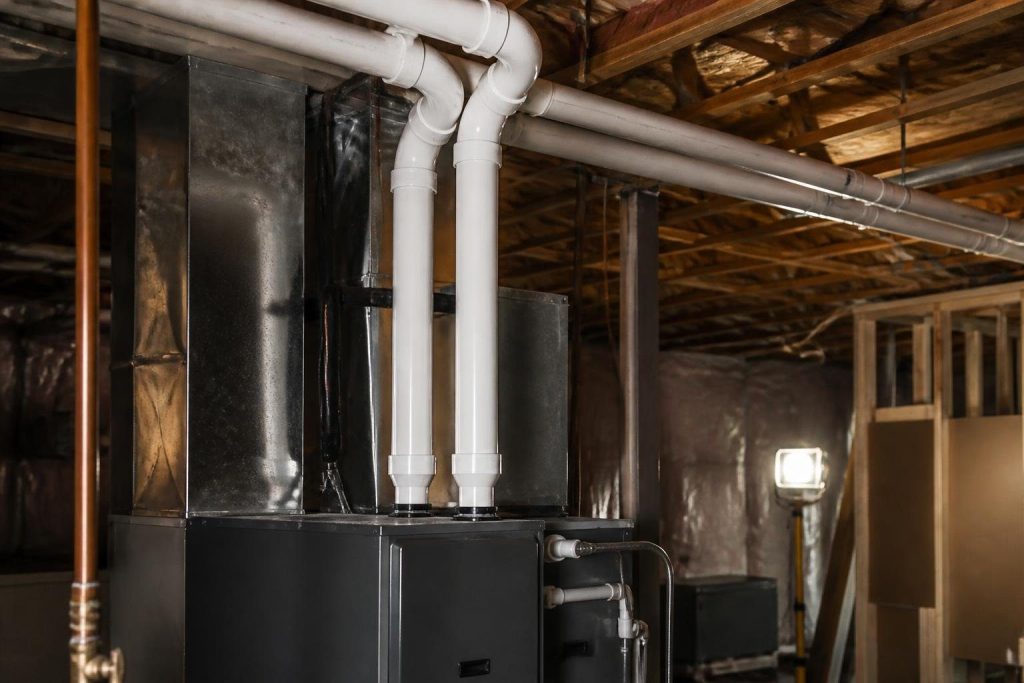
Can you use PVC for a furnace vent pipe?
Yes, but only on a furnace whose installation manual names PVC, which in practice means a condensing furnace. Section 503.4.1 of Seattle’s IFGC-based code requires the appliance to be “listed for use with such venting materials” and its instructions to name the specific plastic.
Section 502.1 requires Category II and III vents to be tested to UL 1738, the venting standard for Category II, III and IV appliances, and Type B vent to UL 441. It waives listing for Category IV plastic only when the furnace maker specifies it.
| Maker document | Plastics named for the vent | Cellular core (foam core) | Canada |
|---|---|---|---|
| Goodman GCVC96 (2018) | Schedule 40 PVC (D1785), ABS Schedule 40 | Accepted: F891 PVC and ABS foam core | S636 listed PVC |
| Carrier 58MVC (legacy model) | ABS, PVC and CPVC, Schedule 40 and SDR | Listed: F891 PVC, F628 ABS | ULC S636; SDR pipe not approved |
| Lennox ML196UHE (2024) | PVC (D1785), CPVC (F441), SDR-21/26 PVC, PolyPro, InnoFlue, IPEX System 1738 | Not on the pipe list | ULC S636, one maker’s system |
Myth: any PVC from the plumbing aisle will do
Code points to the furnace manual, and manuals differ on cellular core. Plastic on an 80% furnace is a known hazard: DOE says high-temperature plastic vent used on some fan-assisted furnaces installed between 1987 and 1993 “has been recalled and should be replaced by stainless steel vent pipe.”
Rheem says new HTPV installs in Category III service “should cease immediately.” Plastic will soon be the norm, because 10 CFR 430.32 requires 95.0 AFUE for non-weatherized gas furnaces made on and after December 18, 2028; our 95% furnace rule explainer covers what that changes.
What are the furnace vent pipe slope, support and length rules?
Furnace vent pipe slope is 1/4 inch per foot, but the direction flips with the category. Code Section 503.10.8 says a Category I connector must “slope upward toward the vent or chimney,” while condensing vents slope down toward the furnace so condensate reaches its trap.
- Slope. Lennox calls a 1/4 inch drop per 12 inches “mandatory for drainage.” For drips from a sagging run, see furnace leaking water.
- Support. Rheem recommends Category I supports at 4 foot intervals and at every elbow. Goodman supports condensing runs every three to five feet; Carrier’s 58MVC says every 5 ft. (3 ft. for SDR PVC).
- Horizontal reach. Lennox’s SL280UHV tables allow 1-1/2 feet of horizontal connector per inch of diameter: 6 feet for a 4 inch connector.
- Cold spaces. Section 503.10.2.2 requires Type B or Type L where a Category I connector crosses an attic or crawl space. Goodman insulates condensing vent exposed below 35°F for long periods with 1/2 inch closed cell foam.
- Total length. Goodman’s *MVC960803BN allows 45 feet of 2 inch pipe with one elbow but 113 feet of 3 inch. Its *MVC961005CN cannot use 2 inch pipe at all, so the model’s table sets the diameter.
A vent that is too long or blocked starves the draft, so the pressure switch stops ignition.
Where must a furnace exhaust pipe terminate outdoors?
A sidewall furnace exhaust pipe must sit 12 inches above grade and clear openings by a distance that depends on whether the furnace is direct vent. For a nondirect-vent terminal, Table 503.8 sets 4 feet below or to the side of an openable window or door, or 1 foot above it.
Direct-vent terminals get shorter distances by input: 6 inches up to 10,000 Btu/h, 9 inches up to 50,000 Btu/h, and 12 inches up to 150,000 Btu/h. The same table requires:
- 3 feet above any mechanical air inlet within 10 feet horizontally;
- 3 feet from a service regulator vent outlet for gas up to 2 psi, and 3 feet to each side up to 15 feet above it;
- 7 feet above a paved public sidewalk or driveway, and never over a walkway where condensate or vapor is a nuisance;
- 12 inches under a deck or porch only when it is open on two sides.
Lennox’s NFPA 54 column matches; Goodman sets 12 inches from any opening for its direct vent units.
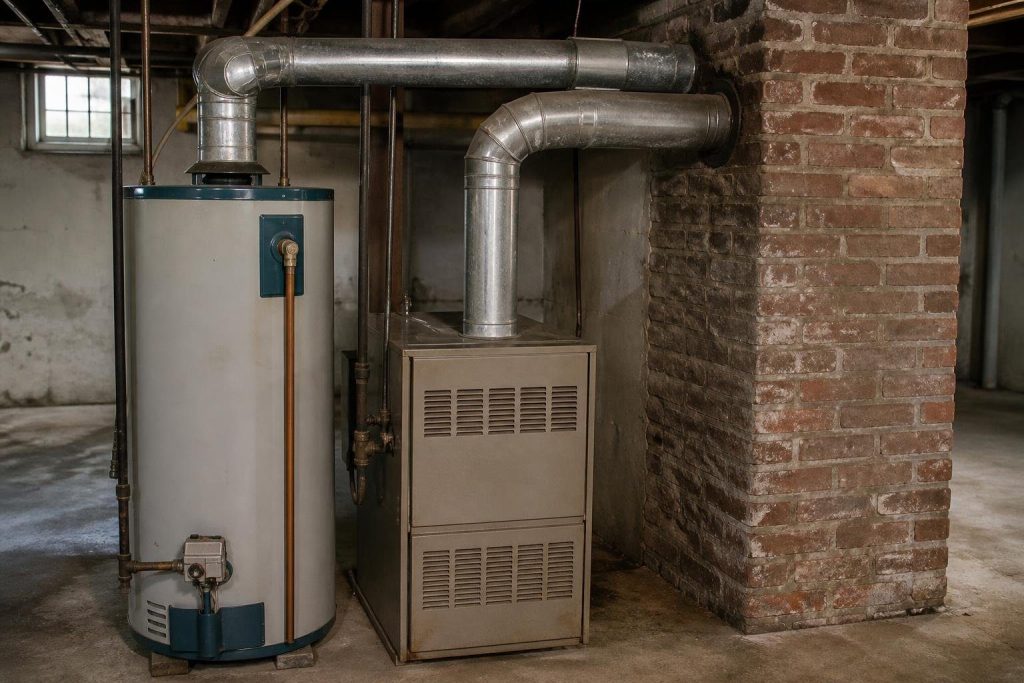
How does B vent work on an 80% furnace?
B vent is double-wall metal gas vent, tested to UL 441, that lets a Category I furnace exhaust rise by buoyancy. Rheem’s 801T instructions say a B-1 vent must end at least 5 feet above the highest flue collar it serves, under a listed cap.
Above the roof, Rheem restates the gas code: a vent that does not qualify for the listed-cap rule must end 2 feet above its roof penetration and 2 feet higher than any part of the building within 10 feet. Lennox’s SL280UHV is “not approved for use with horizontal venting,” so 80% furnaces generally go up, not out.
Lennox prohibits unlined masonry chimneys and bans venting a single fan-assisted furnace into a tile-lined chimney until it is lined with B1 vent or an insulated flexible liner. Rheem forbids sharing a chimney with a wood or coal appliance.
What happens to the water heater when the furnace flue pipe changes?
The water heater can be orphaned. DOE says that when a 90+ AFUE furnace or a heat pump stops using the old chimney, a gas water heater left behind vents through an oversized chimney, which “can lead to condensation and inadequate draft.”
DOE’s fix is a liner sized for the water heater alone, or sometimes a through-wall vent. It also says to reline when installing a furnace rated 80% or more. Lennox’s ML196UHE manual warns the remaining vent is “probably oversized” and must be checked for proper draw.
Section 503.5.6 requires the chimney to be examined before an appliance is replaced, and 503.5.6.3 requires an unsafe chimney to be relined or replaced to NFPA 211. Our oil to gas conversion guide covers liners, and the water heater replacement guide covers venting options.
Get the vent and water heater check in writing when you plan a furnace replacement, and ask whether a mechanical permit applies.
A leaking or backdrafting vent can spill carbon monoxide indoors; Lennox warns the SL280UHV vent “must be securely connected” at all times. Confirm your CO alarm placement too.
How we researched this
On October 11, 2026 we read Chapters 2 and 5 of the 2021 Seattle Fuel Gas Code, a public IFGC adoption with local amendments, since the ICC site blocks automated reading. We read five furnace manuals (Lennox 508245-01 and 507966-04, Rheem 801T, Goodman GCVC96, Carrier 58MVC), the UL 1738 scope, DOE Energy Saver and 10 CFR 430.32; maker figures are maker data. No Trane manual could be retrieved, so no Trane rule is stated. Reddit was skipped (combustion and CO safety topic), and no prices appear because no federal series exists.
Frequently asked questions
What is a furnace vent pipe called?
Installers call it a flue pipe, exhaust pipe or vent connector; the fuel gas code uses “connector” for the pipe joining an appliance to the vertical chimney or vent. On a condensing furnace the plastic exhaust is the whole vent, and direct-vent models add an intake pipe.
Does a gas furnace need a vent pipe?
Yes. Every vented gas furnace needs a vent built for its category, from Type B metal on a Category I unit to the maker’s named plastic on a condensing one. Electric furnaces skip it: DOE notes an all-electric furnace “has no flue loss through a chimney.”
Can I put a screen or cover on my furnace exhaust pipe?
Not unless the maker supplies it. Lennox says “do not use screens or perforated metal in exhaust or intake terminations,” warning they cause freeze-ups and may block the terminal. Use only the termination kit listed in your furnace manual, and keep both pipes clear of snow.
Should a furnace vent pipe be insulated?
Often, yes. Goodman requires 1/2 inch closed cell foam on condensing vent exposed below 35°F for extended periods, and Lennox caps uninsulated vent in unconditioned space at 5 linear feet or the table maximum. A Category I connector in an attic or crawl space must be Type B or Type L under Section 503.10.2.2.
What vent pipe is required in Canada?
Plastic vent for condensing furnaces in Canada must be certified to ULC S636. Lennox requires pipe, fittings, primer and cement from a single manufacturer and the first three feet of vent accessible for inspection. Carrier’s 58MVC manual says SDR pipe is not approved there.
Can a furnace vent pipe go through the roof?
Yes. Goodman’s condensing furnaces may exit the roof if the pipe ends 12 inches above the roof line or expected snow and 12 inches from any wall. A B vent on an 80% furnace ends at least 5 feet above the flue collar, per Rheem.
Sources
- City of Seattle. “2021 Seattle Fuel Gas Code, Chapter 5: Chimneys and Vents.” https://www.seattle.gov/documents/Departments/SDCI/Codes/FuelGasCode/2021SFGCChapter5.pdf. Accessed October 2026.
- City of Seattle. “2021 Seattle Fuel Gas Code, Chapter 2: Definitions.” https://www.seattle.gov/documents/Departments/SDCI/Codes/FuelGasCode/2021SFGCChapter2.pdf. Accessed October 2026.
- Lennox. “ML196UHE Installation Instructions, 507966-04.” https://www.lennox.com/dA/2a12f2b40e/507966-04g.pdf. Accessed October 2026.
- Lennox. “SL280UHV Installation Instructions, 508245-01.” https://www.lennox.com/dA/0891b8032a/508245-01b.pdf. Accessed October 2026.
- Rheem. “Installation Instructions, (-)801T Upflow Series Gas Furnaces” (distributor copy). https://resource.gemaire.com/is/content/Watscocom/Gemaire/rheem_r801t_en_ii.pdf. Accessed October 2026.
- Goodman. “GCVC96 Installation Instructions” (2018, retailer copy). https://cdn.shopify.com/s/files/1/0748/4745/3475/files/GCVC96-Install_11e55e78-9b7a-49aa-bc24-d8f803e9a9af.pdf. Accessed October 2026.
- Carrier. “58MVC Installation Instructions.” https://www.shareddocs.com/hvac/docs/1009/Public/03/58MVC-4SI.pdf. Accessed October 2026.
- UL Standards and Engagement. “UL 1738, Venting Systems for Gas-Burning Appliances, Categories II, III, and IV.” https://www.shopulstandards.com/ProductDetail.aspx?productId=UL1738. Accessed October 2026.
- U.S. Department of Energy. “Furnaces and Boilers” (archived copy). https://web.archive.org/web/2025id_/https://www.energy.gov/energysaver/furnaces-and-boilers. Accessed October 2026.
- eCFR. “10 CFR 430.32, Energy and water conservation standards.” https://www.ecfr.gov/current/title-10/chapter-II/subchapter-D/part-430/subpart-C/section-430.32. Accessed October 2026.
Leave a Reply