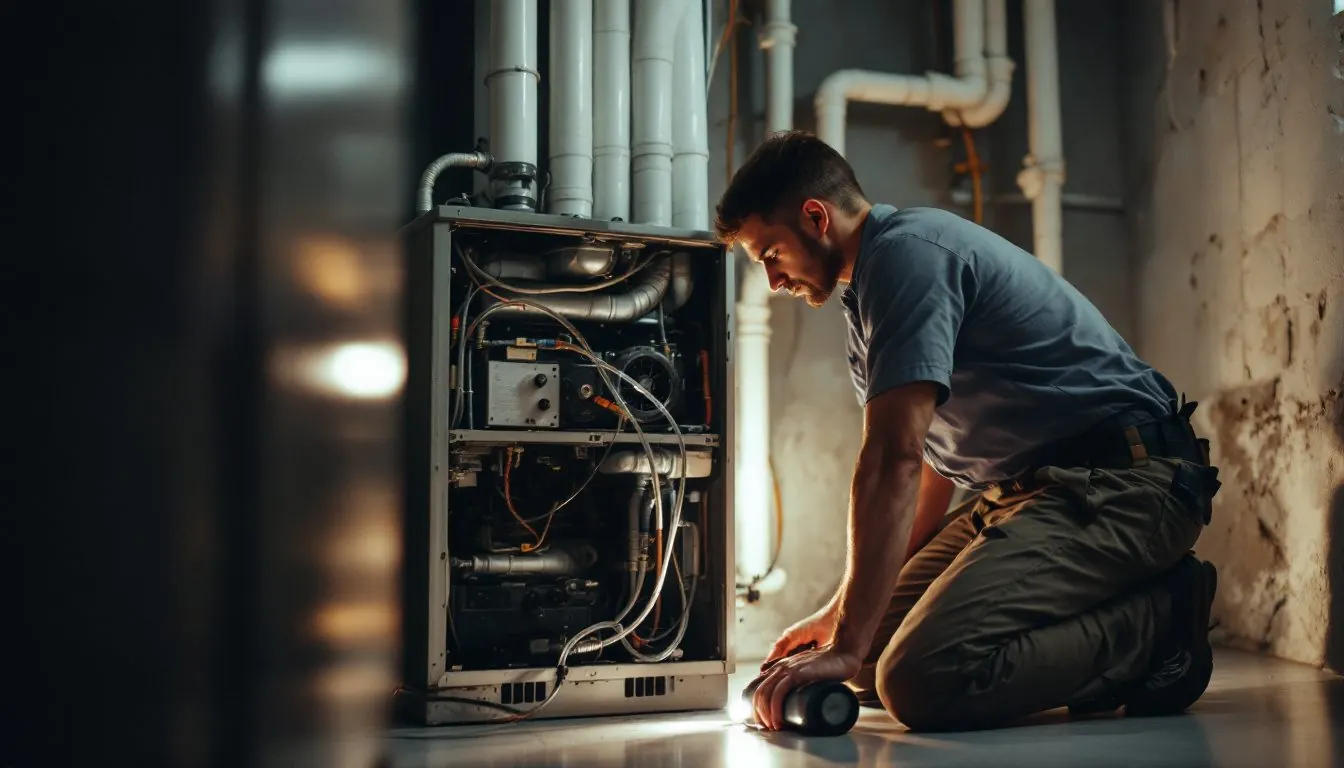
A furnace pressure switch proves the draft inducer is pulling exhaust out through the vent before the burners may light. Stuck open, it never sensed enough suction, usually from a blocked vent, drain or hose or a weak inducer. Stuck closed, it read closed before the inducer started, usually stuck contacts or a shorted wire.
Key Takeaways
- Goodman defines the switch as a safety device that blocks combustion through a restricted or blocked vent (Goodman RS6612022).
- Setpoints are suction in inches of water column: one Goodman GM9S92 inducer switch opens at 1.20, its coil cover switch at 0.10 (Goodman trip point chart).
- The Resideo S9200U1000 board waits 150 seconds for the switch to close, then idles five minutes and retries (Resideo 69-2075).
- The White-Rodgers 50M56D-751 board flashes code 31 for “did not close” and 23 for “did not open” (White-Rodgers).
- Rheem lists six reasons a switch will not close; only one is the switch’s hose, and none is the switch itself (Rheem 801T manual).
- Rheem and Goodman forbid jumpering it; Rheem requires 15 minutes of testing on a new safety switch (Rheem).
What does a furnace pressure switch do?
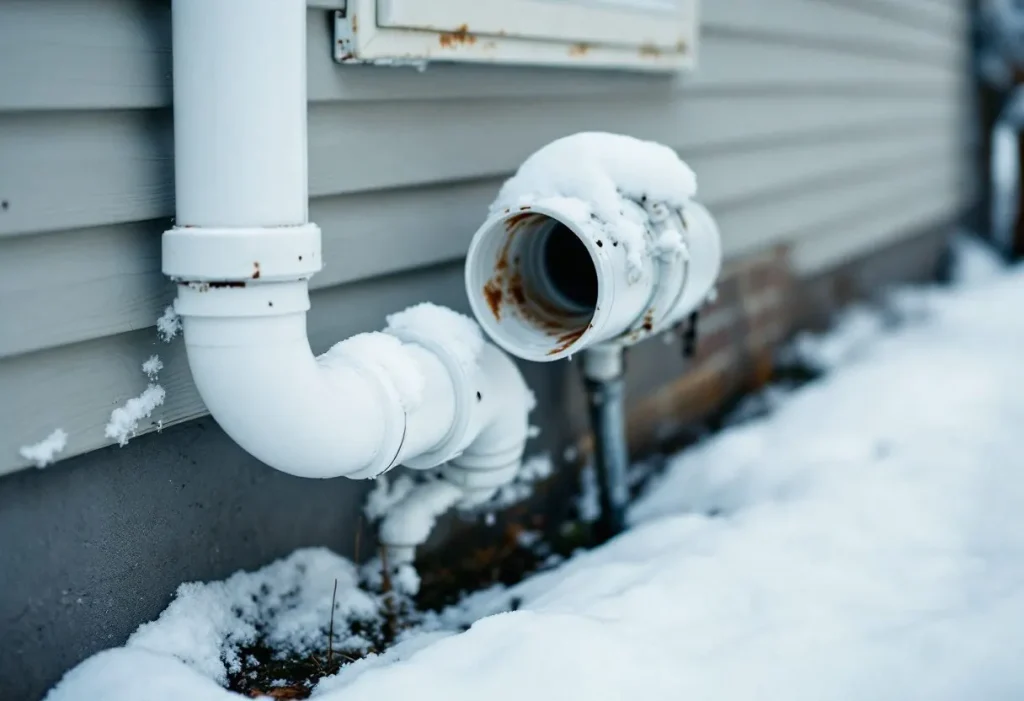
A furnace pressure switch is a diaphragm switch, fed by a hose from the inducer or collector box, that closes only when the draft inducer creates enough suction. Snow packed over the pipe ends is a classic winter reason that suction never builds, and a furnace vent blocked by snow explains why the switch then stays open until both pipes are cleared by hand. Goodman calls it “a safety device to prevent the combustion cycle from occurring with inadequate venting caused by a restricted or blocked vent pipe” (Goodman RS6612022).
The control checks it twice. A Goodman board confirms the switch is open, 0 VAC, before starting the inducer, and begins prepurge once it reads closed, 24 VAC. Our guides to where the ignition sequence stops and the flame sensor cover later steps.
Any furnace with an inducer has one: DOE describes mid-efficiency furnaces, 80% to 83% AFUE, as fan-driven, and condensing furnaces at 90% to 98.5% AFUE (DOE Energy Saver, archived copy). CPSC credits a voluntary furnace standard that “added blocked-vent shut-off devices” (CPSC release 02-255).
What do Lennox, Goodman, Carrier and Rheem flash for a pressure switch fault?
Each maker flags an open and a closed pressure switch with its own codes, and the codes change with the control board: a Goodman GMSS9 red LED flashes 3 for open and 2 for closed, while a Carrier 59TP6B shows status codes 32 and 23. Match the board or series on your door label before reading a row. If the furnace went dark instead, with no code at all, the furnace door switch is the first thing to check, since a blower door left crooked holds it open and every maker forbids bypassing it.
| Furnace and document | Display | Switch stuck open, did not close | Switch stuck closed, did not open |
|---|---|---|---|
| Lennox SL280DFNV, 508150-02 (04/2024) | Seven-segment | E223 low pressure switch failed open; E227 low switch open during trial for ignition or run; E225 high switch failed open | E224 low pressure switch failed closed; E226 high switch failed closed |
| Lennox ML196UHE, 507966-04 (04/2024) | Red LED | 9 flashes: failed to close or opened during heat demand; 10 flashes: Watchguard after 5 openings in one demand | 11 flashes: stuck closed before the combustion air inducer starts |
| Goodman GMSS9, AMSS9, RS6612012 | Single red LED | 3 flashes | 2 flashes |
| Goodman GM9S, Amana AM9S, RS6612022r1 | Display | E2 | E1 |
| Carrier 59TP6B, 59TP6B-01SI (04/19) | Status code LED | 32 low-heat switch did not close or reopened; 31 high-heat switch or relay did not close or reopened; 43 low-heat switch open while high-heat switch closed | 23 pressure switch did not open |
| Rheem (-)801T, 92-24161-164-01 | Seven-segment | 57 combustion switch open when it should be closed; 56 ignition switch open when it should be closed | 55 combustion switch closed when it should be open; 43 ignition switch closed when it should be open |
| Rheem standard single-stage boards | LED blinks | 2 blinks: pressure switch failure, remains open | 4 blinks: pressure switch failure, remains closed |
Compiled by The HVAC Brief, November 2026, from Lennox 508150-02, Lennox 507966-04, Goodman RS6612012, Goodman RS6612022r1, Carrier 59TP6B-01SI, Rheem 92-24161-164-01 and Rheem’s standard furnace flash code page, which excludes modulating, LXE and two-stage furnaces.
Code 43 is the trap in this table: on the Carrier 59TP6B it means the low-heat switch is open, while on the Rheem (-)801T display it means the ignition switch is closed when it should be open. A number read off one brand’s board means nothing on another’s. Board-by-board tables for older Lennox two-LED controls are in the Lennox furnace error codes. Frigidaire furnaces on Nordyne boards show the same trap within one badge, since a red flash count can mean different faults on different boards, as the Frigidaire furnace error codes show.
The Carrier, Bryant and Payne families share most status codes, and the series differences are laid out in the Carrier furnace error codes table. Rheem’s newer Bluetooth boards blink three-digit codes, which the Rheem furnace error codes page decodes digit by digit.
Where is the furnace pressure switch located, and what does the hose do?
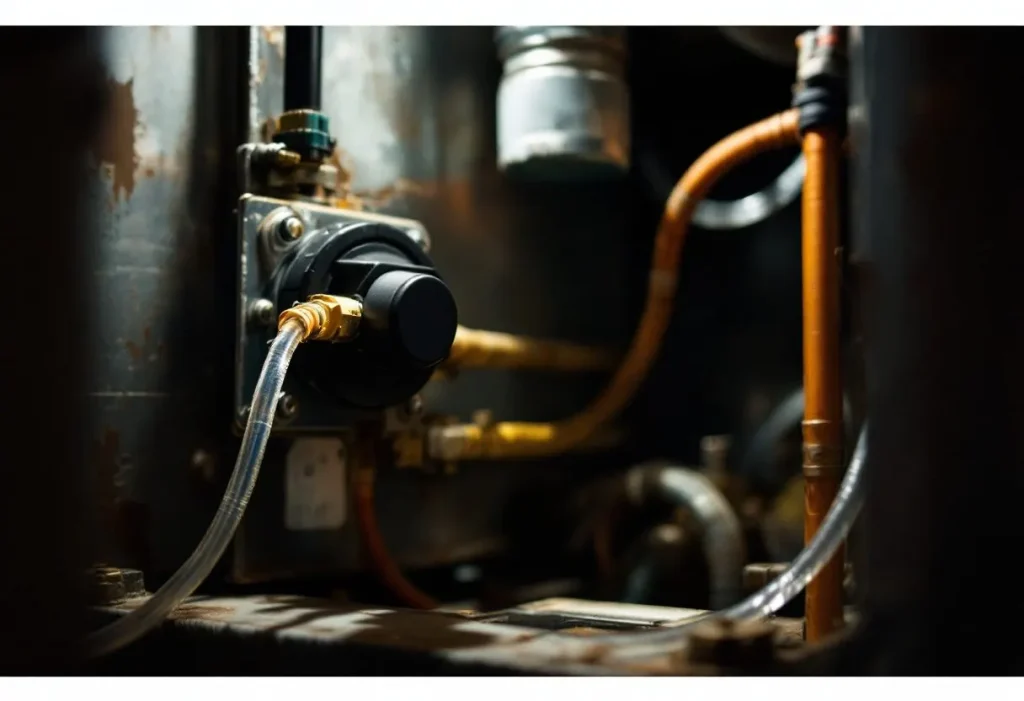
The furnace pressure switch sits beside the inducer motor behind the burner compartment door, hosed to a port on the inducer or collector box. Goodman’s test starts: “Remove burner compartment door to gain access to pressure switch(es)” (Goodman RS6612022).
Goodman’s 90% furnaces carry two switches, on the coil cover and the inducer, each with its own setpoint. If the hose is cracked, kinked, loose or holding water, the switch never sees the real suction; on 90% models Goodman says to check it “for kinks and/or moisure” (sic). After a winter outage that drain can freeze, which is why a frozen condensate drain heads the list when the inducer hums with no glow in a furnace not working after a power outage. Thawing that line takes gentle heat, never a flame, and a frozen furnace condensate line also covers re-priming the trap and keeping the cold section from refreezing.
What pressure closes a furnace pressure switch?
There is no universal number. Each furnace pressure switch is rated for its model in inches of water column (in. w.c.) of suction, printed on the switch. Goodman publishes a “set point on pressure fall,” where the switch opens as suction weakens, and a “max make on pressure rise,” the suction by which it must close.
| Goodman model (RS6612022 chart) | Coil cover switch opens at | Inducer switch opens at | Inducer switch must close by |
|---|---|---|---|
| GM9S92, *M9S920603BNAA | 0.10 ± 0.05 in. w.c. | 1.20 ± 0.05 in. w.c. | 1.41 in. w.c. |
| GM9S96, *M9S960603BNAA | 0.10 ± 0.05 in. w.c. | 1.49 ± 0.07 in. w.c. | 1.70 in. w.c. |
| GM9S96, *M9S961205DNAA | 0.10 ± 0.05 in. w.c. | 0.85 ± 0.05 in. w.c. | 1.00 in. w.c. |
| GC9S96, *C9S960403BNAA | 0.08 ± 0.04 in. w.c. | 1.49 ± 0.07 in. w.c. | 1.70 in. w.c. |
All values are suction readings from Goodman’s trip point chart. Two GM9S96 models differ by 0.64 in. w.c. at the inducer switch, so a “universal” switch is no basis for a repair. The 0.5 to 3.0 in. w.c. range on page one of Google traces to no manufacturer document we found.
What causes a pressure switch to stay open?
A furnace pressure switch stuck open usually means the switch is telling the truth: there is not enough suction at the hose, so the board will not light. Rheem lists six reasons a switch will not close (Rheem 801T):
- An inoperative induced draft blower.
- A loose or leaky pressure switch hose.
- A blockage in the exhaust vent.
- Severe downdrafts canceling the inducer’s draft.
- A leaky gasket at the induced draft blower.
- An improperly sized or installed vent.
For the “open with inducer on” case, Goodman says an inducer that “runs continuously with no furnace operation” points to a blocked flue or inlet pipe, a “blocked drain system,” a weak inducer, a pinched hose or a bad switch (Goodman RS6612022). An inducer that never shuts off is a furnace fault, unlike an outdoor unit that keeps running with the thermostat off, which points to a stuck contactor in an AC that will not turn off. It also flags condensate in the inducer and a plugged switch port, water that on many condensing installs ends up at a condensate pump. Outdoors, CPSC warns that “birds, other animals and insects sometimes nest in vents” (CPSC).
The Resideo S9200U1000 waits 150 seconds, shuts the inducer off, idles five minutes and retries, and “this process continues indefinitely” (Resideo 69-2075). A switch that closes but drops out mid-cycle is one cause of a furnace that short cycles.
What does a pressure switch stuck closed mean?
A pressure switch stuck closed reads closed before the inducer starts, so the board treats it as a failed safety and will not start. Trane gives this fault its own flash count on one of its boards, which is why the Trane furnace error codes have to be read board by board. Rheem: “the pressure switch contacts must open before the unit can go through another heating cycle” (Rheem 801T).
Goodman flashes E1 for a circuit “closed at the start of heating cycle” and lists two causes: sticking contacts, so replace the switch, or a short in the switch wiring (Goodman RS6612022). White-Rodgers’ 50M56D-751 board for Carrier furnaces calls it code 23, “Pressure Switch Did Not Open” (White-Rodgers). Resideo’s board flags it after five seconds and resumes once the switch opens (Resideo). That differs from a tripped high limit switch, which opens on heat. Goodman reads these faults differently from one board to the next, a pattern the Goodman error code tables lay out by control.
Why would a pressure switch not close?
Because the suction at its hose never reaches the switch setpoint. The inducer motor creates the suction the pressure switch measures, so a dead, weak or obstructed inducer looks exactly like a bad switch; the switch itself is to blame only when a manometer shows suction above its rating with the contacts still open. Goodman’s flowchart asks whether the inducer runs, then whether it has 115 volts (Goodman RS6612022).
No voltage points to the board or wiring; voltage with no rotation means “the inducer is defective or off on thermal protector,”: “If you have 115V and the motor does not run, replace the induced draft motor.” A running inducer can still fall short through a leaky gasket or condensate in the housing. Water standing in the vent pipe does the same, and a gurgling furnace exhaust pipe is the usual warning, from a sag between hangers or a trap that cannot drain. On an Amana with a single red LED, a switch that never closed has a blink count of its own, listed in the Amana furnace error codes.
Goodman runs a 15 second post purge; if the switch drops out during prepurge, Resideo holds the inducer on up to 60 seconds to re-close it (Resideo). Only then does the board power the hot surface igniter.
What can a homeowner check, and what needs a technician?
A homeowner can read the fault code, cut power and look for visible blockages; opening the burner compartment, vent or drain is technician work, and Goodman marks drain service “QUALIFIED SERVICER ONLY” (Goodman RS6612022).
Safe owner checks:
- Count and note the flash code through the sight glass.
- Set the thermostat to off, then switch off the furnace’s service switch.
- Outdoors, clear snow, ice, leaves or nests from the intake and exhaust pipe ends you can reach.
- Look at any visible switch hose for a kink, loose end or water, without removing panels.
- Restore power once; if the code returns, call a technician.
| Check | Who | What it proves |
|---|---|---|
| Flash code count | Owner | Stuck closed or stuck open |
| Vent and intake terminations | Owner | Visible blockage |
| Manometer on the hose, inducer running | Technician | Suction versus the switch rating |
| Ohmmeter across switch contacts | Technician | Bad switch or weak suction |
| 115 V at inducer, winding test | Technician | Inducer motor or board fault |
| Drain trap, vent length and elbows | Technician | Water or vent restriction |
Goodman’s core test: with the inducer running, check the contacts with an ohmmeter; if open, “compare the negative reading on the manometer with the rating on the pressure switch.” A blocked vent is also a carbon monoxide risk; CPSC urged yearly inspections “checking chimneys, flues and vents for leakage and blockage” (CPSC), and our guide to CO alarm placement covers the backup. A plugged intake trips the same switch as a plugged exhaust on a sealed furnace, and telling the furnace intake from the exhaust pipe starts where each pipe meets the cabinet, since both are usually white PVC of the same diameter.
Can you bypass a furnace pressure switch, and when is replacement right?
No. Jumpering a furnace pressure switch lets burners fire with no proof exhaust is leaving, and every manufacturer document we read forbids it. Rheem: “DO NOT BYPASS, JUMPER, OR REMOVE ANY SAFETY SWITCH FROM THE FURNACE CONTROL CIRCUIT” (Rheem 801T). Goodman: “Never by-pass or alter furnace controls” (Goodman).
Correction: a top-ranking page tells readers to jumper the switch wires as a diagnostic step. Rheem calls a safety switch shutdown “an indication of a potential safety hazard.”
Replace the switch only when the manometer shows suction above its rating with contacts open, or contacts stick closed. Rheem requires “identical OEM replacement parts” and a test of at least 15 minutes on any new safety switch. Goodman assigns switch assemblies by model: 0130F00480 for the GM9S92 above. No federal price series covers it, as our furnace repair cost breakdown explains.
Condensing, two-switch furnaces are coming: the federal minimum for non-weatherized gas furnaces rises from 80.0% AFUE to 95.0% for units made on and after December 18, 2028 (10 CFR 430.32(e)), covered in our 2028 furnace standard explainer.
How we researched this
Research date: October 8, 2026; updated November 12, 2026, when we opened six more maker documents (two Lennox installation manuals, Goodman RS6612012, Carrier 59TP6B-01SI and Rheem’s flash code page, plus a fresh copy of Rheem 92-24161-164-01) to build the flash code table. We cite 12 sources, listed below; the manufacturer documents are Tier 2, used only for their own equipment, and each code is given only for the board or series named in its row.
Excluded: Reddit and forums (combustion safety topic), the unsourced cost ranges and pressure ranges on page one of Google, and any installed price, since no federal series exists.
Frequently asked questions
Can a bad pressure switch cause a furnace not to turn on?
Yes. If the switch does not close after the inducer starts, the burners never light; if it reads closed before the inducer starts, the inducer never starts. Goodman logs these as E2 and E1, White-Rodgers as codes 31 and 23.
How do I know if my furnace pressure switch is bad?
A technician reads suction with a manometer and checks the contacts with an ohmmeter while the inducer runs. Suction above the switch rating with open contacts means a bad switch. Suction below it points to the vent, hose, drain or inducer, per Goodman.
What causes a pressure switch to be stuck open with the inducer running?
Weak suction at the hose. Goodman lists a blocked flue or inlet pipe, a blocked drain system, a weak inducer and a pinched hose. Rheem adds severe downdrafts, a leaky inducer gasket and an improperly sized vent. Fix the cause before replacing the switch.
Can water in the pressure switch hose stop a furnace?
Yes, on condensing furnaces. Water in the hose or a plugged port hides the suction. Goodman tells technicians to check the hose for kinks and moisture and to prime and clear the drain trap, and reserves drain service for qualified servicers.
Is it safe to run a furnace with the pressure switch jumped?
No. A jumpered switch lets burners fire without proof that exhaust is leaving. Rheem and Goodman both forbid bypassing safety controls. CPSC put heating system and water heater CO deaths at about 160 a year in its 2002 release. Call a technician instead.
How long does the furnace wait for the pressure switch to close?
It depends on the board. The Resideo S9200U1000 waits 150 seconds, idles five minutes and retries indefinitely. If the switch opens during prepurge, it holds the inducer on up to 60 seconds to re-close it. Other boards use different timings.
Sources
- Goodman Manufacturing. “Service and Troubleshooting, GM9S92/GM9S96/GC9S96, RS6612022r1.” https://mobile.goodmanmfg.com/mobileapp/stellent/pdf/infoPdf/Lit/RS6612022R1.pdf. Accessed October 2026.
- Rheem. “Installation Instructions, (-)801T Series, 92-24161-164-01.” https://resource.gemaire.com/is/content/Watscocom/Gemaire/rheem_r801t_en_ii.pdf. Accessed October 2026.
- Resideo. “S9200U1000 Integrated Furnace Control, Installation Instructions, 69-2075EF-07.” https://www.cochranesupply.com/media/assets/product/documents/Honeywell/S9200U1000.pdf. Accessed October 2026.
- White-Rodgers (Copeland). “50M56D-751 Control Kit, Installation Instructions.” https://media.copeland.com/7b1c16cb-45cd-45fe-8e23-b16b0109fc57/0037-7757001%20-%2050M56D-751%20Instruction%20Sheet%20(EF).pdf. Accessed October 2026.
- U.S. Department of Energy, Energy Saver. “Furnaces and Boilers” (archived copy). https://web.archive.org/web/2025id_/https://www.energy.gov/energysaver/furnaces-and-boilers. Accessed October 2026.
- eCFR. “10 CFR 430.32, Energy and water conservation standards.” https://www.ecfr.gov/current/title-10/chapter-II/subchapter-D/part-430/subpart-C/section-430.32. Accessed October 2026.
- U.S. Consumer Product Safety Commission. “CPSC Urges Seasonal Heating Systems Inspections to Prevent CO Deaths,” release 02-255, 2002. https://www.cpsc.gov/Newsroom/News-Releases/2002/CPSC-Urges-Seasonal-Heating-Systems-Inspections-to-Prevent-CO-Deaths. Accessed October 2026.
- Lennox Industries. “SL280DFNV Installation Instructions, 508150-02.” https://www.lennox.com/dA/78477aadd3/508150-02a.pdf. Accessed November 2026.
- Lennox Industries. “ML196UHE Installation Instructions, 507966-04.” https://www.lennox.com/dA/2a12f2b40e/507966-04g.pdf. Accessed November 2026.
- Goodman Manufacturing. “Service Instructions, GMSS9/GCSS9/AMSS9/ACSS9, RS6612012.” https://mobile.goodmanmfg.com/mobileapp/stellent/pdf/infoPdf/Lit/RS6612012.pdf. Accessed November 2026.
- Carrier. “59TP6B Installation, Start-up, Operating and Service and Maintenance Instructions, 59TP6B-01SI, 04/19.” https://www.shareddocs.com/hvac/docs/1009/public/0d/59tp6b-01si.pdf. Accessed November 2026.
- Rheem. “Standard Gas Furnace Diagnostic Codes.” https://my.rheem.com/pts/Topics/GF_Flash_Code.asp. Accessed November 2026.
Leave a Reply