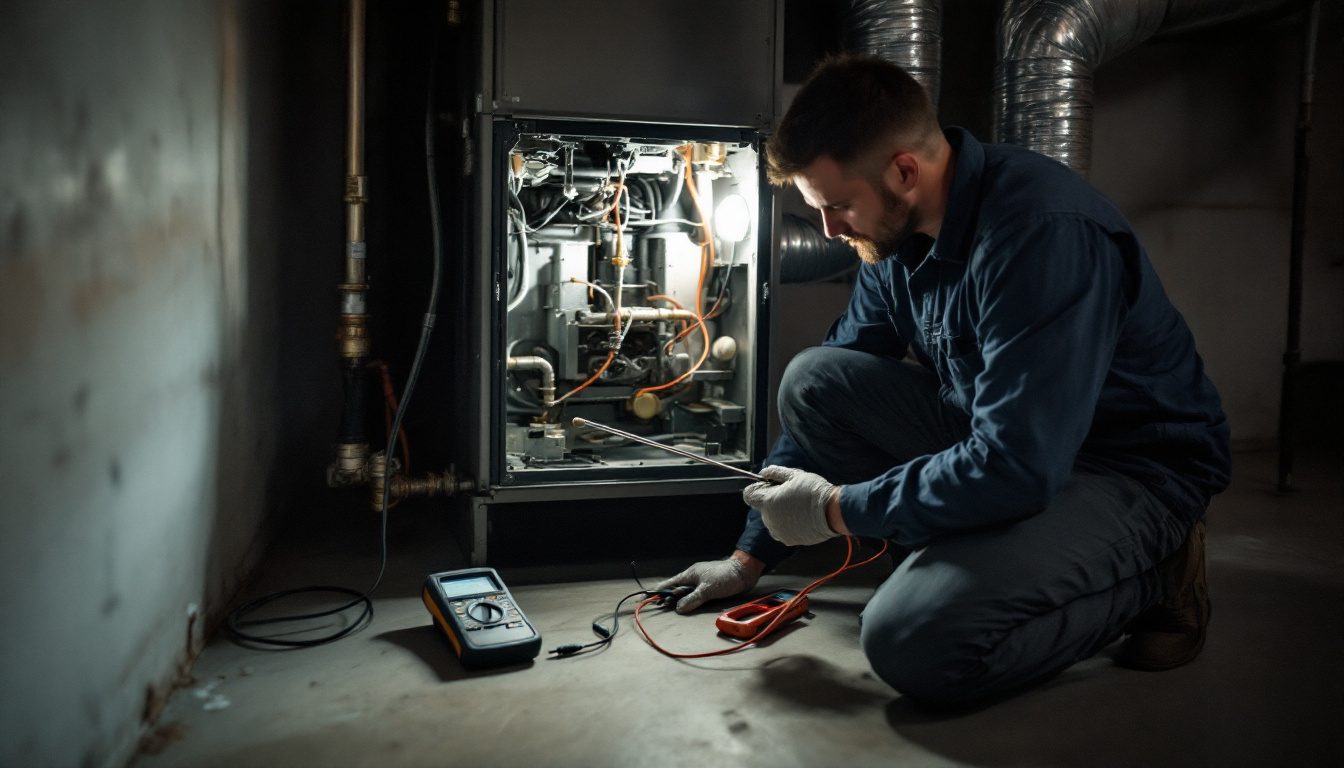
What does a furnace flame sensor do? A furnace flame sensor is a metal rod in the burner flame that proves the gas has lit. If its microamp signal is too weak, the control closes the gas valve within seconds, so burners light, die and retry. A dirty rod is one cause; reversed polarity and bad grounds are others.
Key Takeaways
- Goodman integrated ignition controls read 1 to 4 microamps of flame current (Goodman RS6612022).
- A White-Rodgers board for Carrier furnaces detects flame at 0.25 microamps and rates 1.0 to 5.0 as good (White-Rodgers 50M56D-751).
- The Resideo S9200U1000 board allows three ignition trials, then waits 60 minutes before trying again (Resideo 69-2075).
- Goodman and Rheem both name steel wool for cleaning and both assign the job to a qualified servicer (Rheem 801T manual).
- Reversed L1 and L2 wiring or a poor ground stops flame sensing even on a clean rod (Goodman).
- DOE lists electronic ignition with no pilot light on furnaces rated 80% to 83% AFUE (DOE, archived copy).
What is a furnace flame sensor and how does it work?
A furnace flame sensor is a thin metal rod on the burner assembly, tip in the flame, that tells the control board the gas is actually burning. It senses electrical current carried through the flame, not heat.
The method is flame rectification. The control puts an alternating voltage on the rod; Resideo labels its flame input “90 Vac, current limited” (Resideo). Goodman notes that “for flame rectification the common side of the secondary voltage (24 V) is cabinet grounded,” so the burner is the return path.
Flame ions conduct, and the alternating current “is biased by the flame ions, thereby creating a sensible DC offset” (US Patent 9,927,382). White-Rodgers specifies the result in microamps, measured with a DC ammeter. No current, no gas. The rod works alongside the hot surface igniter that lights the burners, though Rheem’s 801T combines both jobs in one “ignitor/flame sense” probe.
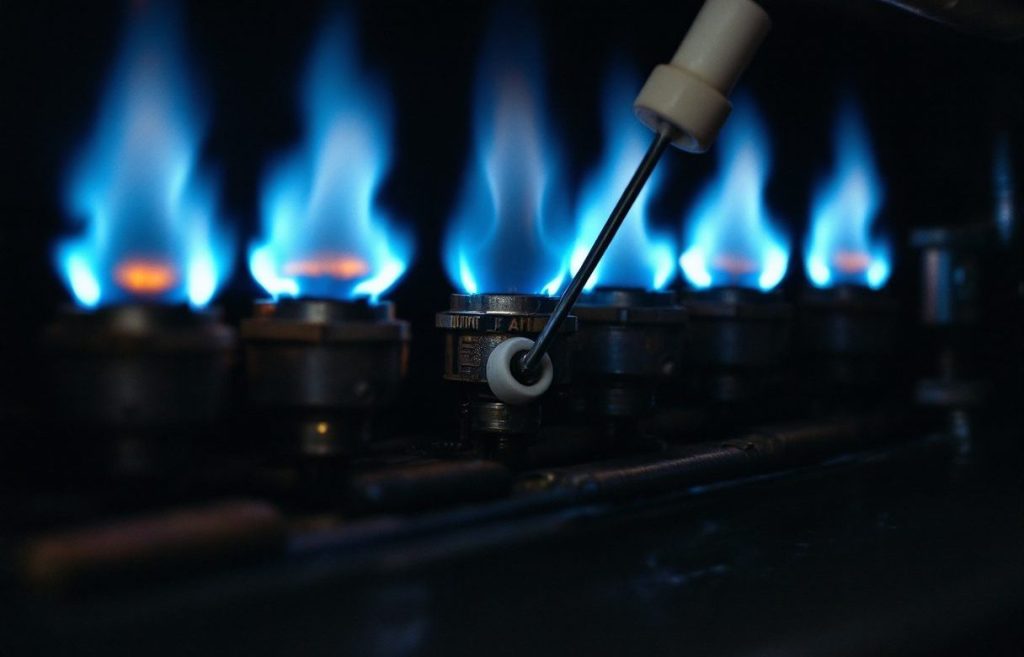
Where is the furnace flame sensor located?
The furnace flame sensor sits in the burner compartment, screwed to the burner assembly with its tip in one burner’s flame and a single wire back to the control board. Position matters: Goodman lists “flame sensor incorrectly positioned in burner” as its own fault and the “sensor to burner gap” as a cause of low readings (Goodman RS6612022). On a sealed combustion furnace the burners sit inside a closed box, which only a technician should open.
What are the symptoms of a bad furnace flame sensor?
The classic symptom of a bad furnace flame sensor is a burner that lights, burns a few seconds, goes out and repeats. The gas did ignite; the control just could not prove it.
The rest is written into the control’s timing. On the Resideo S9200U1000, after a 30 second prepurge and igniter warm-up, if flame is not sensed during the trial, or is lost less than 10 seconds after it, the valve closes, the inducer runs a purge of 60 seconds and the board tries again, with two retries allowed (Resideo). After the third failure it sits in soft lockout for 60 minutes, then starts over.
So the homeowner sees light, die, inducer hum, repeat, then silence. Rheem’s 801T shows code 12, “Low Flame Sense,” and locks out for an hour after four ignition trials (Rheem). The Resideo board flashes its amber LED for a weak flame lasting longer than five seconds, and the White-Rodgers 50M56D-751 logs code 14 for a lockout after 3 retries.
Timing separates this from other faults. A furnace that runs several minutes before stopping points to furnace short cycling causes. One that never lights at all belongs in our guide to a furnace that will not ignite.
What microamp reading does a furnace flame sensor need?
A furnace flame sensor must beat the board’s minimum, and each manufacturer sets its own target. Goodman says its integrated controls “will have 1 to 4 micro-amps” (Goodman). White-Rodgers rates 1.0 to 5.0 as good and 0.5 to 1.0 as marginal (White-Rodgers).
The detection floor sits far lower: that White-Rodgers board confirms flame at 0.25 microamps and treats 0.1 microamps or less as no flame. A coating eats into the gap between floor and target, which is why a sensor can degrade for weeks before it starts failing.
| Control (document) | Flame current figure | Trial for ignition | After failed trials |
|---|---|---|---|
| Goodman GM9S92/GM9S96 (RS6612022) | 1 to 4 microamps | 4 seconds | Lockout after three tries in total |
| White-Rodgers 50M56D-751 (Carrier replacement) | 0.25 microamps minimum; 1.0 to 5.0 good | 3 second ignition activation | Lockout after 3 retries; resets after 1 hour |
| Resideo S9200U1000 (universal) | Weak flame flagged by LED | 4, 6 or 8 seconds | Three trials, then 60 minutes soft lockout |
| Rheem 801T, spark pilot | Code 12, Low Flame Sense | Main valve opens once pilot flame is proven 2 seconds | One-hour lockout after four ignition trials |
Measuring it is a technician task, with burners firing and panels off. Goodman puts a microamp meter in series between the sensor wire and terminal. The White-Rodgers board has test pins where a meter on DC volts reads directly as microamps, 1 VDC equal to 1 microamp.
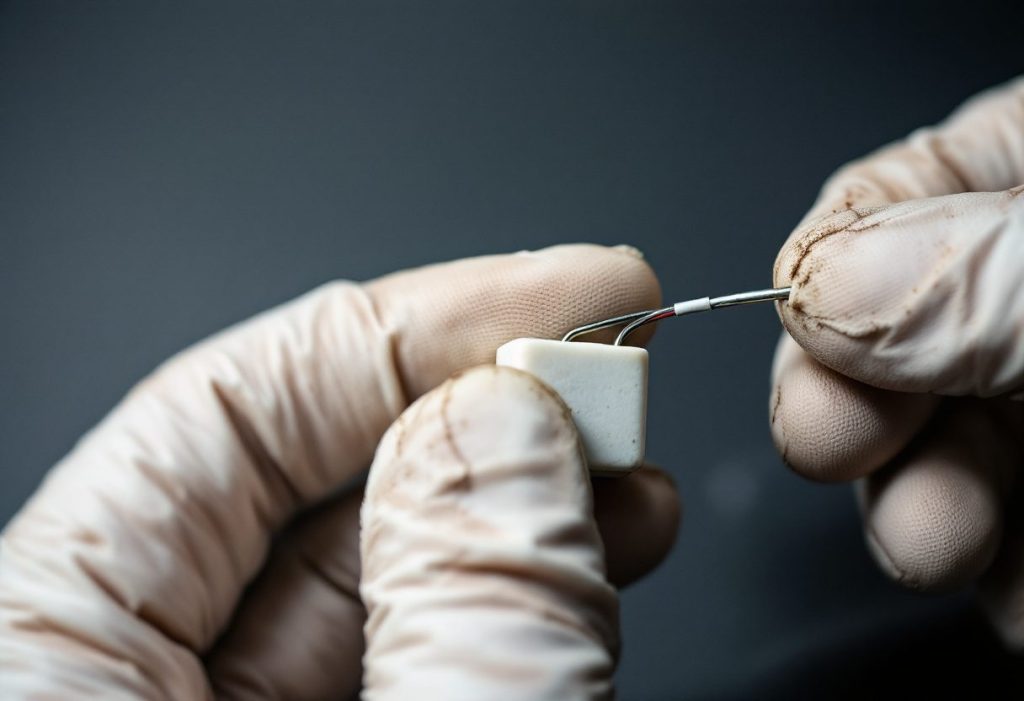
How do you clean a furnace flame sensor safely?
Furnace flame sensor cleaning means lightly polishing the rod with fine steel wool or a Scotch Bright pad, with power and gas off. Both manuals make it a professional job: Goodman says “a qualified servicer must carefully clean the flame sensor with steel wool,” and Rheem assigns it to “a qualified installer, service agency or the gas supplier” each heating season (Rheem).
Safe homeowner work needs no tools. Read the fault code through the sight glass first, because Goodman warns that pulling the blower door without holding the door switch loses the stored code (Goodman). Check the filter and thermostat. If you clean the rod yourself anyway, this is the sequence:
- Turn off power at the furnace service switch and the breaker.
- Close the manual gas valve at the furnace and let the burners cool.
- Photograph the wire, pull it off, remove the mounting screw and slide the rod out.
- Polish only the metal rod, lightly, until the dull coating is gone. Do not bend it.
- Wipe off residue and reinstall it in exactly the same position.
- Restore gas and power and watch one full cycle. If the burners still drop out, stop and call a technician.
Safety: if you smell gas, touch no switches; Goodman says to call the gas supplier from a neighbor’s phone. Never jumper or remove the sensor to keep the heat on: “Never by-pass or alter furnace controls.” DOE suggests every home have a working carbon monoxide alarm, and our guide covers where CO alarms belong.
A clean rod does not replace the annual check. DOE lists “check fuel input and flame characteristics” among jobs for “a heating system professional” (DOE, archived copy), and our furnace maintenance checklist splits owner and technician tasks.
When will cleaning not fix it?
Cleaning will not fix a weak signal when the fault is in the return path, the wiring or the flame itself. Each cause below produces the same light and die symptom.
- Reversed polarity. Rheem warns the control “may not sense flame if L1 and L2 are reversed” (Rheem). White-Rodgers flashes code 25 for reversed polarity or a bad ground.
- Poor ground. Goodman says the ground wire “must run from the furnace all the way back to the electrical panel,” with less than 2 ohms from neutral to the burner nearest the sensor (Goodman).
- Wiring and position. High resistance connections and the sensor to burner gap are on Goodman’s low reading checklist; Resideo adds loose wiring.
- A poor flame. Goodman lists a “lazy burner flame due to improper gas pressure or combustion air” under a minimal flame signal. Our explainer on what burner flame color tells you covers what that looks like.
- The board. With no reading at all and good connections, Goodman’s next step is replacing the ignition control.
One trap: on the Resideo board, a limit switch that opens during the trial counts as a failed ignition. An overheating furnace can look like a flame sensing fault, so a technician checks the furnace limit switch and airflow before condemning the rod.
Furnace flame sensor replacement: when, and what does it cost?
Furnace flame sensor replacement makes sense when the rod is damaged, or still reads low after cleaning while polarity, ground and flame check out. Match the furnace maker’s part number so the tip sits where the flame is.
We do not print a price. No federal or national lab source publishes a flame sensor repair cost, and the ranges on page one of Google cite no data. Our explainer on why no reliable national repair figure exists shows how to sanity check a quote instead.
Before paying, ask what the flame current read and against which manufacturer figure. A Goodman reading inside 1 to 4 microamps says the sensor is not the problem. Our breakdown of which furnace parts fail most puts it beside igniters, inducers and boards.
How we researched this
Research date: October 8, 2026. We read and cite six documents: Goodman service manual RS6612022, Rheem instructions 92-24161-164-01, White-Rodgers 50M56D-751 and Resideo S9200U1000 control instructions, DOE’s furnace guide (archived copy) and US Patent 9,927,382. Manufacturer documents are Tier 2, used only for their own controls.
Excluded: Reddit and forums (gas safety topic); every price range and the “80 percent” cleaning claim on page one of Google, none sourced; and microamp ranges citing no manufacturer document.
Frequently asked questions
Can a furnace run without a flame sensor?
No. The control will not hold the gas valve open without proof of flame. The White-Rodgers 50M56D-751 needs 0.25 microamps to detect flame and treats 0.1 microamps or less as none. Jumpering the sensor defeats a safety control, which Goodman forbids.
How often should a furnace flame sensor be cleaned?
Rheem recommends cleaning it at the beginning of each heating season, by a qualified installer, service agency or the gas supplier. Goodman asks for a professional inspection at least once per year, including burner flame and flame sense.
What microamp reading is good for a flame sensor?
It depends on the control. Goodman integrated controls read 1 to 4 microamps. White-Rodgers rates 1.0 to 5.0 microamps as good and 0.5 to 1.0 as marginal on its 50M56D-751. Use your own furnace’s service figure, measured with the burners firing.
Why does my furnace work after a reset, then fail again?
A marginal signal can pass one attempt and fail the next. The Resideo S9200U1000 also restarts itself: after three failed trials it waits 60 minutes, then tries again. Heat that comes and goes is a reason to have flame current measured.
What is the difference between a flame sensor and a thermocouple?
A thermocouple proves a standing pilot; a flame sensor proves the burner flame in electronic ignition. DOE lists continuous pilot lights on older furnaces rated 56% to 70% AFUE and electronic ignition on mid-efficiency furnaces rated 80% to 83% AFUE.
Is a dirty flame sensor dangerous?
Not by itself. A weak signal makes the control shut the gas, the fail-safe direction; White-Rodgers lists a flame failure response time of 2.0 seconds. The danger is in workarounds such as bypassing the sensor. If you smell gas, leave and call the gas supplier.
Sources
- Goodman Manufacturing (Daikin Comfort Technologies). “Service and Troubleshooting, GM9S92/GM9S96/GC9S96, RS6612022r1.” https://mobile.goodmanmfg.com/mobileapp/stellent/pdf/infoPdf/Lit/RS6612022R1.pdf. Accessed October 2026.
- White-Rodgers (Copeland). “50M56D-751 Control Kit Installation Instructions.” https://media.copeland.com/7b1c16cb-45cd-45fe-8e23-b16b0109fc57/0037-7757001%20-%2050M56D-751%20Instruction%20Sheet%20(EF).pdf. Accessed October 2026.
- Resideo. “S9200U1000 Installation Instructions 69-2075EF-07.” https://www.cochranesupply.com/media/assets/product/documents/Honeywell/S9200U1000.pdf. Accessed October 2026.
- Rheem. “Installation Instructions, (-)801T Upflow Series, 92-24161-164-01.” https://resource.gemaire.com/is/content/Watscocom/Gemaire/rheem_r801t_en_ii.pdf. Accessed October 2026.
- U.S. Department of Energy, Energy Saver. “Furnaces and Boilers (archived copy).” https://web.archive.org/web/2025id_/https://www.energy.gov/energysaver/furnaces-and-boilers. Accessed October 2026.
- U.S. Patent and Trademark Office, via Google Patents. “US 9,927,382 B2, Flame Sense Assembly with Ground Screen.” https://patents.google.com/patent/US9927382. Accessed October 2026.
Leave a Reply