
How do you handle garage heating and cooling? Insulate first, then size the equipment. In our worked example an uninsulated two-car garage loses 25,163 Btu/h on a 0°F night, 6.4 times the insulated version, and a vented gas unit heater or a ductless mini split costs least to run.
Key Takeaways
- Using California Energy Commission JA4 U-factors, our 24 x 24 ft garage needs 25,163 Btu/h uninsulated and 3,916 Btu/h insulated at a 50°F difference.
- An uninsulated steel door (U-1.45) conducts 8.1 times as much heat per square foot as an insulated sectional door (U-0.179).
- At EIA’s October 2026 price forecast, heat costs $17.27 per million Btu from an 80% gas unit heater, $24.37 from a minimum-efficiency mini split and $53.56 from electric resistance.
- A 1,500 W plug-in heater makes 5,118 Btu/h (EIA: 1 kWh = 3,412 Btu), about 20% of the uninsulated load.
- Gas unit heaters made since August 8, 2008 need intermittent ignition plus power venting or a flue damper (10 CFR 431.246).
- About 70 percent of the 43 LP gas heating carbon monoxide deaths in 2022 involved unvented portable propane heaters (CPSC).
What does garage heating and cooling actually involve?
Garage heating and cooling means conditioning a room outside the home’s insulated shell. A typical garage has a steel door, bare stud walls and an open ceiling, so each square foot loses heat far faster than a bedroom.
Treat it as its own zone, as with heating and cooling a glass sunroom. House ducts are ruled out by code, and DOE calls ductless mini splits ideal where extending ductwork “is not feasible.”
How many Btu does it take to heat a two-car garage?
About 25,000 Btu/h if the garage is bare and under 4,000 Btu/h once it is insulated, holding 50°F inside on a 0°F night. We worked it out with the standard conduction formula, Q = U x A x ΔT, rather than a per-square-foot rule of thumb.
The garage is an attached 24 x 24 ft two-car garage with 8 ft walls, three walls exposed, a 16 x 7 ft steel door and a vented attic above. U-factors come from the California Energy Commission’s 2025 JA4 tables, which publish whole-assembly values rather than insulation-only R-values.
| Surface | Area (sq ft) | U, uninsulated | Btu/h per °F | U, insulated | Btu/h per °F |
|---|---|---|---|---|---|
| Walls, 2×4 with drywall | 464 | 0.356 | 165.2 | 0.102 (R-13) | 47.3 |
| Steel overhead door | 112 | 1.45 | 162.4 | 0.179 (insulated sectional) | 20.1 |
| Ceiling to vented attic | 576 | 0.305 | 175.7 | 0.019 (R-49) | 10.9 |
| Heat loss at 50°F difference | 25,163 Btu/h | 3,916 Btu/h |
The bare garage loses 6.4 times as much heat, and insulation cuts the design load 84%. In the bare case the losses split almost evenly: ceiling 35%, walls 33% and door 32%. These are conduction figures only, so air leaking around the door and heat lost through the slab come on top, and a contractor’s Manual J load calculation should set the final size.
Should you insulate the garage before buying a heater?
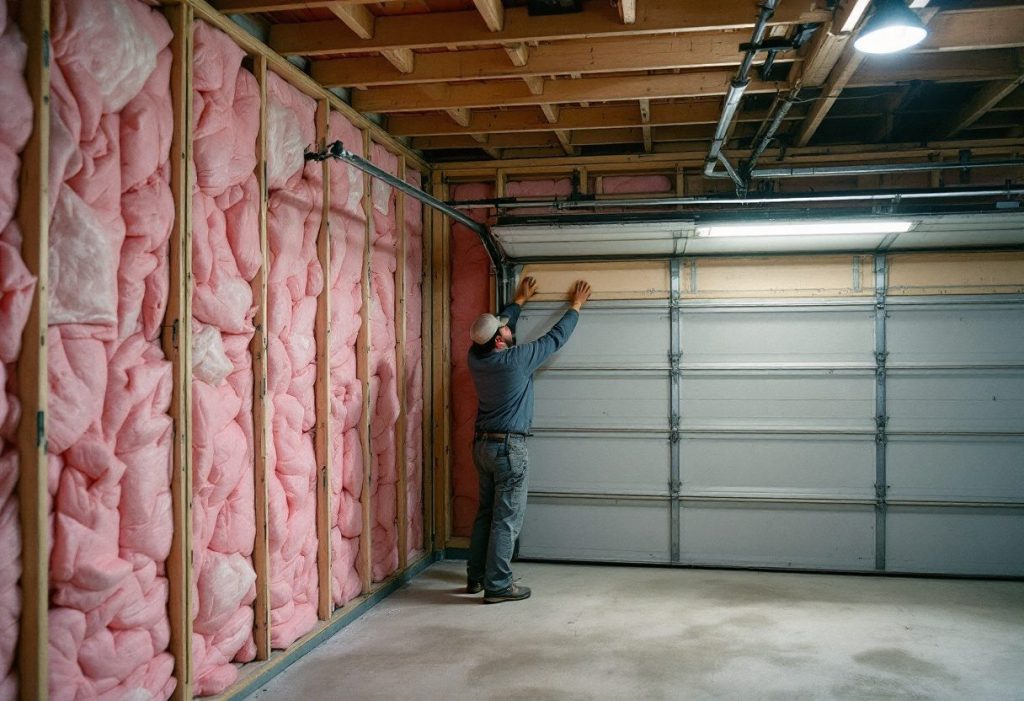
Yes, in most cases. Each upgrade shrinks the heater you have to buy and every hour of fuel after that. In our garage, insulating the ceiling alone cuts the design load by 8,237 Btu/h (33%), an insulated door alone by 7,118 Btu/h (28%) and R-13 walls alone by 5,893 Btu/h (23%).
Start with the ceiling if the attic is open, because it is the cheapest surface to reach. ENERGY STAR recommends R49 for an uninsulated attic in zones 2 and 3 and R60 in zones 4 to 8; our climate-zone guide to attic R-values shows how to check what you have. Then do the door, the walls and the door weatherstripping.
Which garage heating and cooling options work best?
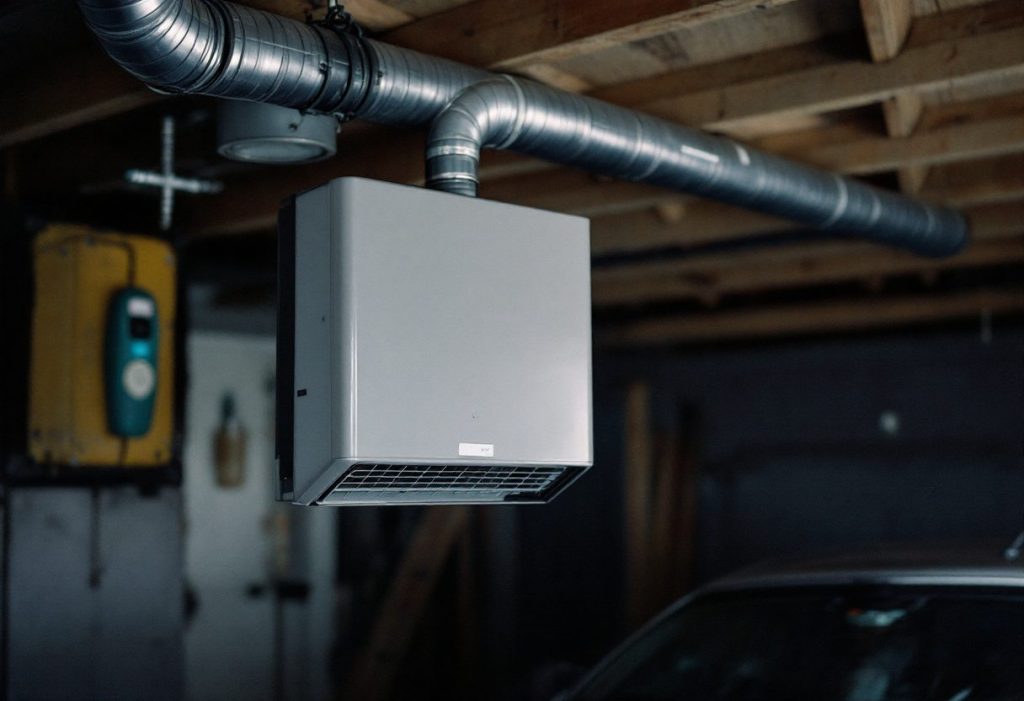
A ductless mini split is the only common option that both heats and cools. A vented gas unit heater gives the cheapest heat where gas is already piped, and electric, infrared and portable heaters suit short or occasional use.
| Option | Heats or cools | Energy | Cost per million Btu delivered | Best fit |
|---|---|---|---|---|
| Ductless mini split heat pump | Both | Electric, dedicated circuit | $24.37 seasonal; $30.61 at COP 1.75 | Year-round workshop, gym or office |
| Vented gas unit heater | Heat | Natural gas, flue to outdoors | $17.27 | Cold climate, gas line nearby |
| Vented propane unit heater | Heat | Propane, flue to outdoors | $34.42 | Cold climate, no gas main |
| Electric unit heater, 240 V | Heat | 5,000 W gives 17,060 Btu/h | $53.56 | Mild climate, weekend use |
| Infrared (radiant) heater | Spot heat | Electric or gas | $53.56 if electric | Standing at one bench |
| Portable 1,500 W heater | Spot heat | 120 V outlet, 5,118 Btu/h | $53.56 | Insulated garage, short sessions |
| Window or through-wall AC | Cool | Electric | Not compared | Cooling only, wall or window opening |
DOE notes that a mini split’s indoor and outdoor units connect through a three-inch hole and can sit up to 50 feet apart. For winter work, look for ENERGY STAR’s cold-climate designation, which requires a COP of at least 1.75 at 5°F; our guide to cold-climate heat pump ratings explains it. Installed prices vary widely, so check the federal per-zone mini split cost data before trusting a quote.
Federal rules define a unit heater as “a self-contained fan-type heater designed to be installed within the heated space,” but set no efficiency minimum for it. We model 80%, the federal floor for a non-weatherized gas furnace. Radiant heaters, DOE says, are “a more efficient choice when you will be in a room for only a few hours” and stay in their line of sight (archived copy).
For cooling, ENERGY STAR’s chart gives 14,000 Btu/h for 550 to 700 sq ft, plus 10 percent if very sunny, or 15,400 Btu/h for our garage. The chart assumes living space, so a hot garage can need more; see our room AC sizing calculator. Single-hose portable units are the weakest choice; see why single-hose portables lose capacity.
What does garage heating cost to run by fuel?
An 8-hour Saturday at 0°F costs about $3.48 with a gas unit heater and $10.78 with electric resistance in the bare garage, and $0.54 to $1.68 once it is insulated. Insulation saves more money than the choice of fuel.
Prices are EIA’s forecast averages for October 2026 to March 2027: $14.32 per thousand cubic feet of gas, 18.28 cents per kWh and $2.52 per gallon of propane, converted at EIA’s 1,036 Btu per cubic foot of gas and 91,452 Btu per gallon of propane. That matches our comparison of home heating system types.
| 8 hours at 0°F outside, 50°F inside | Uninsulated garage | Insulated garage |
|---|---|---|
| Vented gas unit heater, 80% | $3.48 | $0.54 |
| Mini split at COP 1.75 | $6.16 | $0.96 |
| Vented propane unit heater, 80% | $6.93 | $1.08 |
| Electric unit, infrared or portable | $10.78 | $1.68 |
Capacity matters as much as price. A 1,500 W plug-in heater delivers 5,118 Btu/h, enough for the insulated garage but about 20% of the bare one; our space heater running cost and fire data covers that case in detail.
How do you choose a garage heating and cooling system?
Choose by how you use the space, then by fuel. A parking-only garage rarely justifies heat; a daily workshop or gym justifies insulation plus a mini split.
- Decide the use: parking, weekend projects or daily.
- Insulate the ceiling, door and walls.
- Size for the insulated load, not the bare one.
- Want cooling too? Pick a mini split, cold-climate rated if winters reach 5°F.
- Heat only, gas on site? Fit a vented unit heater to code.
- Occasional spot heat? Use infrared or a 240 V electric unit heater.
Planning to install a mini split yourself? Read our note on what EPA says about pre-charged DIY kits first.
Which safety and code rules apply to garage heaters?
Three rules cover most garages: vent every fuel-burning heater outdoors, raise its ignition source at least 18 inches above the floor, and never connect house ducts to the garage. DOE’s Building America program restates 2015 IRC Section G2408.2 as requiring the “ignition source raised 18 inches from the floor” in a garage. Duct and exhaust fan rules are in our attached garage ventilation code guide.
CPSC estimated 34 deaths in 2022 from carbon monoxide in detached structures such as sheds and detached garages; about 70 percent of the 43 LP gas heating deaths involved unvented portable propane heaters. DOE says most states have banned unvented kerosene heaters for home use.
For electric heaters, CPSC advises keeping them three feet from combustibles and plugged into a wall outlet, never an extension cord; it counts about 1,600 portable heater fires a year for 2020 to 2022. It also wants CO alarms on every level of the home, as our CO alarm placement rules explain.
Correction to a common belief
An open overhead door does not make an unvented propane or kerosene heater safe. DOE does not recommend unvented combustion heaters indoors because of the carbon monoxide risk; vented units send flue gases outdoors.
How we researched this
Research date: October 8, 2026. We opened 17 sources, including three ranking competitor pages, and cite 14. The worked example uses CEC JA4 U-factors and excludes air leakage and slab losses; 80% unit heater efficiency is our assumption. Excluded: vendor installed-price surveys and unsourced Btu-per-square-foot rules. Reddit was not used because the topic involves combustion and carbon monoxide.
Frequently asked questions
How many BTU do I need to heat a 2-car garage?
Mostly it depends on insulation. Our 24 x 24 ft garage needed 25,163 Btu/h bare and 3,916 Btu/h insulated to hold 50°F at 0°F outside, conduction only, using California Energy Commission U-factors. Size from a Manual J load calculation, not floor area.
What is the cheapest way to heat a garage?
Where natural gas is piped, a vented gas unit heater: about $17.27 per million Btu delivered at EIA’s October 2026 forecast prices, against $24.37 for a minimum-efficiency mini split and $53.56 for electric resistance. Insulating first cut our example’s load by 84%.
Is it safe to use a propane heater in a garage?
Only a vented, code-installed one. CPSC found about 70 percent of the 43 LP gas heating carbon monoxide deaths in 2022 involved unvented portable propane heaters. Fuel-fired garage appliances also need the ignition source 18 inches above the floor.
Can a mini split heat a garage in winter?
Yes, if it is sized for the insulated load and rated for cold. ENERGY STAR’s cold-climate designation requires a COP of at least 1.75 at 5°F. At that efficiency heat costs $30.61 per million Btu, still well under electric resistance.
Can I extend my home’s ductwork into the garage?
Not in an attached garage. IRC Section R302.5.2, as Knox County, Tennessee restates the 2018 edition, requires garage ducts to be No. 26 gage sheet steel with “no openings into the garage.” A separate mini split or unit heater is the usual answer.
Is an insulated garage door worth it?
If you heat the garage, usually yes. JA4 rates a bare single-layer steel door at U-1.45 and an insulated sectional at U-0.179, so the bare door moves 8.1 times as much heat. In our example the door upgrade alone cut 7,118 Btu/h.
Sources
- California Energy Commission. “2025 Reference Appendices, JA4 U-factor Tables.” https://energycodeace.com/content/cy25-ja45-miscellaneous-construction-table-451-doors. Accessed October 2026.
- EIA. “Short-Term Energy Outlook, October 2026, Table 2.” https://www.eia.gov/outlooks/steo/xls/STEO_m.xlsx. Accessed October 2026.
- EIA. “British thermal units (Btu).” https://www.eia.gov/energyexplained/units-and-calculators/british-thermal-units.php. Accessed October 2026.
- ENERGY STAR. “Recommended Home Insulation R-Values.” https://www.energystar.gov/saveathome/seal_insulate/identify-problems-you-want-fix/diy-checks-inspections/insulation-r-values. Accessed October 2026.
- ENERGY STAR. “Heat Pump Specification Version 6.2.” https://www.energystar.gov/sites/default/files/2025-04/ENERGY%20STAR%20Version%206.2%20Heat%20Pump%20Specification%20Rev.%20March%202025.pdf. Accessed October 2026.
- ENERGY STAR. “Room Air Conditioners.” https://www.energystar.gov/products/room_air_conditioners. Accessed October 2026.
- eCFR. “10 CFR 431.242 and 431.246, Unit Heaters.” https://www.ecfr.gov/current/title-10/chapter-II/subchapter-D/part-431/subpart-N/section-431.246. Accessed October 2026.
- eCFR. “10 CFR 430.32.” https://www.ecfr.gov/current/title-10/chapter-II/subchapter-D/part-430/subpart-C/section-430.32. Accessed October 2026.
- DOE Energy Saver. “Portable Heaters” (archived copy). https://web.archive.org/web/2025id_/https://www.energy.gov/energysaver/portable-heaters. Accessed October 2026.
- DOE Energy Saver. “Ductless Mini-Split Heat Pumps” (archived copy). https://web.archive.org/web/2025id_/https://www.energy.gov/energysaver/ductless-mini-split-heat-pumps. Accessed October 2026.
- DOE Building America Solution Center. “Gas-Fired Boilers Code Compliance Brief.” https://basc.pnnl.gov/code-compliance/gas-fired-boilers-code-compliance-brief. Accessed October 2026.
- Knox County, Tennessee. “2018 IRC Duct Installation and Insulation.” https://www.knoxcounty.org/codes/pdfs/construction_info/DuctInstallation.pdf. Accessed October 2026.
- CPSC. “Keep Warm and Safe This Winter.” https://www.cpsc.gov/Newsroom/News-Releases/2026/Keep-Warm-and-Safe-This-Winter-Tips-for-Using-Generators-Furnaces-and-Space-Heaters. Accessed October 2026.
- CPSC. “Non-Fire Carbon Monoxide Deaths, 2022 Annual Estimates.” https://www.cpsc.gov/s3fs-public/Non-Fire-Carbon-Monoxide-Deaths-Associated-with-the-Use-of-Consumer-Products-2022-Annual-Estimates.pdf. Accessed October 2026.
Leave a Reply