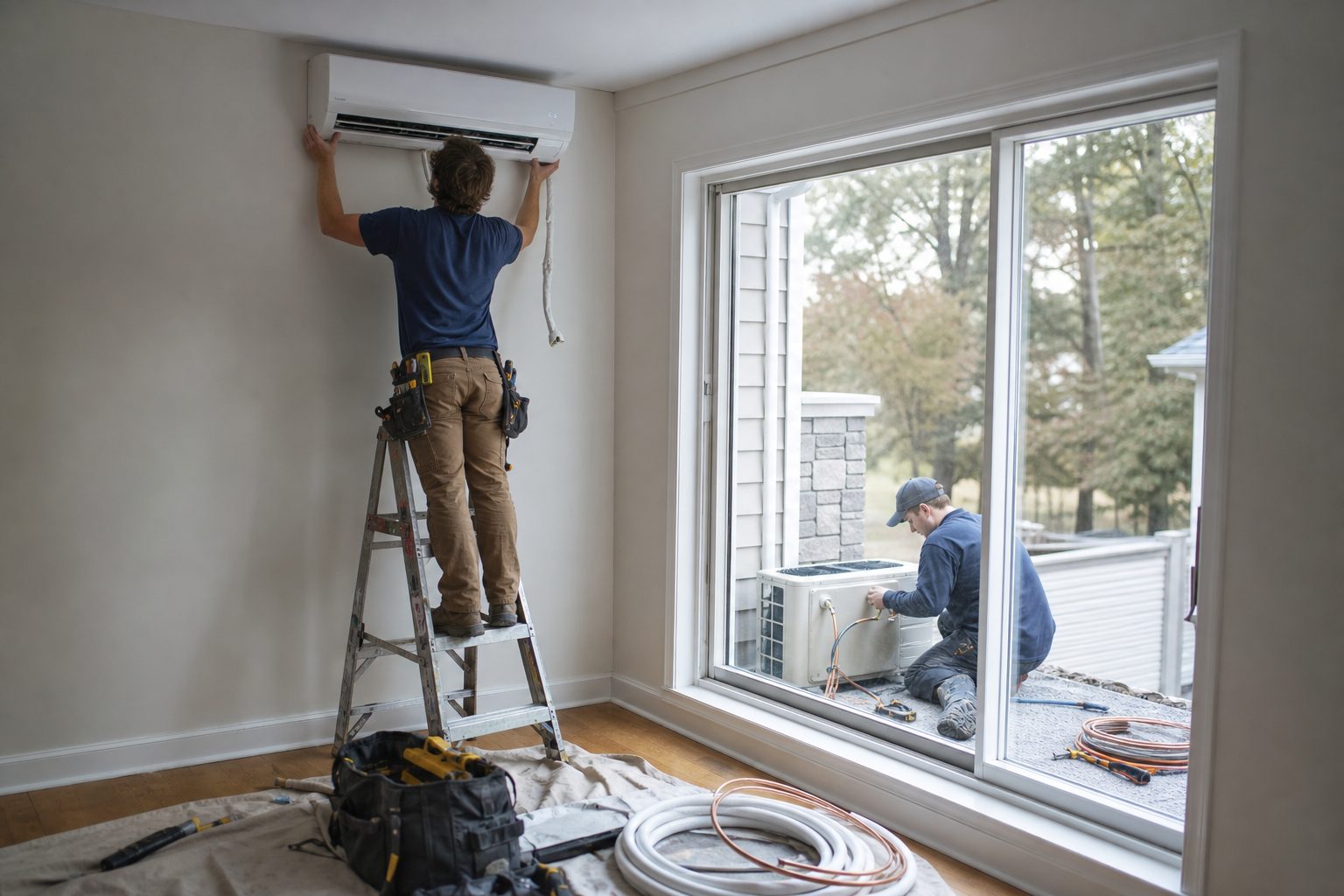
What is the mini split cost for a house? No federal agency collects transaction prices. The one federal table with a ductless row, from EIA, models a single 12,000 Btu per hour head at $2,030 installed in 2022 dollars.
Key Takeaways
- EIA models one 12,000 Btu per hour ductless head at $2,030 installed and $1,580 equipment, 2022 dollars, and holds that flat across every efficiency tier (EIA, March 2023, p.43).
- LBNL recorded a $4,397 median ductless job and $4,421 per ton across 180 records, 2019 dollars, against $2,481 per ton ducted (LBNL, August 2021).
- DOE uses seven residential product classes and none is ductless, so a mini split is regulated as a split system at 14.3 SEER2 and 7.5 HSPF2 (10 CFR 430.32(c)(5)).
- Attaching hoses to a refrigerant circuit makes you a technician under 40 CFR 82.152, so a pre-charged DIY kit is a certification question first.
- HVAC equipment producer prices in August 2026 stood 19.0% above the 2022 average, putting $2,030 near $2,420 on our arithmetic (BLS PCU333415333415).
What does a mini split cost in federal data?
One modelled figure carries the whole federal record: $2,030 installed for a single 12,000 Btu per hour ductless head, 2022 dollars, from EIA. Equipment is $1,580, so the implied installation is $450, which is our subtraction. That is one zone, not a house.
The gap is structural. DOE divides this equipment into seven classes, and its technical support document names them all as split-system, single-package, small duct high velocity or space-constrained. None is ductless.
The data gap
No federal series measures what a ductless installation sells for. EIA says its ductless costs were “determined based on smaller capacity (24 kBtu/h) split-system heat pumps and Gordian’s RSMeans Data”, a construction estimating manual. It is a proxy for a proxy.
LBNL counted ductless projects rather than modelling them, and puts ductless above ducted per ton: $4,421 against $2,481 in 2019 dollars, from energy program records rather than a random sample. The ducted side is in our reading of the federal heat pump cost tables, the equipment in our primer on ductless versus central air.
Why does mini split cost per zone fall and then rise again?
Because the first head pays for the outdoor unit and the last head pays for a bigger one. LBNL’s ductless records, binned by capacity, show median cost rising from $4,145 at half to one ton to $22,448 at four and a half to five tons, in 2019 dollars. Divide by each bin midpoint, our arithmetic, and cost per ton falls to a low near four tons before turning back up.
| LBNL capacity bin | Median total cost (2019$) | Cost per ton at bin midpoint (ours) | Typical head count |
|---|---|---|---|
| 0.5 to 1 ton | $4,145 | $5,527 | One head |
| 1.5 to 2 tons | $8,826 | $5,043 | Two to three heads |
| 2.5 to 3 tons | $12,804 | $4,656 | Three to four heads |
| 3.5 to 4 tons | $16,471 | $4,392 | Four to five heads |
| 4.5 to 5 tons | $22,448 | $4,726 | Five or more heads |
The head counts are ours, inferred from typical 9,000 and 12,000 Btu per hour heads; the dollars are LBNL’s bin medians. Zone count belongs in the quote alongside capacity, set by a load calculation.
Why does a multi zone system need a larger outdoor unit?
Because every head is a branch off one refrigerant circuit and the condenser carries all of them. DOE’s Building America Solution Center sets a ceiling: “It is generally not recommended to connect more than three indoor units to one outdoor unit, but some models allow as many as eight indoor units to connect to one outdoor unit.” Past that, a second condenser is a second equipment line, which turns the per ton column back up.
What do line sets, condensate and electrical add to mini split cost?
Federal tables do not break those lines out, so the only sourced split comes from the literature LBNL reviewed. Applying a contractor survey breakdown of 30% labor, 55% equipment, 10% supplies and 5% other costs to its $4,397 median gives roughly $1,319 of labor and $2,418 of equipment, in 2019 dollars. Line set and condensate materials sit in the supplies line.
| Cost line | Sourced figure | Dollar year | Source |
|---|---|---|---|
| Labor share of a median ductless job | $1,319 | 2019 | Navigant shares, via LBNL |
| Equipment share of the same job | $2,418 | 2019 | Navigant shares, via LBNL |
| Electrical upgrades on ductless projects | $600 to $1,000 | 2019 | Armstrong, via LBNL |
| Implied installation in EIA’s model | $450 | 2022 | Ours, $2,030 minus $1,580 |
Building America lists the install as indoor units, outdoor units, “refrigeration lines, condensate piping, electrical wiring, and thermostat control wiring, and/or control modules”. Line length is also a charge question: “Refrigerant may need to be added if the line set length(s) are longer than the factory charge allows.” Condensate is the ductless-specific line, because a wall-mounted head has no furnace drain pan to borrow and a lift means a pump on its own circuit.
Electrical is the line most likely to surprise. Building America notes that single zone 115 and 120 volt units from 6,000 to 12,000 Btu per hour draw little enough to sit “into lightly loaded existing 15A and 20A 120V circuits”, so a one-head job can avoid panel work. Add four heads and the recorded $600 to $1,000 upgrades apply. Draw by class is in our breakdown of what each machine pulls, and no table here includes the permit most jurisdictions require.
Which efficiency tiers exist in ductless, and what is the federal minimum?
Ductless sits far above its own floor. EIA rates the typical 2022 ductless unit at 21.9 SEER and its high tier at 33.1 SEER, while the binding minimum is 14.3 SEER2 and 7.5 HSPF2 under 10 CFR 430.32(c)(5)(ii). The standard does not set the price here.
Mini splits have no product class of their own. The Code of Federal Regulations covers them as split systems, and 10 CFR 430.2 refers directly to “multi-split, multi-circuit, and multi-head mini-split combinations”. The regional levels in paragraph (c)(6) apply to air conditioner classes only, as our page on the SEER2 minimums sets out.
| EIA ductless tier, 12,000 Btu per hour | SEER | HSPF | Retail equipment (2022$) | Total installed (2022$) |
|---|---|---|---|---|
| 2015 installed base | 16.0 | 10.0 | $1,580 | $2,030 |
| 2022 typical | 21.9 | 11.1 | $1,580 | $2,030 |
| 2022 high | 33.1 | 14.0 | $1,580 | $2,030 |
Read that table twice. EIA carries the same $1,580 equipment and $2,030 installed cost across every tier, including a unit rated at 33.1 SEER. No efficiency premium is modelled for ductless at all, a modelling decision rather than a market finding.
The national lab data disagrees only mildly. LBNL found per ton costs “did not vary consistently with either the heating or cooling efficiency ratings”, and puts the literature estimate for SEER 16 to SEER 18 at $239 to $689 per ton. Its feature chart prices a variable speed compressor at $512 per ton, enhanced efficiency at $464, gas to electric conversion at $267 and cold climate at $250, in 2019 dollars. ENERGY STAR asks more of non-ducted cold climate split systems, 8.5 HSPF2, than of ducted ones at 8.1 HSPF2, and what those 5 degree F ratings test is separate.
Do DIY pre-charged kits change the mini split cost?
They raise a certification question before a price one. A pre-charged kit ships with refrigerant sealed in the line set so the buyer only connects the flare fittings. Under federal rule that is technician work.
40 CFR 82.152 defines a technician as anyone who could be “reasonably expected to violate the integrity of the refrigerant circuit”, and names the qualifying activities as “attaching or detaching hoses and gauges to and from the appliance; adding or removing refrigerant; adding or removing components; and cutting the refrigerant line”. It says technicians “could include” owners of appliances, and 40 CFR 82.161(a) requires Type II certification. Building America is blunter: “Refrigerant charging must be done by an EPA certified technician.” The full reading is in our page on DIY kits and EPA Section 608.
Any saving is bounded by the labor share: about $1,319 of LBNL’s $4,397 median job, or $450 on EIA’s single head. A kit still needs the electrical work, the condensate route and often the permit, as our walk through of a ductless install shows.
What is a 2022 mini split cost worth in 2026 dollars?
About $2,420 installed and $1,880 for equipment, on our arithmetic and not EIA’s. The BLS producer price index for air-conditioning, refrigeration and forced air heating equipment manufacturing averaged 272.893 in 2022 and reached 324.820 in August 2026.
- Start from EIA’s installed cost for one 12,000 Btu per hour head: $2,030 in 2022 dollars.
- Index ratio: 324.820 divided by 272.893 equals 1.1903, a rise of 19.0%.
- $2,030 times 1.1903 gives $2,416, reported as $2,420.
- $1,580 times 1.1903 gives $1,881, reported as $1,880.
Step 4 is the defensible one, because the index measures equipment leaving the factory. Applying it to the full $2,030 assumes labor, markup and tax all moved 19.0%, so treat $2,420 as an upper reference. We track it in our monthly reading of that index.
What these mini split cost figures are not
- Not a quote. EIA built it from RSMeans cost data on a 24,000 Btu per hour split heat pump.
- Not a whole house. EIA prices one 12,000 Btu per hour head.
- Not a random sample. LBNL’s records came from energy programs.
- Not electrical work. Panel capacity, a branch circuit and a condensate pump sit outside every table.
Whether ductless is the right machine comes first, the job of our side by side of wall units, window units and PTACs.
How we researched this
Research date: September 29, 2026. We read the EIA equipment cost study, the DOE 2017 technical support document, the LBNL retrofit cost report, 10 CFR 430.2, 10 CFR 430.32, 40 CFR 82.152, 40 CFR 82.161, the ENERGY STAR heat pump criteria, the DOE Building America ductless guide and BLS series PCU333415333415. We consulted 11 sources and cite 10. Excluded: contractor and vendor price surveys, because no federal series stands behind them. Reddit was not used.
Two limits are ours. LBNL labels the axis of its Figure 55 in dollars per ton while its text calls $4,397 a median system cost, so we report those five adders exactly as labelled and never add them to the median. Its capacity bin chart carries counts summing above the recorded ductless sample, so we read that ladder as a shape, not a census. The per ton column, head counts, $450 implied installation and 2026 adjustment are ours.
Freshness: regulatory text and the price index are current to September 2026; dollar years are 2022 for EIA and 2019 for LBNL. Updates: the price adjustment monthly, the modelled figures when EIA or DOE publishes new ones.
Frequently asked questions
How much does a mini split cost installed?
EIA models one 12,000 Btu per hour ductless head at $2,030 installed in 2022 dollars, $1,580 of it equipment. LBNL recorded a $4,397 median across real ductless projects in 2019 dollars. Both are planning figures, not quotes.
Is there a federal average price for a mini split?
No. No federal series measures installed ductless prices. DOE’s standards work uses seven product classes and none is ductless. EIA’s single row is the only federal ductless cost figure.
Does a three zone mini split cost three times a one zone system?
Less than that, then the advantage fades. LBNL’s binned medians run from $4,145 at half to one ton to $12,804 at two and a half to three tons, 2019 dollars. On our arithmetic at bin midpoints, cost per ton falls from $5,527 to $4,656.
What is the federal minimum efficiency for a mini split?
14.3 SEER2 and 7.5 HSPF2, because mini splits are covered as split system heat pumps under 10 CFR 430.32(c)(5)(ii). There is no separate ductless class, and most ductless equipment clears that floor. EIA rates the typical 2022 unit at 21.9 SEER.
Can I install a pre-charged mini split kit myself?
Connecting the refrigerant circuit makes you a technician under 40 CFR 82.152, which names attaching or detaching hoses and adding refrigerant, and says technicians can include owners of appliances. 40 CFR 82.161(a) then requires Type II certification.
Are these mini split cost figures still accurate in 2026?
They are dated rather than wrong. HVAC equipment producer prices in August 2026 stood 19.0% above their 2022 average. Adjusting EIA’s $1,580 equipment row gives $1,880, and the full $2,030 gives $2,420, our arithmetic.
Sources
- US Energy Information Administration. “Updated Buildings Sector Appliance and Equipment Costs and Efficiencies.” https://www.eia.gov/analysis/studies/buildings/equipcosts/pdf/full.pdf. Accessed September 2026.
- US Department of Energy. “Technical Support Document: Residential Central Air Conditioners and Heat Pumps.” https://downloads.regulations.gov/EERE-2014-BT-STD-0048-0098/attachment_1.pdf. Accessed September 2026.
- Lawrence Berkeley National Laboratory. “The Cost of Decarbonization and Energy Upgrade Retrofits for US Homes.” https://escholarship.org/uc/item/0818n68p. Accessed September 2026.
- Office of the Federal Register. “10 CFR 430.32.” https://www.ecfr.gov/current/title-10/section-430.32. Accessed September 2026.
- Office of the Federal Register. “10 CFR 430.2.” https://www.ecfr.gov/current/title-10/section-430.2. Accessed September 2026.
- Office of the Federal Register. “40 CFR 82.152.” https://www.ecfr.gov/current/title-40/section-82.152. Accessed September 2026.
- Office of the Federal Register. “40 CFR 82.161.” https://www.ecfr.gov/current/title-40/section-82.161. Accessed September 2026.
- US Department of Energy Building America Solution Center. “Ductless (Mini-Split) Heat Pumps.” https://basc.pnnl.gov/resource-guides/ductless-mini-split-heat-pumps. Accessed September 2026.
- ENERGY STAR. “Heat Pump Equipment Key Product Criteria.” https://www.energystar.gov/products/heating_cooling/heat_pumps_air_source/key_product_criteria. Accessed September 2026.
- US Bureau of Labor Statistics. “Series PCU333415333415.” https://data.bls.gov/timeseries/PCU333415333415. Accessed September 2026.
Leave a Reply