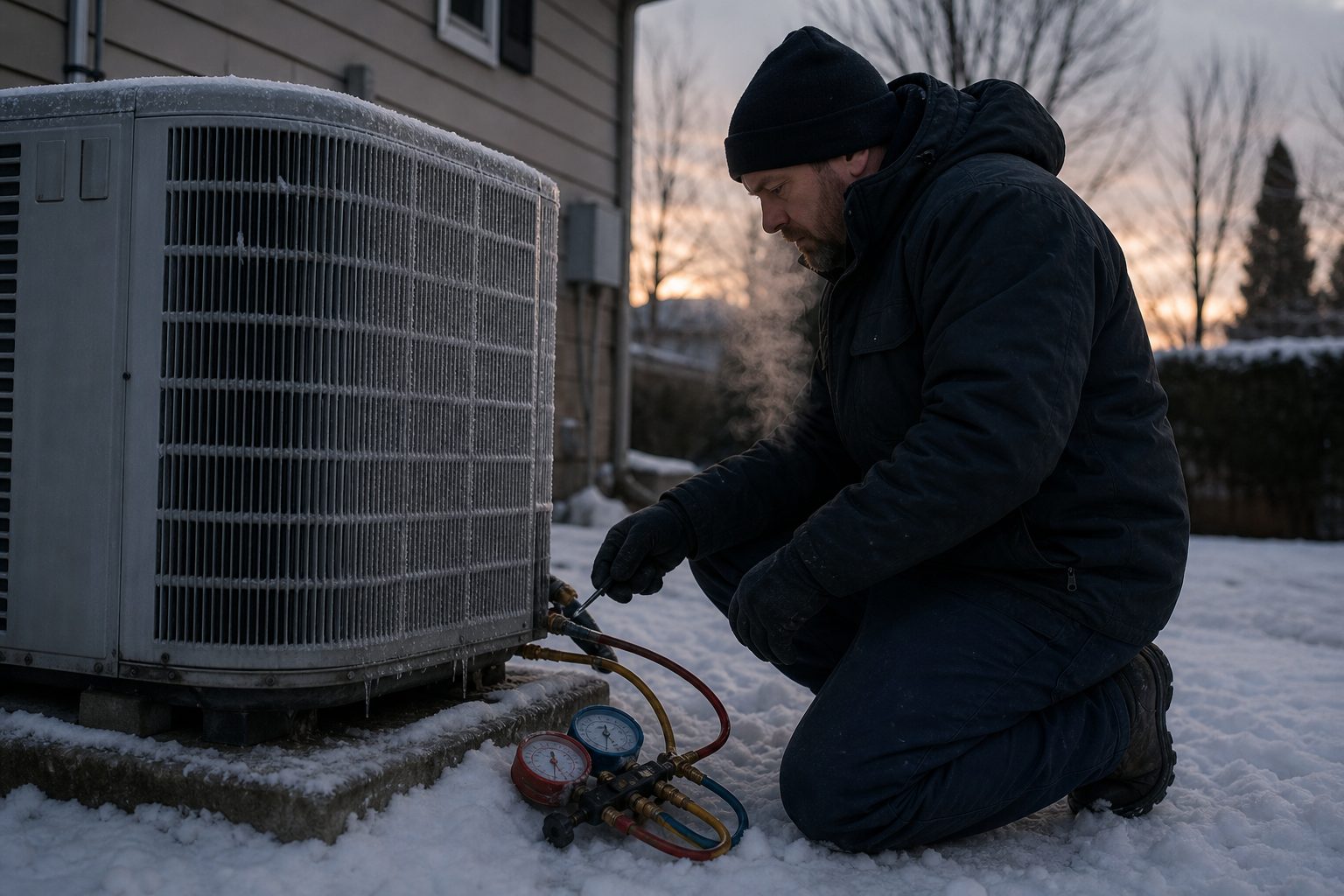
What is a cold climate heat pump? One that passes two low temperature tests. ENERGY STAR Version 6.2 gives the Cold Climate mark only to heat pumps that reach a COP of 1.75 at 5°F and keep 70 percent of their 47°F heating capacity.
Key Takeaways
- The designation is set by ENERGY STAR Version 6.2, March 2025.
- Low ambient criteria: COP at 5°F of 1.75 or more, and 5°F capacity at 70 percent of the 47°F figure, per 10 CFR Part 430 Appendix M1.
- 146,784 of 284,057 listings in the ENERGY STAR certified dataset carried the flag on September 22, 2026.
- The DOE Challenge is stricter: COP 2.4 at 5°F for 24,000 to 48,000 Btu/h, at a 100 percent capacity ratio.
- PNNL measured COPs of 1.5 to 4.5 from minus 15°F to 65°F at 23 field sites.
What makes a heat pump a cold climate heat pump?
Two measured numbers at one test point. A cold climate heat pump is one whose heating capacity and efficiency at 5°F were tested and found to clear the EPA thresholds. The cabinet, refrigerant and brand decide nothing.
The phrase is used loosely in sales copy. It has one defined meaning in ENERGY STAR and a stricter one at DOE. The mechanism is in our explainer on the refrigeration cycle a heat pump runs in reverse. For how the certified range actually performs against these criteria, see our analysis of whether heat pumps work in cold weather: the median certified model keeps 77% of its capacity at 5°F.
What does the ENERGY STAR Cold Climate specification require?
Version 6.2, revised March 2025, sets the rule in two layers: Table 3 sets seasonal efficiency floors, and a low ambient clause sets the 5°F floors and requires a controls verification procedure run by the unit’s native controls.
The seasonal floors are SEER2 of 15.2, with HSPF2 of 8.5 non-ducted split and 8.1 ducted split and packaged. Table 2, for the plain ENERGY STAR mark, asks only 7.8 HSPF2. Those metrics replaced SEER and HSPF under the rulemaking that reset the federal efficiency minimums by region.
| Criterion | ENERGY STAR Cold Climate (V6.2) | DOE CCHP Challenge (5°F segment) |
|---|---|---|
| COP at 5°F | 1.75 or higher | 2.4 at 24,000 to 48,000 Btu/h; 2.1 above |
| Heating capacity at 5°F vs 47°F | 70 percent or higher | 100 percent |
| Compressor cut-out | Not specified | No higher than minus 10°F; cut-in no higher than minus 5°F |
Sources: ENERGY STAR Version 6.2, Table 3 and Section 3.B.ii; DOE CCHP Challenge, Table II-2.
The variable speed question
Version 6.2 does not require a variable speed compressor. Variable speed appears in the test method instead: for such units the 47°F reference capacity comes from the Appendix M1 H1N test rather than H12. The market converged anyway. On September 22, 2026, 137,343 cold climate listings used a continuously variable compressor, 9,440 two-stage.
Why do capacity and COP fall as the outdoor temperature drops?
The outdoor coil has less heat to work with and the compressor works harder to move it. As outdoor air cools, the pressure difference widens and suction density falls, so less heat reaches the house per unit of electricity.
A 2013 DOE Building America field study in Connecticut put it plainly: “As with any heat pump, capacity (heat output) decreases as the ‘source’ (outdoor air) temperature decreases.” It adds that standard air source heat pumps “more rapidly lose heating capacity as the outdoor temperature drops below about +30°F.”
The building moves the other way, so demand climbs while supply falls. A cold climate design changes the slope of that supply line, not its direction. A variable speed compressor runs faster in cold weather, so some listings report 5°F capacity near the 47°F nominal.
What do the 47°F, 17°F and 5°F ratings mean?
They are fixed laboratory conditions from the federal test procedure at 10 CFR Part 430, Subpart B, Appendix M1. Each pairs an outdoor air temperature with 70°F indoor dry bulb, then reports heating capacity in Btu/h and the electrical input. The 5°F point is the H4 test.
| Test | Outdoor air (dry bulb / wet bulb) | What it tells you |
|---|---|---|
| H1 or H1N | 47°F / 43°F | Nominal capacity. The denominator in the capacity ratio. |
| H2 | 35°F / 33°F | Frost accumulation test. Defrost cycles happen here. |
| H3 | 17°F / 15°F | Mid cold point on most rating sheets. Median listing holds 83 percent of 47°F capacity. |
| H4 | 5°F / 4°F maximum | Low ambient point. COP and capacity ratio are measured here. |
Test conditions per the DOE CCHP Challenge procedure, Tables A-2 and A-3, referencing Appendix M1. Indoor air is 70°F dry bulb.
The 5°F capacity of a variable speed unit is measured at maximum operation, while the 47°F reference is the H1N nominal. COP at 5°F excludes resistance heat, which is why ratings and bills tell different stories.
What did the DOE Cold Climate Heat Pump Challenge show?
It showed the ENERGY STAR floor is not the ceiling. DOE launched the Residential Cold Climate Heat Pump Challenge on November 1, 2021 with eight manufacturers committed, among them Carrier, Daikin, Lennox and Trane.
The Challenge also writes a control requirement ENERGY STAR leaves open: a compressor cut-out no higher than minus 10°F, cut-in no higher than minus 5°F. An optional segment adds measured performance at minus 15°F.
Pacific Northwest National Laboratory ran the field validation. Its November 2024 review reported 23 field sites and heat pump COPs of 1.5 to 4.5 from minus 15°F to 65°F. With auxiliary heat included, system COPs ran 1.0 to 4.5. PNNL recorded that prototypes provided heat “with little assistance from auxiliary elements, even during the coldest winter periods.”
Does a cold climate heat pump still need backup heat?
In most cold parts of the country, yes. The designation guarantees performance at 5°F, not that the unit alone covers design load at every hour. The temperature where output stops matching heat loss, and the AUX versus EM HEAT distinction, are covered in what those two thermostat modes cost to run.
The common failure is a control that locks the compressor out too early. Many thermostats carry a lockout setpoint that stops the heat pump below a set outdoor temperature and hands the load to resistance elements. Set it at 35°F on a unit rated 1.75 COP at 5°F and the system spends its coldest hours near a COP of 1.0. Our explainer on what a thermostat can and cannot sense covers why these stay at factory defaults.
Oversized heat strips raise service size and peak demand; undersized ones leave the house short on the design day. Strip capacity, staging and interlock are set at the indoor unit, which is why air handler commissioning matters here.
What does the defrost cycle look like in cold weather?
The outdoor coil runs colder than the outdoor air, so when its surface falls below the dew point moisture condenses, and below freezing it turns to ice. The unit clears it by briefly running as an air conditioner. From the yard that looks like steam and a stopped fan. Inside, supply air goes cool for a few minutes.
The DOE Building America report describes it directly: the unit “sheds the ice by temporarily turning into an air conditioner,” and to stop register air feeling cold it “simultaneously turns on a supplemental electric heating element (typically 5 kW).” That is why the aux light appears during defrost, and why it is not a fault.
Defrost costs efficiency, so good controls keep it short. In that Connecticut study, electric heat was 1 to 3 percent of system energy use. The report also documented the failure mode: cycles ran too short, meltwater refroze and ice built up until a technician removed it. Persistent coil ice is a service call, among the other problems only heat pumps have.
How do you verify a cold climate heat pump model before you buy?
Check two databases, not the brochure. ENERGY STAR certified data carries the Cold Climate flag and the 5°F numbers; the AHRI Directory confirms the quoted pair was certified together.
- Get full model numbers for the outdoor unit and indoor coil. A quote naming only the outdoor unit cannot be verified.
- Search that pair in the ENERGY STAR product finder or its open dataset.
- Read the fields that matter: cold climate yes or no, COP at 5°F, capacity at 47°F, 17°F and 5°F, HSPF2, SEER2.
- Confirm the listing’s AHRI reference number in the AHRI Directory of Certified Product Performance, which issues a ratings certificate.
- Keep the certificate. Rebate programs often require it, and it proves the installed combination is the rated one.
The ratings apply to the combination, not the outdoor unit alone. A substituted coil produces a system nobody rated, which is the quiet way a cold climate purchase stops being one, and one reason a heat pump installation differs from a furnace swap. Ductless models carry the same designation, per how a ductless mini split differs from central air.
Weighing the premium? See what the reversing valve adds to an air conditioner, and what heat costs by fuel.
How we researched this
Research date: September 22 and 23, 2026. Every criterion was read in the source document, not a summary: ENERGY STAR Version 6.2 (March 2025), the DOE CCHP Challenge test procedure (October 2021), and PNNL’s 2024 DOE Building Technologies Office review.
Listing counts and capacity ratios are our tabulation of the ENERGY STAR certified air source heat pump dataset, queried September 22, 2026, when it reported 284,057 rows. Medians cover 48,862 cold climate rows with usable capacity at 47°F and 5°F. Listings are matched combinations, not distinct models.
Excluded: manufacturer capacity tables and extreme temperature marketing claims, not third party verified; installed prices, because no federal series publishes them; and NEEP’s product list, a Tier 2 reference. Reddit was not used.
Frequently asked questions
What temperature can a cold climate heat pump work down to?
ENERGY STAR certifies performance at 5°F and sets no minimum operating temperature. The DOE Challenge does: a qualifying unit needs a compressor cut-out no higher than minus 10°F, and its optional segment requires measured performance at minus 15°F.
Is a cold climate heat pump the same as an ENERGY STAR heat pump?
No. A standard ENERGY STAR split system needs HSPF2 of 7.8 under Version 6.2 Table 2. The Cold Climate designation in Table 3 raises that to 8.5 for non-ducted splits or 8.1 for ducted and packaged units, and adds the 5°F tests.
Does a cold climate heat pump have to be variable speed?
Not under Version 6.2, which sets no compressor staging requirement. The market moved there anyway: on September 22, 2026, 137,343 cold climate listings used a continuously variable compressor and 9,440 were two-stage.
Why does my heat pump blow cool air and steam outside in winter?
That is a defrost cycle. DOE’s Building America report notes the unit runs a supplemental electric element, typically 5 kW, so supply air does not feel cold. In that study the electric heat was 1 to 3 percent of total system use.
What is a good COP at 5°F?
1.75 is the ENERGY STAR floor and it binds: the lowest COP at 5°F among cold climate listings is exactly 1.75. The DOE Challenge set 2.4 for 24,000 to 48,000 Btu/h units, so a rating in the 2s beats it.
How much capacity does a cold climate heat pump lose at 5°F?
Less than 30 percent, by definition. Across 48,862 cold climate listings we tabulated, median 5°F capacity was 77 percent of the 47°F figure, and the median at 17°F was 83 percent.
Sources
- ENERGY STAR. “Central Air Conditioner and Heat Pump Specification, Version 6.2 (Rev. March 2025).” https://www.energystar.gov/sites/default/files/2025-04/ENERGY%20STAR%20Version%206.2%20Heat%20Pump%20Specification%20Rev.%20March%202025.pdf. Accessed September 2026.
- ENERGY STAR. “Heat Pump Equipment Key Product Criteria.” https://www.energystar.gov/products/air_source_heat_pumps/key-product-criteria. Accessed September 2026.
- U.S. DOE. “Residential Cold Climate Heat Pump Technology Challenge Specification,” 2021. https://www.energy.gov/sites/default/files/2021-10/bto-cchp-tech-challenge-spec-102521.pdf. Accessed September 2026.
- U.S. DOE. “Residential Cold Climate Heat Pump Challenge.” https://www.energy.gov/cmei/buildings/residential-cold-climate-heat-pump-challenge. Accessed September 2026.
- PNNL for U.S. DOE. “Residential CCHP Technology Challenge: Field Validation,” 2024. https://www.energy.gov/sites/default/files/2024-11/bto-peer-2024-32252-residential-cchp-technology-challenge-mendon.pdf. Accessed September 2026.
- ENERGY STAR. “Certified Air-Source Heat Pumps” dataset. https://data.energystar.gov/Active-Specifications/ENERGY-STAR-Certified-Air-Source-Heat-Pumps/w7cv-9xjt. Retrieved September 22, 2026.
- Johnson, R.K. “Measured Performance of a Low Temperature Air Source Heat Pump,” DOE Building America, 2013. https://www1.eere.energy.gov/buildings/publications/pdfs/building_america/low_temp_air_source_heat_pump.pdf. Accessed September 2026.
- AHRI. “Directory of Certified Product Performance.” https://www.ahridirectory.org/. Accessed September 2026.
Leave a Reply