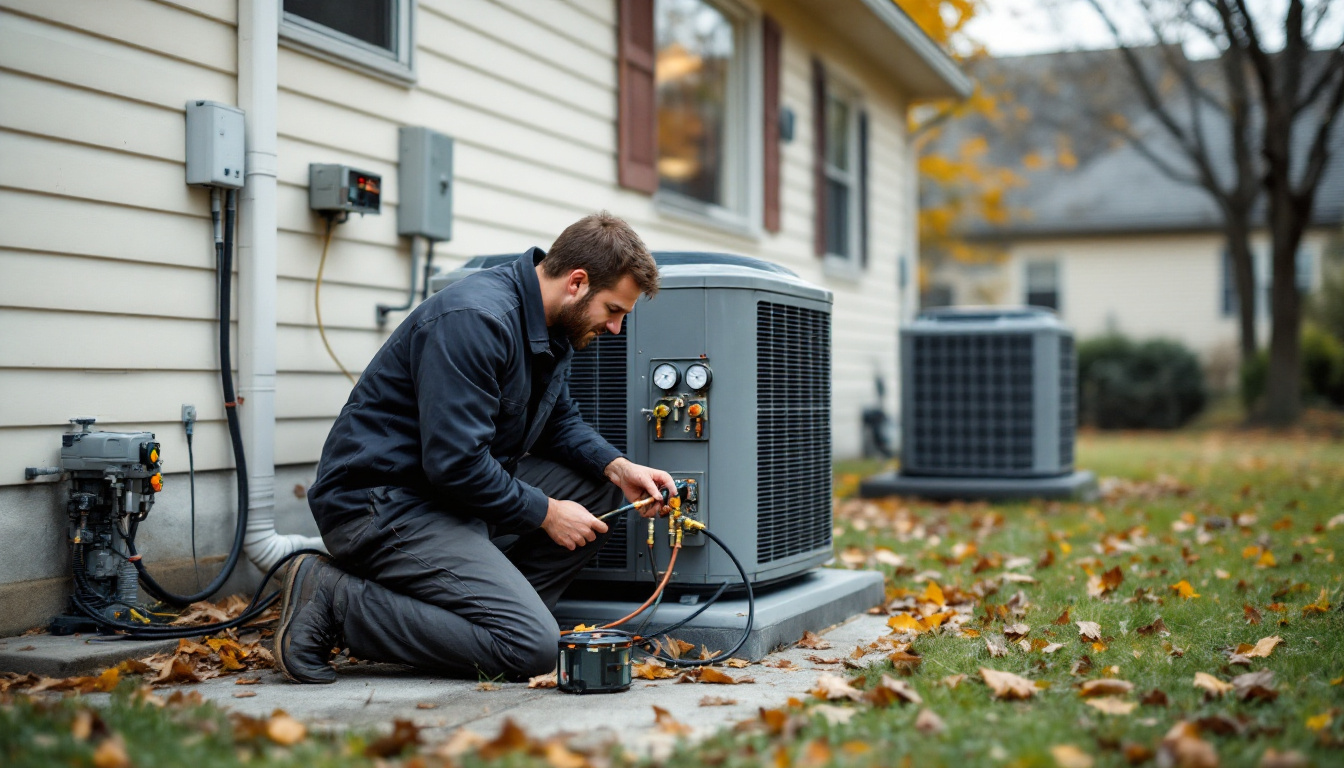
Heat pump vs air conditioner? A heat pump is an air conditioner with a reversing valve, so it cools the same way and is rated on the same SEER2 scale. The three differences that matter are a second federal rating, roughly $1,500 more installed, and the heating fuel it replaces.
Key Takeaways
- DOE’s Building America Solution Center names the core hardware difference: a heat pump carries a reversing valve.
- Under 10 CFR 430.32(c)(5), split heat pumps need 14.3 SEER2 and 7.5 HSPF2; split air conditioners need 13.4 SEER2.
- Only air conditioners face the regional floor: 14.3 SEER2 for split units under 45,000 Btu/hr installed in the Southeast or Southwest.
- EIA prices a 3 ton split heat pump at minimum efficiency at $6,810 installed, against $5,310 for a northern air conditioner (2022 dollars).
- AHRI counted 3,063,290 air conditioners and 2,570,228 heat pumps shipped in the US, January to July 2026.
What is the real difference between a heat pump and an air conditioner?
One valve. A heat pump is a split air conditioner plus a reversing valve that flips refrigerant flow, so the outdoor coil absorbs heat and the indoor coil releases it. ENERGY STAR says in the summer months a heat pump works just like a standard air conditioner would. Our walkthrough of why moving heat beats making it covers the cycle; our central air primer covers the cooling-only side.
Two more parts follow. Building America notes heat pumps carry a built-in defrost cycle to keep the outdoor coils from icing up. DOE’s test procedure rulemaking notes that appendix M1 defines a demand-defrost control system as one that defrosts the outdoor coil only when measuring a predetermined degradation of performance, and credits it inside the HSPF2 calculation.
The third is backup heat. Building America states that all-electric air-source heat pumps “come equipped with electric resistance strip heaters for supplementary heat if needed.” What that strip heat draws is set out in our explainer on AUX and EM HEAT.
How do the federal ratings differ for a heat pump vs an air conditioner?
Both are rated in cooling on SEER2; only the heat pump adds HSPF2 for heating. Since January 1, 2023, a split air conditioner must reach 13.4 SEER2 and a split heat pump 14.3 SEER2 and 7.5 HSPF2, under 10 CFR 430.32(c)(5).
The rule states HSPF standards “are based on Region IV, the minimum standardized design heating requirement,” one DOE climate bin rather than your own winter. A single-package heat pump needs only 13.4 SEER2 and 6.7 HSPF2.
Under 10 CFR 430.32(c)(6), split air conditioners under 45,000 Btu/hr installed in the Southeast or Southwest must hit 14.3 SEER2, and Southwest units add an EER2 floor of 11.7 or 9.8. Heat pumps face one national minimum everywhere. Our page on the regional cooling floors lists the states.
The regional rule is enforced at installation
National minimums apply to equipment manufactured on or after January 1, 2023; regional minimums apply to air conditioners installed on or after that date. A model below the applicable level “cannot be installed in that region.”
| Federal requirement, split systems | Air conditioner | Heat pump |
|---|---|---|
| Cooling rating metric | SEER2 | SEER2 |
| National minimum, from Jan 1 2023 | 13.4 SEER2 | 14.3 SEER2 |
| Heating rating metric | None | HSPF2, minimum 7.5 |
| Southeast minimum, under 45,000 Btu/hr | 14.3 SEER2 | Not covered |
| Southwest minimum, under 45,000 Btu/hr | 14.3 SEER2 plus 11.7 or 9.8 EER2 | Not covered |
| Off mode power limit | 30 watts | 33 watts |
Source for every row: eCFR, 10 CFR 430.32(c), current text accessed September 2026.
What does a heat pump cost to install compared with an air conditioner?
About $1,500 more, in the one federal study that prices both. EIA’s equipment cost study, updated March 2023 in 2022 dollars, lists a 3 ton split system at the 2023 federal minimum at $6,810 installed for an air-source heat pump and $5,310 for a northern central air conditioner.
Two caveats apply. EIA priced the air conditioner as a coil-only system and the heat pump as a blower-coil system, so part of the gap buys a blower. The southern air conditioner at 14.3 SEER2 is $5,520, narrowing the gap to $1,290. Our breakdown of what federal estimates say a cooling-only system costs has the full column.
The equipment premium is $1,430 of the $1,500, so EIA prices the labor of both jobs almost identically. Where a heat pump installation does diverge is in sizing for two seasons and what the electrical panel carries.
Does a heat pump cost less to run than an air conditioner?
In cooling, no. At the same SEER2, tonnage and ductwork, both use the same electricity. The heat pump’s operating advantage sits in the months the air conditioner is off, so payback is a heating fuel question.
EIA puts the US average residential electricity price at 18.34 cents per kilowatthour in June 2026, with 2026 year to date at 18.16 cents against 16.91 cents a year earlier. The US average residential natural gas price was $13.96 per thousand cubic feet in January 2026, up from $12.44 in January 2025. Use your own state’s rates; we track how far residential electricity rates diverge between states.
The full gas arithmetic is in our heat pump and gas furnace comparison. The short sequence:
- Price your current heating fuel from 12 months of bills.
- If cooling is being replaced anyway, the premium is the $1,500 gap.
- Compare that fuel per delivered Btu against your electricity rate divided by seasonal performance.
- Confirm the electrical service can carry strip heat below the balance point.
Which one are US buyers actually choosing?
Air conditioners, still, by a narrow margin. AHRI’s July 2026 statistical release, issued September 11, 2026, counts 3,063,290 central air conditioners and 2,570,228 air-source heat pumps shipped in the United States in the first seven months of 2026. Heat pumps were 45.6 percent of the combined 5,633,518 units.
Heat pumps grew slightly faster: up 5.8 percent year to date against 5.2 percent for air conditioners, with the combined total up 5.5 percent. July 2026 alone saw 503,151 air conditioners and 413,679 heat pumps. Our analysis of the share heat pumps took over two years covers the longer arc.
When is an air conditioner still the right call?
Two situations, mainly: a home with a sound recent gas furnace, which has already bought its heating, and a home whose electrical service cannot carry resistance backup.
In the furnace case there is a middle path: Building America notes dual-fuel systems “combine the air-source heat pump with another source of supplementary heat, such as a gas furnace,” so the heat pump covers mild weather and the furnace the cold end.
In the electrical case, EIA’s technology notes say heat pumps “are generally sized to meet the cooling load of the house,” and “when the heating load exceeds heat pump heating capacity, electric resistance heat is used to supplement.” That backup draw can force a panel or service upgrade, depending on the home.
| Situation | What usually decides it | Likelier answer |
|---|---|---|
| Recent gas furnace, AC failed | Only cooling is being bought | Air conditioner, or dual-fuel heat pump |
| Electric resistance heat, AC failed | Heat pump displaces resistance heating | Heat pump |
| Panel cannot carry strip heat | Electrical capacity, not efficiency | Air conditioner until the service upgrade is priced |
| Southeast or Southwest replacement | Both must clear 14.3 SEER2 anyway | Compare on heating fuel |
| Furnace and AC both at end of life | One machine replaces two | Heat pump, subject to the fuel price check |
How do equipment life and maintenance compare?
A heat pump runs in both seasons. EIA assigns air-source heat pumps an average life of 15.3 years, from a Weibull distribution, while its central air conditioner tables carry a range of 11 to 25 years.
Maintenance cost is identical: EIA assigns both the same $20 to $150 annual band, covering filters, coil cleaning, condensate treatment and refrigerant pressure checks. Our guidance on servicing a heat pump twice a year splits the checklist by season.
The reversing valve, defrost board and strip heaters are also parts an air conditioner cannot fail on. Our rundown of the faults only heat pumps have covers the common ones.
How we researched this
Research date: September 20, 2026. We cite eight sources and rejected others, including an ORNL prototype paper and a DOE page still showing pre-2023 minimums. Efficiency rules come from the current eCFR text of 10 CFR 430.32(c); all costs from one EIA study, so both machines share one method and one dollar year, 2022, left unadjusted.
Excluded: contractor price surveys (no sample basis or dollar year) and component claims no federal document verifies. Reddit was not used. AHRI counts shipments in the fifty states and the District of Columbia, not installations, and states it does no market forecasting.
Frequently asked questions
Does a heat pump cool as well as an air conditioner?
Yes. In cooling both run the same refrigeration cycle and are rated on SEER2 under 10 CFR 430.32(c)(5). A split heat pump must reach a higher national cooling minimum, 14.3 SEER2 against 13.4 SEER2 for a split air conditioner, though the regional rule lifts southern air conditioners to 14.3.
Can you add heating to an existing air conditioner?
Not by retrofit. The reversing valve and defrost control are built into the equipment, so a cooling-only condenser is not converted in the field. Switching means replacing the outdoor unit and usually the indoor coil, which is why the decision is normally made at replacement time.
Why does a heat pump have two efficiency ratings?
Because it does two jobs: SEER2 measures cooling season performance and HSPF2 heating season performance. 10 CFR 430.32(c) states the HSPF standards “are based on Region IV, the minimum standardized design heating requirement,” so the rated number reflects one DOE climate bin, not your own winter.
Is a heat pump more expensive to install than an air conditioner?
Yes, by about $1,500 in the only federal study that prices both. EIA lists $6,810 installed for a 3 ton split heat pump at the 2023 minimum and $5,310 for a 3 ton northern air conditioner, both in 2022 dollars. Most of that gap, $1,430, is equipment rather than labor.
Do heat pumps wear out faster because they run year round?
EIA’s assumptions point that way without proving it. It assigns air-source heat pumps an average life of 15.3 years, while its central air conditioner tables carry a range of 11 to 25 years. Annual maintenance cost is identical in the same source, at $20 to $150.
Do heat pumps have to meet the SEER2 regional standards?
No. The regional minimums in 10 CFR 430.32(c)(6) apply only to air conditioners installed in the Southeast or Southwest. Split heat pumps are held to the national minimum of 14.3 SEER2 and 7.5 HSPF2 in every state, a requirement that attaches at manufacture rather than installation.
Sources
- US Office of the Federal Register. “10 CFR 430.32 Energy and water conservation standards and their compliance dates.” https://www.ecfr.gov/current/title-10/chapter-II/subchapter-D/part-430/subpart-C/section-430.32. Accessed September 2026.
- US Energy Information Administration. “Updated Buildings Sector Appliance and Equipment Costs and Efficiencies.” https://www.eia.gov/analysis/studies/buildings/equipcosts/pdf/full.pdf. Accessed September 2026.
- Air-Conditioning, Heating and Refrigeration Institute. “AHRI Releases July 2026 U.S. Heating and Cooling Equipment Shipment Data.” https://www.ahrinet.org/sites/default/files/2026-09/July2026StatisticalRelease.pdf. Accessed September 2026.
- US Department of Energy, Building America Solution Center. “Traditional Split Heat Pumps.” https://basc.pnnl.gov/resource-guides/traditional-split-heat-pumps. Accessed September 2026.
- US Department of Energy. “Energy Conservation Program: Test Procedure for Central Air Conditioners and Heat Pumps (NOPR).” https://www.energy.gov/sites/default/files/2024-02/cac_tp_nopr.pdf. Accessed September 2026.
- US Energy Information Administration. “Electric Power Monthly, Table 5.3, Average Price of Electricity to Ultimate Customers.” https://www.eia.gov/electricity/monthly/epm_table_grapher.php?t=epmt_5_3. Accessed September 2026.
- US Energy Information Administration. “U.S. Price of Natural Gas Delivered to Residential Consumers.” https://www.eia.gov/dnav/ng/hist/n3010us3m.htm. Accessed September 2026.
- ENERGY STAR. “How Does a Heat Pump Work?” https://www.energystar.gov/products/ask-the-experts/how-does-heat-pump-work. Accessed September 2026.
Leave a Reply