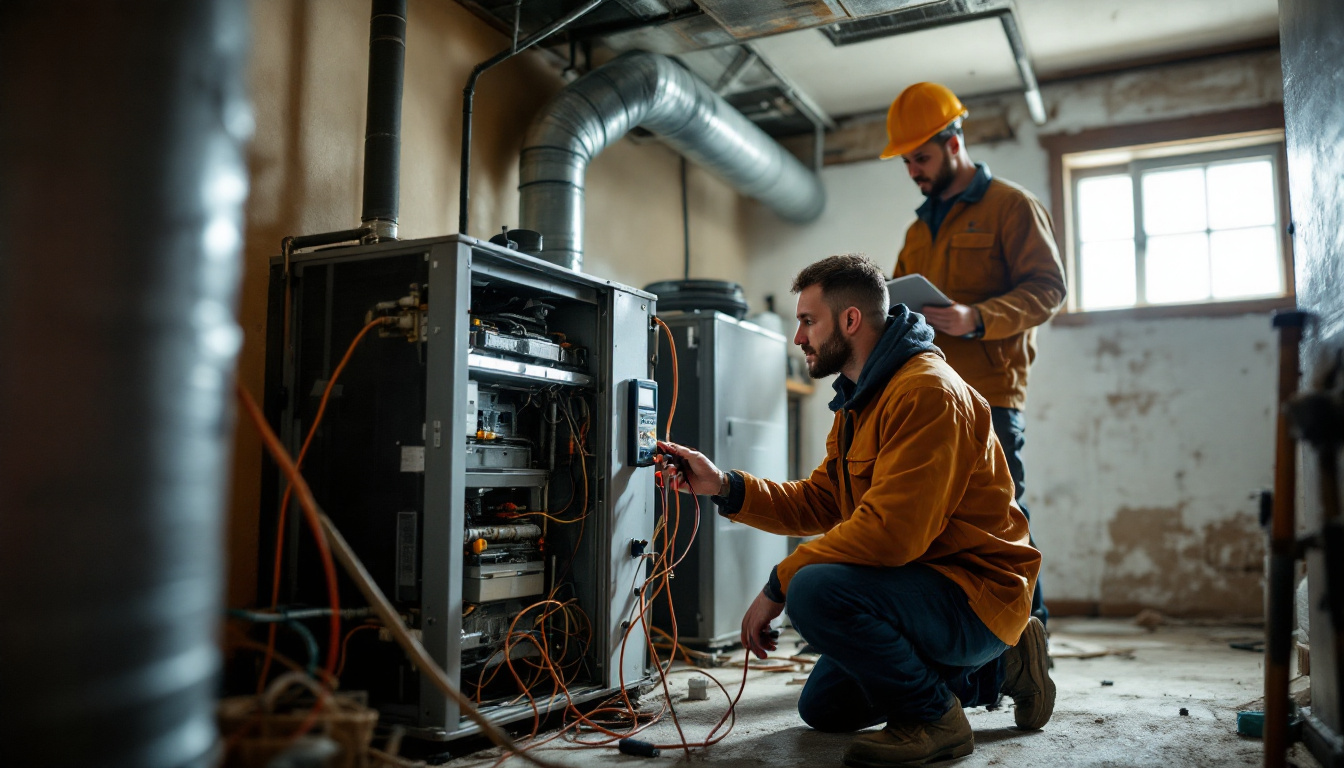
What is auxiliary heat on a heat pump? Auxiliary heat is the electric resistance backup that runs alongside the compressor when the heat pump cannot meet the load. Emergency heat locks the compressor out and runs that backup alone, at roughly 2.2 times the cost per unit.
Key Takeaways
- Electric resistance backup is “100% energy efficient in the sense that all the incoming electric energy is converted to heat”, a COP of 1.00 (DOE Energy Saver, archived).
- In EM HEAT the “Compressor is locked out”, per the Resideo VisionPRO 8000 installation instructions. AUX is a stage the thermostat calls by itself.
- US residential electricity averaged 18.34 cents per kilowatthour in June 2026, per EIA Table 5.3.
- DOE says not to set a heat pump thermostat back “if it causes the backup heating to come on” (Energy Saver, archived).
- ENERGY STAR’s cold climate designation requires a “COP at 5° F ≥ 1.75”, per its key product criteria.
What is auxiliary heat on a heat pump thermostat?
Auxiliary heat is electric resistance backup running at the same time as the compressor, because the heat pump alone cannot hold the setpoint. The thermostat closes a second relay, the strip heaters energize, the display reads AUX. In cold weather that is by design.
A heat pump moves heat rather than making it, so output falls as outdoor air cools. The thermostat carries separate terminals for the two backup calls, AUX for the supplemental stage and E for emergency heat, as any heat pump wall control does. How far it falls is published for every certified model; our cold-weather analysis finds the median keeps 77% of rated capacity at 5°F.
| Thermostat mode | What is running | How it is triggered | Efficiency of the added heat |
|---|---|---|---|
| HEAT, no indicator | Compressor only | Automatic, above the balance point | Seasonal COP about 2.20 at the federal minimum |
| HEAT with AUX showing | Compressor plus strip heaters | Automatic second stage, or defrost | Blended, 1.00 to the compressor figure |
| EM HEAT | Strip heaters only, compressor locked out | Selected by hand | COP 1.00 |
Mode behavior per Resideo instructions 68-0280. Efficiency figures are The HVAC Brief calculation from 10 CFR 430.32(c)(5) and appendix M1.
How is emergency heat different from auxiliary heat?
Emergency heat is a mode a person selects. Auxiliary heat is a stage the thermostat calls on its own. The difference that matters is the compressor: in AUX it keeps contributing cheap heat, in EM HEAT it is switched out.
The Resideo VisionPRO 8000 installation instructions put it plainly: “Emergency heat cycles to maintain temperature. Compressor is locked out.” The same document lists AUX as the “Auxiliary heat relay” and E as the “Emergency heat relay for heat pump systems”. That is manufacturer documentation, not a federal standard, so confirm it during a thermostat swap.
The lockout is the point of the setting. It exists for the day the compressor, reversing valve or outdoor fan fails, one of the faults only heat pumps have. Leaving it selected afterward is the most expensive mistake on the thermostat.
What does auxiliary heat cost compared with the compressor?
Heat from electric strip heaters costs about 2.2 times as much per unit as heat from a minimum efficiency heat pump. Every input is federal; the arithmetic is our own.
Split system heat pumps made since January 1, 2023 must reach a Heating Seasonal Performance Factor 2 of 7.5 under 10 CFR 430.32(c)(5). Appendix M1 to 10 CFR part 430 defines HSPF2 as “the total space heating required during the heating season, expressed in Btu, divided by the total electrical energy consumed by the heat pump system during the same season, expressed in watt-hours”. At 3,412 Btu per kilowatthour (EIA), HSPF2 divided by 3.412 is a seasonal COP: 7.5 gives 2.20, the DOE Cold Climate Heat Pump Challenge’s 8.5 gives 2.49.
Electric resistance sits at 1.00 by definition. At 18.34 cents per kilowatthour, one million Btu of delivered heat costs 53.75 dollars on strip heat, 28.29 dollars at the 1.9 COP measured in the field at 0 to 5 °F, 24.45 dollars at 7.5 HSPF2 and 21.58 dollars at 8.5 HSPF2. State rates move all four: see electricity prices by state and cost per million Btu by system.
One caveat: HSPF2 is a Region IV seasonal average, and appendix M1 already models “resistive space heating” inside the rated HSPF2 figure.
How big are heat pump strip heaters, and what do they draw?
Residential strip heat is built from elements of roughly five kilowatts each, staged so they do not all energize at once. DOE describes an electric furnace as blowing air over “a stack of three to seven electric resistance coils, called elements, each of which are typically rated at five kilowatts”.
Field data matches. Across 22 cold climate heat pumps monitored for the DOE Challenge, PNNL-37127 found “the first stage was typically around 5 kW, and the total auxiliary heat capacity was around 15-20 kW”. Its most common defrost strategy ran the fan with that first stage, which is why AUX can flash on near freezing. The same physics governs baseboard heaters.
| Strip heat bank | Current at 240 volts | Heat output | Cost per hour |
|---|---|---|---|
| 5 kW, first stage only | 20.8 amps | 17,060 Btu per hour | $0.92 |
| 10 kW | 41.7 amps | 34,120 Btu per hour | $1.83 |
| 15 kW | 62.5 amps | 51,180 Btu per hour | $2.75 |
| 20 kW | 83.3 amps | 68,240 Btu per hour | $3.67 |
The HVAC Brief calculation. Current is kilowatts divided by 240 volts; output uses 3,412 Btu per kilowatthour (EIA); cost uses 18.34 cents per kilowatthour. Many air handlers run at 208 volts.
For scale, PNNL measured a median 0.5 to 1.1 kilowatts per ton in heat pump only mode below 30 °F, or 28 to 61 cents an hour for three tons.
What is the balance point, and when should auxiliary heat switch on?
The balance point is the outdoor temperature at which heat pump output equals the house’s heat loss, and below it auxiliary heat is legitimately needed. DOE describes “a winter outdoor temperature at which the heat pump capacity is identical to the house’s heating load”, one “usually well below 40°F for code-built homes”.
The archived DOE page works an example at a 35 °F balance point. DOE’s Building America Solution Center adds the design side: right sizing for cooling leaves heating capacity short in most of the country, and “the auxiliary or backup heat will make up the difference, but at a much lower efficiency”. That is why installation choices matter more than any thermostat feature.
Why is auxiliary heat running in mild weather?
Auxiliary heat above the balance point is a signal, not normal operation. In mild weather the compressor should satisfy the thermostat alone, so AUX at 45 or 50 °F points at a control fault, a charge or airflow problem, or a deep setback.
DOE names the most common cause: “Many heat pump controls are incorrectly wired to automatically turn on the auxiliary strip heat if the indoor thermostat is changed by more than 3 degrees F regardless of the outdoor temperature.” At 50 °F outside, it says, a jump from 66 °F to 70 °F should not fire the strips.
The code point most installers miss
DOE states that “Energy codes require that heat pumps with auxiliary electric resistance back-up heat have controls to prevent unnecessary heat strip operation. This is one of the most commonly violated installation practices for heat pumps.” It names an outdoor lockout thermostat as one fix, and requirements vary by code edition.
Charge and airflow are the other suspects. DOE notes that split systems are charged in the field, that the wrong refrigerant charge cuts performance, and that airflow much below 350 cubic feet per minute per ton does the same. Both drag the real balance point upward, which is what an annual maintenance visit is for.
What should a homeowner check before calling a technician?
Four checks take ten minutes, and none involve opening the air handler:
- Confirm the mode switch reads HEAT, not EM HEAT. Left there after a cold snap, the compressor is still locked out.
- Compare the outdoor temperature with the balance point on the install paperwork. AUX below it is expected.
- Raise the setpoint in one or two degree steps. A four degree jump can fire the strips.
- Change the filter and open every register. Restricted airflow lowers capacity and pulls the crossover into milder weather.
If AUX still shows, ask about the lockout setting, the charge and the airflow. The wider cost question sits in heat pumps against gas furnaces.
How we researched this
Research date: September 18, 2026. Efficiency minimums come from 10 CFR 430.32(c)(5); the HSPF2 definition and the modeling of backup heat from appendix M1, both in the 2024 GovInfo edition. Prices come from EIA Table 5.3, June 2026. Field performance comes from PNNL-37127, January 2025, covering 22 units monitored in the United States and Canada, winter 2022 to early fall 2024. Three DOE Energy Saver pages were read as archived copies because the live pages moved.
Thermostat behavior rests on one manufacturer document, the Resideo VisionPRO 8000 instructions, attributed as a Tier 2 source. Excluded: contractor blogs and lead generation pages, which supply most of the search results and none of the numbers; vendor estimates of strip heat spending, because no federal series measures it; and Reddit, which we skip on anything touching electrical loads. No installed prices appear because no federal source publishes them.
Frequently asked questions
Is it bad to leave the thermostat on emergency heat?
Yes, for cost. In the Em. Heat position the compressor is locked out, per the Resideo VisionPRO 8000 instructions, so all the heat comes from resistance at a COP of 1.00 rather than about 2.20 at the 7.5 HSPF2 minimum. Use it when the compressor has failed.
At what temperature does auxiliary heat come on?
At the balance point, where heat pump capacity equals the house’s heating load. DOE says that point is “usually well below 40°F for code-built homes” and works an example at 35 °F. Yours depends on the envelope and the equipment.
Does AUX heat mean my heat pump is broken?
Not on its own. Below the balance point, and during defrost, auxiliary heat is designed behavior: PNNL found the most common defrost strategy among 22 cold climate prototypes ran the fan with the first stage, around 5 kW. AUX in mild weather is the version to investigate.
Why does AUX come on when I turn the thermostat up?
Usually a control wiring defect. DOE says many heat pump controls turn the strips on whenever the setpoint moves more than 3 degrees F, whatever the outdoor temperature. Its worked example puts 50 °F outside and a jump from 66 °F to 70 °F, which should not fire the strips.
How much more does emergency heat cost than heat pump heating?
About 2.2 times as much per unit of delivered heat. At the June 2026 US average of 18.34 cents per kilowatthour, one million Btu costs 53.75 dollars on strip heat and 24.45 dollars from a 7.5 HSPF2 heat pump. Those are The HVAC Brief calculations from federal inputs.
Do cold climate heat pumps still need auxiliary heat?
Less of it, but yes. ENERGY STAR requires a “COP at 5° F ≥ 1.75” for the cold climate designation, and the DOE Challenge asked for a capacity ratio of 100 percent at 5 °F. Even so, PNNL recorded auxiliary elements engaged 25 percent of the time in the coldest bin it charted.
Sources
- US GPO. “10 CFR 430.32.” https://www.govinfo.gov/content/pkg/CFR-2024-title10-vol3/xml/CFR-2024-title10-vol3-sec430-32.xml. Accessed September 2026.
- US GPO. “Appendix M1 to Subpart B of Part 430.” https://www.govinfo.gov/content/pkg/CFR-2024-title10-vol3/xml/CFR-2024-title10-vol3-part430-subpartB-appM1.xml. Accessed September 2026.
- EIA. “Electric Power Monthly, Table 5.3.” https://www.eia.gov/electricity/monthly/epm_table_grapher.php?t=epmt_5_3. Accessed September 2026.
- EIA. “Units and calculators explained.” https://www.eia.gov/energyexplained/units-and-calculators/. Accessed September 2026.
- PNNL. “PNNL-37127, Performance Results from DOE Cold Climate Heat Pump Challenge Field Validation.” https://www.pnnl.gov/main/publications/external/technical_reports/PNNL-37127.pdf. Accessed September 2026.
- DOE Energy Saver. “Electric Resistance Heating.” Archived copy. https://web.archive.org/web/20260101034530id_/https://www.energy.gov/energysaver/electric-resistance-heating. Accessed September 2026.
- DOE Energy Saver. “Air-Source Heat Pumps.” Archived copy. https://web.archive.org/web/20260101025734id_/https://www.energy.gov/energysaver/air-source-heat-pumps. Accessed September 2026.
- DOE Energy Saver. “Operating and Maintaining Your Heat Pump.” Archived copy. https://web.archive.org/web/20260101015456id_/https://www.energy.gov/energysaver/operating-and-maintaining-your-heat-pump. Accessed September 2026.
- DOE Building America Solution Center. “Cold Climate Heat Pump Sizing and Selection.” https://basc.pnnl.gov/resource-guides/cold-climate-heat-pump-sizing-and-selection. Accessed September 2026.
- ENERGY STAR. “Air-Source Heat Pumps Key Product Criteria.” https://www.energystar.gov/products/heating_cooling/heat_pumps_air_source/key_product_criteria. Accessed September 2026.
- Resideo. “VisionPRO 8000 installation instructions 68-0280.” https://customer.resideo.com/resources/Techlit/TechLitDocuments/68-0000s/68-0280.pdf. Accessed September 2026.
Leave a Reply