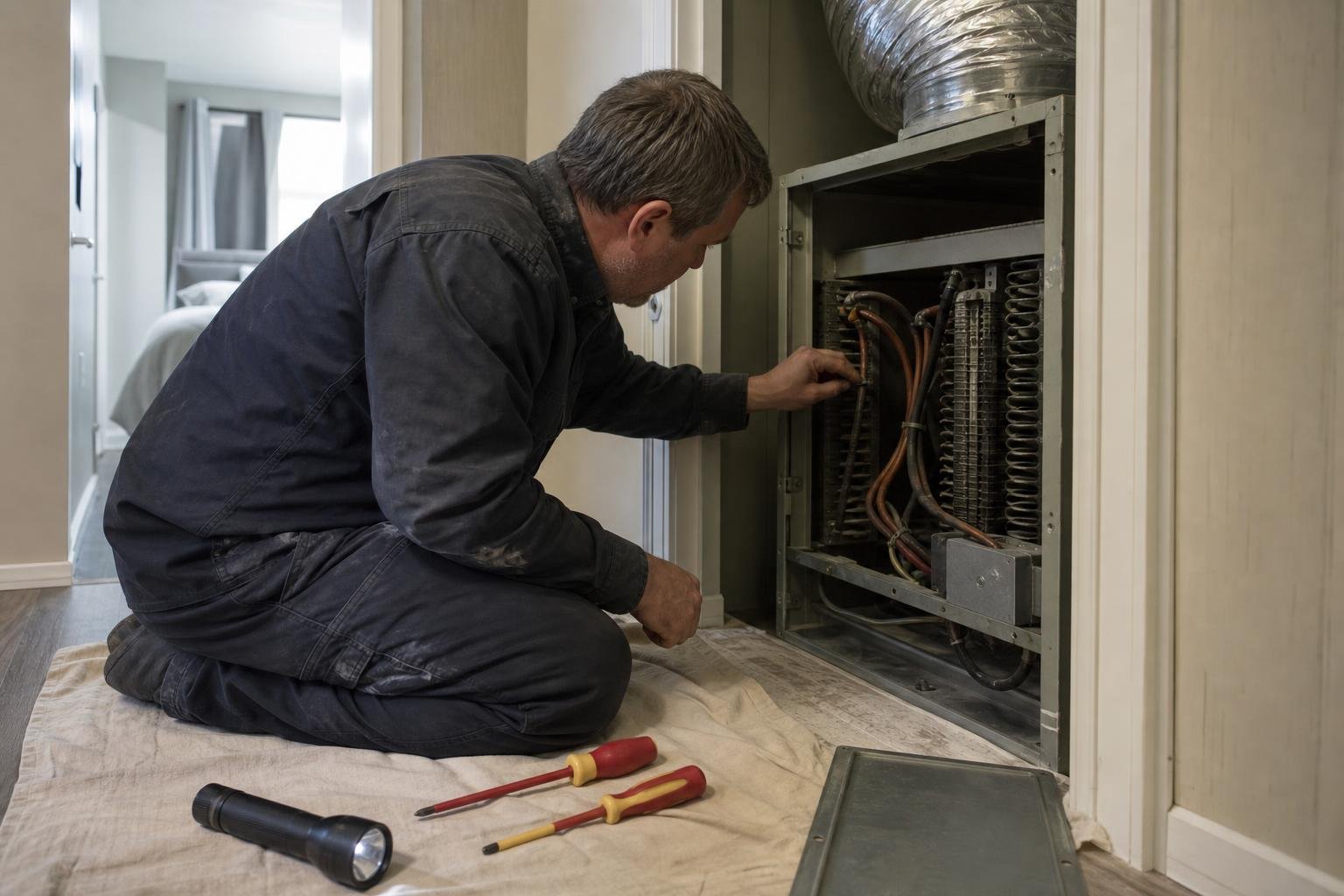
What is an electric furnace? An electric furnace is a ducted heater that blows air across resistance elements switched on in stages. It turns every kilowatt hour into heat, yet at the 2026 US price that heat costs about $53 per million Btu, more than double a minimum efficiency heat pump.
Key Takeaways
- Electric central furnaces were main heat in 13.82 million US homes in 2020, about 11% of homes (EIA RECS 2020, Table HC6.1).
- DOE describes three to seven elements, typically five kilowatts each, that switch on in stages (DOE Energy Saver, archived copy).
- One Johnson Controls 20 kW model draws 83.8 amps on a single circuit and allows a 110 amp maximum breaker (EBE/EUE installation manual).
- Federal rules set a 78.0% minimum AFUE for electric furnaces built since January 1, 1992, and cap standby power at 10 watts (10 CFR 430.32).
- US homes paid 18.19 cents per kWh on average, January to July 2026 (EIA Electric Power Monthly, Table 5.6.B).
- By our arithmetic that is $53.31 per million Btu from an electric furnace and $24.25 from a heat pump at the 7.5 HSPF2 federal minimum.
What is an electric furnace?
An electric furnace is a central forced-air heater with no burner, no flue and no fuel line. Federal rules define an electric central furnace as one that supplies heat “through a system of ducts” with heat “generated by one or more electric resistance heating elements” and air moved by a fan or blower.
The cabinet holds a blower, an element rack, sequencers, limit switches and a 24 volt control board, and it connects to the same ductwork a gas furnace would use.
How does an electric furnace stage its heating elements?
An electric furnace switches its elements on one stage at a time, seconds apart, so the branch circuit and the service never see the full load in one instant. DOE says the elements “activate in stages to avoid overloading the home’s electrical system,” and a built-in limit controller shuts the unit off if the blower fails or a filter clogs.
The timing comes from a sequencer, a heat-operated relay. Resideo’s R8330D sequencer switches the fan and up to three elements with “10 seconds minimum between stages.” A call for heat runs like this:
- The thermostat energizes the first sequencer’s 24 volt heater.
- The fan and first element start together, so air moves before heat builds.
- Further elements follow; every stage on one sequencer is on within 2 minutes.
- When the call ends, the elements drop out in turn and are all off within 4 minutes.
Two or three sequencers can be chained to run four to nine elements. A breaker that trips at start-up points at the circuit; see our guide to why an HVAC breaker keeps tripping.
What size electric furnace do you need, and what circuit does it take?
Residential electric furnaces are sold by kilowatt, commonly 10, 15 and 20 kW, and each kilowatt delivers 3,412 Btu per hour. At 240 volts a 10 kW unit draws about 41.7 amps of element current, a 15 kW unit 62.5 amps and a 20 kW unit 83.3 amps, which is why these furnaces need their own large branch circuits.
Those amp and Btu figures are our arithmetic, using the EIA conversion of 3,412 Btu per kWh. The wiring columns come from one nameplate family, the Johnson Controls EBE/EUE series for manufactured and modular homes.
| Size | Btu per hour (our math) | Amps at 240 V (our math) | EBE/EUE model | Circuit load, single circuit | Max breaker, single circuit |
|---|---|---|---|---|---|
| 10 kW | 34,120 | 41.7 | EBE10A | 43.8 A | 60 A |
| 15 kW | 51,180 | 62.5 | EBE15A | 63.8 A | 80 A |
| 20 kW | 68,240 | 83.3 | EBE20A | 83.8 A | 110 A |
Manufacturer columns: Johnson Controls manual 5396713-BIM-E-0720, Tables 2 and 4. Circuit load includes the blower.
Split across two circuits, the 20 kW unit takes a 60 amp and a 50 amp breaker. Voltage matters: the 15 kW model is rated 15.0 kW at 240 volts but 12.6 kW at 220 volts. Size from a heat loss figure, which our heating load calculator estimates, and leave wire and breaker sizing to the nameplate and a licensed electrician under local code.
Is an electric furnace the same as an air handler with a heat kit?
Mechanically they are close: both are a blower cabinet with elements, sequencers and limits. An electric furnace is built as the main heat source; an air handler is built around an indoor refrigerant coil, and its heat kit is an accessory that backs up a heat pump.
Many electric furnaces are sold ready for cooling. Johnson Controls says its EBE/EUE units are “factory equipped with a blower, coil shelf, and control system for add-on air conditioning and heat pump,” Add an indoor coil and an outdoor unit and the cabinet cools too; with a heat pump, the elements become backup heat.
Separate heating and cooling thermostats then need an interlock so both never run at once, and the coil shelf must be sealed air tight. Our guides to setting an air handler and coil and to how heat strips back up a heat pump cover each step.
Why does a 100% efficient electric furnace cost so much to run?
An electric furnace turns each kilowatt hour into 3,412 Btu of heat and no more, while a heat pump moves extra heat in from outdoors. At 18.19 cents per kWh, the US residential average for January to July 2026, a million Btu from an electric furnace costs $53.31 by our arithmetic, against $24.25 from a heat pump at the federal minimum.
Our math: a million Btu is 293.08 kWh, so at a coefficient of performance (COP) of 1.0 it costs 293.08 times $0.1819. The federal floor for a split heat pump since January 1, 2023 is 7.5 HSPF2; divided by 3.412 that is a seasonal COP of 2.20, about 45% of the electricity.
Ducts widen the gap: DOE says electric furnaces cost more to run than other resistance systems “because of their duct heat losses.” Our baseboard heater analysis reached the same verdict: resistance heat pays only where heating is occasional. Rerun the math with your rate from our electricity prices by state.
At 18.19 cents, a 15 kW furnace with every element on costs about $2.73 an hour, by our arithmetic. Other fuels on the same basis are in what heat costs by fuel.
What federal efficiency standards apply to an electric furnace?
Electric furnaces made on or after January 1, 1992 must reach at least 78.0% AFUE under 10 CFR 430.32(e), and those made since May 1, 2013 may draw no more than 10 watts in standby or off mode.
The fan rule applies from July 3, 2019: a non-weatherized electric furnace fan must meet FER = 0.044 × Qmax + 165 watts per 1,000 cfm. The 95% AFUE floor starting December 18, 2028 covers gas furnaces only, not electric models.
Myth: a higher AFUE electric furnace saves money
DOE puts the AFUE of an all-electric furnace “between 95% and 100%,” yet still calls it “an uneconomic choice” in most of the country because of electricity prices. The bill follows kWh used, not the label.
How many US homes heat with an electric furnace?
EIA’s 2020 Residential Energy Consumption Survey counted 13.82 million homes whose main heating equipment was an electric central warm-air furnace. That is about 11% of the 123.53 million US homes and about a third of the 42.57 million that heat mainly with electricity.
Single-family detached houses account for 6.47 million of them; the rest are apartments, attached homes and mobile homes. See how American homes are heated for the full fuel mix.
When is an electric furnace still a sensible choice?
An electric furnace makes sense where heating hours are few, gas is unavailable, or it backs up a heat pump. There, simplicity and no combustion can outweigh a per Btu cost about double a minimum efficiency heat pump.
- Mild climates. A high rate on a small annual load is still a small bill.
- No gas line. No flue or gas piping, which suits apartments and manufactured homes.
- Backup to a heat pump. Paired with an outdoor unit, the elements cover defrost and the coldest hours.
- Simple installation. A circuit and ducts, with no venting.
Where heating runs for months, the arithmetic favors a heat pump. Our explainer on how a heat pump moves heat covers the mechanism, and our heat pump replacement guide covers the swap.
How we researched this
Research date: October 5, 2026. Every figure was read at the source document in this session.
Consulted and cited: the nine sources below, including two DOE Energy Saver pages read as archived copies because the live pages 404. EIA’s 2026 price is preliminary, year to date through July. Manufacturer documents illustrate mechanism and nameplates only.
Excluded: contractor blogs and retail sizing charts (no stated basis) and installed prices (no federal series). No Reddit: this is high-amperage 240 volt work, and our rule keeps forum advice out of electrical safety topics. Figures labelled as ours are our arithmetic on the cited inputs.
Frequently asked questions
How many amps does a 20 kW electric furnace draw?
About 83.3 amps of element current at 240 volts, by our arithmetic. The Johnson Controls EBE20A lists 83.8 amps on one circuit, blower included, with a 110 amp maximum breaker. For other equipment, see our guide to HVAC watts and amps.
Can you add central air to an electric furnace?
Often, yes. Johnson Controls says its EBE/EUE furnaces have a blower, coil shelf and controls “for add-on air conditioning and heat pump.” An indoor coil, line set and outdoor unit are added, and separate heating and cooling thermostats need an interlock.
Why does an electric furnace blow cool air for the first minute?
The elements come on in stages. A sequencer such as the Resideo R8330D waits at least 10 seconds between stages, and the blower starts with the first stage, so the first air out of the registers is only partly heated.
Is an electric furnace cheaper to run than a heat pump?
No. At 18.19 cents per kWh, the US residential average for January to July 2026, a million Btu costs $53.31 from an electric furnace and $24.25 from a 7.5 HSPF2 heat pump, by our arithmetic. Installation is separate; see our furnace price breakdown.
What efficiency must a new electric furnace meet?
At least 78.0% AFUE under 10 CFR 430.32(e) for units made since January 1, 1992. Since May 1, 2013, standby and off mode draw is capped at 10 watts, and since July 3, 2019 the blower fan must meet a fan energy rating limit.
What maintenance does an electric furnace need?
Mainly clean filters. DOE notes the limit controller “may shut the furnace off if the blower fails or if a dirty filter is blocking the airflow.” Element, sequencer and wiring checks belong to a licensed technician with the power off.
Sources
- Electronic Code of Federal Regulations. “10 CFR 430.32, Energy and water conservation standards and their compliance dates.” https://www.ecfr.gov/current/title-10/chapter-II/subchapter-D/part-430/subpart-C/section-430.32. Accessed October 2026.
- Electronic Code of Federal Regulations. “10 CFR 430.2, Definitions.” https://www.ecfr.gov/current/title-10/chapter-II/subchapter-D/part-430/subpart-A/section-430.2. Accessed October 2026.
- U.S. Energy Information Administration. “RECS 2020, Table HC6.1, Space heating in U.S. homes, by housing unit type.” https://www.eia.gov/consumption/residential/data/2020/hc/pdf/HC%206.1.pdf. Accessed October 2026.
- U.S. Energy Information Administration. “Electric Power Monthly, Table 5.6.B, Average Price of Electricity to Ultimate Customers by End-Use Sector, by State, Year-to-Date.” https://www.eia.gov/electricity/monthly/epm_table_grapher.php?t=epmt_5_6_b. Accessed October 2026.
- U.S. Energy Information Administration. “Energy conversion calculators.” https://www.eia.gov/energyexplained/units-and-calculators/energy-conversion-calculators.php. Accessed October 2026.
- U.S. Department of Energy, Energy Saver. “Electric Resistance Heating” (archived copy). https://web.archive.org/web/2025id_/https://www.energy.gov/energysaver/electric-resistance-heating. Accessed October 2026.
- U.S. Department of Energy, Energy Saver. “Furnaces and Boilers” (archived copy). https://web.archive.org/web/2025id_/https://www.energy.gov/energysaver/furnaces-and-boilers. Accessed October 2026.
- Johnson Controls Ducted Systems. “Electric Furnace Models EBE*/EUE* Installation Manual, 5396713-BIM-E-0720.” https://www.yorknow.com/pub/media/documentation/EBE_EUE_Installation.pdf. Accessed October 2026.
- Resideo (Honeywell). “R8330D Electric Furnace Sequencer, 60-0327.” https://customer.resideo.com/resources/Techlit/TechLitDocuments/60-0000s/60-0327.pdf. Accessed October 2026.
Leave a Reply