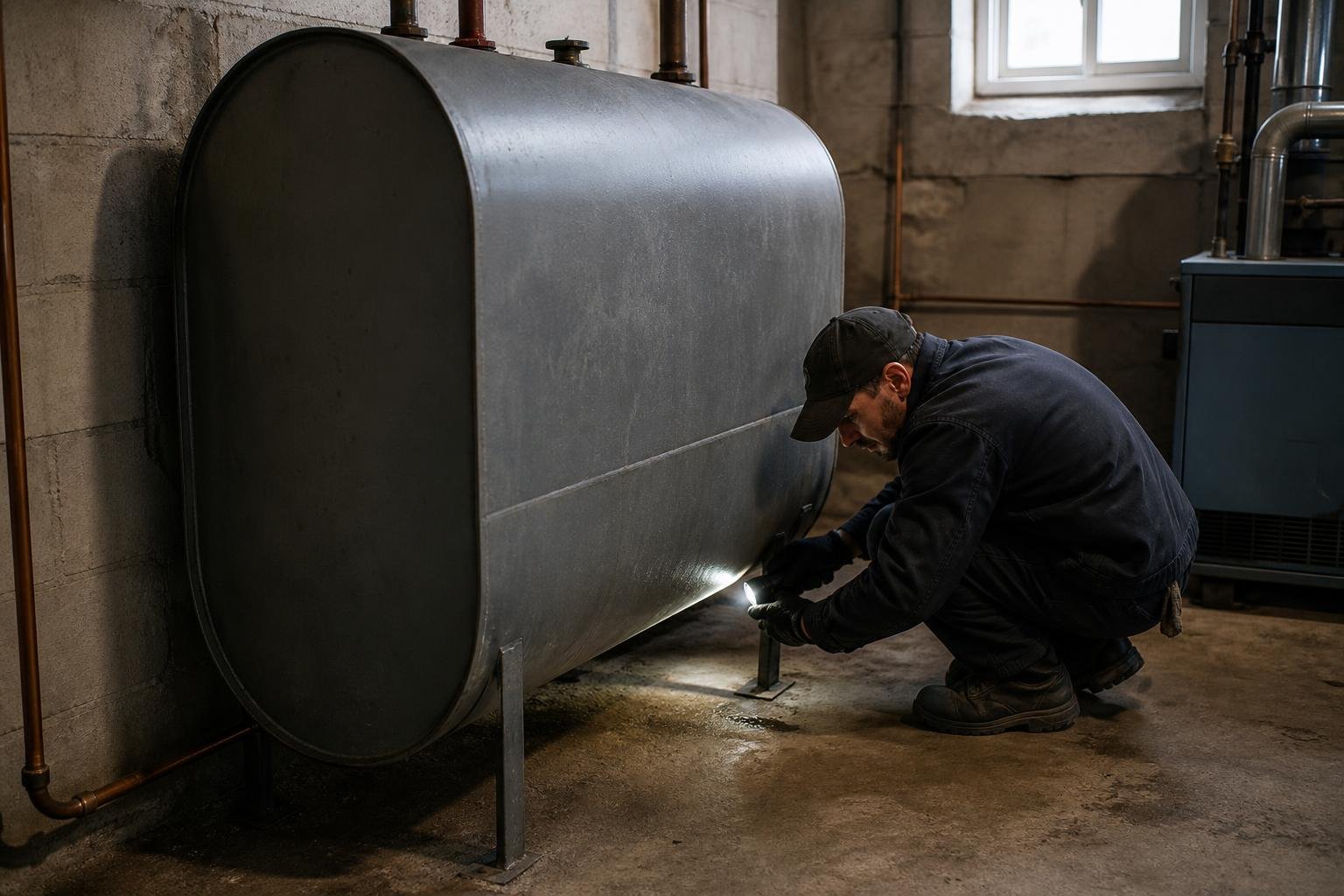
What is a heating oil tank? A heating oil tank is the steel or fiberglass vessel that stores a home’s fuel oil, most often a 275 gallon tank in a basement, outdoors or buried. Steel tanks rust from the inside, and federal tank rules exclude them, so states set the rules.
Key Takeaways
- 4.93 million US homes heated mainly with fuel oil or kerosene in 2020, 4.07 million of them in the Northeast (EIA RECS HC6.7).
- 40 CFR 280.12 excludes any “tank used for storing heating oil for consumptive use on the premises where stored” from federal tank rules.
- MassDEP puts buried steel tank life at about 10 to 20 years; tanks rust from the inside out.
- On a vertical 275 gallon tank, 1/4 on the gauge is about 21% of volume, by our geometry on Granby’s dimensions.
- New Jersey requires a certified contractor to close any underground tank, removed or abandoned in place.
- Massachusetts makes insurers offer at least $50,000 first party and $200,000 third party leak coverage to upgraded homes.
What sizes does a heating oil tank come in?
Most homes use a 275 gallon steel tank, built vertical or horizontal on the same oval profile. Granby Industries lists its standard UL 80 residential line at 120 to 330 gallons. How fast a household empties one depends on climate and house size, which we work through in how much heating oil a house uses.
| Granby model | Nameplate | H x W x L | Empty weight |
|---|---|---|---|
| Stubby vertical | 220 gallons | 44 x 27 x 48 in | 215 lb |
| Vertical | 275 gallons | 44 x 27 x 60 in | 250 lb |
| Horizontal | 275 gallons | 27 x 44 x 60 in | 250 lb |
| Vertical | 330 gallons | 44 x 27 x 72 in | 290 lb |
The nameplate overstates one delivery: oil below the suction line, the sludge layer and the headspace at the top all come out of it, which matters when you compare minimum orders for cash delivery. Full, a 275 gallon tank weighs more than 2,000 pounds, MassDEP warns, so an outdoor tank needs sound legs on a concrete pad.
How do you read a heating oil tank gauge?
The float gauge on top reads the oil’s height, not its volume. Because the tank is oval, its bottom and top quarters hold less than the middle, so 1/4 on the dial is less than a quarter of the nameplate.
Our geometry on Granby’s 44 by 27 inch profile puts 1/4 on a vertical 275 gallon tank at about 21% of volume, roughly 58 gallons. Half reads 50%, and 3/4 is about 79%, roughly 217 gallons.
Why will a driver not fill the tank to the top?
The driver stops when the vent alarm goes quiet. Air pushed out through the vent whistles until oil reaches the end of the alarm tube, and MassDEP notes that crews listen for it because overfills are a common source of spills.
No federal rule sets the headspace, so take 6 inches as an illustration. On our geometry the top 6 inches of a vertical 275 gallon tank hold about 9%, roughly 25 gallons; on a horizontal tank they hold about 19%, roughly 52 gallons.
How long does a heating oil tank last?
A steel heating oil tank lasts about 10 to 20 years buried and no more than about 30 years indoors, per MassDEP, which adds that “often their lifespan is much shorter.” An outdoor tank left uncovered for 10 years or longer should be replaced.
The damage starts inside. Condensation water and sludge settle under the oil, and MassDEP says “tanks primarily rust from the inside out,” so painting the outside does not usually help. It advises a tank cleanout at least every 10 years.
Pennsylvania DEP’s checklist flags a tank taking on water, a rise greater than 1/2 inch over 8 to 12 hours. Ask for a water check during the annual burner service visit.
Does the EPA regulate a home heating oil tank?
No. The definition of an underground storage tank in 40 CFR 280.12 “does not include any” of nine tank types, and item (2) is a “Tank used for storing heating oil for consumptive use on the premises where stored.”
Item (9) separately excludes a basement tank “situated upon or above the surface of the floor.” EPA’s UST questions page adds that “state or local regulatory agencies may regulate these tanks.”
Myth: an unregulated tank is nobody’s problem
Federal exclusion is not a pass. New York’s guide says contamination “must be reported” to its Spills Hotline even though most home tanks sit outside its bulk storage rules.
What do New Jersey, New York and Massachusetts require of an oil tank owner?
Each state runs its own program. New Jersey controls who closes a tank, New York requires spill reporting, and Massachusetts requires a supply line upgrade.
| State | Which home tanks | Key requirement | Leak reporting |
|---|---|---|---|
| New Jersey, NJDEP | Residential tanks of any size, above or below ground | Underground closure, removed or abandoned in place, by a contractor certified under N.J.A.C. 7:14B | Hotline, 1-877-WARNDEP |
| New York, NYSDEC | Most are under 1,100 gallons and outside bulk storage rules | Closed tanks emptied, cleaned and purged of vapors | Spills Hotline, 1-800-457-7362 |
| Massachusetts, MassDEP | Oil heated homes of 1 to 4 units | Oil safety valve or sleeved supply line by September 30, 2011 | 10 gallons or more within 2 hours |
After a discharge, New Jersey’s UHOT program requires a Certified Subsurface Evaluator or a Licensed Site Remediation Professional, and the case closes with a No Further Action letter after a $400 review fee. New York flags that Nassau, Suffolk and Westchester counties may regulate smaller tanks.
What are the signs of a leaking heating oil tank, and who pays?
The signs are rising oil use, oil odors, stained soil and a tank taking on water, and the owner usually pays. Pennsylvania DEP also lists vapors in the basement and a burner running erratically; NYSDEC notes a leak may occur only when the tank is full.
Check an unexplained jump in gallons against what each delivery cost in past seasons. Rust, weeps, loose legs, a stuck gauge and a silent whistle belong on any fall heating checklist.
Liability follows the property: Pennsylvania DEP tells buyers that “in most cases, when you purchase the property, you inherit all liability associated with the tank.” NYSDEC warns that many homeowner policies carry a “pollution exclusion” clause, so you “could get stuck with the bill.”
Massachusetts put a “simple” leak cleanup at as much as $15,000 in 2011, and one reaching groundwater at $250,000 or more. Its law makes insurers offer leak coverage to upgraded homes, but buying it is optional. New Jersey’s UST Fund offers hardship grants up to $500,000 per site for leaking underground tanks, but excludes aboveground tank discharges.
Should you remove, replace or abandon an underground heating oil tank?
Remove it if you can. NYSDEC calls removal “the best choice” because it lets you check the soil and avoids sinkholes if the tank collapses. Abandonment in place, filling the cleaned tank with sand or another inert material, is the fallback when removal would endanger the house.
- Call the local building or fire official; permits are local, as with other permitted heating work.
- Hire a qualified contractor. New Jersey’s fund pays for abandonment only if a licensed civil engineer finds removal may weaken the structure.
- Have the tank emptied, cleaned and purged of vapors, as New York law requires.
- Inspect the excavation for holes, staining and odors, and report any discharge.
- Keep every record for the eventual sale.
A replacement is usually an aboveground tank in the basement, garage or a shed. It is also the moment to compare what a million Btu costs by fuel, and whether a cold climate heat pump would retire the tank.
With a boiler, the radiators or baseboard stay when the fuel changes, as our guide to boiler and baseboard heat explains. That makes a propane boiler the closer swap where gas mains do not reach.
How we researched this
Research date: October 5, 2026. We read 40 CFR 280.12 from the eCFR, EPA’s UST guidance, and homeowner guidance from environmental agencies in New Jersey, New York, Massachusetts, Pennsylvania and Maryland, several through Internet Archive copies because the live sites block automated readers. Gauge and headspace percentages are our geometry on Granby’s published dimensions. Dealer blogs, tank charts and contractor price lists were excluded, and so was Reddit, since leaks are a safety and liability topic.
Frequently asked questions
How long does a 275 gallon oil tank last?
MassDEP says indoor tanks last no more than about 30 years and often much less, and most buried steel tanks about 10 to 20 years. An outdoor tank uncovered for 10 years or longer should be replaced, because water and sludge rust it from the inside.
How much oil does a 275 gallon tank hold after a fill?
Less than 275 gallons. The driver stops when the vent whistle goes quiet, leaving headspace. As an illustration, 6 inches of headspace on a vertical 275 gallon tank is about 25 gallons by our geometry, and oil below the suction line is not usable either.
Does homeowners insurance cover an oil tank leak?
Often not. NYSDEC warns that many policies carry a pollution exclusion clause. Massachusetts requires insurers to offer leak coverage to homes with an oil safety valve or sleeved supply line, but the coverage is an optional purchase, so check your policy wording.
Do I have to remove an oil tank before selling my house?
The state guidance we read sets no general removal rule, but local rules vary. NYSDEC says a bank or buyer likely will ask for an environmental assessment or removal, and Pennsylvania DEP says a buyer in most cases inherits all liability associated with the tank.
Is a basement oil tank regulated by the EPA?
No. 40 CFR 280.12 excludes tanks storing heating oil for consumptive use on the premises, and separately excludes tanks sitting on or above the floor of a basement or cellar. States such as New Jersey, New York and Massachusetts set their own requirements instead.
What does 1/4 on an oil tank gauge mean?
On a vertical 275 gallon tank it means about 21% of the volume, roughly 58 gallons, by our geometry. The float measures height, and the rounded bottom of the oval tank holds less oil per inch than the straight middle section.
Sources
- eCFR. “40 CFR 280.12, Definitions.” https://www.ecfr.gov/current/title-40/chapter-I/subchapter-I/part-280/subpart-A/section-280.12. Accessed October 2026.
- EPA. “Frequent Questions About Underground Storage Tanks.” https://www.epa.gov/ust/frequent-questions-about-underground-storage-tanks. Accessed October 2026.
- MassDEP. “Prevent Heating Oil Leaks and Spills.” https://www.mass.gov/doc/tips-for-maintaining-your-home-heating-system-prevent-heating-oil-leaks-and-spills-1/download. Archived copy. Accessed October 2026.
- Commonwealth of Massachusetts. “Homeowner Oil Heating System Upgrade and Insurance Law.” https://www.mass.gov/files/documents/2017/11/07/Homeowner%20Oil%20System%20Insurance%20Law.pdf. Archived copy. Accessed October 2026.
- NYSDEC. “Underground Heating Oil Tanks: A Homeowner’s Guide.” https://dec.ny.gov/environmental-protection/hazardous-substance-bulk-storage/underground-heating-oil-tanks-homeowner-guide. Archived copy. Accessed October 2026.
- NJDEP. “Homeowner’s Guide to the Unregulated Heating Oil Tank Program.” https://dep.nj.gov/srp/unregulated/. Archived copy. Accessed October 2026.
- NJDEP. “Instructions for Petroleum UST Remediation, Upgrade and Closure Fund, Unregulated Leaking Tanks.” https://www.nj.gov/dep/srp/finance/ustfund/ustfund_unreg_app_ins.pdf. Archived copy. Accessed October 2026.
- Pennsylvania DEP. “Helpful Tips for Heating Oil Tanks.” https://files.dep.state.pa.us/EnvironmentalCleanupBrownfields/SiteRemediation/SiteRemediationPortalFiles/Home%20Heating%20brochure.pdf. Accessed October 2026.
- Maryland Department of the Environment. “Facts About: Vent Alarms on Your Home Heating Oil Tank.” https://mde.maryland.gov/programs/Land/OilControl/Documents/Vent%20Alarms%20on%20Home%20Heating%20Oil%20Tanks%20Fact%20Sheet%20Revised%205.2.16%201%20pg.pdf. Archived copy. Accessed October 2026.
- Granby Industries. “Standard Residential Oil Storage Tank UL 80.” https://www.granbyindustries.com/en-us/petroleum-tanks/products/standard/. Accessed October 2026.
- EIA. “2020 RECS Table HC6.7.” https://www.eia.gov/consumption/residential/data/2020/hc/xls/HC%206.7.xlsx. Accessed October 2026.
Leave a Reply