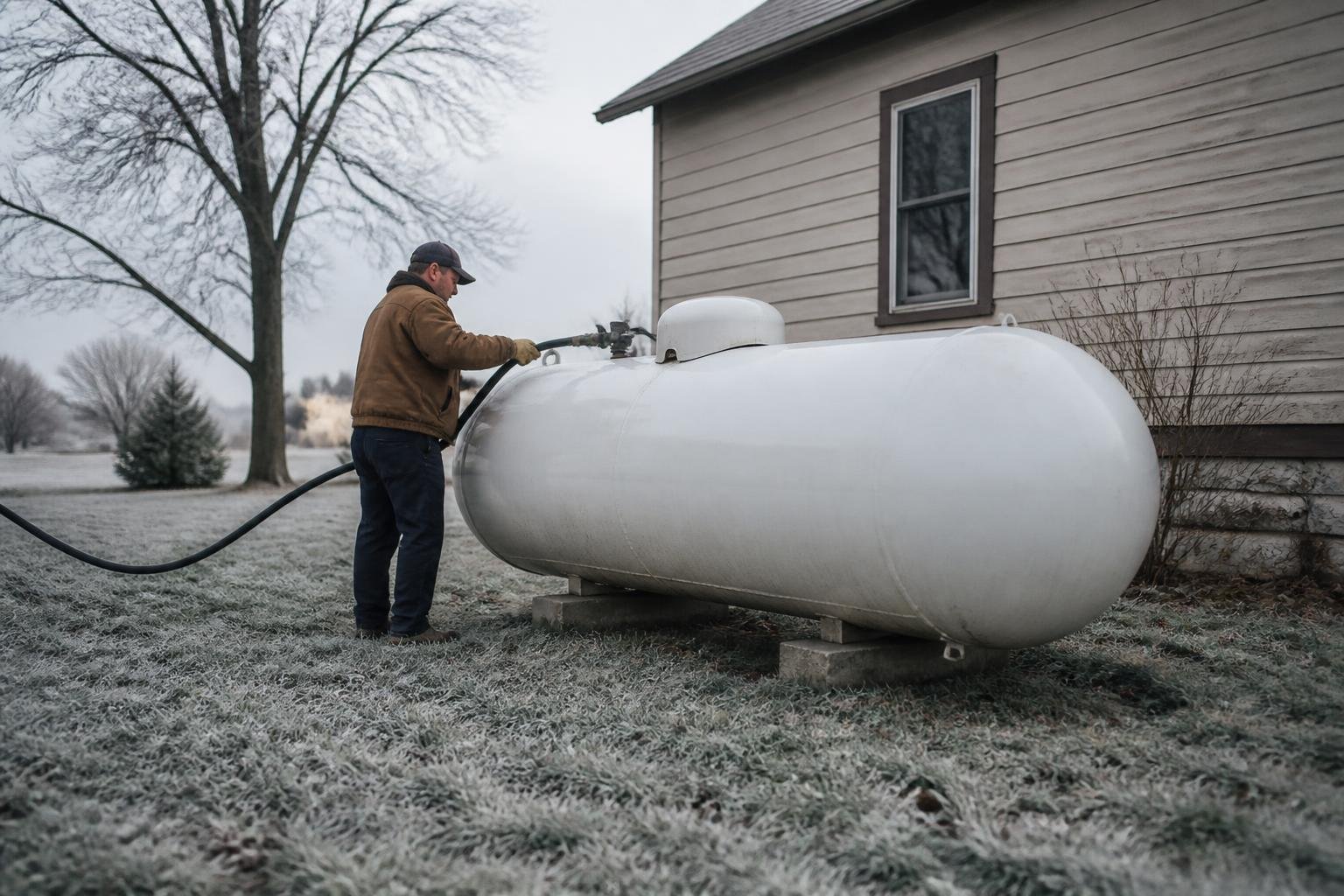
What is a propane heating system? A propane heating system is a furnace, boiler or room heater burning gas from a tank on your own property, refilled by truck. It is the main heat in 5.21 million US homes, mostly rural ones beyond the natural gas main.
Key Takeaways
- 5.21 million US homes heated mainly with propane in 2020, and 4.03 million of them used a central furnace, per EIA RECS table HC6.1.
- About 79% of propane heated homes are rural, our tabulation of EIA RECS 2020 microdata.
- A “full” tank is about 80% liquid, says North Carolina’s LP-gas regulator, so a 500 gallon tank holds about 400 gallons.
- North Carolina statute 119-58(b) bars filling a competitor’s tank, so a leased tank usually ties you to one dealer.
- US residential propane averaged $2.553 a gallon across 26 weekly EIA readings, October 2025 to March 2026, our average.
- Propane vapor density is 1.55 against air at 1.0, per OSHA chemical data, so leaks sink and pool near the floor.
Who uses a propane heating system, and where?
Mostly rural homeowners beyond the reach of a gas main. EIA’s 2020 Residential Energy Consumption Survey counts 5.21 million homes heated mainly with propane, about 4% of the 123.53 million US homes, against 62.71 million on piped natural gas.
Our tabulation of the RECS 2020 microdata puts 4.12 million of those 5.21 million homes in Census rural areas, about 79%. Propane is the main fuel in 17.8% of rural homes but only 0.9% of homes in urban areas. Owners dominate too: 4.55 million propane heated homes were owner occupied, per the federal breakdown of how US homes are heated.
The Midwest leads with 2.12 million propane heated homes, and 2.93 million sit in EIA’s very cold and cold climate zones. Counting water heating and cooking, 11.14 million homes used propane, our tabulation.
Which appliances can a propane heating system use?
The same equipment families that burn natural gas: a furnace, a boiler, or a built-in room heater. Furnaces dominate, carrying 4.03 million of the 5.21 million propane heated homes in RECS 2020.
| Main heating equipment, propane homes | Homes, 2020 | Source |
|---|---|---|
| Central warm air furnace | 4.03 million | RECS table HC6.1 |
| Built-in room heater burning gas or oil | 0.54 million | Our tabulation, RECS microdata |
| Steam or hot water boiler system | 0.45 million | Our tabulation, RECS microdata |
| Other equipment | 0.19 million | Our tabulation, RECS microdata |
A propane furnace is installed much like any other gas furnace replacement, and a propane boiler feeds the same hot water baseboard and radiator loops.
Smaller homes may use a vented wall heater instead.
A natural gas appliance is not a propane appliance. OSHA’s LP-gas standard, 29 CFR 1910.110(b)(20)(ii), says an appliance built for another gas may run on LP-gas “only after it is properly converted, adapted, and tested for performance with LP-Gas.” In practice, ask for the conversion kit the appliance manufacturer specifies, fitted by a licensed gas technician where local code requires one.
Should you own or lease the propane tank?
Leasing is simpler, but it usually locks you to one dealer. Wisconsin’s consumer protection agency puts it plainly: “Most propane retail marketers won’t deliver propane to a tank owned by another retail marketer.” Owning lets you compare prices, but the same agency warns it brings “considerable maintenance costs and responsibilities.”
In some states the lock is law. North Carolina’s Department of Agriculture notes that General Statute 119-58(b) “prohibits an LP-gas company from filling a tank that is owned by a competitor.” Vermont’s rule CP 111, issued by the Attorney General, says no seller shall fill a tank without the owner’s permission.
| Question | Leased tank | Owned tank |
|---|---|---|
| Who can fill it | Usually only the tank’s owner, the dealer | Any dealer you choose, after its safety check |
| Switching cost | A pick-up fee may apply (Wisconsin DATCP) | A new dealer inspects and charges a fee before filling |
Under Vermont’s CP 111.09(f)(4), a seller may not charge a fee to remove its tank or end service once that tank has been on the premises 12 months or more, and state law gives the seller 20 days to pull an aboveground tank, 30 days for an underground one. Rules differ by state, so read the lease first. Oil homes face different trade-offs, covered in our oil tank guide.
How much propane does a tank actually hold?
About 80% of its rated size. North Carolina’s LP-gas regulator explains that “a ‘full’ tank is about 80% liquid so there is expansion space if the liquid warms.” The sizes below are those named in Vermont rule CP 111.08.
| Rated tank size | Usable at 80% (our arithmetic) | Largest minimum delivery allowed in Vermont |
|---|---|---|
| 250 gallons | 200 gallons | 125 gallons |
| 325 gallons | 260 gallons | 175 gallons |
| 500 gallons | 400 gallons | 225 gallons |
| 1,000 gallons | 800 gallons | 300 gallons |
The average propane heated home burned 538 gallons for space heating in 2020, our weighted average of EIA estimates. On our arithmetic that is about 1.3 fills of a 500 gallon tank, before water heating or cooking.
How do propane heating deliveries and payment plans work?
You pick a delivery method and, separately, a way to pay. Wisconsin’s consumer agency describes both: some dealers “deliver propane automatically to refill your tank,” while others let you “monitor your usage and call when you need a delivery,” usually called will-call.
- Automatic delivery. The dealer schedules fills. On combined pre-pay and keep-fill contracts, Wisconsin warns refills continue after prepaid gallons run out, possibly at a higher price.
- Will-call. You read the tank gauge and phone in an order. Ask how much advance notice the dealer needs.
- Pre-pay or fixed price. Offered in summer at a fixed price. Overbuy and you may get a credit; underbuy and you may pay market price.
- Budget plan. Spreads the projected annual cost over several months or a year, with payments that may be adjusted midwinter.
Ask about add-on charges too: Wisconsin lists trip fees, after-hours and weekend charges, partial fills and inspection fees. Vermont bars a minimum yearly purchase except under a guaranteed price plan. Oil customers weigh a similar menu, explained in our look at cash heating oil.
What did propane heating fuel cost last winter?
US residential propane averaged $2.553 a gallon across the 26 weekly EIA readings from October 6, 2025 to March 30, 2026, our average. The season opened at $2.417 on October 6 and peaked at $2.678 on March 23, 2026.
The winter before averaged $2.591 over the same 26 week window, starting at $2.404 on October 7, 2024. EIA’s FAQ notes its published prices “do not include taxes, premiums, or any discounts,” so a delivered bill will differ. For propane against gas, oil and heat pumps per million Btu, see our cost of heat by fuel comparison.
Is propane heating safe, and how do leaks behave differently?
It can be, with sound installation and upkeep, but a leak behaves differently from natural gas. A 1982 recall notice from the Consumer Product Safety Commission warns: “Because LP gas, unlike natural gas, is heavier than air, it may accumulate near the floor.”
OSHA lists propane’s vapor density at 1.55, with a flammable range of 2.1% to 9.5% in air. Leaked gas can collect in basements and crawl spaces, which matters wherever a furnace sits below grade.
Pure propane is a “colorless, odorless gas,” in OSHA’s description, so the smell is added. The federal LP-gas standard requires an odorant strong enough to signal gas at no more than one fifth of the lower flammable limit. If the odor is strong, Connecticut’s Public Utilities Regulatory Authority says to “leave the premises immediately” and call your propane company from a neighbor’s home.
The odorant does nothing for carbon monoxide. CPSC lists propane among the fuels whose incomplete burning produces CO, a “colorless, odorless, poisonous gas,” so a propane home still needs CO alarms; see where to mount CO alarms. Burner behavior offers clues too, covered in our guide to furnace flame color. CPSC links portable propane heaters to about 25 CO deaths a year, more than all furnaces combined; see our carbon monoxide deaths statistics.
How we researched this
Research date: October 5, 2026. Household counts come from EIA RECS 2020 tables HC6.1, HC6.2, HC6.6 and HC6.7. The rural share, equipment split, any use count and 538 gallon average are our weighted tabulations of the RECS 2020 microdata (version 7).
Prices are EIA’s weekly residential propane series; season averages are ours. We consulted 28 sources and cite 14.
Excluded: Reddit and all user forums, because this is a combustion and gas safety topic where anonymous anecdote carries no weight. Also excluded: dealer blogs and tank prices, which no federal series publishes.
Frequently asked questions
How many US homes heat with propane?
EIA’s Residential Energy Consumption Survey counted 5.21 million homes using propane as their main heating fuel in 2020, out of 123.53 million. Our tabulation of its microdata shows 11.14 million homes used propane for some purpose, and about 79% of propane heated homes are rural.
Can another company fill my leased propane tank?
Usually not. Wisconsin DATCP says most dealers will not deliver to a tank owned by another dealer, North Carolina statute 119-58(b) prohibits it, and Vermont rule CP 111 bars filling without the owner’s permission. Owning your tank lets you shop on price.
Can I run a natural gas furnace on propane?
Only after conversion. OSHA’s LP-gas standard, 29 CFR 1910.110(b)(20)(ii), allows an appliance built for another gas to use LP-gas only after it is properly converted, adapted and tested. Ask for the manufacturer’s conversion kit and a licensed gas technician to fit it.
Why is a propane tank only filled to 80%?
For expansion room. North Carolina’s Department of Agriculture explains that a full tank is about 80% liquid so there is space if the liquid warms. On our arithmetic, a 500 gallon tank therefore holds about 400 gallons and a 1,000 gallon tank about 800.
Is propane heavier than air?
Yes. OSHA lists propane’s vapor density at 1.55, where air is 1.0, and CPSC has warned that LP gas, unlike natural gas, may accumulate near the floor. Basements and crawl spaces are the riskiest spots for a propane leak.
Does a propane home need a carbon monoxide alarm?
Yes. The propane odorant warns of unburned gas, not carbon monoxide. CPSC names propane among the fuels whose incomplete burning makes CO, a colorless, odorless gas, and recommends CO alarms on every level of the home and outside sleeping areas.
What did a gallon of propane cost last winter?
EIA’s weekly survey put US residential propane between $2.417 on October 6, 2025 and $2.678 on March 23, 2026. Across all 26 weekly readings the average was $2.553, our calculation, excluding taxes and discounts, which EIA’s prices do not include.
Sources
- U.S. Energy Information Administration. “Table HC6.1 Space heating in U.S. homes, by housing unit type, 2020.” https://www.eia.gov/consumption/residential/data/2020/hc/pdf/HC%206.1.pdf. Accessed October 2026.
- U.S. Energy Information Administration. “RECS 2020 Housing Characteristics Tables HC6.2, HC6.6 and HC6.7.” https://www.eia.gov/consumption/residential/data/2020/index.php?view=characteristics. Accessed October 2026.
- U.S. Energy Information Administration. “2020 RECS Survey Data, public use microdata file and codebook.” https://www.eia.gov/consumption/residential/data/2020/index.php?view=microdata. Accessed October 2026.
- U.S. Energy Information Administration. “Weekly U.S. Propane Residential Price.” https://www.eia.gov/dnav/pet/hist/LeafHandler.ashx?n=PET&s=W_EPLLPA_PRS_NUS_DPG&f=W. Accessed October 2026.
- U.S. Energy Information Administration. “Why am I being charged more for heating oil or propane than the price on EIA’s website?” https://www.eia.gov/tools/faqs/faq.php?id=169&t=5. Accessed October 2026.
- North Carolina Department of Agriculture and Consumer Services. “LP-Gas FAQ for Consumers.” https://www.ncagr.gov/divisions/standards/lp-gas/lp-gas-faq-and-interests-consumers/standards-lp-gas-faq-consumers. Accessed October 2026.
- Vermont Attorney General’s Office. “Consumer Protection Rule (CP) 111, Propane.” https://ago.vermont.gov/sites/ago/files/wp-content/uploads/2018/03/CP-Rule-111.pdf. Accessed October 2026.
- Wisconsin Department of Agriculture, Trade and Consumer Protection. “Propane Buying Tips for Consumers.” https://datcp.wi.gov/Pages/Publications/PropaneConsumerTips500.aspx. Accessed October 2026.
- eCFR. “29 CFR 1910.110, Storage and handling of liquefied petroleum gases.” https://www.ecfr.gov/current/title-29/subtitle-B/chapter-XVII/part-1910/subpart-H/section-1910.110. Accessed October 2026.
- Occupational Safety and Health Administration. “Propane, chemical data.” https://www.osha.gov/chemicaldata/563. Accessed October 2026.
- U.S. Consumer Product Safety Commission. “Explosion Hazard Results In Recall Of Honeywell Heating Gas Control Valves.” January 15, 1982. https://www.cpsc.gov/Recalls/1982/explosion-hazard-results-in-recall-of-honeywell-heating-gas-control-valves. Accessed October 2026.
- U.S. Consumer Product Safety Commission. “Carbon Monoxide Questions and Answers.” https://www.cpsc.gov/Safety-Education/Safety-Education-Centers/Carbon-Monoxide-Information-Center/Carbon-Monoxide-Questions-and-Answers. Accessed October 2026.
- U.S. Consumer Product Safety Commission. “Carbon Monoxide Information Center.” https://www.cpsc.gov/Safety-Education/Safety-Education-Centers/Carbon-Monoxide-Information-Center. Accessed October 2026.
- Connecticut Public Utilities Regulatory Authority. “What To Do If You Smell Propane Gas.” https://portal.ct.gov/pura/gas-pipeline-safety/what-to-do-if-%2Dyou-smell-propane-gas. Accessed October 2026.
Leave a Reply