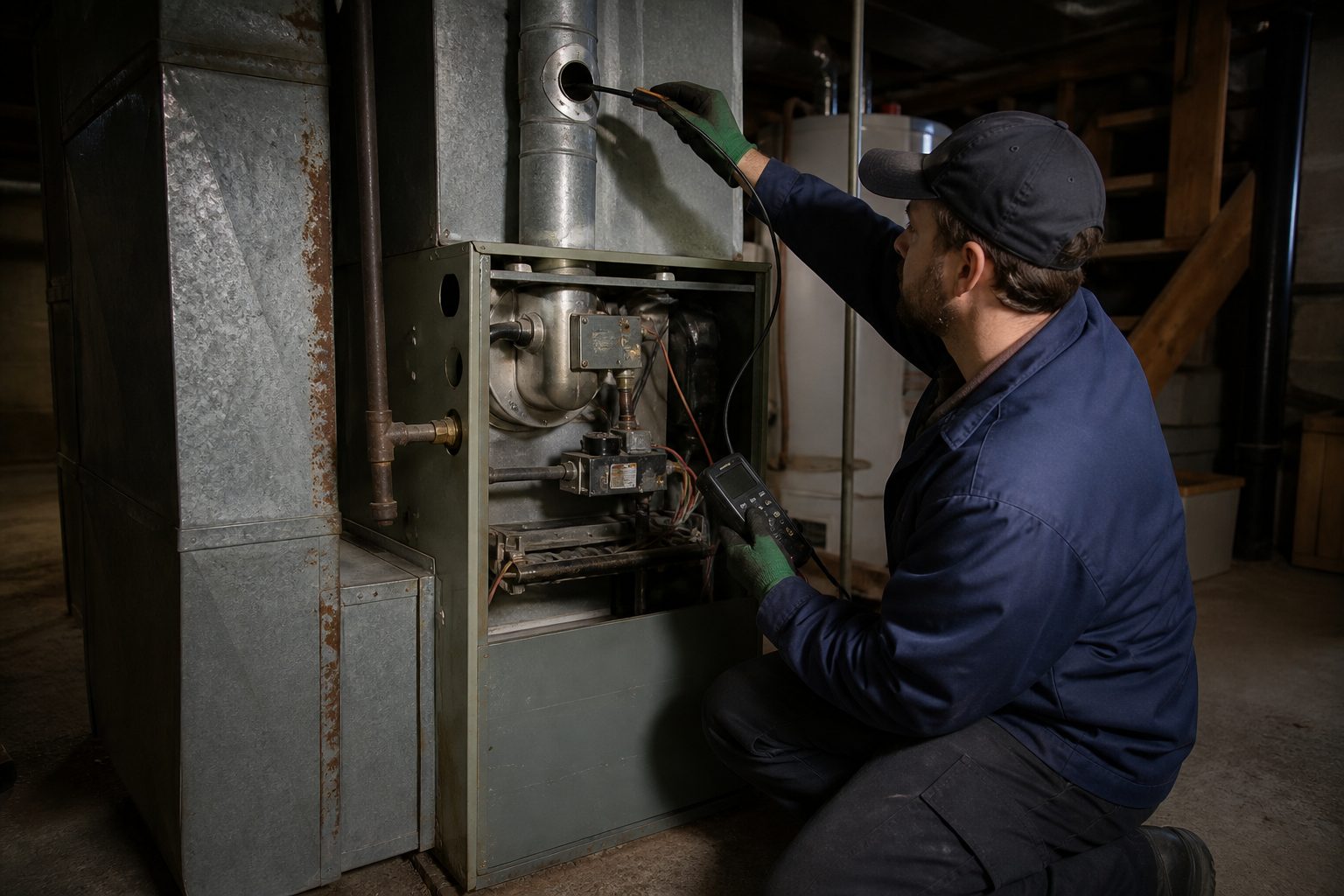
What does furnace flame color tell you? A properly adjusted natural gas or propane burner should show a steady blue flame. EPA treats a persistent yellow tip as maladjustment and higher pollutant output. A blue flame is not proof the furnace is safe.
Key Takeaways
- EPA says improper burner adjustment is “often indicated by a persistent yellow-tipped flame” and “causes increased pollutant emissions” (EPA).
- CO is “produced by the incomplete burning” of fuels including propane and natural gas (CPSC).
- CPSC estimated 274 non-fire CO deaths from consumer products in 2022; 76, or 28 percent, involved heating appliances (CPSC, May 2026).
- One CPSC test furnace ran on with its vent 86 percent blocked while air free flue CO passed 3,400 ppm (CPSC test report).
- Gas furnaces and boilers were tied to an estimated 21 CO deaths a year, 2017 to 2019 (88 FR 73269).
- Most condensing furnaces are sealed combustion units, so the burner is hidden and flame color is not an available check (DOE Building America).
What does furnace flame color actually tell you?
Furnace flame color is a coarse read on how completely the gas is burning. A steady blue flame says the burner is getting roughly the air it was designed for. A lazy yellow or orange flame says it is not.
No appearance measures carbon monoxide, draft or heat exchanger integrity. The failures that kill people are invisible at the burner: a cracked exchanger, a soot blocked flue or a disconnected vent pipe all sit behind a textbook flame.
Why does a properly adjusted burner burn blue?
A blue flame means the fuel is premixed with enough air before the port that combustion finishes cleanly and fast. EPA puts the benchmark plainly: “Ask your gas company to adjust the burner so that the flame tip is blue.”
Propane burns blue too, but needs far more air per cubic foot of gas, so orifices and shutters are fuel specific. A unit converted between fuels without the right orifice kit will not burn correctly, which is how a routine heating call becomes a combustion job.
What does a yellow or orange furnace flame mean?
A persistent yellow or orange furnace flame means the burner is short of primary air and combustion is finishing late, or not at all. EPA states that improper adjustment, “often indicated by a persistent yellow-tipped flame, causes increased pollutant emissions.” The glow is incandescent soot, which is why yellow flames leave deposits.
Usual causes are a misadjusted air shutter, debris in the burner, a partly plugged orifice, or a room starved of combustion air. A restricted return pulls the appliance off design airflow, which is why duct and airflow faults surface as combustion complaints and why filters matter.
CPSC saw the consequence in 2022 casework: vents “blocked by soot caused by inefficient combustion, which, in turn, may have been caused by several factors, such as leaky or clogged burners, an over-firing condition, or inadequate combustion air.”
How does incomplete combustion produce carbon monoxide?
Carbon monoxide forms when there is not enough oxygen at the flame to turn every carbon atom into carbon dioxide, so some stops at CO. CPSC defines it as “a deadly, colorless, odorless, poisonous gas” produced by “the incomplete burning of various fuels.” The air starvation that turns a flame yellow is the mechanism that makes CO.
EPA’s indoor air guidance names the paths: “leaking chimneys and furnaces,” back drafting, and flues that are “improperly sized, blocked or disconnected.” EPA reports levels near properly adjusted gas stoves are often 5 to 15 ppm, and near poorly adjusted stoves 30 ppm or higher.
What are flame lifting, rollout and flashback?
Three ways a gas flame leaves its design position. Lifting, or blowoff, happens when the mixture leaves the port faster than the flame propagates, so the flame floats or goes out. Flashback is the reverse: the flame burns back inside the burner. Yellow tipping is a third limit, set by too little primary air. US Bureau of Mines researchers mapped all three in a 1955 report, Fundamental flashback, blowoff, and yellow-tip limits of fuel gas-air mixtures.
Flame rollout is the visible end state: flames spilling out of the burner compartment because the passages beyond are blocked.
Appliances are supposed to catch that. The ANSI standards for gas furnaces and boilers require the unit to “shut off if flames issue outside of the burner compartment” and to “shut off when vent or flue is fully blocked.” CPSC notes those switches “were added to and became effective in the standards between 1987 and 1993.”
| What you see | What it means | Device that may respond | What it does not rule out |
|---|---|---|---|
| Steady blue cones | Primary air near design | Flame sensor holds the valve open | Cracked exchanger, blocked flue |
| Lazy yellow or orange tips | Air starved combustion | None directly; soot may later trip a pressure switch | Flue CO, visible only on an analyzer |
| Flame floating off the ports | Lifting, often a wrong orifice | Flame sensor may drop out and lock the unit out | Gas pressure fault, bad conversion |
| Flames at the cabinet opening | Rollout from a blocked heat exchanger | Flame rollout switch, manual reset | Damage already done to the exchanger |
A furnace that locks out before it ever makes a flame is a different problem, traced through the ignition sequence instead.
Why is flame color not available on many modern furnaces?
Because the burner is sealed inside the cabinet. DOE describes Category IV equipment as “high-efficiency, condensing, sealed combustion/direct-vent, forced-draft appliances” whose “combustion chamber is sealed off from the CAZ” and whose “combustion air is supplied entirely from the outdoors through a sealed pipe.” There is no open burner compartment to look at.
The coming 95 percent AFUE floor for gas furnaces makes sealed combustion the normal case. The trade is worth naming: DOE states that “properly installed direct-vent appliances cannot backdraft into the living space.”
Appliances with a visible flame are now mostly older atmospheric furnaces, gas water heaters and some gas fireplaces, where the flame is yellow on purpose.
What does a technician measure instead of flame color?
Numbers, taken while the appliance runs. CPSC’s own test rig recorded gas manifold pressure, static pressure in the vent pipe, flue gas temperature and temperature rise across the heat exchanger. That is close to the field list.
- Verify draft and check for spillage. DOE’s combustion appliance zone protocol directs testers to “check that the appliance drafts correctly using a smoke pen” and to test for spillage after five minutes of burner operation.
- Measure CO in the flue. The ANSI Z21 standards require that a furnace “must not produce CO in excess of 400 ppm” under prescribed laboratory test conditions.
- Read ambient CO in the room. DOE guidance: “If the CO level is above 35 ppm, the appliance must be removed or serviced and retested.”
- Check firing rate against the nameplate. Raising one CPSC test furnace from 100,000 to 128,000 Btu per hour pushed air free flue CO past 3,400 ppm.
- Measure temperature rise against the rating plate band. A rise outside it points at airflow, and airflow points at the filter, the ducts or the blower.
The hard rule
A yellow flame together with a sounding CO alarm, or with headache, dizziness, nausea or confusion in more than one person, is not a diagnostic moment. CPSC instructs: “Immediately move outside to fresh air. Call your emergency services, fire department, or 911.” Placement matters as much as ownership, and where alarms have to go is set by code in many jurisdictions.
Why does a blue flame not prove the furnace is safe?
Because the dangerous failures sit downstream of the flame. CPSC ran a high efficiency furnace with its vent 86 percent blocked and it kept operating. Chamber CO stayed between 0 and 6 ppm while air free flue CO ran from 59 ppm to 545 ppm. It shut down only at 88 percent blockage or greater.
Heat exchanger cracks behave the same way. CPSC’s 2022 incident review lists “compromised heat exchangers or filter doors/covers that were removed or not sealed” among furnace conditions at fatal scenes. None of those change the flame. The agency’s verdict: “injuries and deaths from CO poisoning have continued to occur despite the existence of these voluntary standards provisions.”
Flame color is a free screening test with a low ceiling. It catches gross maladjustment and little else. An annual combustion check, part of the standard furnace service list, tests what you cannot see. The same holds for certified wood and pellet stoves.
How we researched this
Research date: September 2026. Nine sources were consulted and all nine are cited, all federal: two EPA indoor air pages, three CPSC documents including the proposed rule at 88 FR 73269, two DOE Building America guides, and a 1955 US Bureau of Mines report at OSTI.
Excluded: Reddit and all homeowner forums, skipped entirely because this is a combustion and carbon monoxide safety topic where anonymous anecdotes carry real risk. Also excluded: contractor blogs quoting flue CO thresholds we could not trace to a federal source, and installed prices, since no federal series publishes combustion pricing. Flame appearance here is qualitative, not a measurement.
Frequently asked questions
Is a little yellow in a furnace flame normal?
Brief orange flecks as household dust or lint burns off are common on open burner appliances. Persistence is what matters. EPA treats a persistent yellow-tipped flame as maladjustment with higher pollutant emissions, so steady yellow across the whole flame is a service call; momentary sparkles usually are not.
What color should a propane furnace flame be?
Blue, the same as natural gas. Propane needs more air per cubic foot of gas, so orifices and shutters are sized for the fuel. A unit converted between fuels without the correct orifice kit can burn yellow whatever the shutter setting, and that correction is a technician job in most jurisdictions.
Does a blue flame mean there is no carbon monoxide?
No. Every hydrocarbon flame makes some carbon monoxide; the hazard is how much reaches the house. CPSC ran a test furnace with its vent 86 percent blocked while air free flue CO climbed from 59 ppm to 545 ppm, with nothing unusual visible at the burner.
My flame is blue but the CO alarm sounded. What do I do?
Leave. CPSC instructs occupants to “immediately move outside to fresh air,” call 911, do a head count, and not reenter until responders permit it. A blue flame does not override an alarm, and generators, vehicles and portable heaters are common sources outside the furnace.
Can a humidifier change the flame color?
Not directly. A bypass or fan powered whole house humidifier adds moisture to the plenum, and a leak or misrouted drain can corrode a heat exchanger over months. That argues for keeping the unit on the annual service list, not for reading anything into the flame.
How do I check flame color on a condensing furnace?
You generally cannot. DOE describes Category IV condensing furnaces as sealed combustion, direct vent units whose combustion chamber is closed off and fed by an outdoor air pipe. The diagnosis there is combustion analysis at the flue, plus draft and gas pressure, not a visual check.
Sources
- EPA. “Sources of Combustion Products.” https://www.epa.gov/indoor-air-quality-iaq/sources-combustion-products. Accessed September 2026.
- EPA. “Carbon Monoxide’s Impact on Indoor Air Quality.” https://www.epa.gov/indoor-air-quality-iaq/carbon-monoxides-impact-indoor-air-quality. Accessed September 2026.
- CPSC. “Carbon Monoxide Questions and Answers.” https://www.cpsc.gov/Safety-Education/Safety-Education-Centers/Carbon-Monoxide-Information-Center/Carbon-Monoxide-Questions-and-Answers. Accessed September 2026.
- CPSC. “Non-Fire CO Deaths Associated with the Use of Consumer Products: 2022 Annual Estimates.” https://www.cpsc.gov/s3fs-public/Non-Fire-Carbon-Monoxide-Deaths-Associated-with-the-Use-of-Consumer-Products-2022-Annual-Estimates.pdf. Accessed September 2026.
- CPSC. “Furnace CO Emissions Under Normal and Compromised Vent Conditions.” https://www.cpsc.gov/s3fs-public/pdfs/CO_emissions_furnace4.pdf. Accessed September 2026.
- CPSC. “Safety Standard for Residential Gas Furnaces and Boilers,” 88 FR 73269. https://www.federalregister.gov/documents/2023/10/25/2023-23302/safety-standard-for-residential-gas-furnaces-and-boilers. Accessed September 2026.
- DOE Building America. “Combustion Furnaces.” https://basc.pnnl.gov/resource-guides/combustion-furnaces. Accessed September 2026.
- DOE Building America. “Combustion Appliance Zone (CAZ) Testing.” https://basc.pnnl.gov/resource-guides/combustion-appliance-zone-caz-testing. Accessed September 2026.
- Grumer, Harris and Rowe. “Fundamental flashback, blowoff, and yellow-tip limits of fuel gas-air mixtures.” US Bureau of Mines, 1955. https://www.osti.gov/biblio/7351992. Accessed September 2026.
Leave a Reply