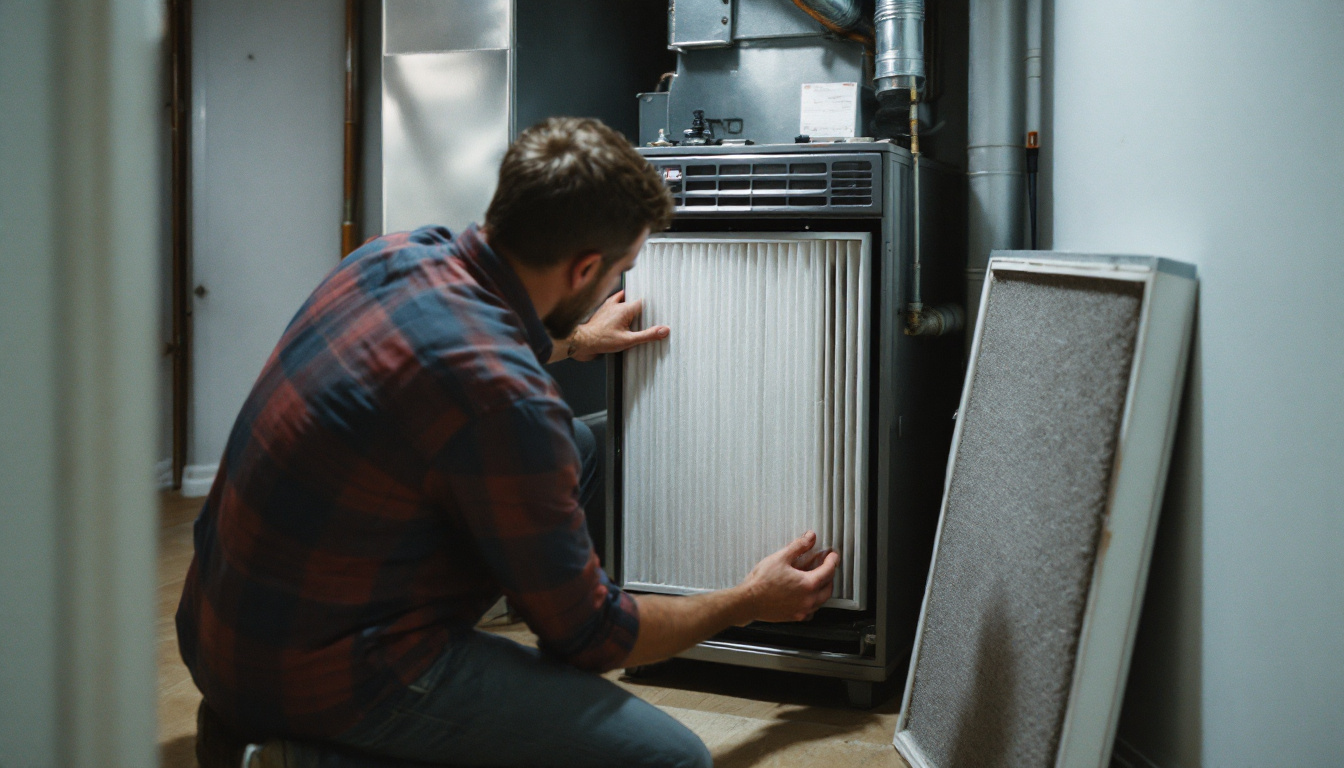
HVAC filters: which one do you buy, and how often do you change it? Buy one that fits the slot snugly, up to MERV 13 if your system can handle it. Check it once a month, per ENERGY STAR, and expect to replace it every 60 to 90 days, the interval EPA says manufacturers typically recommend.
Key Takeaways
- ENERGY STAR tells owners to inspect, clean, or change air filters once a month.
- EPA says manufacturers typically recommend replacement every 60 to 90 days.
- EPA’s upgrade advice: at least MERV 13, or as high as your system fan and filter slot can accommodate.
- Flat or panel filters typically rate MERV 1 to 4 and mainly protect the equipment (EPA technical summary).
- A North Carolina state filter specification lets the actual face run up to five-eighths of an inch under the nominal size.
- DOE says a clogged filter lets dirt bypass it and build up on the evaporator coil (archived copy).
HVAC filters are the part of a forced air system owners handle most. This guide covers filter types, location, sizing, change intervals, ratings and neglect. What MERV measures, and why a higher number can cut airflow, lives in our explainer on MERV and airflow.
What types of HVAC filters are there?
Home HVAC filters fall into five groups: flat panel, pleated, deep pleated media, electrostatically charged media and HEPA. EPA’s examples of central in-duct filters run from 1 inch fiberglass MERV 4 panels to 5 inch deep pleated MERV 16 filters.
- Flat or panel. EPA’s technical summary says these typically rate MERV 1 to 4, are about 1 to 2 inches thick and mostly protect fan motors, heat exchangers and other surfaces from buildup.
- Pleated. Pleated and extended surface filters typically rate MERV 5 to 13 or higher. EPA says the added surface area often gives them a longer lifespan.
- Deep pleated media. These may be as much as 4 to 12 inches thick. EPA says most manufacturers rely on extended depth and extensive pleating to reach MERV 14 to 16 with low resistance to airflow.
- Electret (charged) media. Charged fibers attract particles, but EPA notes these filters see reduced efficiency as they load with dust.
- HEPA. EPA’s HEPA definition, which it credits to the U.S. Department of Energy, is a filter that can theoretically remove at least 99.97% of particles 0.3 microns in size. EPA says HEPA is common in portable air cleaners.
DOE notes filters can be reusable or disposable. UV lamps and whole-home purifiers are a separate purchase with separate claims, covered in our guide to UV lights and air purifiers.
| Filter type | Typical rating | Typical thickness | Mainly for |
|---|---|---|---|
| Flat or panel | MERV 1 to 4 | 1 to 2 inches | Protecting the equipment |
| Pleated | MERV 5 to 13 or higher | Commonly 1 to 5 inches | Equipment plus room particles |
| Deep pleated media | Up to MERV 14 to 16 | 4 to 12 inches | High rating, lower resistance |
| Electret media | Varies | Varies | Efficiency drops as it loads |
| HEPA | Not MERV; 99.97% at 0.3 microns | Deep pleats | Mostly portable air cleaners |
Sources: EPA Residential Air Cleaners technical summary, 3rd edition; EPA What is a HEPA filter?; EPA Guide to Air Cleaners in the Home (1 to 5 inch thickness range).
Where is the HVAC filter in your house?
In a central system the filter sits on the return side: in a slot along the return duct at the indoor air handler or furnace, or behind a return grille in the living space. Those are the two central air conditioner locations the Department of Energy describes.
Look for a narrow door where the large return duct meets the cabinet. If there is none, check the grilles that pull air in; our guide to supply and return vents shows how to tell them apart. DOE says a room air conditioner’s filter is usually in the grille facing the room.
EPA says window and wall mounted ductless units typically have limited filtration, meant to keep the unit clean rather than remove fine particles. Cleaning those screens is covered in our mini split cleaning guide.
How do you read an HVAC filter size?
Read the three numbers on the frame as width, height and depth in inches, and treat them as a label. The printed size is nominal, the size of the frame it fits; the filter itself is built slightly smaller.
No federal rule sets the gap. One government example is North Carolina’s purchasing specification 4130-1Y (March 17, 2017), which says actual face dimensions shall not be undersized by more than five-eighths of an inch from nominal. It also sets minimum actual depths.
| Nominal depth on the label | Minimum actual depth (NC spec 4130-1Y) |
|---|---|
| 1 inch | 7/8 inch |
| 2 inch | 1 3/4 inches |
| 4 inch | 3 3/4 inches |
| 6 inch | 5 7/8 inches |
In practice, copy the size printed on the old filter. EPA says filters commonly come 1 to 5 inches thick and should fit snugly, so air does not leak around them, without bending or crushing.
How do you change an HVAC filter?
A filter change is an owner task: ENERGY STAR lists it under actions to do yourself and says your contractor can show you how. The steps below follow EPA and DOE guidance.
- Turn the system off at the thermostat.
- Open the filter door or return grille and slide the old filter out.
- Note the nominal size on the frame. If the filter is heavily soiled, EPA says to consider changing more often.
- Find the arrow on the new filter. EPA says it should point in the direction of airflow, toward the air handler.
- Slide it in snugly with no edge gaps, close the door, date the frame and restart the system.
Myth: the highest rated filter is always best
EPA’s technical summary warns that bypass airflow around a poorly fitted filter reduces its effectiveness, and that simply installing a high efficiency filter is no guarantee it will work as intended. Fit comes first; rating comes second.
How often should you check and change HVAC filters?
Check HVAC filters monthly and replace them when dirty, which EPA says manufacturers typically put at 60 to 90 days. Those are the two federal anchors: ENERGY STAR’s monthly inspection and EPA’s manufacturer interval.
DOE’s fallback, if you are unsure: clean or replace filters every month or two during the cooling season, and more often with constant use, dust or pets. Heat pumps run in both seasons, as our heat pump maintenance schedule reflects. The technician’s side of upkeep is in our furnace maintenance checklist.
What rating of HVAC filter should you buy?
Buy the highest rated filter your system can move air through, with MERV 13 as EPA’s target. EPA’s MERV rating page says: “If you decide to upgrade to a higher efficiency filter, choose a filter with at least a MERV 13 rating, or as high a rating as your system fan and filter slot can accommodate.”
The caveat follows: “You may need to consult a professional HVAC technician to determine the highest efficiency filter that will work best for your system.” EPA’s home guide adds that most systems can accommodate a MERV 13 filter without creating equipment problems, provided it is replaced frequently.
EPA says MERV reports capture of particles between 0.3 and 10 microns under the ASHRAE Standard 52.2 test method, and MERV 13 and above must show at least 50% removal of the smallest particles tested. FPR and MPR labels are proprietary scales, EPA notes.
HEPA is usually unnecessary in a central system. Home systems usually run less than 25% of the time in heating and cooling seasons, per EPA, and its technical summary says most MERV 13 to 16 filters are likely almost as effective as HEPA at reducing most indoor particle sizes.
What does a neglected HVAC filter do to your equipment?
A clogged filter chokes airflow, raises energy use and lets dirt reach the coil. ENERGY STAR says a dirty filter can increase energy costs and damage your equipment, leading to early failure.
DOE describes the mechanism: when airflow is obstructed, dirt can bypass the filter and accumulate on the evaporator coil, reducing its heat absorbing capacity. EPA adds that a filter’s resistance slowly increases over its useful life as it loads, so the blower motor pushes against more every week.
Low airflow is one route to an iced coil, which our guide to an AC that freezes up separates from a refrigerant fault. Duct restrictions are covered in our ductwork and airflow guide, and ENERGY STAR’s contractor tasks, such as cleaning coils and adjusting blower components, are in our breakdown of what a proper tune-up includes.
How we researched this
Research date: September 17, 2026. We consulted eight sources and cited seven: ENERGY STAR’s Maintenance Checklist; EPA’s MERV, HEPA and Guide to Air Cleaners in the Home pages; EPA’s Residential Air Cleaners technical summary, 3rd edition; an archived DOE Energy Saver page; and North Carolina filter specification 4130-1Y. Every quote and figure was read at the source.
Excluded: EPA’s COVID-19 filter page (written for large buildings); retailer size charts, the only sources for typical nominal versus actual gaps; and filter prices, which no federal series covers. A Reddit search returned only retail listings, so no Reddit material was used.
Frequently asked questions
How often should I change my HVAC filter?
Check it monthly and replace it when dirty. ENERGY STAR advises inspecting, cleaning or changing filters once a month, and EPA says manufacturers typically recommend replacement every 60 to 90 days. If the old filter looks heavily soiled when you pull it, EPA suggests changing more often.
Is a MERV 13 filter too restrictive for a home system?
Usually not. EPA says most furnaces and HVAC systems can accommodate a MERV 13 filter without creating equipment problems, provided the filter is replaced frequently. Systems are rarely labeled with filter limits, so EPA recommends asking an HVAC technician if you are unsure.
Why is my filter smaller than the size printed on it?
The printed size is nominal, a label for the frame it fits, and the filter is built a little smaller. North Carolina’s state purchasing specification, for example, allows the actual face to be undersized by up to five-eighths of an inch and a 1 inch nominal filter to be as thin as 7/8 inch.
Which way does the arrow on an HVAC filter point?
Toward the direction the air flows, which means toward the furnace or air handler and away from the return duct or grille. EPA’s Residential Air Cleaners technical summary says filters should be installed so the printed arrow points in the direction of airflow within the system.
Can I put a HEPA filter in my furnace?
It is seldom needed. EPA defines HEPA as capturing at least 99.97% of 0.3 micron particles and says such filters are common in portable air cleaners. Its technical summary finds most MERV 13 to 16 furnace filters likely almost as effective as HEPA in homes, because central systems run so little.
What happens if I never change the filter?
Airflow drops, energy use rises and the equipment wears. ENERGY STAR says a dirty filter can increase energy costs and damage your equipment, leading to early failure, and the Department of Energy says dirt can bypass a clogged filter and accumulate on the evaporator coil, cutting its ability to absorb heat.
Sources
- ENERGY STAR. “Maintenance Checklist.” https://www.energystar.gov/saveathome/heating-cooling/maintenance-checklist. Accessed September 2026.
- U.S. Environmental Protection Agency. “What is a MERV rating?” https://www.epa.gov/indoor-air-quality-iaq/what-merv-rating. Accessed September 2026.
- U.S. Environmental Protection Agency. “What is a HEPA filter?” https://www.epa.gov/indoor-air-quality-iaq/what-hepa-filter. Accessed September 2026.
- U.S. Environmental Protection Agency. “Guide to Air Cleaners in the Home.” https://www.epa.gov/indoor-air-quality-iaq/guide-air-cleaners-home. Accessed September 2026.
- U.S. Environmental Protection Agency. “Residential Air Cleaners: A Technical Summary, 3rd Edition.” https://www.epa.gov/sites/default/files/2018-07/documents/residential_air_cleaners_-_a_technical_summary_3rd_edition.pdf. Accessed September 2026.
- U.S. Department of Energy, Energy Saver. “Maintaining Your Air Conditioner” (archived copy). https://web.archive.org/web/2025id_/https://www.energy.gov/energysaver/maintaining-your-air-conditioner. Accessed September 2026.
- North Carolina Department of Administration, Purchase and Contract. “Specification for Filters, Air (HVAC), 4130-1Y.” https://www.doa.nc.gov/pc-stc-031a-s4130-1pdf-standard-specification-air-filters/open. Accessed September 2026.
Leave a Reply