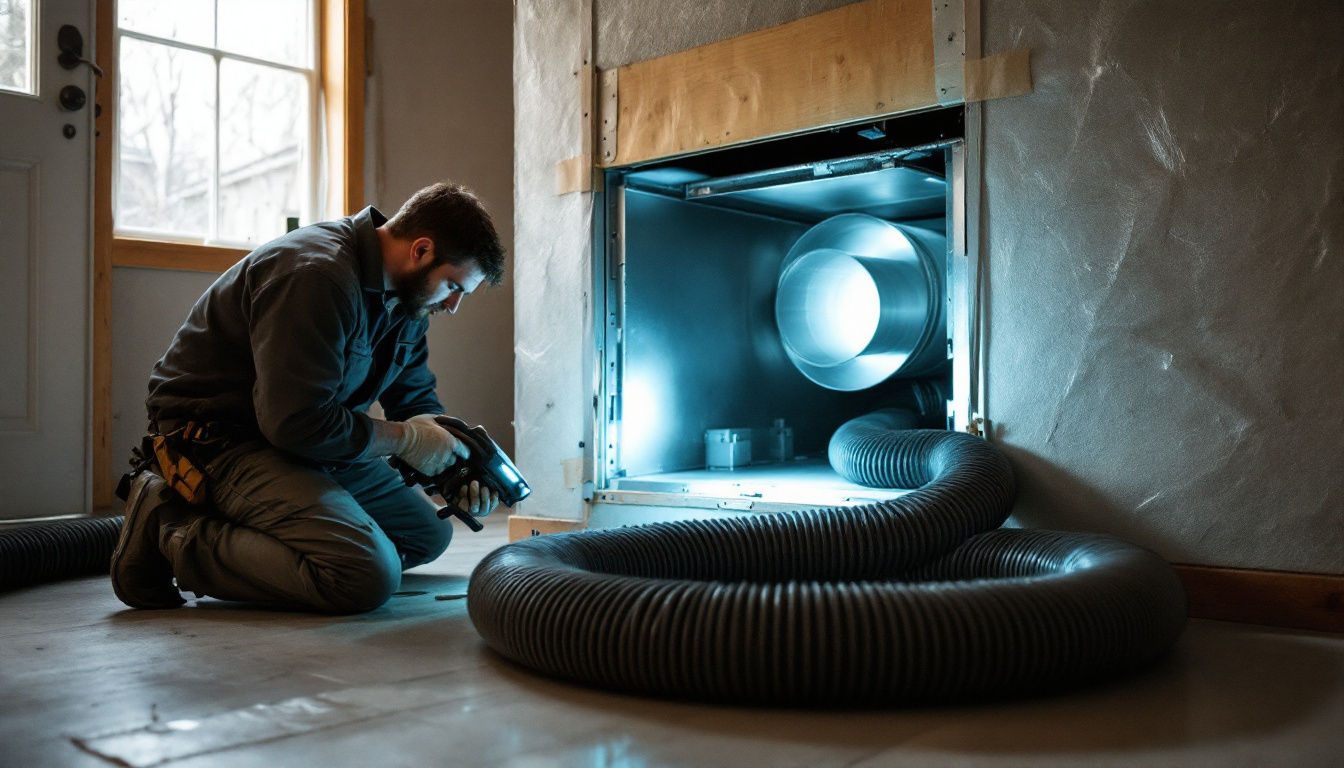
Is air duct cleaning worth it? Usually not. EPA says duct cleaning “has never been shown to actually prevent health problems” and does not recommend routine cleaning. Three conditions justify the job: visible mold in the ducts, vermin, or debris heavy enough that particles reach the room.
Key Takeaways
- EPA says duct cleaning “has never been shown to actually prevent health problems,” and does not recommend it “except on an as-needed basis” (EPA 402-K-97-002, October 1997).
- The industry standard sets a measurable pass mark: NADCA Vacuum Test debris must not exceed 0.75 mg per 100 sq cm (ACR, The NADCA Standard, 2021, section 5.5).
- New Jersey won $1.71 million in penalties over coupons advertising duct cleaning at $37.95 to $69.95, used to “bait the buyer into purchasing higher-priced services” (NJ Attorney General, 2011).
- No federal price series covers the work: the Consumer Price Index carries 400 items and none is duct cleaning (BLS CPI item file).
- About 20 to 30 percent of the air moving through a typical duct system is lost to leaks, not dirt (ENERGY STAR).
What does EPA actually say about air duct cleaning?
EPA’s position is blunt. “Duct cleaning has never been shown to actually prevent health problems,” says publication EPA 402-K-97-002, which has stood since October 1997, and studies do not conclusively show dust levels rising because of dirty ducts “or go down after cleaning.”
The reason is mechanical: much of the dirt “adheres to duct surfaces and does not necessarily enter the living space,” and EPA finds “no evidence that a light amount of household dust or other particulate matter in air ducts poses any risk to health.” The annual job EPA does push is a combustion safety check, one item on what to do before the heating season.
When is air duct cleaning worth doing?
EPA names three conditions and they are the whole test: substantial visible mold growth inside hard surface ducts or on other components, ducts “infested with vermin, e.g. (rodents or insects),” or ducts “clogged with excessive amounts of dust and debris and/or particles are actually released into the home from your supply registers.”
Many sections cannot be inspected visually, so ask the provider to show you the mold. EPA warns that “the cause or causes must be corrected or else the problem will likely recur,” which is why testing the duct system comes first.
| EPA condition | What EPA says | What to fix first |
|---|---|---|
| Substantial visible mold in hard surface ducts | Only an expert can confirm mold | The moisture source. EPA: “mold growth will recur” otherwise |
| Vermin infestation (rodents or insects) | A qualifying condition on its own | The entry point into the duct |
| Excessive dust and debris | Qualifies only when particles reach the room | Filtration, and the cause |
| Wet or moldy fiberglass liner or duct board | EPA: it “cannot be effectively cleaned and should be removed and replaced” | Replacement, not cleaning |
Why does EPA warn about biocides and sealants inside ducts?
Because most of what gets sprayed into a residential duct is not registered for that use. EPA is explicit: “No chemical biocides are currently registered by EPA for use in internally-insulated air duct systems.” A few products are registered for bare sheet metal ducts, and that is all.
None are registered for fiberglass duct board or lined ducts, “so it is important to determine if sections of your system contain these materials before permitting the application of any biocide.” EPA also warns that sprayed material may be “transported through the system,” worth weighing against the claims for in-duct UV lamps and add-on purifiers.
Sealants are the other upsell. Laboratory tests show sprayed sealants “tend not to completely coat the duct surface,” and EPA, NADCA, NAIMA and SMACNA “do not currently recommend the routine use of sealants to encapsulate contaminants in any type of duct.”
No such thing as an EPA certified duct cleaner
EPA tells homeowners to “be wary of duct cleaners who claim to be certified by EPA.” The agency “neither establishes duct cleaning standards nor certifies, endorses, or approves duct cleaning companies.” Avoid anyone making “sweeping claims about the health benefits of duct cleaning.”
What does a real air duct cleaning job involve?
A real job is containment, inspection, coil and blower cleaning, and a measured endpoint, not a hose pushed into a register. The reference is ACR, The NADCA Standard, from the National Air Duct Cleaners Association, an industry document rather than a federal rule. NADCA issued a 2025 edition on September 24, 2025; the sections below are from the public 2021 edition.
- Inspect first. Section 1.7 requires inspection of at least 10 percent of components in scope, and all of them on a mold remediation project.
- Establish containment. Section 3.4 requires continuous negative pressure in the portion being cleaned, verified during the project under section 4.1.1.
- Handle the exhaust. Equipment exhausting indoors needs HEPA filtration at 99.97 percent for 0.3 micron particles; equipment without it exhausts outdoors.
- Cut and close real service openings. Section 4.2.1 bars any that degrade structural, thermal or functional integrity; section 4.2.8.1 bars exposed fibrous glass edges.
- Clean the coil, drain pan and blower too. ACR separates Type 1 dry cleaning from Type 2 wet cleaning, required where debris is adhered.
- Verify and document. Section 5.1 requires verification immediately after cleaning and before the system runs again; section 5.5 caps NADCA Vacuum Test debris at 0.75 mg per 100 square centimeters.
Steps two and six are why a real job takes hours, and the coil work overlaps with a proper maintenance visit.
What is the cheap whole house duct cleaning coupon selling?
It sells the visit, not the cleaning, and the pattern sits in state enforcement records. New Jersey’s Division of Consumer Affairs investigated two Bloomfield companies whose coupons advertised “Whole Duct House Cleaning” for $37.95 to $69.95.
The Division alleged they “often failed to perform the services for the specified price,” and that the coupons “were allegedly used to bait the buyer into purchasing higher-priced services.” A judgment signed March 31, 2011 ordered $68,157.36 in restitution and $1.71 million in civil penalties (NJ Attorney General).
EPA’s guidance puts the work at “$450 to $1,000 per heating and cooling system,” varying with system size, accessibility, climate region and contamination level. Those are 1997 dollars. EPA’s counters are procedural: three written estimates, and be shown the contamination, the habits that protect you when picking an HVAC contractor.
No federal series measures the work either. The BLS Consumer Price Index item file carries 400 items, none of them duct cleaning, and the Producer Price Index industry file lists 998 codes with nothing closer than janitorial services, NAICS 561720. Every national average price therefore traces to a lead generation platform, not a federal sample, which is why none appears here or in a national average repair bill.
What actually fixes the symptoms people buy duct cleaning for
Three fixes cover almost every complaint behind a duct cleaning call. EPA’s framing: “the most effective ways to improve your indoor air are to reduce or remove the sources of pollutants and to ventilate with clean outdoor air.”
Dust that keeps coming back is usually a filter problem. EPA says to “select a filter rated at least MERV 13 or as high as your system will accommodate,” while warning that “no air cleaner or filter will eliminate all of the air pollutants in your home” (EPA, Guide to Air Cleaners in the Home). The catch is airflow, which is why the highest MERV rating is not automatically right and filter type and change interval matter more.
Weak rooms and high bills are usually a leakage problem. ENERGY STAR puts the loss in a typical house at 20 to 30 percent of the air moving through the duct system, to “leaks, holes, and poorly connected ducts.” If rooms never balance, look at duct design and airflow.
Smells and recurring growth are a moisture problem. EPA is unambiguous: “Controlling moisture is the most effective way to prevent biological growth in air ducts.” An oversized air conditioner cycles too briefly to remove humidity, the mechanism behind a cold, clammy house. Before chasing an odor, work out what the smell is telling you.
How we researched this
Cited primary sources: EPA’s guidance “Should You Have the Air Ducts in Your Home Cleaned?” (EPA 402-K-97-002, October 1997), every quotation checked character by character against the live page; EPA’s Guide to Air Cleaners in the Home; ENERGY STAR’s duct sealing page; the BLS Consumer Price Index item and Producer Price Index industry files; and the New Jersey Attorney General release of April 5, 2011. Research date: September 18, 2026.
Tier 2, attributed as such: ACR, The NADCA Standard, 2021 edition, from the National Air Duct Cleaners Association, the trade body for duct cleaners. We cite it for what it specifies, not as evidence that cleaning works.
Excluded: contractor blogs, duct cleaning company pages and lead generation cost calculators, because none price from a measured sample, so no national average price appears here. A claim about a 2010 review reporting higher post-cleaning contaminant levels was dropped because we could not open the study. Reddit returned no usable threads, so no Reddit content or number is used.
Frequently asked questions
Does air duct cleaning improve indoor air quality?
There is no federal finding that it does. EPA states that duct cleaning “has never been shown to actually prevent health problems,” and that studies do not conclusively show particle levels rising because of dirty ducts or falling after cleaning, because much of the dirt adheres to duct surfaces.
How often should air ducts be cleaned?
There is no recommended interval. EPA does not recommend cleaning “except on an as-needed basis because of the continuing uncertainty about the benefits of duct cleaning under most circumstances.” Its guidance says to avoid cleaners who sell cleaning as routine maintenance.
Should I let a duct cleaner spray a sanitizer or fogger in my ducts?
Not without checking what your ducts are made of. EPA states that “no chemical biocides are currently registered by EPA for use in internally-insulated air duct systems,” and none for fiberglass duct board or lined ducts. Using a pesticide against its label violates federal law.
What should air duct cleaning cost?
No federal series measures it. EPA’s 1997 guidance described services typically ranging from “$450 to $1,000 per heating and cooling system,” depending on system size, accessibility, climate region and contamination level. Those are 1997 dollars; the BLS Consumer Price Index carries no duct cleaning item.
Do dirty ducts make a heating and cooling system less efficient?
Cleaning ducts alone has little demonstrated effect. EPA says research suggests cleaning dirty cooling coils, fans and heat exchangers can improve efficiency, but “little evidence exists to indicate that simply cleaning the duct system will increase your system’s efficiency.” Leakage is the measured problem.
How can I tell whether a duct cleaner did the job?
Ask for verification, not a photo of a dirty vent. ACR, The NADCA Standard requires cleanliness verification immediately after cleaning and before the system runs again. Under section 5.5, NADCA Vacuum Test debris must not exceed 0.75 mg per 100 sq cm, with lab results documented.
Sources
- U.S. Environmental Protection Agency. “Should You Have the Air Ducts in Your Home Cleaned?” (EPA 402-K-97-002, October 1997). https://www.epa.gov/indoor-air-quality-iaq/should-you-have-air-ducts-your-home-cleaned. Accessed September 2026.
- U.S. Environmental Protection Agency. “Guide to Air Cleaners in the Home.” https://www.epa.gov/indoor-air-quality-iaq/guide-air-cleaners-home. Accessed September 2026.
- ENERGY STAR (U.S. EPA). “Duct Sealing.” https://www.energystar.gov/saveathome/heating-cooling/duct-sealing. Accessed September 2026.
- U.S. Bureau of Labor Statistics. “cu.item,” Consumer Price Index item file. https://download.bls.gov/pub/time.series/cu/cu.item. Accessed September 2026.
- U.S. Bureau of Labor Statistics. “pc.industry,” Producer Price Index industry file. https://download.bls.gov/pub/time.series/pc/pc.industry. Accessed September 2026.
- New Jersey Office of the Attorney General, Division of Consumer Affairs. “NJ Division of Consumer Affairs Prevails in Suit Against Duct Cleaning Companies,” April 5, 2011. https://www.nj.gov/oag/newsreleases11/pr20110405a.html. Accessed September 2026.
- National Air Duct Cleaners Association. “ACR, The NADCA Standard for Assessment, Cleaning, and Restoration of HVAC Systems, 2021 Edition.” https://nadca.com/sites/nadca/files/docs/2021/acr_the_nadca_standard_2021_edition.pdf. Accessed September 2026. Tier 2, trade association.
- National Air Duct Cleaners Association. “NADCA Releases 2025 Edition of ACR, The NADCA Standard for Assessment, Cleaning and Restoration of HVAC Systems,” September 24, 2025. https://nadca.com/press-releases/nadca-releases-2025-edition-acr-nadca-standard-assessment-cleaning-and-restoration. Accessed September 2026.
Leave a Reply