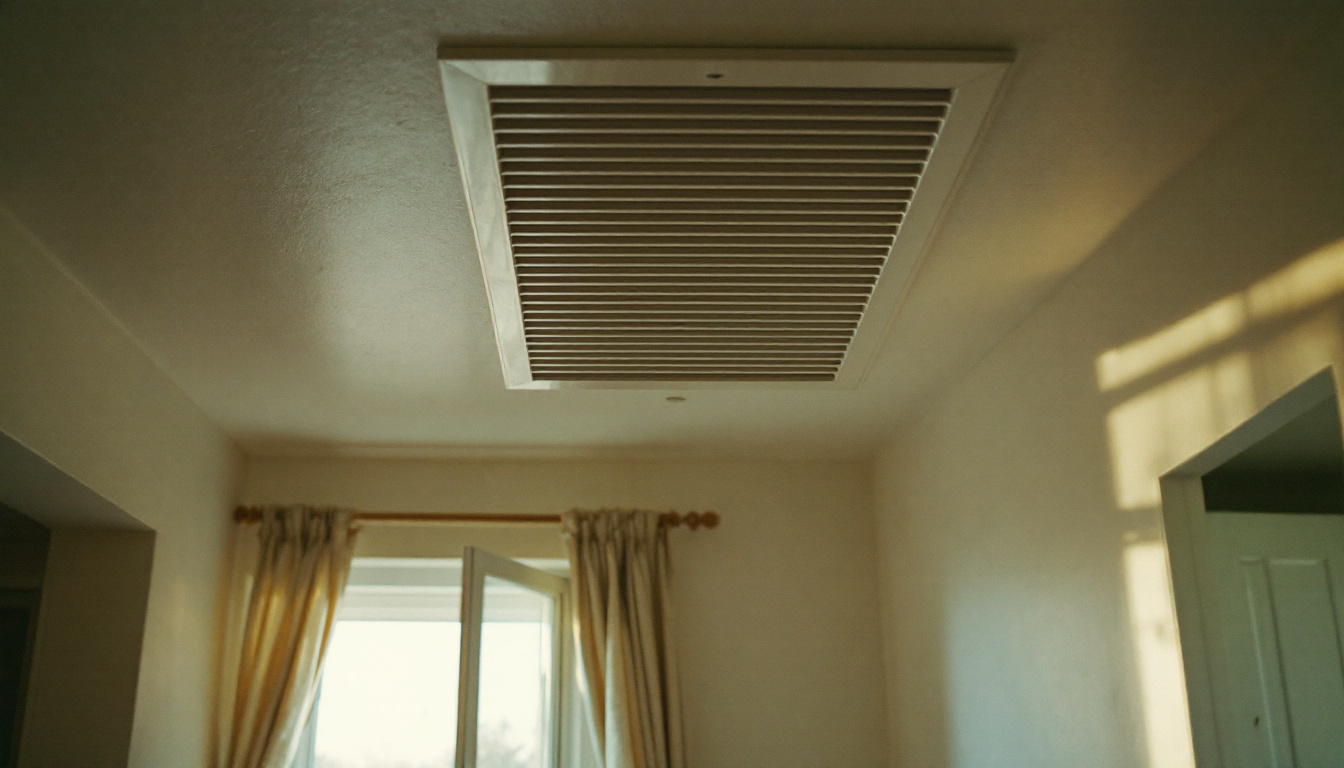
What is a whole house fan? A whole house fan pulls cool outdoor air in through open windows and pushes hot indoor air into the attic. It works where nights fall below about 67°F and fails on humid nights, because it never dries the air.
Key Takeaways
- DOE Building America sizes fans at 12 to 23 air changes per hour, or 0.2 to 0.375 cfm per cubic foot.
- DOE Energy Saver’s looser rule, half the house volume a minute, is 30 air changes per hour (archived copy).
- DOE modeled 308 kWh saved a year in Denver, 58 kWh in Santa Rosa, California (DOE 2012).
- The National Weather Service calls dew points of 65°F or above oppressive, the line this fan cannot cross.
- EPA excludes whole house fans and attic fans from ENERGY STAR under its ventilating fans specification, Version 4.1, Section 2.B.
What is a whole house fan, and how does it cool?
A whole house fan is a large ceiling or roof mounted fan that draws outdoor air in through open windows and exhausts indoor air into a vented attic. No refrigerant, no compressor. Rated airflows from 1,000 to 10,000 cfm are typical, per DOE Building America.
Cooling comes from three effects: cooler outdoor air replaces hot indoor air, drywall and framing are pre-cooled overnight, and air movement makes people feel cooler at the same temperature, a corner of what ventilation covers in HVAC. Building America is firm that whole house fans should not run at the same time as air conditioning.
How many cfm does a whole house fan need?
Federal sources disagree. Building America compiled code requirements, manufacturer data and field studies and landed on 12 to 23 air changes per hour, or 0.2 to 0.375 cfm per cubic foot. DOE Energy Saver is looser, at half the house volume a minute, or 30 air changes per hour.
Building America’s example: a 1,500 square foot house with 9 foot ceilings holds 13,500 cubic feet, so the fan belongs between 2,700 and 5,060 cfm. Use the cfm certified under the Home Ventilating Institute test HVI-916, not the number on the box; HVI is a trade association, so that is a yardstick, not a standard.
How much attic vent area does a whole house fan need?
At least 1 square foot of net free vent area per 750 cfm, and 2 square feet of total area where vents are screened, because screens cut net free area by about 50 percent. DOE Energy Saver calls it 2 to 4 times the normal vent area.
Retrofits skip this step, and the failure mode is specific: too little vent area reduces airflow and pushes hot attic air back into the house. Screened vents have only 60 percent free area, so a vent stamped 100 square inches delivers 60. Open window area counts too: DOE wants at least 4 square feet of screened window per 1,000 cfm.
Code sets a lower bar. The 2015 IRC Section R806.1, as restated by DOE, requires net free area of not less than 1/300 of the attic, 5 square feet for a 1,500 square foot attic; a 4,500 cfm fan there needs 6, and 1/150 applies without soffit vents, per our guide to roof ventilation requirements.
Where does a whole house fan fail?
On humid nights. The fan moves air and nothing else. DOE Energy Saver says whole house fans do not dehumidify air like air conditioners and heat pumps, which makes them less suitable for high humidity climates.
Watch the dew point, not the relative humidity: the National Weather Service calls summer dew points at or below 55°F comfortable and 65°F or above oppressive. Warm humid air pulled in by the fan can condense on surfaces an air conditioner has cooled, Building America warns, and mold can follow. EPA wants indoor relative humidity below 60 percent, the reading behind a cold but humid house.
Building America calls IECC zones 3B, 4B and 5B very well suited, 2B, 3C, 4C and 6B good candidates, 1A through 3A less so. Behind those labels is Givoni 1991: cooling season lows below about 67°F and a day to night swing of about 25°F or more, the conditions that also favor an evaporative cooler. Where air conditioning runs by day, a night at least 10°F cooler than the daytime indoor air makes overnight operation fine.
How does a whole house fan compare with an attic fan?
A whole house fan and an attic fan are not the same machine. Building America’s attic ventilation fans guide is direct: whole house fans exhaust and cool the living space, attic ventilation fans the unconditioned attic; we cover powered attic ventilators separately. ENERGY STAR adds that where soffit vents are blocked and the attic is not sealed, attic fans will suck cool conditioned air up out of the house.
| Device | What it moves | Power, as sourced | Fails when |
|---|---|---|---|
| Whole house fan | Outdoor air through the living space, out via the attic | 0.15 W per cfm in DOE’s 2012 model, about 675 W at 4,500 cfm | Humid nights, too few open windows, too little vent area |
| Powered attic ventilator (attic fan) | Attic air only, never the living space | No federal figure; DOE cites studies where it uses more than it saves | Ceiling is not air sealed |
| Central air conditioner | Indoor air across a refrigerant coil | About 1,290 W for 18,000 Btu/h at DOE’s 14 Btu per watt-hour | Rarely on comfort, whatever the dew point |
DOE frames the efficiency gap. At a 15°F indoor to outdoor difference, a 1,200 cfm fan delivers roughly 18,000 Btu/h after fan heat; with a 360 W motor and 50 percent storage efficiency that is 25 Btu per watt-hour, against around 14 for a high efficiency air conditioner.
None of this replaces a compressor in a hot humid climate. It is a shoulder season tool alongside the other categories of cooling equipment, and DOE says to fix a poorly insulated envelope first.
What does a whole house fan cost to run?
Take DOE’s 0.15 W per cfm: a 4,500 cfm fan is 675 W. Eight hours is 5.4 kWh, about 99 cents at 18.34 cents per kWh, the US residential average for June 2026 (EIA Table 5.3). Eight hours of air conditioning for the same 18,000 Btu/h is about 10.3 kWh, or $1.89.
The ceiling on savings is set by the load: EIA puts air conditioning at 19 percent of US home electricity in 2020, 254 billion kWh, and a fan reaches only the mild night part.
Savings depend on climate. DOE modeled a 2,400 square foot house in TRNSYS 17 at a 76°F cooling setpoint, and labels the results optimistic, assuming ideal operation and diligent window scheduling.
| Location | IECC climate zone | Annual savings (kWh) | Cooling energy savings |
|---|---|---|---|
| Denver, Colorado | 5B | 308 | 33% |
| Sacramento, California | 3B | 212 | 20% |
| Albuquerque, New Mexico | 4B | 173 | 14% |
| Burlington, Vermont | 6A | 124 | 34% |
| Santa Rosa, California | 3C | 58 | 48% |
Read the Santa Rosa row: a 48 percent cut is only 58 kWh because there was almost no cooling load, and DOE notes it assumes no compressor cooling. Savings swing with state electricity prices, against what cooling costs to run.
California’s Title 24 process, cited by DOE, cut modeled whole house fan savings by 75 percent for non ideal operation.
What does a whole house fan installation require?
DOE Energy Saver tells installers to measure the attic, install dedicated circuit wiring and add attic vents if needed. A 675 W fan is not a plug-in appliance.
Safety point
A whole house fan can reverse the draft on a gas appliance. DOE Energy Saver warns that proper ventilation prevents backdrafting, which can pull carbon monoxide indoors. Building America adds that appliances drawing room air or with a standing pilot light are not recommended with a whole house fan, and a furnace without one only with a switch that stops both at once.
For the eight months the fan is idle, DOE Energy Saver says it needs an air tight cover, and Building America wants an insulated, gasketed damper the owner can work from inside the house.
Do not cut ceiling joists; pick a fan sized to 16 or 24 inch joist spacing. And air seal the ceiling plane, garage wall and crawlspace, the discipline that also makes a bathroom exhaust fan work.
How we researched this
Research date: September 18, 2026. Every number came from the eleven sources below, opened in this session. The DOE Energy Saver page was read from a Wayback Machine capture dated January 1, 2026, because the live URL returns 404.
Excluded: installed prices, because no federal or national laboratory source publishes one, and vendor quotes are not data. Manufacturer calculators and contractor blogs were read for orientation, cited for nothing. Reddit was skipped, per our rule for combustion and electrical topics. Section R806.1 comes through DOE because codes.iccsafe.org blocks requests.
Two inconsistencies are reported, not smoothed over: DOE Energy Saver’s sizing rule (30 air changes per hour) sits above the Building America band, and the 2012 Measure Guideline models 0.15 W per cfm while its worked example draws 360 W at 1,200 cfm. Watt and cost figures are our arithmetic.
Frequently asked questions
Is a whole house fan the same as an attic fan?
No. The DOE Building America Solution Center draws the line: a whole house fan exhausts and cools the living space, while an attic ventilation fan, or powered attic ventilator, cools only the unconditioned attic. The loose label attic fan starts the confusion.
Can you run a whole house fan with the air conditioning on?
DOE Building America says no. Running both pulls humid outdoor air onto surfaces the air conditioner has cooled, raising the latent load and risking condensation and mold. In humid regions DOE advises keeping air conditioning off for several hours before and after fan operation.
Does a whole house fan work in a humid climate?
Poorly. DOE Energy Saver states that whole house fans do not dehumidify air the way air conditioners and heat pumps do, making them less suitable for high humidity climates. The National Weather Service treats dew points of 65°F and above as oppressive, and no fan lowers one.
Do whole house fans qualify for ENERGY STAR?
No. EPA’s ENERGY STAR Program Requirements for Residential Ventilating Fans, Version 4.1, Section 2.B, lists ventilating fans used for cooling, whole house fans given as the example, among excluded products. Powered attic ventilators such as gable fans sit in the same clause.
How much electricity does a whole house fan use?
DOE’s 2012 ventilation cooling model assumed 0.15 W per cfm for an insulated damper fan, putting a 4,500 cfm unit near 675 W. At the EIA US residential average of 18.34 cents per kWh for June 2026, an eight hour night runs about 99 cents.
Is a whole house fan safe with a gas furnace or water heater?
Only with precautions. DOE Building America says combustion appliances that draw room air or have a standing pilot light are not recommended in a house with a whole house fan; a furnace without a standing pilot is acceptable if a switch prevents both running at once.
Sources
- DOE Building America Solution Center. “Whole-House Fans.” https://basc.pnnl.gov/resource-guides/whole-house-fans. Accessed September 2026.
- DOE Energy Saver. “Cooling with a Whole House Fan.” Archived copy, January 1, 2026. https://web.archive.org/web/2025id_/https://www.energy.gov/energysaver/cooling-whole-house-fan. Accessed September 2026.
- DOE Building America Solution Center. “Calculating Attic Passive Ventilation.” https://basc.pnnl.gov/information/calculating-attic-passive-ventilation. Accessed September 2026.
- DOE Building America Solution Center. “Attic Ventilation Fans.” https://basc.pnnl.gov/information/attic-ventilation-fans. Accessed September 2026.
- Springer, D., Dakin, B., German, A. “Measure Guideline: Ventilation Cooling.” DOE Building America and NREL, 2012. https://www1.eere.energy.gov/buildings/publications/pdfs/building_america/measure_guide_vent_cooling.pdf. Accessed September 2026.
- EIA. “Electric Power Monthly, Table 5.3: Average Price of Electricity to Ultimate Customers.” June 2026 data, released August 26, 2026. https://www.eia.gov/electricity/monthly/epm_table_grapher.php?t=epmt_5_3. Accessed September 2026.
- EIA. “How much electricity is used for air conditioning in the United States?” https://www.eia.gov/tools/faqs/faq.php?id=1174&t=1. Accessed September 2026.
- EPA ENERGY STAR. “Program Requirements for Residential Ventilating Fans, Version 4.1.” https://www.energystar.gov/sites/default/files/Ventilating%20Fans%20Version%204.1%20Program%20Requirements_0.pdf. Accessed September 2026.
- EPA ENERGY STAR. “About Attic Ventilation.” https://www.energystar.gov/saveathome/seal_insulate/do-it-yourself-guide/about-attic-ventilation. Accessed September 2026.
- EPA. “Mold Course Chapter 2.” https://www.epa.gov/mold/mold-course-chapter-2. Accessed September 2026.
- National Weather Service La Crosse. “Dew Point vs. Humidity.” https://www.weather.gov/arx/why_dewpoint_vs_humidity. Accessed September 2026.
Leave a Reply