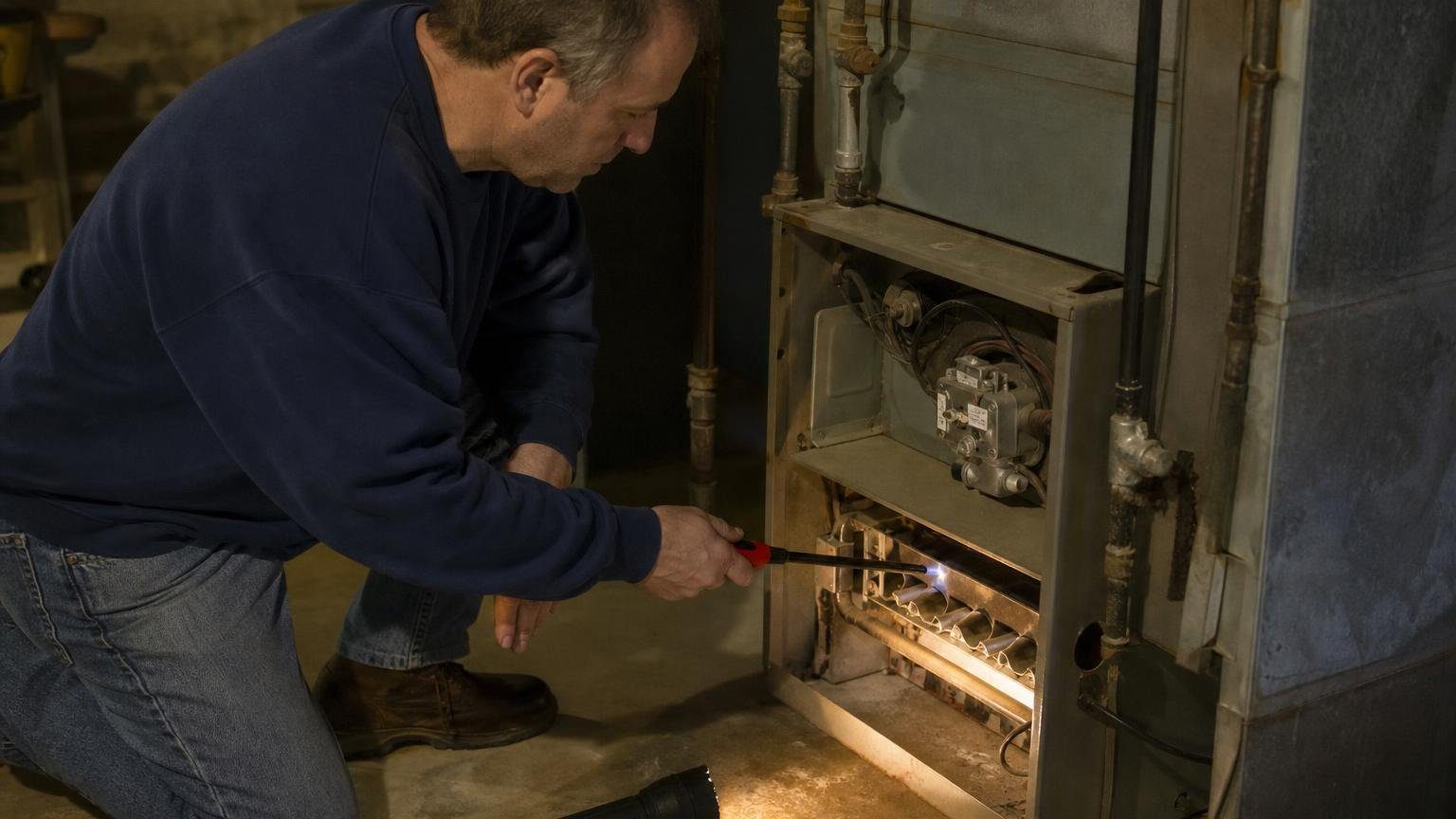
Furnace pilot light out? Only a standing pilot furnace has one you relight by hand. Smell for gas first. If there is none, turn the knob to PILOT, push and light it, hold about one minute, then turn to ON. If you smell gas, do not light anything: leave and call your gas supplier.
Key Takeaways
- DOE ties a continuous pilot light to older systems rated 56% to 70% AFUE (DOE Energy Saver, archived copy).
- Resideo’s lighting label: wait five (5) minutes to clear gas, then hold the knob about one (1) minute after the pilot lights (Resideo 69-0183).
- Honeywell’s VR8200 valve lists a 30 mV nominal thermocouple and a 2 mV open circuit turndown (Honeywell 68-0046).
- Gas boilers made since September 1, 2012 may not have a constant-burning pilot; the furnace rules carry no pilot clause (10 CFR 430.32).
- A 1,000 Btu/h pilot burning all year costs about $129.71 at EIA’s 2025 price of $15.34 per Mcf (EIA; our arithmetic).
- Smell gas? PHMSA says leave the area on foot and call 911 from a safe location (PHMSA, archived copy).
Does my furnace have a pilot light?
It has one you can relight only if its gas valve has a knob marked OFF, PILOT and ON. That is a standing pilot, a small flame that burns around the clock. Other furnaces light electronically on each call for heat, some via a spark-lit pilot.
DOE lists a continuous pilot light and 56% to 70% AFUE as traits of older systems, and “electronic ignition (no pilot light)” with 80% to 83% AFUE for mid-efficiency ones (DOE Energy Saver, archived copy). Gas wall furnaces are the common exception; see our wall heater guide.
| Ignition type | What you see | Pilot burning between cycles? | Can you relight it by hand? |
|---|---|---|---|
| Standing pilot (thermocouple) | Knob marked OFF, PILOT, ON; small steady flame | Yes, always | Yes, per the label |
| Standing pilot (thermopile, millivolt) | Same knob; pilot generator powers the thermostat; wall heaters | Yes, always | Yes, per the label |
| Intermittent pilot (spark to pilot) | Spark lights a pilot, then the burner | Only on a call for heat | No; the module relights it |
| Hot surface ignition | Ceramic element glows, then burners light | No pilot at all | No; diagnose the igniter |
| Direct spark ignition | Spark at the main burner | No pilot at all | No; control retries or locks out |
Resideo’s S8610U intermittent pilot module sparks a pilot and opens the main valve only once that flame is proved (Resideo 69-1955). Goodman’s single stage furnaces use a hot surface igniter with a 17-second warm up (Goodman RS6612022), and Resideo’s S87 sparks the main burner directly (Resideo 68-0039). No pilot? Start with why a furnace will not ignite.
How does a furnace pilot light work?
The pilot flame heats a thermocouple, which makes a tiny voltage that holds the gas valve’s safety magnet open. If the flame goes out, the voltage collapses and the valve closes. That is why you hold the knob in while lighting: your thumb holds the valve open until the thermocouple is hot.
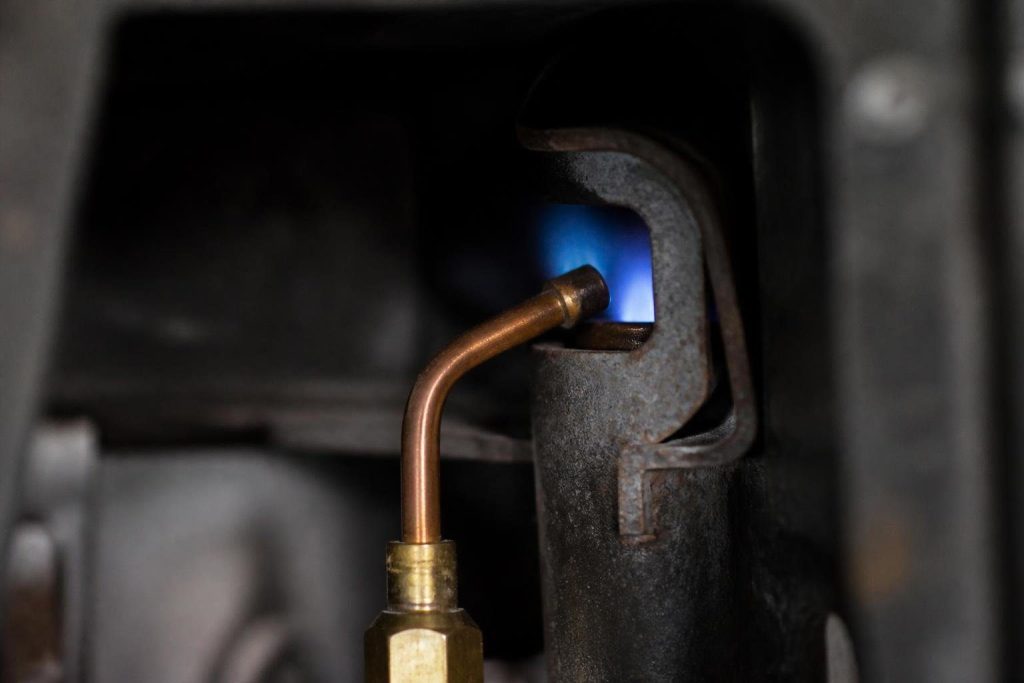
Honeywell’s VR8200 standing pilot valve lists a thermocouple nominal output of 30 mV and an open circuit turndown voltage of 2 mV (Honeywell 68-0046). The flame should envelop 3/8 to 1/2 in. of the thermocouple tip.
Millivolt appliances use a thermopile, or pilot generator, that powers the valve and a millivolt thermostat. Williams’ room heater manual wants a reading of 450 millivolts or more at PILOT (Williams owner’s manual). Modern furnaces replace both parts with a flame sensor that proves flame by microamps.
When should you not relight a furnace pilot light?
Do not relight it if you smell gas, if any part has been under water, if the knob will not move by hand, or if the pilot keeps going out after several tries. Each is a stop condition printed on the manufacturer’s lighting label.
If you smell gas
Resideo’s label says: do not try to light any appliance, do not touch any electric switch, do not use any phone in the building, and call your gas supplier from a neighbor’s phone; if you cannot reach the supplier, call the fire department (Resideo 69-0183). PHMSA adds: leave on foot, do not hunt for the leak, and call 911 from a safe location (PHMSA).
The label also says “Never use tools” on the knob, and if the knob or reset button does not pop up when released, stop and call a technician. It is also a good moment to confirm your CO alarms are where code puts them.
How to relight a furnace pilot light, step by step
Follow the label on your own furnace first. Below is Resideo’s printed label for its standing pilot controls, condensed from 15 steps; Honeywell and Williams print the same five minute wait and one minute hold.
- Set the thermostat to its lowest setting and turn off all electric power to the furnace.
- Remove the control access panel and turn the gas control knob clockwise to OFF.
- Wait five (5) minutes to clear out any gas. Then smell for gas, including near the floor. If you smell gas, stop and follow the gas smell steps above.
- Remove the pilot access panel. Find the pilot by following the metal tube from the gas control.
- Turn the knob counterclockwise to PILOT. Push in the knob, or the red reset button, all the way and hold it.
- Immediately light the pilot. Keep holding about one (1) minute after it lights, then release.
- If it goes out, repeat from step 2. After several failed tries, turn the knob to OFF and call for service.
- Replace the pilot panel, turn the knob counterclockwise to ON, replace the access panel, restore power and set the thermostat.
Source: Resideo 69-0183. If the pilot holds but the burner never fires, see our furnace gas valve guide.
Why won’t the furnace pilot light stay lit?
If the pilot dies when you release the knob, the thermocouple circuit is not holding the valve open. Honeywell’s VR8200 service section gives the check order:
- Hold the knob in at least one minute so the thermocouple heats.
- Flame: the pilot flame must wrap 3/8 to 1/2 in. of the thermocouple tip.
- Thermocouple wiring to the valve.
- The thermocouple nut: tightened 1/4 turn beyond finger tight at the power unit.
- Thermocouple millivolts, open and closed circuit; replace it if out of range.
- Power unit resistance: above 11 ohms means replacing the gas control.
Source: Honeywell 68-0046. If the pilot will not light at all, it lists air in the pilot line, a closed pilot adjustment screw, and a clogged pilot tube or orifice. Steps 5 and 6 need a meter and a technician.
A pilot that stays lit while the burner never fires is a different fault: Williams lists the thermostat, its wiring, a plugged burner orifice and a weak generator. On an intermittent pilot furnace run by a control board, resetting the furnace and reading its control board flash codes come first.
How much gas does a standing pilot use?
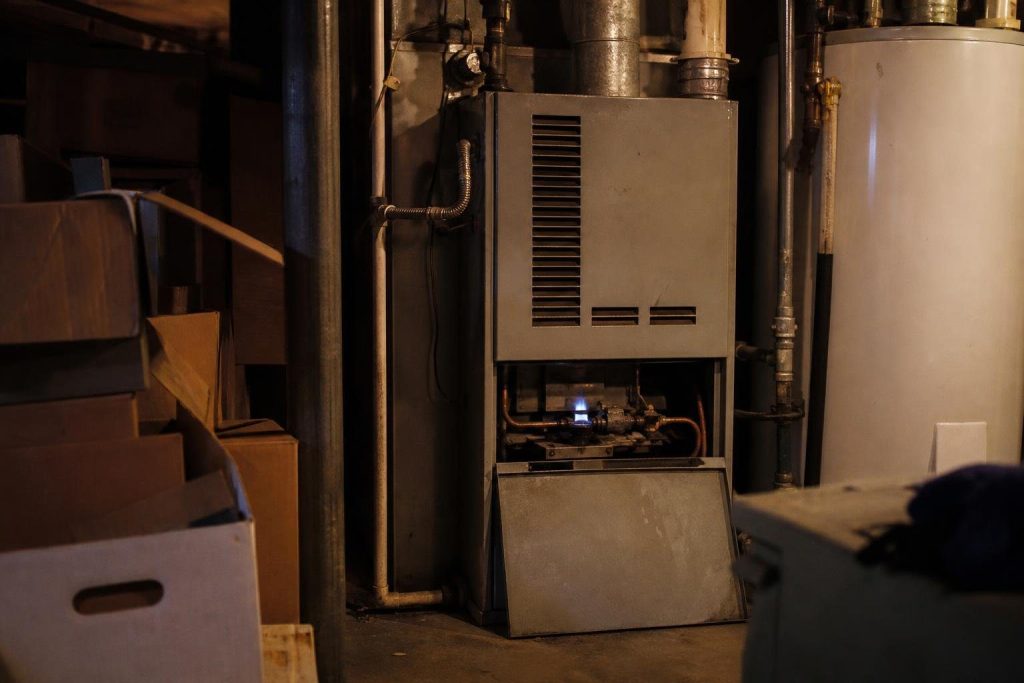
About 8.46 Mcf, or $129.71, a year for a 1,000 Btu/h pilot that never goes out, at 2025 gas prices. That is our arithmetic, the method behind our gas fireplace pilot cost breakdown.
The working: 1,000 Btu/h times 8,760 hours, divided by EIA’s 1,036 Btu per cubic foot, is 8.46 Mcf; at $15.34 per Mcf (EIA, 2025 annual) it costs $129.71. Natural Resources Canada’s 600 to 1,500 Btu range gives $77.83 to $194.56. Shut off for six warm months, it costs about half: $64.85.
DOE calls gas furnaces with pilot lights prime candidates for replacement. Your state’s rate is in our natural gas prices by state table.
Are standing pilots still legal on new furnaces?
Federal rules do not ban them on furnaces by name; they set efficiency floors a standing pilot design struggles to meet. Gas boilers are different: 10 CFR 430.32 says “constant-burning pilot not permitted” outright.
| Product (10 CFR 430.32) | Pilot rule | Efficiency floor |
|---|---|---|
| Non-weatherized gas furnace, made Nov 19, 2015 to Dec 17, 2028 | None written | 80.0% AFUE |
| Non-weatherized gas furnace, made from Dec 18, 2028 | None written | 95.0% AFUE |
| Gas hot water boiler, made from Jan 15, 2021 | Not permitted (since Sept 1, 2012) | 84% AFUE |
| Gas steam boiler, made from Jan 15, 2021 | Not permitted (since Sept 1, 2012) | 82% AFUE |
| Gas wall furnace, gravity type up to 27,000 Btu/h, from Apr 16, 2013 | None written | 65% AFUE |
Source: 10 CFR 430.32(e) and (i). Against DOE’s 56% to 70% AFUE for continuous pilot systems, the 80% floor leaves little room, and the 95% rule tightens it, as our report on the 2028 furnace standard explains. Wall furnaces carry lower floors and no pilot clause. The rules apply by manufacture date, so an existing pilot furnace can keep running.
How we researched this
Researched October 9, 2026. We read 10 CFR 430.32 via the eCFR API, four Resideo and Honeywell documents, Goodman and Williams manuals, and DOE, EIA, PHMSA, Federal Register and NRCan pages, all cited. Costs are our arithmetic. Excluded: unsourced thermocouple prices and “mid-1990s” cutoff claims. Gas safety topic, so no Reddit.
Frequently asked questions
Why does my furnace pilot light keep going out?
Usually the thermocouple circuit. Honeywell’s VR8200 checklist: hold the knob a full minute, make sure the flame wraps 3/8 to 1/2 in. of the thermocouple tip, check the wiring and nut, then test its millivolts. Resideo’s label says that after several failed tries, turn the knob to OFF and call for service.
Why won’t my pilot light stay lit when I release the knob?
The thermocouple is not making enough voltage to hold the safety magnet. Honeywell rates the VR8200 thermocouple at 30 mV nominal with a 2 mV turndown. Hold the knob at least one minute; if it still drops, a technician tests and replaces the thermocouple.
How long do you hold the pilot button?
About one minute after the pilot lights. Resideo’s lighting label says to hold the control knob or red reset button for about one (1) minute, then release it and let it pop back up. Honeywell’s VR8200 instructions say the same.
Should a furnace pilot light always be on?
On a standing pilot furnace, yes, during the heating season. You can turn it off for summer with the label’s turn-off steps, which by our arithmetic saves about half of the $129.71 a 1,000 Btu/h pilot costs a year. Relight it with the full label procedure in fall.
Can I relight the pilot if I smell gas?
No. Resideo’s label says do not try to light any appliance, do not touch electric switches or use a phone in the building, and call your gas supplier from a neighbor’s phone. PHMSA says leave the area on foot and call 911 from a safe location.
Do new gas furnaces have pilot lights?
Rarely a standing one. DOE lists electronic ignition with no pilot light on mid-efficiency furnaces, and new non-weatherized gas furnaces must reach 80.0% AFUE now and 95.0% from December 18, 2028. Some use an intermittent pilot that a spark lights only on a call for heat.
Sources
- eCFR. “10 CFR 430.32, Energy and water conservation standards.” https://www.ecfr.gov/current/title-10/chapter-II/subchapter-D/part-430/subpart-C/section-430.32. Accessed October 2026.
- Resideo. “Standing pilot lighting instructions, 69-0183.” https://res.cloudinary.com/dzhpkjoqj/Resideo/69-0183.pdf. Accessed October 2026.
- Honeywell. “VR8200, VR4200 Combination Gas Controls, 68-0046.” https://www.cochranesupply.com/media/assets/product/documents/Honeywell/VR8200.pdf. Accessed October 2026.
- Resideo. “S8610U Universal Intermittent Pilot Module, 69-1955.” https://res.cloudinary.com/dzhpkjoqj/Resideo/69-1955.pdf. Accessed October 2026.
- Resideo. “S87 Direct Spark Ignition Control Module, 68-0039.” https://customer.resideo.com/resources/Techlit/TechLitDocuments/68-0000s/68-0039.pdf. Accessed October 2026.
- Goodman. “Service and Troubleshooting, RS6612022.” https://mobile.goodmanmfg.com/mobileapp/stellent/pdf/infoPdf/Lit/RS6612022R1.pdf. Accessed October 2026.
- Williams Furnace Co. “Vented Room Heaters Owner’s Manual.” https://cdn.shopify.com/s/files/1/0782/2077/files/Williams_RH_Manual.pdf. Accessed October 2026.
- US DOE. “Furnaces and Boilers” (archived copy). https://web.archive.org/web/2025id_/https://www.energy.gov/energysaver/furnaces-and-boilers. Accessed October 2026.
- EIA. “Natural Gas Residential Price, Annual.” https://www.eia.gov/dnav/ng/hist/n3010us3a.htm. Accessed October 2026.
- EIA. “Units and calculators explained.” https://www.eia.gov/energyexplained/units-and-calculators/. Accessed October 2026.
- Federal Register. “Proposed Determination of Miscellaneous Gas Products,” 87 FR 6786. https://www.federalregister.gov/documents/2022/02/07/2022-02386/energy-conservation-program-proposed-determination-of-miscellaneous-gas-products-as-a-covered. Accessed October 2026.
- Natural Resources Canada. “All About Gas Fireplaces.” https://natural-resources.canada.ca/energy-efficiency/energy-star/all-about-gas-fireplaces. Accessed October 2026.
- PHMSA. “Pipeline Leak Recognition and What to Do” (archived copy). https://web.archive.org/web/2025id_/https://www.phmsa.dot.gov/safety-awareness/pipeline/pipeline-leak-recognition-and-what-do. Accessed October 2026.
Leave a Reply