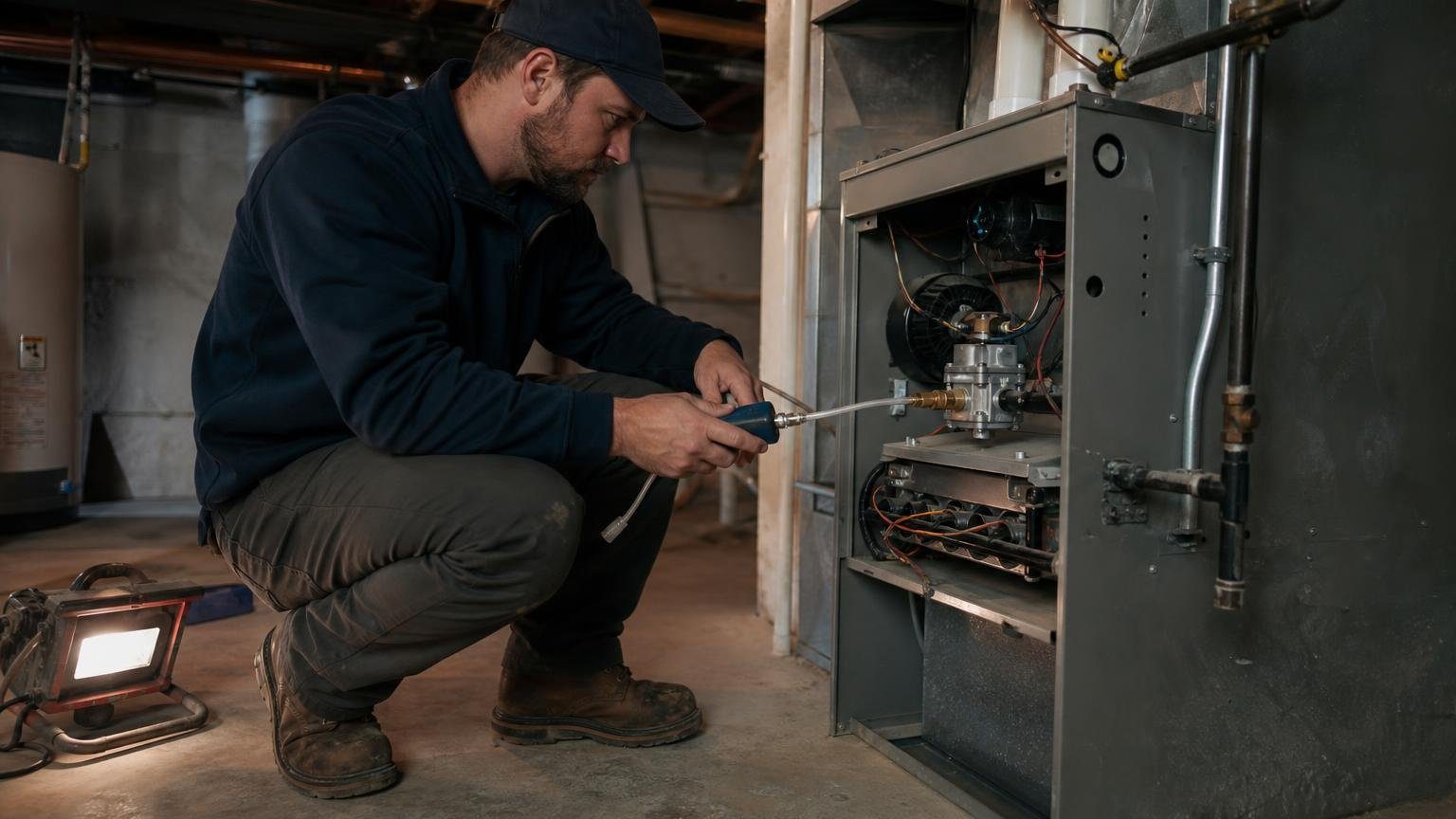
What is a furnace gas valve? A furnace gas valve is a 24 volt combination control that keeps gas behind two automatic valves until the control board energizes it, then regulates burner pressure. Goodman and Lennox manuals specify 3.5 in. w.c. on natural gas and 10.0 on propane at full fire.
Key Takeaways
- A Resideo VR8205 holds a manual valve, two automatic operators and a servo regulator in one body, and draws 0.5 A at 24 VAC (Resideo 68-0049).
- Goodman’s two-stage CVC96 manual sets natural gas at 1.9 in. w.c. low fire and 3.5 high; propane at 6.0 and 10.0 (Goodman IOG-2015A).
- White-Rodgers 36J valves are rated to 1/2 psi, or 14.0 in. w.c., at the inlet (White-Rodgers WR-6960).
- Resideo’s VR8205 chart: no voltage at the MV terminals means check the control circuit, not the valve (Resideo).
- Resideo forbids jumpering the coil terminals; a knob that will not turn by hand means a technician replaces the valve (Resideo).
- Connecticut makes unlicensed heating appliance work a class B misdemeanor, with an owner-occupant exemption (CGS 20-341).
What does a furnace gas valve do?
A furnace gas valve is the last control between the gas line and the burners. It opens only when the furnace control board sends it 24 volts, which happens after the inducer, pressure switch and igniter have all proved. Goodman describes its CVC96 valve as “a 24 volt gas valve controlled during furnace operation by the integrated control module” (Goodman IOG-2015A).
It does three jobs: shutoff, on command opening, and pressure regulation. The valve body is built to CSA/ANSI Z21.78, whose 2025 edition covers controls with a “maximum operating gas pressure of 1/2 psi” (Standards Council of Canada listing). Our walk through the full ignition sequence shows where the valve sits in the cycle.
What is inside a combination furnace gas valve?
Inside one housing sit a manual valve, two automatic valves in series and a pressure regulator. Resideo lists the VR8205 as “a safety shutoff, a manual valve, two automatic operators and a pressure regulator,” and White-Rodgers labels the same pair “Main & Redundant” on its 36G/J wiring sheet (White-Rodgers 36G/J).
On a call for heat, the first valve’s solenoid opens and the second valve’s diaphragm lifts under the regulator’s control. When the call ends, Resideo says spring pressure closes the second valve “to provide a second barrier to gas flow.” Slow opening models ramp outlet pressure from zero to rated in 3 to 6 seconds on an 80,000 Btu/h furnace, per the same document.
What should furnace gas valve manifold pressure be?
Manifold pressure is whatever the furnace rating plate says. In the manuals we read, that lands near 3.5 in. w.c. for natural gas and 10.0 for propane at full fire, with two-stage low fire roughly half. Goodman lets the final setting stray no more than 0.3 in. either way on natural gas, and 0.5 on LP.
| Manual (furnace family) | Fuel | Low fire | High or single fire | Inlet supply |
|---|---|---|---|---|
| Goodman IOG-2015A (CVC96, MVC96, two-stage) | Natural | 1.6 to 2.2 (1.9) | 3.2 to 3.8 (3.5) | 4.5 to 10.0 |
| Goodman IOG-2015A | Propane | 5.7 to 6.3 (6.0) | 9.7 to 10.3 (10.0) | 11.0 to 13.0 |
| Lennox 507103-04 (ML180UHE, 0 to 2,000 ft) | Natural | none listed | 3.5 | 4.5 to 13.0 |
| Lennox 507103-04 | Propane | none listed | 10.0 | 11.0 to 13.0 |
| Trane BAYLPSS210B propane kit (36G or 36J two-stage) | Propane | 5.0 to 6.0 | 10.5 to 11.0 | not stated |
All values in inches of water column. Sources: Lennox 507103-04, Trane 18-CH12D28-7B, Goodman IOG-2015A. Altitude changes the number: Lennox drops its 090 model to 2.7 on natural gas between 4,501 and 7,500 ft.
Reading these numbers takes a manometer on the outlet tap with the burners lit. Adjusting the regulator is technician work, and Goodman allows “only minor adjustments” there. Owners should know the plate value and ask for the reading.
Why is the furnace gas valve not opening?
A furnace gas valve that will not open is usually obeying orders: the board withholds 24 volts until every upstream step proves. Technicians work down this sequence and stop at the first failure:
- Call for heat. Is the thermostat sending a heat call? See our thermostat troubleshooting guide.
- Inducer and pressure switch. The inducer must run and the pressure switch must close.
- Ignition proof. A hot surface igniter must glow, or a spark must fire.
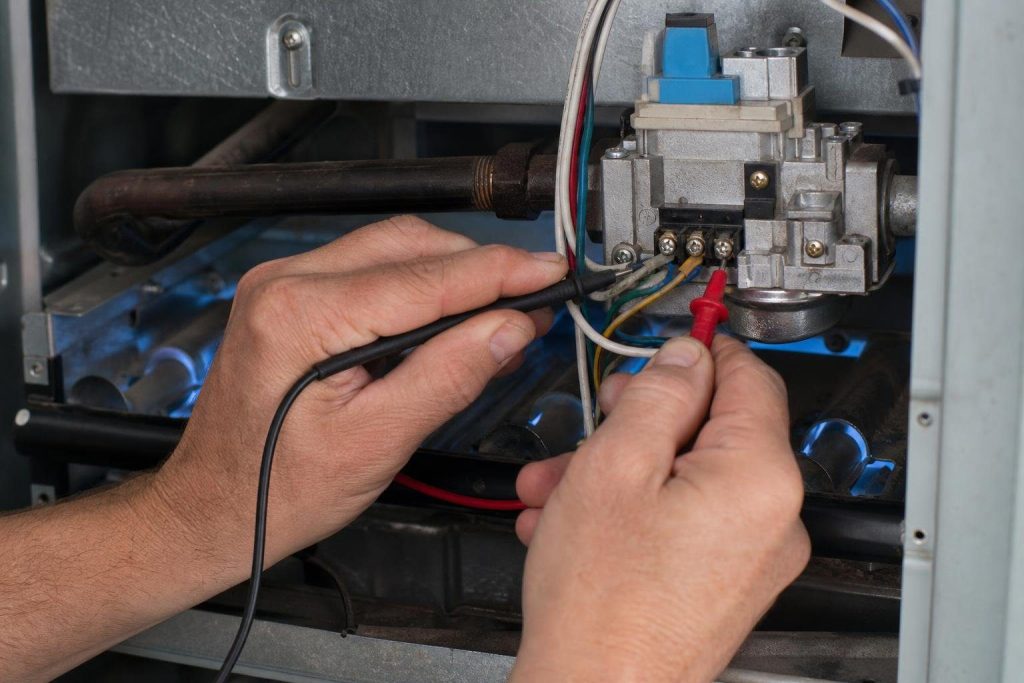
- 24 VAC at the valve terminals. With the board in trial for ignition, a meter across the coil terminals should read about 24 volts. No voltage points back to the furnace control board or an open safety.
- Manual knob or switch. The valve’s own ON/OFF control and the appliance shutoff valve must both be open.
- Inlet pressure. A manometer on the inlet tap confirms supply: Goodman’s minimum is 4.5 in. w.c. for natural gas and 11.0 for propane.
Resideo’s VR8205 chart reads the same way: measure across the MV terminals; with no voltage, “check control circuit”; with proper voltage and the knob on, “replace gas control.” Only then is the valve itself the suspect. If the burners light and then drop out after a few seconds, the valve opened fine: that pattern points to flame sensing, not the valve.
How do technicians test a furnace gas valve?
Testing a furnace gas valve takes two instruments: a voltmeter at the coil terminals and a manometer on the inlet and outlet taps. Resideo’s logic is blunt: if inlet pressure is in range and the specified outlet pressure cannot be reached, “replace gas control.” If inlet pressure is low, the problem is the supply, not the valve.
Resideo also lists a hard to turn knob as a replacement trigger, and says to “use only your hand” on it. The control “contains no replaceable components,” and “force or attempted repair may result in fire or explosion.” Tapping a stuck valve with a tool, a common piece of online advice, is exactly that kind of force.
Honeywell or White-Rodgers: which furnace gas valve fits?
The right furnace gas valve is the maker’s listed part, or a universal valve matching its fuel, stages, opening type and ignition. The VR8205 sheet, long sold as a Honeywell valve, now carries a 2021 Resideo Technologies copyright. Here is how its specs compare with White-Rodgers:
| Spec | Resideo VR8205 (single stage) | White-Rodgers 36J22, 36J54 |
|---|---|---|
| Coil | 24 VAC, 0.5 A | 24 VAC, 0.28 A single, 0.43 A two-stage |
| Natural gas factory setting | 3.5 (adjust 3.0 to 5.0) | 3.5 single; LO 1.5, HI 3.5 two-stage |
| LP setting range | 8.0 to 12.0 | 7.0 to 12.0 single; 4.0 to 10.0 low, 6.0 to 12.0 high |
| LP conversion | Kit 393691, ordered separately; step opening models cannot convert | Conversion kit included in the box |
| Manual control | ON/OFF knob | Electric ON/OFF switch |
Pressures in in. w.c. The brand matters less than the match: Z21.78 says a listed control is not automatically acceptable on an appliance “without supplemental tests” on that design. Converting to propane means a new regulator spring and burner orifices: Trane’s BAYLPSS210B kit for 36G or 36J valves ships a White-Rodgers spring kit plus #56 orifices, and our propane heating explainer covers the fuel side.
Can you replace a furnace gas valve yourself?
In most cases, no. Furnace gas valve replacement is gas work, and the manuals say who does it: Resideo states “installer must be a trained, experienced service technician,” and Lennox requires “a licensed professional HVAC installer or equivalent, service agency, or the gas supplier.”
State law varies. Connecticut’s licensing chapter covers the “installation, repair, replacement” of heating appliances and their devices, and willful unlicensed work is a class B misdemeanor; it exempts owners working on a single-family home they occupy (CGS chapter 393). Goodman’s manual notes that Massachusetts requires a licensed plumber or gas fitter. Our state licensing table covers the rest.
Never bypass the valve. Resideo’s caution reads: “Never apply a jumper across or short the valve coil terminals.” A valve forced open skips every safety that proves draft and flame. Resideo calls for a gas leak test after installation, and Trane warns that a conversion not done exactly to instructions can produce carbon monoxide. Keep CO alarms placed to code.
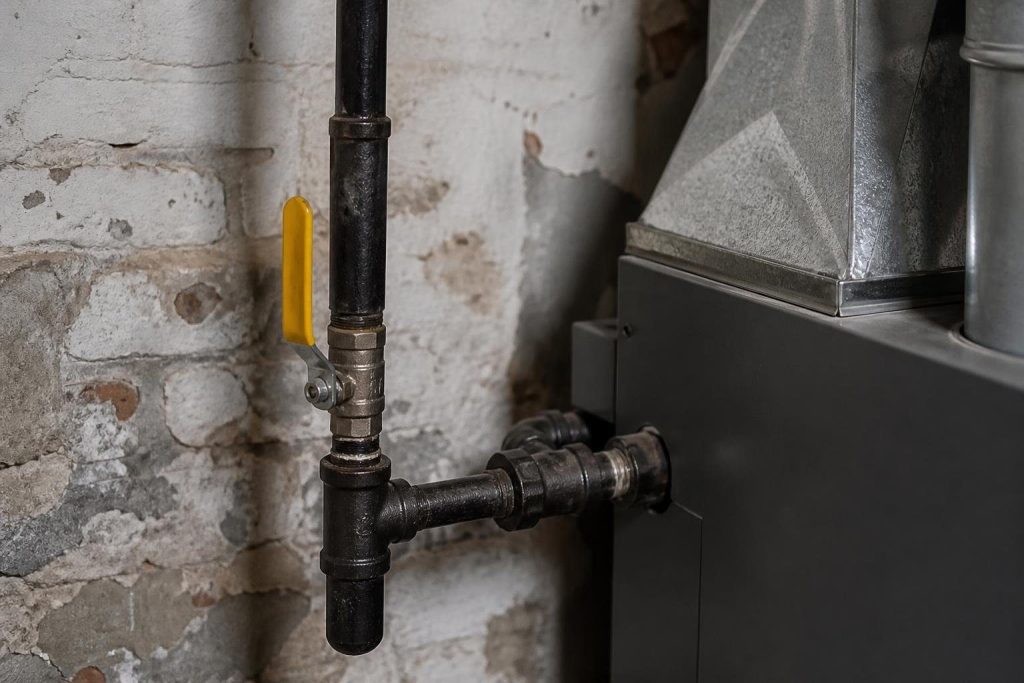
Code also governs the shutoff upstream: IFGC Section 409.5.1, as carried into North Carolina’s fuel gas code, puts it “within 6 feet” of the appliance, in the same room (NC Department of Insurance). No federal or national lab series prices a gas valve replacement, so we publish no cost range; the bill turns on valve type, stage count and any LP kit.
How we researched this
Research date: October 9, 2026. None of the top three ranking pages cited a source or gave a manifold pressure. We consulted 16 documents and cite nine: three valve maker documents, three furnace maker manuals, two code or statute texts and one standard listing. Manufacturer data describes only that maker’s equipment.
Excluded: Reddit and forums (gas and combustion safety topic), contractor price pages (no federal price series exists) and any pressure figure we could not trace to a named manual.
Frequently asked questions
Why is my furnace gas valve not getting 24 volts?
Because the control board has not released it. It powers the valve only after the heat call, inducer, pressure switch and igniter prove, so an open safety or lockout stops the voltage. Resideo’s VR8205 chart says that with no voltage at the MV terminals, check the control circuit. Our guide on how to reset a furnace covers lockouts.
Why does the furnace gas valve click but no gas flows?
A click means the coil is energized. Next comes the manual knob or switch, the appliance shutoff valve and inlet pressure; Goodman’s natural gas minimum is 4.5 in. w.c. If 24 VAC is present, the knob is on and supply pressure is in range, Resideo’s instruction is to replace the gas control.
How long does a furnace gas valve last?
Resideo says to replace a VR8205 that has likely operated more than 200,000 cycles, has a hard to turn knob, or fails checkout. Valves in high ammonia settings such as animal barns may fail in one or two years, and any valve flooded with water must be replaced.
Can a furnace gas valve be converted to propane?
Usually, with the maker’s kit. Resideo sells kit 393691 for standard and slow opening VR8205 valves but says step opening models cannot be converted. White-Rodgers packs a conversion kit with its 36J valves. Burner orifices change too, and Goodman requires the furnace maker’s propane kit.
What inlet gas pressure should a furnace gas valve see?
Goodman’s CVC96 manual calls for 4.5 to 10.0 in. w.c. on natural gas and 11.0 to 13.0 on propane. Resideo lists a nominal inlet of 5.0 to 7.0 for natural gas and 12.0 to 14.0 for LP on the VR8205. White-Rodgers rates its 36J valves to 1/2 psi, which is 14.0 in. w.c.
What should I do if I smell gas near the furnace gas valve?
Follow Resideo’s homeowner warning: shut off the manual valve in the gas piping to the appliance, or at the tank on LP. Do not touch any electrical switch or use the phone; leave the building and call your gas supplier, or the fire department if the supplier cannot be reached. LP is heavier than air, so it collects low.
Sources
- Resideo Technologies. “VR8205 Combination Gas Controls, Installation Instructions 68-0049-03.” https://res.cloudinary.com/dzhpkjoqj/Resideo/68-0049.pdf. Accessed October 2026.
- White-Rodgers. “36 Series Electronic Ignition Gas Valves, WR-6960.” https://resource.bakerdist.com/is/content/Watscocom/Gemaire/white-rodgers_36j54-214_article_1438071350237_en_ss.pdf. Accessed October 2026.
- White-Rodgers. “36G/J Wiring, Gas Valves.” https://resource.bakerdist.com/is/content/Watscocom/Gemaire/white-rodgers_36j54-214_article_1438071350237_en_wd.pdf. Accessed October 2026.
- Goodman Manufacturing. “Installation Instructions for *CVC96*BA and *MVC96*BA Two-Stage Gas Furnace, IOG-2015A.” https://mobile.goodmanmfg.com/mobileapp/stellent/pdf/infoPdf/Lit/IOG-2015A.pdf. Accessed October 2026.
- Lennox Industries. “ML180UHE Merit Series Gas Furnace Installation Instructions, 507103-04.” https://www.lennox.com/dA/9b51323cc2/507103-04a.pdf. Accessed October 2026.
- Trane. “BAYLPSS210B Propane Conversion Kit, 18-CH12D28-7B-EN.” https://elibrary.tranetechnologies.com/public/residential-hvac/Literature/Installation/18-CH12D28-7B-EN_03022023.pdf. Accessed October 2026.
- Connecticut General Assembly. “Chapter 393 (sections 20-330, 20-340, 20-341).” https://www.cga.ct.gov/current/pub/chap_393.htm. Accessed October 2026.
- North Carolina Department of Insurance. “2012 NC Fuel Gas Code changes (IFGC 409.5.1).” https://ncosfm.gov/2012-nc-fuel-gas-code-includes-abridged-residential-part-6-bcc-ad-hoc-committee-meeting-information/open. Accessed October 2026.
- Standards Council of Canada. “CSA/ANSI Z21.78:25, CSA 6.20:25 Combination gas controls for gas appliances.” https://ccn-scc.ca/standardsdb/standards/4033741. Accessed October 2026.
Leave a Reply