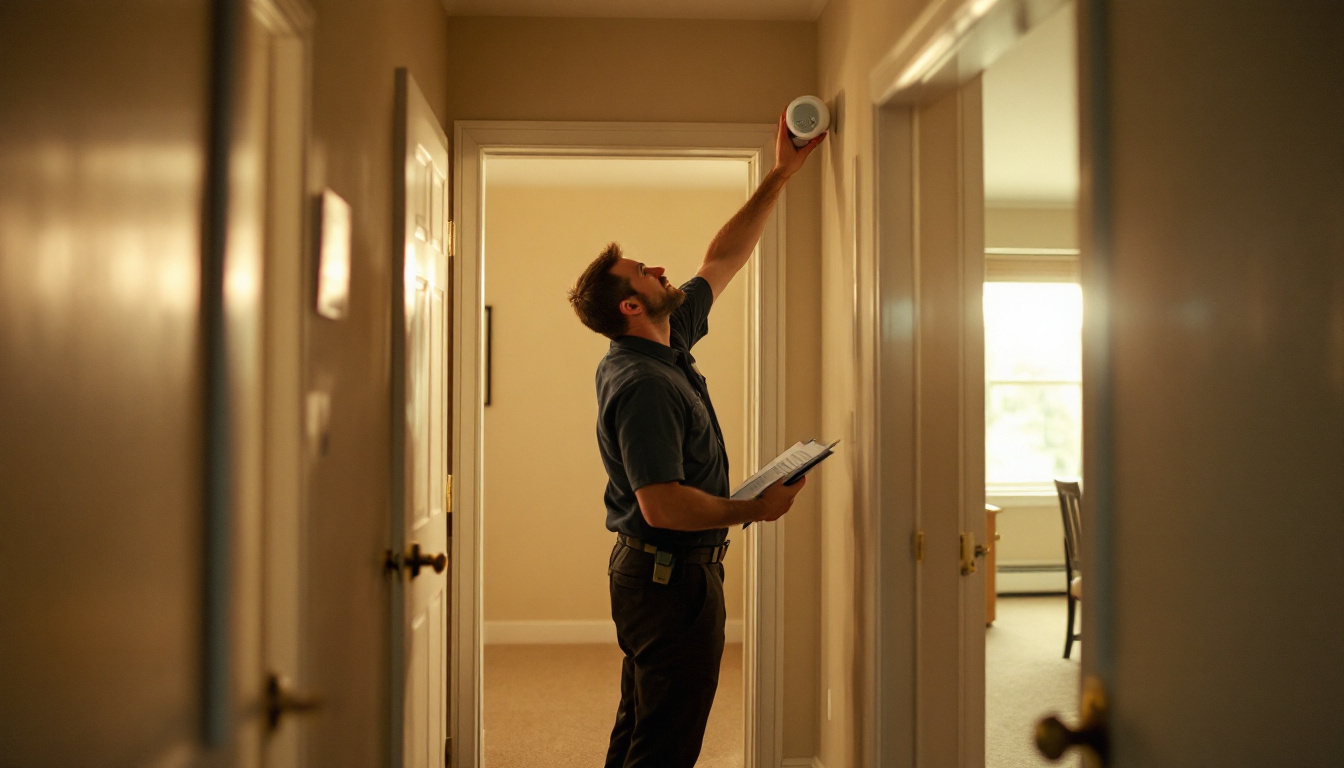
Carbon monoxide detector placement: where do the alarms actually go? One outside each separate sleeping area, in the immediate vicinity of the bedrooms, and one on every level. Height barely matters; distance from the furnace does.
Key Takeaways
- IRC Section R315.3 puts alarms outside each separate sleeping area, per the North Carolina Office of the State Fire Marshal.
- The model code applies only with a fuel fired appliance or an attached garage opening into the dwelling.
- The US Fire Administration recommends an alarm on every level, above the code minimum.
- UL 2034 requires alarm within 60 to 240 minutes at 70 ppm, per CPSC conformance testing.
- CPSC estimated 274 non fire CO deaths from consumer products in 2022: 76 from heating systems, 107 from engine driven tools.
- CDC counts more than 400 unintentional non fire CO deaths a year.
What does the code actually require for carbon monoxide detector placement?
Section R315.3 requires alarms “outside of each separate sleeping area in the immediate vicinity of the bedrooms,” and adds that where a fuel burning appliance sits inside a bedroom or its attached bathroom, an alarm goes inside that bedroom.
Under R315.2.1, new construction needs alarms only where the dwelling contains a fuel fired appliance, or has an attached garage with an opening that communicates with the dwelling. An all electric house with a detached garage is exempt; attached garage ventilation is a separate question.
R315.2.2 extends it to existing homes when alterations, repairs or additions require a permit. States amend that: North Carolina lists four triggers, including any trade permit for installing or replacing a fuel fired appliance, so a permitted boiler replacement there brings alarms with it.
The model code says nothing about a basement alarm unless it holds a sleeping area. Federal guidance goes further: EPA states that each floor of the home needs a separate detector.
How high on the wall should a CO alarm be mounted?
Almost anywhere works. CPSC’s consumer guidance says alarms “may be installed into a plug-in receptacle or high on the wall.” Carbon monoxide mixes with room air.
CO does not pool on the floor or bank at the ceiling like smoke. Kidde tells owners to keep the unit clear of curtains and furniture and mount it at eye level so the indicator lights stay readable.
The height myth, corrected
No federal source or model code sets a mounting height for a residential CO alarm. R315.3 specifies a location, not an elevation.
What clearances does carbon monoxide detector placement need?
The code is silent on clearances, so the manufacturer’s instruction governs. Kidde’s KN COB B user guide says to locate the alarm at least 5 feet from all fuel burning appliances; other models publish different figures.
The same guide lists spillage or reverse venting of fuel burning appliances, from wind, exhaust fans or loose vent pipes, as causes of transient CO. An alarm mounted over a gas water heater with a draft hood sits in that path.
| Do not install | Reason Kidde gives |
|---|---|
| Within 5 feet of a fuel burning appliance | None stated |
| Bathroom or other damp, humid space | Avoid spraying aerosols near the alarm |
| Kitchen, garage or furnace room | Dust, grease and household chemicals can affect the sensor |
| Ceiling fan turbulence, fresh air vents, doors or openable windows | None stated |
| Dead air at a vaulted ceiling peak or gable | None stated |
| Behind curtains or furniture | CO must be able to reach the sensor |
| Below 40 F or above 100 F | None stated |
Source: Kidde KN COB B user guide. Not set by the IRC.
Keep the hallway alarm away from the bathroom door and confirm the exhaust fan is ducted outdoors. In the kitchen, mount away from the range and check the hood vents outside rather than recirculating. Ranges and ovens carried an estimated 16 CO deaths in 2022.
Do combination smoke and CO alarms count, and must they be interconnected?
Yes, and yes when more than one is required. IRC Section R315.4 permits combination carbon monoxide and smoke alarms in lieu of CO alarms, and R315.1.1 requires them to be listed to both UL 2034 and UL 217.
R315.5 in the unamended 2018 IRC requires that where more than one CO alarm is required, actuation of one activates all of them; listed wireless alarms are accepted. An exception covers existing homes where alterations do not expose the structure.
R315.6 sets the power source: building wiring with battery backup, excepting buildings without commercial power and retrofits under R315.2.2.
How long does a CO alarm last, and what is the end of life chirp?
Every retail UL certified CO alarm built after August 2009 has to signal its own end of life, a UL 2034 change CPSC recommended in 2004. Who dies, when and from which products is in our carbon monoxide deaths statistics, from CPSC data through 2022.
The Kidde KN COB B guide gives a seven year service life and tells owners to write a replace by date on the label. CDC’s guidance is blunter: replace the detector per the manufacturer’s instructions or every 5 years.
The end of life signal on that model is a chirp every 30 seconds, easily confused with a low battery. An exhausted sensor looks identical to a working one, so the written date is the only reminder.
What level of carbon monoxide actually sets the alarm off?
Not a single number. UL 2034 defines alarm points as concentration and time pairs, and CPSC’s conformance test report reproduces the pass windows. An alarm that fires before the window opens fails, just as a late one does.
| CO concentration | Required alarm window | What CPSC says people feel |
|---|---|---|
| 30 ppm | Must not alarm in 30 day or 8 hour tests | Most people have no symptoms from 1 to 70 ppm |
| 70 ppm | 60 to 240 minutes | Headache, fatigue and nausea become noticeable |
| 150 ppm | 10 to 50 minutes | Approaching the sustained 150 to 200 ppm band |
| 400 ppm | 4 to 15 minutes | Disorientation, unconsciousness and death possible |
| 16 ppm per minute to 480 ppm | 19 to 30 minutes | Rapid buildup, typical of engine exhaust |
A listed alarm must stay silent at 30 ppm, yet CPSC notes some heart patients feel chest pain in the 1 to 70 ppm range. CDC recommends detectors with digital readouts.
What should you do when the CO alarm sounds?
Leave first, diagnose later. CPSC’s instruction is to never ignore an alarming CO alarm, move to fresh air and call emergency services. The sequence below follows CPSC and the Kidde guide.
- Move everyone outdoors, or to an open door or window, immediately.
- Check that every person is accounted for.
- Call 911 or the fire department from outside the building.
- Do not re enter until responders arrive, the building is aired out, and the alarm returns to normal.
- Never restart the source of a CO problem until it has been corrected.
CDC lists the common symptoms as headache, dizziness, weakness, upset stomach, vomiting, chest pain and confusion.
Why carbon monoxide detector placement is not a substitute for combustion testing
CPSC says a CO alarm provides “some added protection, but it is no substitute for proper use and upkeep of appliances that can produce CO.” The alarm is a trip wire, not a measurement of your heat exchanger, flue or draft.
Heating systems accounted for 76 of the 274 non fire CO deaths in 2022, furnaces and boilers for 20 of those and portable heaters for 34. Engine driven tools carried 107, or 39 percent, 93 of them generators. The heating share is what pre season safety checks target.
A technician with a combustion analyzer measures what an alarm cannot. Ask for flue gas, draft and ambient CO readings at the annual furnace visit or the boiler service and keep them year over year. CPSC recommends annual professional inspection plus a check of chimneys and flues for blockages and corrosion.
A wood or pellet stove needs the same scrutiny, and fuel burning portable heaters are the largest heating subcategory. A cracked heat exchanger is another thing a service call finds and an alarm may not; see what fails on a furnace.
How we researched this
Research date: September 2026. We cite 10 sources; a DOE Building America page added nothing unique, and NFPA and First Alert pages failed to load. The ICC code server blocks automated retrieval, so IRC R315 text comes from two code official restatements (North Carolina and Boulder City, Nevada). Neither replaces your locally adopted code.
Death estimates come from the CPSC report published May 2026 covering 2022. Alarm thresholds come from a CPSC staff report reproducing the UL 2034 windows; we did not buy the UL standard. Clearances come from one manufacturer guide because no federal source publishes them.
Reddit was excluded entirely because this is a carbon monoxide safety topic. Contractor blogs, alarm retailer pages and SEO roundups were excluded for every number. No installed prices appear because no federal series publishes them.
Frequently asked questions
Should a carbon monoxide detector go high or low on the wall?
Either works. CPSC states alarms may be installed into a plug-in receptacle or high on the wall. CO mixes with room air, and no federal source or model code sets a mounting height for a residential alarm. Keep it clear of curtains and furniture.
Do I need a CO alarm in the basement?
The model code requires one only if the basement contains a sleeping area, but the US Fire Administration recommends an alarm on every level. If the furnace or water heater is down there, that alarm sits closest to the likely source. Kidde’s guide says keep it 5 feet away.
How far should a CO detector be from a furnace?
Follow the instruction in your box. The Kidde KN COB B guide says at least 5 feet from all fuel burning appliances; other models publish different figures. The IRC sets no clearance, so the manufacturer’s figure governs. The same guide also says to keep the alarm out of furnace rooms.
How many carbon monoxide detectors does a house need?
At minimum, one outside each separate sleeping area per IRC R315.3, plus one inside any bedroom containing a fuel burning appliance. The US Fire Administration recommendation of an alarm on every level usually adds a basement or main floor unit.
How often should a CO detector be replaced?
CDC advises replacing the detector per the manufacturer’s instructions or every 5 years. The Kidde KN COB B is rated for seven years. Every retail UL certified alarm made after August 2009 must signal its own end of life, usually a chirp every 30 seconds.
What ppm does a CO alarm go off at?
UL 2034 uses time and concentration pairs, not one threshold. Per CPSC conformance testing, an alarm must sound within 60 to 240 minutes at 70 ppm, 10 to 50 minutes at 150 ppm, and 4 to 15 minutes at 400 ppm. At 30 ppm it must not alarm.
Sources
- U.S. Consumer Product Safety Commission. “Non-Fire Carbon Monoxide Deaths Associated with the Use of Consumer Products: 2022 Annual Estimates.” https://www.cpsc.gov/s3fs-public/Non-Fire-Carbon-Monoxide-Deaths-Associated-with-the-Use-of-Consumer-Products-2022-Annual-Estimates.pdf. Accessed September 2026.
- U.S. Consumer Product Safety Commission. “Carbon Monoxide Alarm Conformance Testing to UL 2034: Standard for Safety.” https://www.cpsc.gov/s3fs-public/pdfs/COAlarmConformanceReportPhaseI.pdf. Accessed September 2026.
- U.S. Consumer Product Safety Commission. “Carbon Monoxide Fact Sheet.” https://www.cpsc.gov/safety-education/safety-guides/carbon-monoxide/carbon-monoxide-fact-sheet. Accessed September 2026.
- U.S. Consumer Product Safety Commission. “Carbon Monoxide Questions and Answers.” https://www.cpsc.gov/Safety-Education/Safety-Education-Centers/Carbon-Monoxide-Information-Center/Carbon-Monoxide-Questions-and-Answers. Accessed September 2026.
- Centers for Disease Control and Prevention. “About Carbon Monoxide Poisoning.” https://www.cdc.gov/carbon-monoxide/about/index.html. Accessed September 2026.
- U.S. Fire Administration. “Carbon Monoxide Poisoning Prevention.” https://www.usfa.fema.gov/prevention/life-safety-hazards/carbon-monoxide/. Accessed September 2026.
- U.S. Environmental Protection Agency. “Where should I place a carbon monoxide detector?” https://www.epa.gov/indoor-air-quality-iaq/where-should-i-place-carbon-monoxide-detector. Accessed September 2026.
- North Carolina Department of Insurance, Office of the State Fire Marshal. “Carbon Monoxide Alarms, 2018 Residential Code Section R315.” https://www.ncosfm.gov/residential/0315-carbon-monoxide-alarms/open. Accessed September 2026.
- City of Boulder City, Nevada. “Smoke and Carbon Monoxide Alarms, 2018 International Residential Code Sections R314 and R315.” https://www.bcnv.org/DocumentCenter/View/55/Smoke-and-Carbon-Monoxide-Alarms-PDF. Accessed September 2026.
- Kidde. “Carbon Monoxide Alarm User’s Guide, Model KN-COB-B.” https://www.sidharvey.com/documents/KN-COB-B.PDF. Accessed September 2026.
Leave a Reply