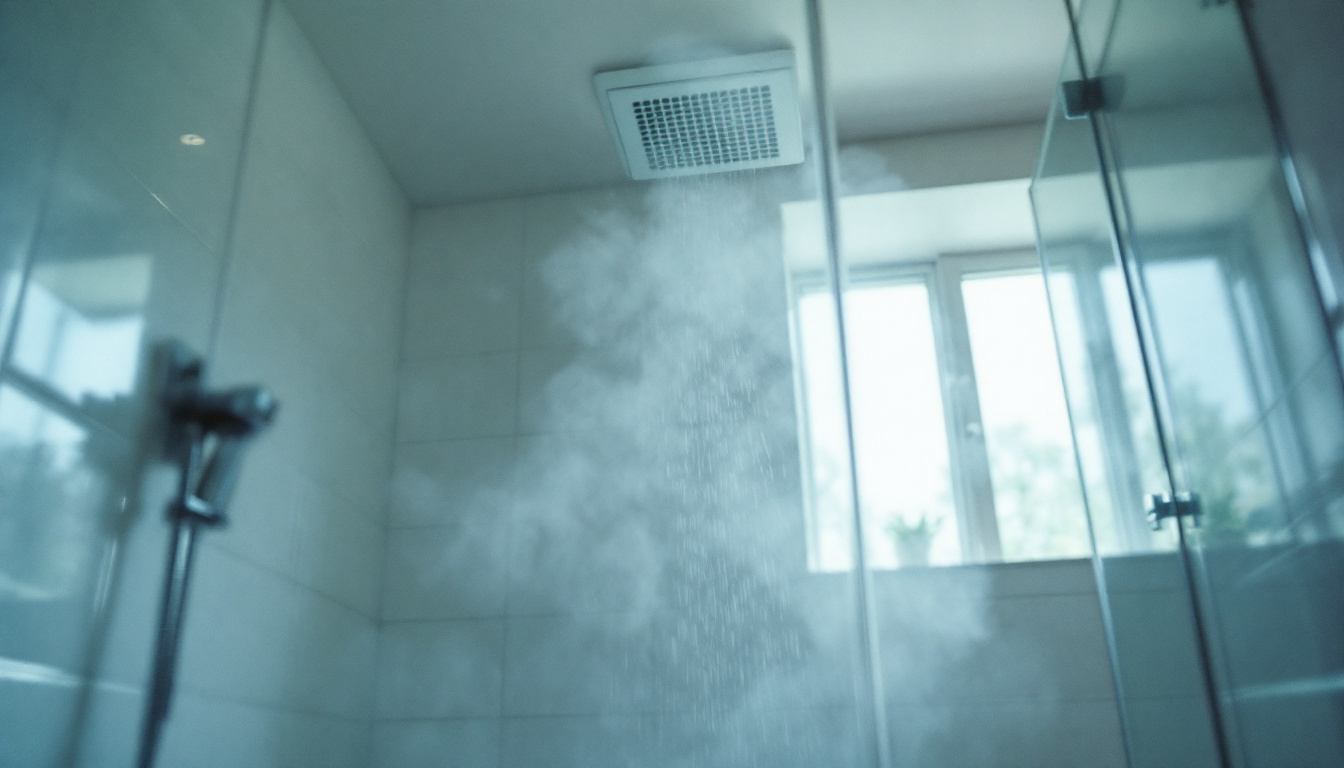
What does a bathroom exhaust fan need to do? Move at least 50 cfm when switched on, or 20 cfm if it runs continuously, and send that air outdoors through a short, sealed duct with a damper. Buy a fan rated above the minimum, because ducts cut real airflow.
Key Takeaways
- DOE restates the IRC 2021 (Section M1507) and ASHRAE 62.2 bathroom minimum as 50 cfm intermittent or 20 cfm continuous in its bathroom exhaust fan guide.
- ENERGY STAR recommends a fan rated at least 70 cfm to deliver the 50 cfm intermittent minimum once ducted, per the same DOE guide.
- A shower produces a half pint of water vapor for every 5 minutes of run time, per the DOE Home Improvement Expert checklist.
- ENERGY STAR bathroom fans of 10 to 89 CFM must reach 2.8 cfm per watt at no more than 2.0 sones, per its key product criteria.
- ASHRAE 62.2 limits intermittent bath fans to 3 sones and continuous fans to 1 sone, per DOE’s fan ratings guide.
- EPA advises indoor relative humidity below 60 percent, ideally between 30 percent and 50 percent, in its mold course.
A bathroom exhaust fan pulls steam, odors and fumes out of a bathroom and pushes them outside. It is local exhaust rather than whole-house fresh air, a distinction our explainer on what ventilation actually covers in a home sets out.
Why does a bathroom need an exhaust fan at all?
Bathrooms need exhaust because showers release a lot of water vapor into a small room. The DOE checklist puts it at a half pint for every 5 minutes of shower run time, and warns that without a fan the moisture can raise the risk of mold and mildew on floors, walls and ceilings.
EPA lists showering among the activities that raise indoor humidity, and its brief guide to mold and moisture says to run the bathroom fan or open the window when showering. EPA’s target is relative humidity below 60%. Homes that run too dry in winter face the opposite problem, covered in our look at when a whole house humidifier helps. DOE’s Building America guide adds that operable windows should not be relied on for consistent bathroom ventilation.
What size bathroom exhaust fan do you need?
For spot exhaust, a bathroom exhaust fan needs at least 50 cfm if it runs intermittently or 20 cfm if it runs continuously. DOE’s Building America Solution Center gives those as the local exhaust requirement of ASHRAE 62.2 (2010) and IRC 2021 Section M1507. Jurisdictions adopt different code editions, so confirm locally.
The minimum is measured airflow, not the number on the box. DOE notes that duct work, termination and installation can pull measured airflow below the factory rating. That is why ENERGY STAR recommends a rating of more than 50 cfm to deliver 20 cfm continuously, and at least 70 cfm to deliver 50 cfm intermittently.
A bath fan can also serve as whole-house ventilation, which the DOE checklist sizes by floor area. DOE’s guide says this single-point strategy is not recommended; the better options are in our comparison of balanced mechanical ventilation systems.
| Operating mode | Minimum airflow | Suggested fan rating | Noise target |
|---|---|---|---|
| Intermittent spot exhaust (IRC 2021 M1507, ASHRAE 62.2) | 50 cfm | At least 70 cfm (ENERGY STAR) | 3 sones or less |
| Continuous spot exhaust (IRC 2021 M1507, ASHRAE 62.2) | 20 cfm | More than 50 cfm (ENERGY STAR) | 1 sone or less |
| Whole-house use (DOE checklist) | 50 cfm up to 1,500 sq ft; 70 cfm to 2,500 sq ft; 100 cfm above | Verify by measurement | 1 sone or less |
How loud and how efficient should a bathroom exhaust fan be?
A bathroom exhaust fan that runs intermittently should be rated 3 sones or less, and one that runs continuously 1 sone or less. DOE’s guides on intermittent and continuous fan ratings attribute both limits to ASHRAE 62.2 and note that a quiet refrigerator runs at about 1.0 sone.
Noise matters for moisture, not just comfort. DOE says overly noisy fans are more likely to be switched off too soon to clear the moisture after a shower.
ENERGY STAR adds its own bars. Ventilation fans first qualified for the ENERGY STAR label in June 2001, and certified models must meet an efficacy floor in cubic feet per minute per watt and a sone ceiling by airflow band.
| ENERGY STAR bathroom and utility room fan band | Minimum efficacy (cfm/W) | Maximum sound (sones) |
|---|---|---|
| 10 to 89 CFM | 2.8 | 2.0 |
| 90 to 200 CFM | 3.5 | 2.0 |
| 201 to 500 CFM (max speed) | 4.0 | 3.0 |
Certified bathroom fans must also deliver at least 70% of their airflow at 0.25 in. w.g. static pressure compared with 0.1 in. w.g. Fans with more than one speed must meet the criteria at each required speed.
How should a bathroom exhaust fan duct be run?
Run the duct by the most direct route outdoors, keep the first three feet from the fan straight, and end at a wall or roof cap with a damper. The DOE checklist says the fan “shall be installed to vent outdoors, not into an attic, crawlspace, or space between floors.”
DOE’s guide prefers smooth duct such as galvanized sheet metal or PVC at the manufacturer’s size, and warns that a 90-degree elbow right at the fan port can significantly reduce airflow. The same friction logic runs through our guide to ductwork and airflow problems.
DOE also recommends insulating the duct against condensation and sealing seams with mastic or UL 181 tape. When reusing an old duct, the checklist says to confirm it meets the length limits in 2015 IRC Table M1506.2.
Code point: the attic is not outdoors
A duct that ends in the attic moves bathroom moisture into the roof space instead of removing it. DOE’s retrofit guidance says such a duct should be replaced or rerouted to the outside. Attic vent sizing is a separate job, covered in our guide to how much ventilation a roof needs.
Placement of the cap matters too. DOE’s guide puts the outlet at least 10 ft from any mechanical air inlet or 3 ft from any gravity air inlet, per IRC Section M1504.3, and not blowing onto a walkway.
Which controls keep a bathroom fan running long enough?
A timer or humidity sensor keeps the fan on after you leave, which a plain wall switch does not. DOE recommends a timer switch and leaving the fan running for 1 hour after a shower for effective humidity control.
The DOE checklist notes that fans can run automatically with humidity sensors, and some multi-speed fans run continuously at low speed. If a bathroom still smells musty with a working fan, see our guide to what HVAC odors usually mean; clamminess across the whole house is explained in why a house feels cold but humid.
How do you install a bathroom exhaust fan?
Size it, mount and seal it, duct it outdoors, terminate it, then test it. The steps below condense DOE’s Building America guide and checklist.
- Size the fan. Choose at least 70 cfm for intermittent use or more than 50 cfm for continuous use, ENERGY STAR certified.
- Mount and air seal. Cut the opening just large enough, point the exhaust port toward the termination and caulk the housing to the drywall.
- Connect the duct. Use mechanical fasteners or a clamp, sealed with mastic or UL 181 tape.
- Route the duct. Keep the first 3 ft straight, use gradual bends, insulate it and slope it away from the fan where possible.
- Terminate outdoors. Fit a damper cap at least 10 ft from mechanical air inlets and flash the exterior penetration.
- Box the housing in a vented attic. Cover it with a sealed rigid foam box, then insulation.
- Wire the fan and controls. This is electrical work; in many jurisdictions it needs a permit or a licensed electrician.
- Verify. Check the damper opens freely, then measure airflow with a flow hood, flow grid or anemometer per ANSI/RESNET/ICC 380.
If you hire the job out, ask how the installer will confirm airflow; our checklist for vetting an HVAC contractor covers licensing and permits. Kitchens follow a different rule set, explained in our guide to venting a range hood.
What goes wrong with bathroom exhaust fans?
Most weak bathroom fans fail on installation, not the motor. DOE’s training photos flag 90-degree elbows at the fan port, overlong duct runs, unsealed penetrations and fans whose label rating may fall short once installed.
DOE says draw may improve by vacuuming the cover and blades and clearing a clogged termination, and the checklist tells homeowners to check the vent annually for debris and insect nests. A fan that still underperforms should be replaced.
How we researched this
We consulted 10 sources and cited 8: four DOE Building America Solution Center (PNNL) pages, two ENERGY STAR pages and two EPA mold guidance pages, in September 2026. codes.iccsafe.org blocks automated access, so IRC requirements are cited through DOE’s restatement, using the section numbers DOE names.
Excluded: manufacturer marketing, contractor blogs and installed prices, because no federal source publishes a national installed price for bathroom fans. Reddit was not used because installation involves electrical work.
Frequently asked questions
How many cfm does a bathroom exhaust fan need?
At least 50 cfm for intermittent use or 20 cfm for continuous use, per DOE’s restatement of IRC 2021 Section M1507 and ASHRAE 62.2. Because ducts reduce real airflow, ENERGY STAR recommends a fan rated at least 70 cfm for intermittent use. Check which code edition your jurisdiction has adopted.
Can a bathroom exhaust fan vent into the attic?
No. DOE’s checklist says the fan shall vent outdoors, not into an attic, crawlspace, or space between floors. An existing fan that exhausts into the attic should have its duct rerouted outside to a cap with a damper that closes when the fan is off.
How long should a bathroom fan run after a shower?
DOE’s Building America guide recommends leaving the fan running for one hour after a shower for effective humidity control. It suggests a timer switch rather than a standard wall switch so the fan shuts off on its own; humidity sensor controls are another option.
What sone rating is quiet for a bathroom fan?
ASHRAE 62.2, as restated by DOE, calls for 3 sones or less on intermittent bath fans and 1 sone or less on continuous fans. DOE notes a quiet refrigerator runs at about 1.0 sone. ENERGY STAR caps certified bathroom fans between 10 and 200 CFM at 2.0 sones.
How far should the exhaust cap be from an air intake?
DOE’s Building America guide places the outlet at least 10 ft from any mechanical air inlet or at least 3 ft from any gravity air inlet, citing IRC Section M1504.3. It also says the exhaust should not be directed onto a walkway.
What humidity should a bathroom be kept at?
EPA does not publish a bathroom-specific figure, but its mold course says indoor relative humidity should be kept below 60 percent, ideally between 30 percent and 50 percent, if possible. EPA also advises running the bathroom fan or opening the window when showering.
Sources
- U.S. Department of Energy, Building America Solution Center (PNNL). “Bathroom Exhaust Fans.” https://basc.pnnl.gov/resource-guides/bathroom-exhaust-fans. Accessed September 2026.
- U.S. Department of Energy, Building America Solution Center (PNNL). “Bathroom Exhaust Fan” (Home Improvement Expert checklist). https://basc.pnnl.gov/home-improvement-expert/checklists/bathroom-exhaust-fan. Accessed September 2026.
- U.S. Department of Energy, Building America Solution Center (PNNL). “Intermittent Supply/Exhaust Fan Ratings.” https://basc.pnnl.gov/resource-guides/intermittent-supplyexhaust-fan-ratings. Accessed September 2026.
- U.S. Department of Energy, Building America Solution Center (PNNL). “Continuous Supply/Exhaust Fan Ratings.” https://basc.pnnl.gov/resource-guides/continuous-supplyexhaust-fan-ratings. Accessed September 2026.
- ENERGY STAR (U.S. EPA). “Ventilation Fans Key Product Criteria.” https://www.energystar.gov/products/ventilation_fans/key_product_criteria. Accessed September 2026.
- ENERGY STAR (U.S. EPA). “Ventilation Fans.” https://www.energystar.gov/products/ventilation_fans. Accessed September 2026.
- U.S. Environmental Protection Agency. “Mold Course Chapter 2.” https://www.epa.gov/mold/mold-course-chapter-2. Accessed September 2026.
- U.S. Environmental Protection Agency. “A Brief Guide to Mold, Moisture and Your Home.” https://www.epa.gov/mold/brief-guide-mold-moisture-and-your-home. Accessed September 2026.
Leave a Reply