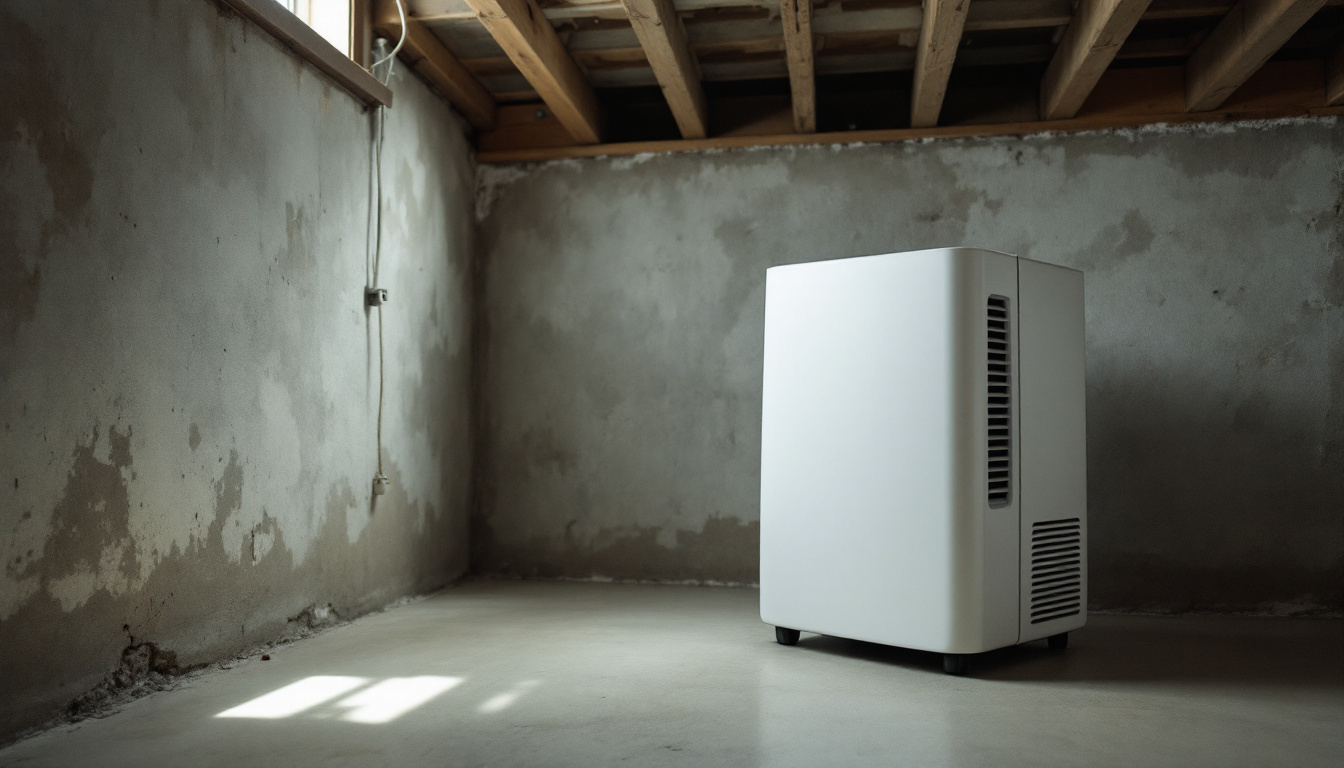
How do you size a dehumidifier and run it for less? Match the pints per day on the federal label to how damp the space is, hold humidity between 30 and 50 percent, and drain to a floor drain. The 2019 federal test changed what a pint rating means. A dehumidifier controls moisture but brings in no fresh air; the trade offs against fans and ERVs are in our basement ventilation guide.
Key Takeaways
- Portables are tested at 65 degrees F and 60 percent relative humidity under Appendix X1 to 10 CFR Part 430, not the old 80 degrees F.
- That 15 degree F drop means an old 70 pint unit now rates near 40 to 45 pints per day, per ENERGY STAR.
- The federal floor in 10 CFR 430.32(v)(2) is 1.30 liters per kWh up to 25.00 pints per day, 1.60 from 25.01 to 50.00.
- In the ENERGY STAR certified dataset, no portable is rated above 50.00 pints per day.
- Median certified portable use is 335 kWh a year, about 61 dollars at EIA‘s June 2026 average of 18.34 cents per kWh.
What size dehumidifier do I need?
Size by how wet the space is, not by floor area alone. ENERGY STAR publishes a two variable chart: dampness condition against room size. A damp room under 2,000 square feet calls for 20 to 30 pints per day, and the program says it is better to oversize than undersize. That reverses air conditioner sizing, where oversizing leaves a cold but clammy house.
| Condition without dehumidification | Under 2,000 sq ft | Over 2,000 sq ft |
|---|---|---|
| Slightly to moderately damp, musty odor, 50 to 75 percent RH | 20 to 30 pints/day | 30+ pints/day |
| Very damp, damp spots on walls and floors, 75 to 90 percent RH | 25 to 40 pints/day | 40+ pints/day |
| Wet, sweating walls or seepage, 90 to 100 percent RH | 30 to 50 pints/day | 50+ pints/day |
Source: ENERGY STAR, September 2026. Capacities are Appendix X1 ratings.
- Log relative humidity with a hygrometer over several days.
- Place that reading in the band above, then read across to your room size.
- Add a band if a dryer, sump or bare dirt floor feeds the load, and rule out mechanically introduced outdoor air before buying.
Why did dehumidifier pint ratings drop in 2019?
Because the test moved to cooler air. Table 1 to Paragraph 4.1.1 of Appendix X1 sets portable testing at 65 degrees F dry bulb and 60 percent relative humidity, with whole home units at 73 degrees F. ENERGY STAR puts it plainly: this 15 degree F reduction means a unit tested to the new procedure will likely report a smaller capacity.
| Old rating (80 F test) | New Appendix X1 rating (65 F test) |
|---|---|
| 30 pints/day | About 20 pints/day |
| 40 pints/day | About 25 pints/day |
| 50 pints/day | About 30 pints/day |
| 60 pints/day | About 35 pints/day |
| 70 pints/day | About 40 to 45 pints/day |
| 90 pints/day | About 55 pints/day |
A date is attached. Appendix X1 states that after January 22, 2024, any representation of a dehumidifier’s energy efficiency must follow that appendix.
The 70 pint unit is a rating artifact
Across the 550 certified models we pulled on September 18, 2026, the highest Appendix X1 capacity on any of the 526 portables is 50.00 pints per day. The federal standard has a band at 50.01 pints or more, and nothing certified is in it.
How efficient does a dehumidifier have to be by law?
Efficiency is regulated as Integrated Energy Factor, in liters of water removed per kWh. ENERGY STAR defines it as the ratio between capacity and the energy used in dehumidification, standby and off modes. The floor applies to units made on or after June 13, 2019.
| Product class | Federal minimum IEF, 10 CFR 430.32(v)(2) | ENERGY STAR V6.0 minimum IEF |
|---|---|---|
| Portable, 25.00 pints/day or less | 1.30 L/kWh | 1.70 L/kWh |
| Portable, 25.01 to 50.00 pints/day | 1.60 L/kWh | 2.01 L/kWh |
| Portable, 50.01 pints/day or more | 2.80 L/kWh | 3.30 L/kWh |
| Whole home, case volume 8.0 cubic feet or less | 1.77 L/kWh | 2.22 L/kWh |
| Whole home, case volume over 8.0 cubic feet | 2.41 L/kWh | 3.81 L/kWh |
The right hand column is Version 6.0 of the ENERGY STAR requirements, effective October 1, 2025. ENERGY STAR says a certified unit removes the same moisture as a similarly sized conventional one using 20 percent less energy.
One caveat belongs on any 2026 purchase. On May 16, 2025, DOE proposed a rule, docket EERE-2025-BT-STD-0013, to rescind in part the amended standards for non whole home units, returning them to the October 1, 2012 levels of 1.35 to 2.5 liters per kWh. The eCFR still showed 2019 levels in September 2026.
What does it cost to run a dehumidifier?
Multiply the model’s published annual kWh by your electricity price. Across the 526 certified portables listed in September 2026, median annual use is 335 kWh, and EIA puts the June 2026 US average residential price at 18.34 cents per kWh. Our calculation: 335 times 0.1834 equals 61.44 dollars a year.
The spread matters more than the median. Certified portables run 105 kWh to 886 kWh a year, by the same arithmetic 19 dollars to 162 dollars. Whole home units run 419 kWh to 2,808 kWh, or 77 dollars to 515 dollars, still under a season of central cooling. Use your own rate: state prices move that by more than a factor of two.
Where does a dehumidifier actually help?
Basements and closed crawl spaces, where the moisture load sits in the ground and the air is too cool for cooling equipment to help. The DOE Building America Solution Center notes that in hot humid climates the air conditioner alone may not remove enough latent heat to hold relative humidity below 60 percent.
The same guide names the usual fault in newer houses. Oversizing the cooling system causes short cycling, so the thermostat hits set point before moisture condenses on the coil. A dehumidifier patches that, it does not fix it.
In crawl spaces, seal and drain first: the Building America guide cites 2009 IRC R408.3, which already requires a drying mechanism at 1 cfm per 50 square feet or 50 cfm total. Upstairs, a steaming bathroom wants a fan that removes humidity at the source, a tight house a balanced ventilation appliance.
When is a dehumidifier the wrong tool?
When the water is liquid, when the space is too cold, or when the cooling system is the real fault. EPA is direct on the first: the key to mold control is moisture control, and wet materials dried within 24 to 48 hours will in most cases not grow mold. No appliance fixes a bad downspout.
Temperature rules out the second. ENERGY STAR warns that frost can form on the condensing coils if air temperature drops below 65 degrees F, the physics that also ices over an evaporator coil.
The third case is diagnostic. A persistent musty smell from the registers points at a wet coil or drain pan, not at room air. A dehumidifier is the mirror image of a winter humidifier, so running both at once is a controls problem.
How should you set up drainage and maintenance?
Move the water by gravity and keep the coil clean. ENERGY STAR notes that many portables accept a hose fitted to the bucket and directed into a floor drain or sump pump, so nothing needs emptying. Expect the room to feel warmer: a dehumidifier slightly warms the space as it removes moisture.
- Site the unit close to the drain or sump, so the hose stays short.
- Keep hoses clear of cords, and use a properly grounded outlet.
- Leave clearance around the cabinet unless discharge is top mounted.
- Close doors and windows, and keep the unit away from dust sources.
- Set the humidistat in the 30 to 50 percent band and let it cycle.
Portable or whole home dehumidifier: which should you buy?
Portables cover one room and plug in. Whole home units are ducted appliances, defined in 10 CFR 430.2 by that ducting rather than by size, and sit far above portables on capacity.
| Certified models, September 2026 | Portable | Whole home |
|---|---|---|
| Models listed | 526 | 24 |
| Median Appendix X1 capacity | 29.29 pints/day | 65.0 pints/day |
| Median Integrated Energy Factor | 2.01 L/kWh | 2.30 L/kWh |
| Median annual energy use | 335 kWh | 628 kWh |
| Annual energy range | 105 to 886 kWh | 419 to 2,808 kWh |
Source: ENERGY STAR certified product data, 550 models, September 18, 2026.
ENERGY STAR frames the whole home decision narrowly. These systems can be expensive, it says, but carry significant benefits for relatively well sealed homes with central air reading above 55 percent humidity consistently. If one basement room reads high, buy a portable.
A ducted unit is an installation, not a purchase. It ties into the existing duct system, so the questions you ask up front matter more than the badge.
How we researched this
Research date: September 18, 2026. Standards came from the eCFR text of 10 CFR 430.32(v), test conditions from Appendix X1 Table 1 to Paragraph 4.1.1, definitions from 430.2.
The model statistics are ours. We pulled the ENERGY STAR Certified Dehumidifiers dataset that day, 550 records, and computed medians and ranges by product type. Every dollar figure is our own calculation: annual kWh times 0.1834 dollars, the June 2026 price in EIA Electric Power Monthly Table 5.3, which EIA marks preliminary.
Excluded: retailer capacity claims and vendor sizing calculators, which mix the two rating systems; installed price surveys, because no federal series publishes dehumidifier installed cost; and Reddit, where a site restricted search returned only retail listings. No trade association or manufacturer material backs any figure. We recheck standards on any DOE change, the dataset and price twice a year.
Frequently asked questions
What humidity should I set a dehumidifier to?
EPA advises keeping indoor humidity below 60 percent, ideally between 30 and 50 percent. ENERGY STAR gives the same band and adds that in colder climates during the heating season, levels should sit at 30 to 40 percent.
Is a 50 pint dehumidifier today the same as a 50 pint unit from 2016?
No. ENERGY STAR publishes a correlation showing an old 50 pint rating maps to about 30 pints per day under the current test, because portables are now tested at 65 degrees F rather than 80. A unit labeled 50 pints today removes more water.
How much electricity does a dehumidifier use in a year?
The median across 526 ENERGY STAR certified portables listed in September 2026 is 335 kWh a year, in a range of 105 to 886 kWh. At 18.34 cents per kWh that median is near 61 dollars a year.
Can I run a dehumidifier in a cold basement or garage?
Only with a unit rated for it. ENERGY STAR warns that frost can form on the condensing coils if the air temperature drops below 65 degrees F. Below that, buy a model rated for low temperature use or one with an anti frost sensor.
Do I need a dehumidifier in a crawl space?
Only after the space is sealed and drained. The DOE Building America Solution Center cites 2009 IRC R408.3, which requires unvented crawl spaces to have a drying mechanism delivering at least 1 cfm per 50 square feet or 50 cfm total, whichever is greater.
Are the federal dehumidifier standards changing?
A proposal is open. DOE published a proposed rule on May 16, 2025, docket EERE-2025-BT-STD-0013, to rescind in part the amended standards for non whole home dehumidifiers, returning them to the October 1, 2012 levels of 1.35 to 2.5 liters per kWh. Comments closed July 15, 2025.
Sources
- eCFR. “10 CFR 430.32(v), Dehumidifiers.” https://www.ecfr.gov/current/title-10/chapter-II/subchapter-D/part-430/subpart-C/section-430.32. Accessed September 2026.
- eCFR. “Appendix X1 to Subpart B of Part 430.” https://www.ecfr.gov/current/title-10/chapter-II/subchapter-D/part-430/subpart-B/appendix-Appendix%20X1%20to%20Subpart%20B%20of%20Part%20430. Accessed September 2026.
- eCFR. “10 CFR 430.2.” https://www.ecfr.gov/current/title-10/chapter-II/subchapter-D/part-430/subpart-A/section-430.2. Accessed September 2026.
- ENERGY STAR. “Dehumidifiers.” https://www.energystar.gov/products/dehumidifiers. Accessed September 2026.
- ENERGY STAR. “Dehumidifiers Key Efficiency Criteria.” https://www.energystar.gov/products/dehumidifiers/key_efficiency_criteria. Accessed September 2026.
- ENERGY STAR. “Dehumidifier Testing and Capacity.” https://www.energystar.gov/products/dehumidifier_testing_and_capacity. Accessed September 2026.
- ENERGY STAR. “Certified Dehumidifiers dataset.” https://data.energystar.gov/resource/mgiu-hu4z.json. Accessed September 2026.
- EPA. “A Brief Guide to Mold, Moisture and Your Home.” https://www.epa.gov/mold/brief-guide-mold-moisture-and-your-home. Accessed September 2026.
- EIA. “Electric Power Monthly, Table 5.3.” https://www.eia.gov/electricity/monthly/epm_table_grapher.php?t=epmt_5_3. Accessed September 2026.
- DOE Building America. “Whole-House Dehumidification.” https://basc.pnnl.gov/resource-guides/whole-house-dehumidification. Accessed September 2026.
- DOE Building America. “Unvented, Insulated Crawlspaces.” https://basc.pnnl.gov/resource-guides/unvented-insulated-crawlspaces. Accessed September 2026.
- DOE. “Rescinding in Part the Amended Standards for Dehumidifiers.” https://www.govinfo.gov/content/pkg/FR-2025-05-16/html/2025-08558.htm. Accessed September 2026.
Leave a Reply