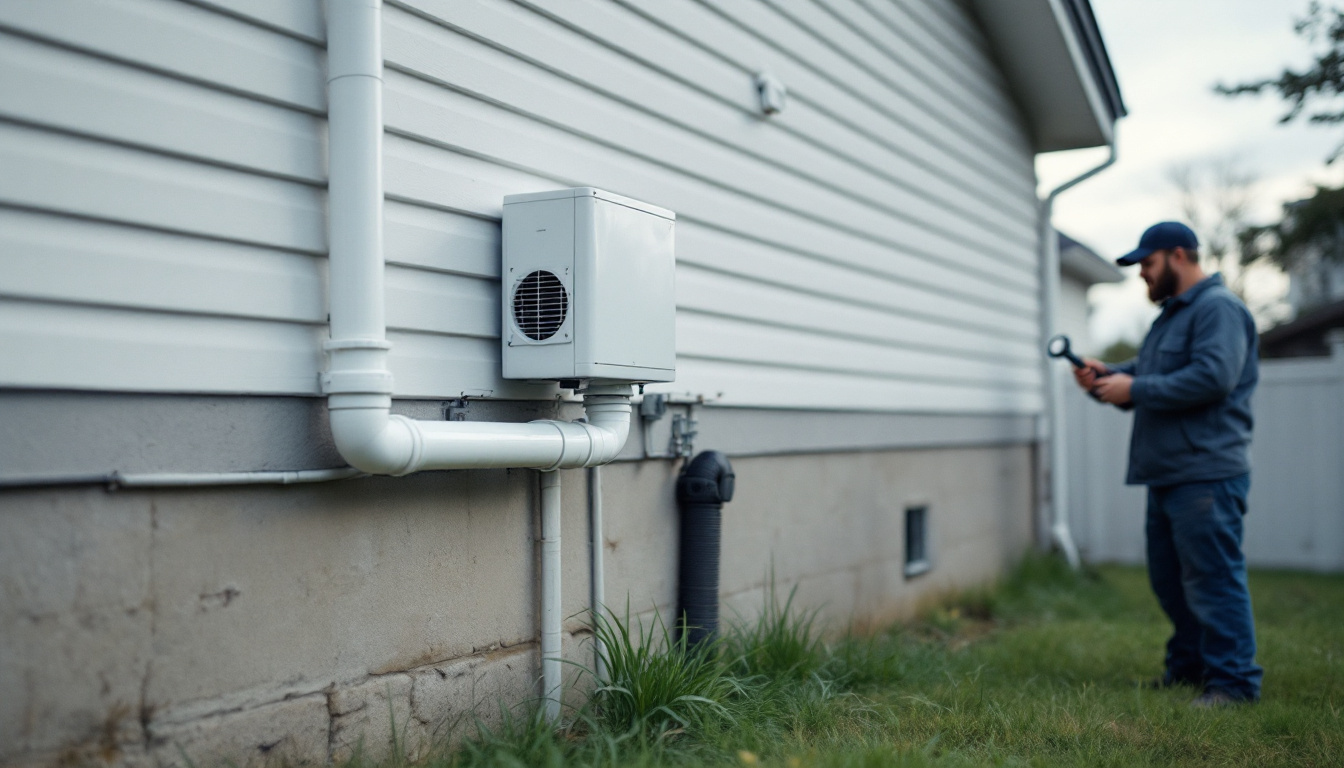
What is a radon mitigation system? A radon mitigation system is a sealed pipe, a continuously running fan and a roof vent that pull radioactive soil gas from under the foundation and discharge it outdoors, away from the living space.
Key Takeaways
- Radon causes about 21,000 US lung cancer deaths a year and is the number one cause among non-smokers (EPA).
- EPA’s action level is 4 pCi/L, and EPA says consider fixing between 2 and 4 pCi/L (A Citizen’s Guide to Radon).
- Active sub-slab suction cuts radon 50 to 99 percent, and the fan must never sit in or below a livable area (Consumer’s Guide).
- Residential radon fans have typically run 50 to 90 watts, around the clock (EPA/625/R-93/011, archived).
- EPA’s October 2025 cost model uses $1,826 to install and $206 a year to operate, in 2023 dollars (EPA).
- For existing homes EPA points to ANSI/AARST SGM-SF-2023, effective December 1, 2023 (EPA).
What is a radon mitigation system?
It is permanent building equipment with four parts: a suction point cut through the floor slab, a sealed pipe, an electric fan that never switches off, and a vent above the roof. EPA calls it a soil suction radon reduction system.
It does not clean indoor air. It changes soil pressure. EPA explains that indoor air pressure is usually lower than soil pressure around the foundation, so the house acts like a vacuum and draws radon in through cracks. It is not ventilation in the sense the trade uses the word, and will not dry a damp basement.
Why must the radon fan run all the time?
Because the exposure never stops. EPA states that radon is responsible for about 21,000 lung cancer deaths every year and is the number one cause of lung cancer among non-smokers. The Surgeon General has warned it is the second leading cause overall.
Testing comes first, always. EPA says fix the home when a long-term test reads 4 pCi/L or more, consider fixing when two short-term tests average 4 pCi/L or higher, and consider fixing between 2 and 4 pCi/L. EPA puts the average indoor level near 1.3 pCi/L and says no level of radon is safe.
How does sub-slab depressurization work?
Active sub-slab suction, or sub-slab depressurization, is what EPA calls the most common and usually the most reliable radon reduction method. Suction pipes run through the slab into the crushed rock or soil below, and a radon vent fan draws the soil gas out and releases it outdoors, creating negative pressure beneath the slab.
- Diagnostics first: EPA describes chemical smoke tests and a vacuum-cleaner soil communication test showing how easily air moves under the foundation.
- A suction point is cut through the slab, often over a dug pit. EPA found enlarging the pit extended the suction field where sub-slab communication was poor.
- Cracks, joints and the sump lid are sealed. EPA says sealing alone has not been shown to lower radon significantly or consistently, but that it makes other techniques more effective.
- Pipe runs to the fan and up to the termination, where a short, smooth run matters for the same reason static pressure decides what a blower delivers.
- A warning device is fitted and the home retested with the fan on.
| Technique | Typical radon reduction | EPA’s comment |
|---|---|---|
| Sub-slab suction (sub-slab depressurization) | 50 to 99 percent | Works best if air moves easily under the slab |
| Passive sub-slab suction | 30 to 70 percent | May suit cold climates; not as effective as active suction |
| Sub-membrane depressurization in a crawl space | 50 to 99 percent | Less heat loss than natural crawl space ventilation |
From EPA, A Consumer’s Guide to Radon Reduction.
Where does the radon fan go, and why not indoors?
EPA’s installation checklist is explicit: the exhaust fan must not be located in or below a livable area, and should be installed in unconditioned space. EPA lists the usual spots as garages, attics and the exterior of the home.
The reason is mechanical. Pipe upstream of the fan is under suction, so a leak there only pulls house air in. Pipe downstream is under positive pressure, so a leak there pushes soil gas out. Put that section in a basement and a cracked fitting discharges radon into the house the system was meant to protect. A fan in an attic makes attic intake and exhaust worth a look.
Termination follows the same logic. EPA requires exhaust pipes to vent above the roof surface and 10 feet or more above the ground, at least 10 feet from windows, doors or other openings, unless the pipe vents at least 2 feet above those openings.
The fan is not a comfort device
EPA is unambiguous: the fan should never be turned off, and must run continuously for the system to work. EPA also requires a warning device, usually a manometer, plus a post-mitigation test within 30 days of installation and no sooner than 24 hours after the fan starts. Retest every two years.
What does a radon mitigation system cost to run each year?
Two numbers answer that: the fan’s electricity, and EPA’s modeled total, which also counts conditioned air pulled out.
EPA’s technical guidance for active soil depressurization reported that the centrifugal in-line tubular fans used in residential systems typically range from approximately 50 watts with 4 inch couplings to approximately 90 watts with 6 inch couplings, and that fans as small as 29 watts have been used by some mitigators. That document dates from October 1993, so it is an equipment-class range.
The table below is our own arithmetic, not a federal figure. We multiplied each wattage by 8,760 hours and priced the result at 18.34 cents per kilowatthour, the US residential average for June 2026 in EIA’s Electric Power Monthly, Table 5.3. State rates vary widely.
| Radon fan power | Electricity per year | Cost per year at 18.34 cents per kWh |
|---|---|---|
| 29 watts (smallest EPA names) | 254 kWh | $46.59 |
| 50 watts (4 inch coupling) | 438 kWh | $80.33 |
| 90 watts (6 inch coupling) | 788 kWh | $144.59 |
The HVAC Brief calculation: watts x 8,760 hours / 1,000 x $0.1834. Wattage: EPA/625/R-93/011 (1993). Price: EIA, Table 5.3, residential, June 2026. No conditioned-air penalty.
EPA’s model is larger because it counts more than the fan. Its October 2025 benefit and cost analysis uses baseline inputs of $1,826 to install active soil depressurization, $206 a year to operate, $476 to replace the fan every 10 years and $151 for the warning device, all in 2023 dollars. They rest on 1990s cost data adjusted with the GDP price index, so they are modeling figures, not a market survey, and only a starting point in a home systems evaluation.
Which standards does EPA point to for radon mitigation?
The ANSI/AARST consensus standards. For existing single-family homes that means ANSI/AARST SGM-SF-2023, “Soil Gas Mitigation Standards for Existing Homes,” which EPA describes as specifying practices, minimum requirements and general guidance for reducing soil gas entry into existing homes. Effective December 1, 2023.
A companion standard covers testing: ANSI/AARST MAH-2023, the protocol for measuring radon in homes, before and after any work. One inconsistency is worth knowing: the consumer booklet EPA still distributes cites the older ASTM E2121.
How does a radon mitigation system affect combustion appliances?
This is where the HVAC trade has a stake. EPA warns that a contractor may have concerns about backdrafting of combustion appliances when considering radon mitigation, and may recommend a qualified inspector check them. That check is right in any house with a natural draft furnace, boiler or water heater.
The test that settles it is combustion appliance zone testing. DOE’s Building America Solution Center tells testers to run clothes dryers and exhaust fans at maximum speed, then test for spillage at the draft hood relief opening after 5 minutes of main burner operation. Your bathroom exhaust fans and a high capacity range hood create that scenario anyway, with the radon fan on top.
The stakes are carbon monoxide. CPSC reports that on average about 170 people in the United States die every year from CO produced by non-automotive consumer products. A spilling appliance is one of the few genuine reasons to leave the building and call for help.
One route overlaps with mechanical ventilation. EPA lists a heat recovery ventilator as a radon reduction technique in its own right, more effective when it ventilates only the basement, and says HRVs used for radon control should run all the time. The difference between heat recovery and energy recovery units decides what you get in a humid climate, and the combustion check belongs on the pre-heating-season list.
How we researched this
Research date: September 2026. Cited: seven EPA radon publications, among them Radon-Resistant Construction Basics and Techniques, plus EIA, DOE and CPSC. All ten appear under Sources.
Excluded: contractor and lead-generation price pages, which publish installed costs with no stated sample or dollar year, and manufacturer fan specification sheets. Reddit and user forums were not consulted at all: this is a combustion, carbon monoxide and cancer-risk topic, where anonymous anecdote has no place.
Limits: EPA’s wattage range dates from 1993 and its cost inputs are inflation-adjusted 1990s data. No federal series measures installed radon mitigation prices.
Frequently asked questions
How much electricity does a radon mitigation system use?
EPA’s technical guidance puts residential radon fans at roughly 50 to 90 watts. Run continuously, 50 watts is 438 kWh a year and 90 watts is 788 kWh. At 18.34 cents per kWh, the June 2026 US residential average, that is $80.33 and $144.59 a year. Our calculation, not a federal number.
Can I turn the radon fan off in summer?
No. EPA states the fan should never be turned off and must run continuously for the system to work correctly. EPA notes that when windows and doors opened for natural ventilation are closed again, radon concentrations most often return to previous values within about 12 hours.
How do I know the radon fan is still working?
Check the warning device. EPA requires one on every active system and lists a liquid gauge, a sound alarm, a light indicator and a dial gauge. The usual one is a manometer, a U-shaped tube of colored liquid on the pipe. Unequal columns mean suction. Level columns mean the fan stopped.
Do I have to retest after mitigation?
Yes. EPA calls for a post-mitigation radon test within 30 days of installation, but no sooner than 24 hours after the fan is running. EPA recommends a two to seven day measurement, windows and doors closed 12 hours before and during, and an independent follow-up rather than only the installer’s result.
How long does a radon fan last?
EPA states that fans may last five years or more, that manufacturer warranties tend not to exceed five years, and that the fan may then need repair or replacement. EPA’s October 2025 cost model assumes replacement every 10 years at $476 in 2023 dollars. Plan in that window and budget labor as well.
Does a passive radon system need a fan added?
Only if testing says so. EPA’s radon-resistant construction guidance calls for an electrical junction box in the attic for use with a vent fan should a stronger system be needed. A Citizen’s Guide to Radon says every new home should be tested after occupancy, and that at 4 pCi/L or more a qualified mitigator adds the fan.
Sources
- EPA. “A Citizen’s Guide to Radon.” https://www.epa.gov/sites/default/files/2016-12/documents/2016_a_citizens_guide_to_radon.pdf. Accessed September 2026.
- EPA. “A Consumer’s Guide to Radon Reduction.” https://www.epa.gov/sites/default/files/2016-12/documents/2016_consumers_guide_to_radon_reduction.pdf. Accessed September 2026.
- EPA. “Health Risk of Radon.” https://www.epa.gov/radon/health-risk-radon. Accessed September 2026.
- EPA. “Radon Standards of Practice.” https://www.epa.gov/radon/radon-standards-practice. Accessed September 2026.
- EPA. “Analysis of Benefits and Costs of Radon Reduction Strategies,” October 2025. https://www.epa.gov/system/files/documents/2025-12/analysis-of-benefits-and-costs-of-radon-508.pdf. Accessed September 2026.
- EPA. “Radon Reduction Techniques for Existing Detached Houses” (EPA/625/R-93/011), archived copy. https://archive.epa.gov/epa/sites/production/files/2019-07/documents/radon_reduction_techniques_for_existing_detached_houses-_technical_guidance_for_active_soil_depressurization_systems.pdf. Accessed September 2026.
- EPA. “Radon-Resistant Construction Basics and Techniques.” https://www.epa.gov/radon/radon-resistant-construction-basics-and-techniques. Accessed September 2026.
- EIA. “Electric Power Monthly, Table 5.3.” https://www.eia.gov/electricity/monthly/epm_table_grapher.php?t=epmt_5_3. Accessed September 2026.
- DOE Building America Solution Center. “Combustion Appliance Zone (CAZ) Testing.” https://basc.pnnl.gov/resource-guides/combustion-appliance-zone-caz-testing. Accessed September 2026.
- CPSC. “Carbon Monoxide Questions and Answers.” https://www.cpsc.gov/Safety-Education/Safety-Education-Centers/Carbon-Monoxide-Information-Center/Carbon-Monoxide-Questions-and-Answers. Accessed September 2026.
Leave a Reply