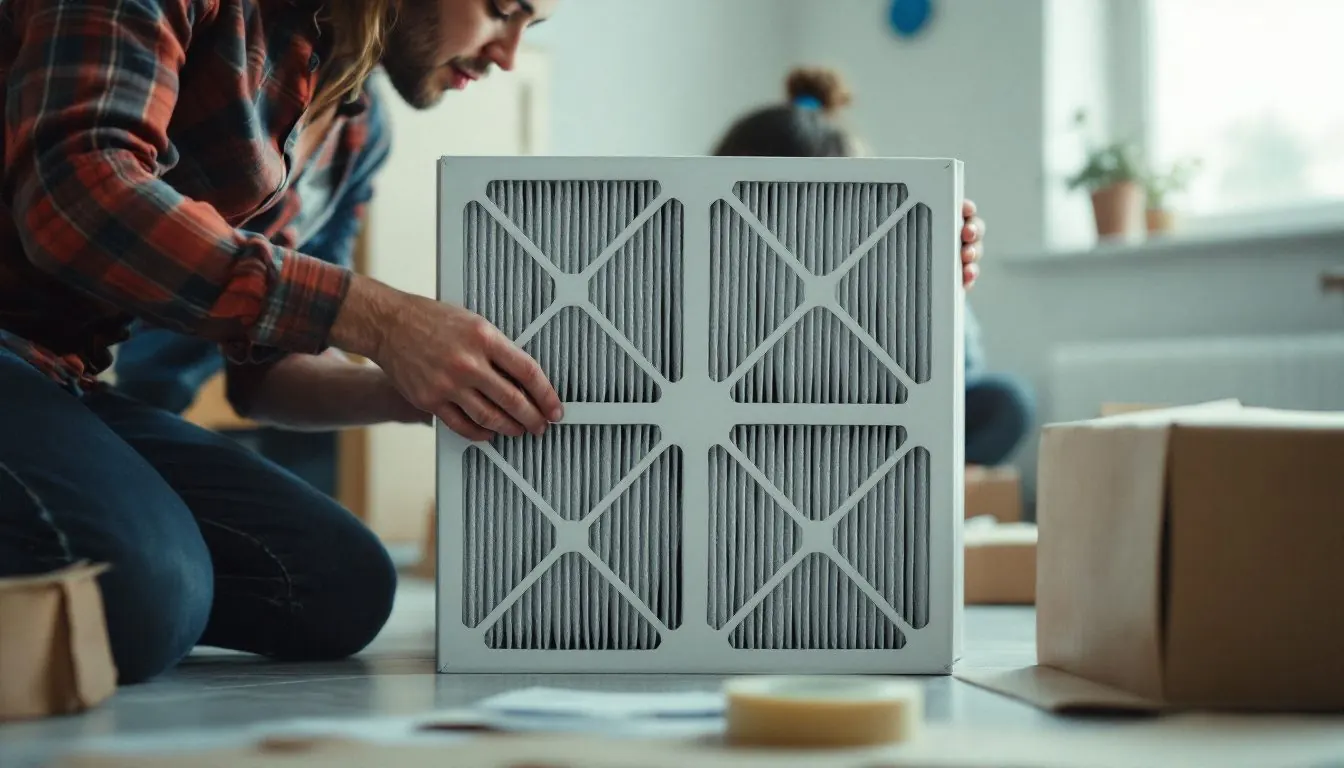
What is a Corsi Rosenthal box, and does it work? A Corsi Rosenthal box is a 20-inch box fan sealed onto a cube of four or five MERV 13 furnace filters. In EPA chamber tests the four-filter version delivered 401 CFM of clean air against wildfire smoke, more than three times a small commercial purifier.
Key Takeaways
- EPA measured a smoke CADR of 401 CFM for a four-filter CR box, against 111 CFM for a box fan with one filter (EPA).
- That is a 261% gain over the single-filter baseline, the largest of any design EPA tested (Holder et al., 2022).
- A UC Davis five-filter box measured 600 to 852 CFM for particles larger than 0.5 micron, from low to high fan speed (Dal Porto et al., 2022).
- In an EPA research chamber a CR box cut airborne infectious virus by 99.4% after 60 minutes (EPA ORD presentation).
- Underwriters Laboratories found no fire hazard in tests of five box fan models with filters attached, but EPA says to use only fans made in 2012 or later (EPA).
- Four boxes run 9 hours a day across a university campus kept at least 60% of their starting CADR after 40 weeks (Pistochini et al., 2025).
What is a Corsi-Rosenthal box, and who invented it?
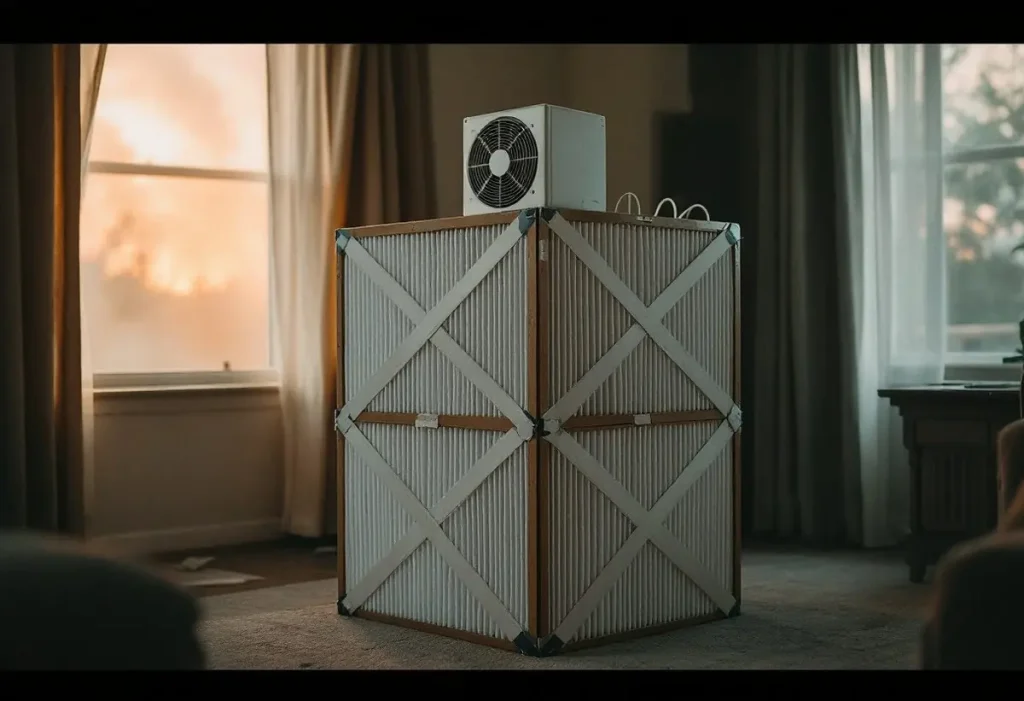
A Corsi-Rosenthal box, or CR box, is a do-it-yourself portable air cleaner: four or five pleated MERV 13 filters taped into a cube, with a box fan on top pulling room air through all of them. Spreading the airflow over several filters lowers resistance, so the fan moves far more air than it can through a single filter.
The design dates to August 2020. UC Davis researchers write in a peer-reviewed 2022 paper that it “was originally proposed by Richard Corsi on Twitter and with Jim Rosenthal making the first prototype.” Rosenthal, who runs Tex-Air Filters, described his first build on August 22, 2020: “two 16X20X2 and three 20X20X2” MERV 13 filters taped into a box.
It works like a commercial HEPA air purifier, but with cheaper, less efficient media spread over a much larger area.
Does a Corsi-Rosenthal box work? What the tests measured
Yes. Every test we reviewed put a CR box at or above the range of commercial room purifiers. The exact number depends on the fan, the filters and the test particles.
| Test | Configuration | CADR (CFM) | Power (W) | Noise |
|---|---|---|---|---|
| EPA, Holder et al. 2022 | Box fan, one 1-inch MERV 13 filter | 111 | 77 | 55 dBA at 2 ft |
| EPA, Holder et al. 2022 | CR box, four 1-inch MERV 13, shroud | 401 | 76 | 55 dBA at 2 ft |
| EPA, Holder et al. 2022 | Small commercial air cleaner, turbo | 119 | 41 | 51 dBA at 2 ft |
| Dal Porto et al. 2022 (UC Davis) | CR box, five 2-inch MERV 13, low to high | 600 to 852 | 67 to 98 | 58 to 67 dB at 5 ft |
| UC Davis WCEC 2021 | Four 20x20x2 MERV 13, shroud, $30 Lasko fan | 165 to 239 (estimated) | 70 to 102 | 53 to 61 dB at 10 ft |
| EPA ORD 2023 | Four 20x20x2 MERV 13, high speed | 234 (live virus) | Not reported | Not reported |
The spread reflects test method, not quality. EPA used simulated smoke from smoldering pine needles; Dal Porto used salt particles with a median diameter of 1.2 microns, which MERV 13 media catches more easily. UC Davis’s Western Cooling Efficiency Center did not measure particles at all; it multiplied measured airflow by the filter’s rated 54% efficiency and called the result “conservative.”
Correction: the 850 CFM figure
The widely repeated “600 to 850 CFM” comes from Dal Porto’s tests on particles larger than 0.5 micron with five 2-inch filters, not on smoke. Holder’s EPA team found that test method alone can make CADRs for the same design vary by 1.5 to 3 times across studies. For wildfire smoke, the EPA number to plan around is 401 CFM.
How do you build a Corsi Rosenthal box?
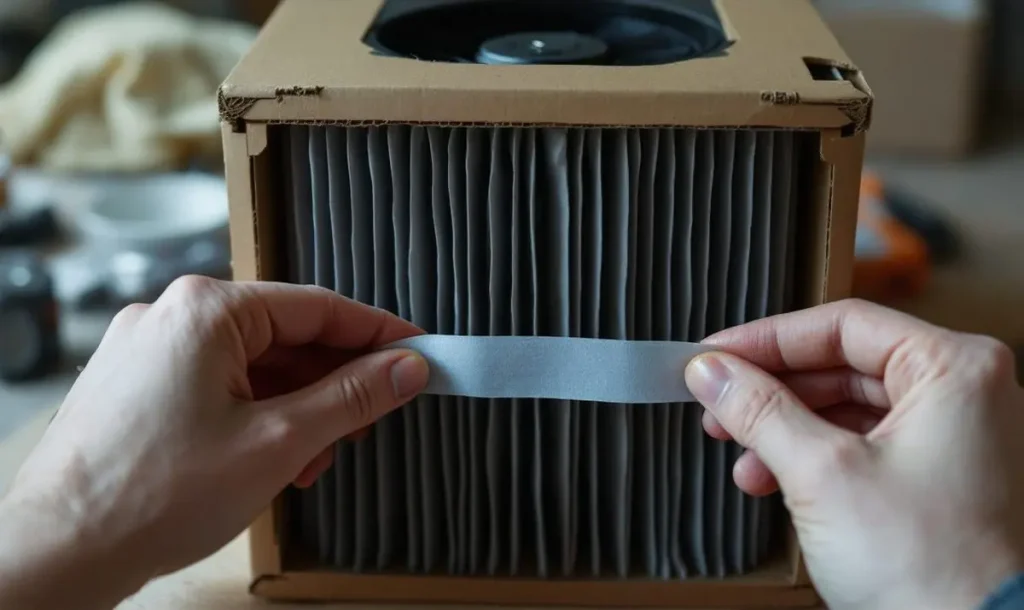
You need a 20-inch box fan, four 20×20 MERV 13 filters, duct tape and a sheet of cardboard; UC Davis built one for $74.48 in 2021, using a $30 fan and filters at $11.12 each. EPA’s guidance and the published test builds agree on the steps below.
- Buy a box fan made in 2012 or later with a UL or ETL safety mark.
- Buy four 20×20 MERV 13 filters, matching the fan face.
- Stand the filters on edge in a square, airflow arrows pointing into the cube, and tape every seam.
- Tape cardboard over the bottom so air enters only through the filters.
- Set the fan on top, blowing up and away, and tape it on with no gaps.
- Tape a cardboard shroud over the outlet corners, with a round hole the diameter of the blades.
- Date the filters and point the exhaust up or sideways, never at the floor.
The free shroud matters: EPA found it alone raised CADR by 40% by stopping air recirculating around the blade tips. With the fan pointed at the floor, Dal Porto’s box fell from 600 to 481 CFM on low. Filter choice matters too: our guide to why MERV ratings and filter area interact explains the tradeoff.
How big a room can a Corsi-Rosenthal box clean?
One four-filter CR box can serve a room of about 600 square feet with 8-foot ceilings, on EPA’s sizing table. EPA’s Guide to Air Cleaners in the Home lists a minimum CADR of 390 CFM for a 600 square foot room, and the CR box measured 401 CFM on smoke.
Worked example: a 12 by 15 foot bedroom with an 8-foot ceiling holds 1,440 cubic feet, so 401 CFM times 60 divided by 1,440 gives about 16.7 clean air changes per hour; our air changes per hour formula walks through the same steps. For a classroom, Dal Porto notes that an 8,000 cubic foot room needs 400 CFM of CADR to reach three air changes per hour.
Is a Corsi-Rosenthal box safe to run?
With a newer fan, the testing says yes. EPA had Underwriters Laboratories run five box fan models with clean, smoke-loaded and dust-loaded filters, including a seven-hour test with both sides of the fan blocked, and “None of the filter/fan test scenarios caught fire.”
The limits: EPA recommends against DIY cleaners built on fans made before 2012 and says older fans should not run unattended or while people sleep. EPA also says not to use an extension cord and to keep working smoke detectors throughout the home.
The box removes particles only. It does nothing for gases, and EPA’s guide says a cleaner needs activated carbon or another sorbent to filter gases, which matters for VOCs from paints and furnishings. Never add an ozone generator to the setup to chase odors.
How does a Corsi-Rosenthal box compare with a HEPA purifier?
It delivers more clean air per dollar and per watt, but it is louder and bulkier. At April 2022 retail prices EPA’s CR box cost $73.59 to build and the small commercial unit $123.05.
Dal Porto’s team put the DIY box at “approximately one-tenth the initial cost” of the HEPA units it tested per unit of air cleaned, and at 8.9 CFM per watt on low speed, “three times more efficient than the Energy Star standard.” Multiply the monthly kWh by your state’s electricity rate to estimate running cost.
Noise is the real tradeoff. Dal Porto measured 58 dB on low and 67 dB on high at 5 feet, against 54 dB for the smaller HEPA unit; see how decibel ratings stack. UC Davis suggests low speed during class and high at lunch.
How often should you change Corsi-Rosenthal box filters?
It depends on the air. During smoke events EPA says to check filters daily and change them when they turn dark brown or gray or smell of smoke. In ordinary use, a 2025 UC Davis study found boxes kept at least 60% of their starting CADR after 40 weeks of 9-hour days.
Smoke loads filters fast. In Holder’s tests a smoke-loaded 1-inch filter cut a single-filter fan’s CADR from 111 to 4.31 CFM. Pistochini’s team traced the slower, long-term decline to “a loss of filter electrostatic charge over time,” not clogging. The same rules for changing furnace and HVAC filters apply: date them and keep spares.
A box can trim household dust too, though it will not fix the causes of indoor dust. To see whether a box is working in your room, a low-cost particle monitor is enough: Dal Porto found a low-cost sensor gave CADR results “generally similar” to research instruments.
How we researched this
On October 31, 2026 we read four EPA documents, the Holder, Dal Porto and Pistochini papers, the UC Davis WCEC case study, the EPA ORD slides and Jim Rosenthal’s 2020 post; 13 sources opened, 10 cited. None of the top-ranking pages put smoke CADR, power and noise side by side. Excluded: a preprint with estimated CADRs, a filter-seller blog, social media shroud tests and news price ranges. Reddit was skipped (electrical and fire safety topic). The EPA ORD slides did not undergo formal quality assurance review.
Frequently asked questions
Does a Corsi-Rosenthal box remove wildfire smoke?
Yes, the particle part. EPA measured a four-filter box at 401 CFM against simulated wildfire smoke. EPA still notes on its wildfire page that commercial air cleaners with a known CADR are typically preferred, and that filters may need changing daily during heavy smoke.
Can I use 1-inch filters instead of 2-inch filters?
Yes. EPA’s 401 CFM result used four 1-inch MERV 13 filters. Deeper media helps: a single 4-inch MERV 13 filter raised a box fan’s smoke CADR by 123% over a single 1-inch filter in the same EPA study.
Can I use MERV 8 or MERV 11 filters?
You can, but you lose performance. In EPA’s tests a single 1-inch MERV 11 filter gave 63.6 CFM of smoke CADR, against 111 CFM for MERV 13 on the same fan. EPA recommends MERV 13 to catch the very small particles in smoke.
Is it safe to run a Corsi-Rosenthal box overnight?
EPA’s UL testing found no fire hazard with newer fans, so use one made in 2012 or later with a UL or ETL mark. EPA says fans made before 2012 should not run unattended or while people sleep. Skip extension cords and keep working smoke detectors in the home.
Does a Corsi-Rosenthal box remove odors or VOCs?
No. MERV 13 filters capture particles, not gases. EPA’s Guide to Air Cleaners in the Home says removing gases takes an activated carbon or other sorbent filter, so smoke odor can linger after the particles drop.
Does a Corsi-Rosenthal box remove viruses?
It removes airborne particles that carry them. In EPA’s 3,000 cubic foot chamber a CR box cut infectious MS2 virus in the air by 97% at 30 minutes and 99.4% at 60 minutes. UC Davis advises wearing a mask and gloves when changing used filters and bagging them.
Sources
- US EPA. “Research on DIY Air Cleaners to Reduce Wildfire Smoke Indoors.” https://www.epa.gov/air-research/research-diy-air-cleaners-reduce-wildfire-smoke-indoors. Accessed October 2026.
- Holder, Halliday and Virtaranta, Indoor Air. “Impact of do-it-yourself air cleaner design on the reduction of simulated wildfire smoke in a controlled chamber environment.” https://pmc.ncbi.nlm.nih.gov/articles/PMC9828579/. Accessed October 2026.
- Dal Porto, Kunz, Pistochini, Corsi and Cappa, Aerosol Science and Technology. “Characterizing the performance of a do-it-yourself (DIY) box fan air filter.” https://indoorairquality.initiative.uconn.edu/wp-content/uploads/sites/3533/2023/02/Characterizing-the-performance-of-a-do-it-yourself-DIY-box-fan-air-filter.pdf. Accessed October 2026.
- UC Davis Western Cooling Efficiency Center. “Testing Different Configurations of Do-It-Yourself Portable Air Cleaners.” https://energy.ucdavis.edu/wp-content/uploads/Case-Study_DIY-Portable-Air-Cleaners-083121.pdf. Accessed October 2026.
- US EPA Office of Research and Development (Ratliff). “EPA ORD’s Corsi-Rosenthal Box Bioaerosol Testing Results.” https://today.uconn.edu/wp-content/uploads/2023/10/EPA-ORD-CR-Box-Bioaerosol-Results-embargoed-10-30-23-11am-est.pdf. Accessed October 2026.
- Pistochini, Jaeger, Cappa and Corsi, Environmental Science: Processes and Impacts. “Longevity of size-dependent particle removal performance of do-it-yourself box fan air filters.” https://pubmed.ncbi.nlm.nih.gov/39465609/. Accessed October 2026.
- US EPA. “Air Cleaners, HVAC Filters, and Coronavirus (COVID-19).” https://www.epa.gov/indoor-air-quality-iaq/air-cleaners-hvac-filters-and-coronavirus-covid-19. Accessed October 2026.
- US EPA. “Wildfires and Indoor Air Quality (IAQ).” https://www.epa.gov/emergencies-iaq/wildfires-and-indoor-air-quality-iaq. Accessed October 2026.
- US EPA. “Guide to Air Cleaners in the Home, 2nd edition.” https://www.epa.gov/sites/default/files/2018-07/documents/guide_to_air_cleaners_in_the_home_2nd_edition.pdf. Accessed October 2026.
- Tex-Air Filters (Jim Rosenthal). “A Variation on the ‘Box Fan with MERV 13 Filter’ Air Cleaner.” https://www.texairfilters.com/a-variation-on-the-box-fan-with-merv-13-filter-air-cleaner/. Accessed October 2026.
Leave a Reply