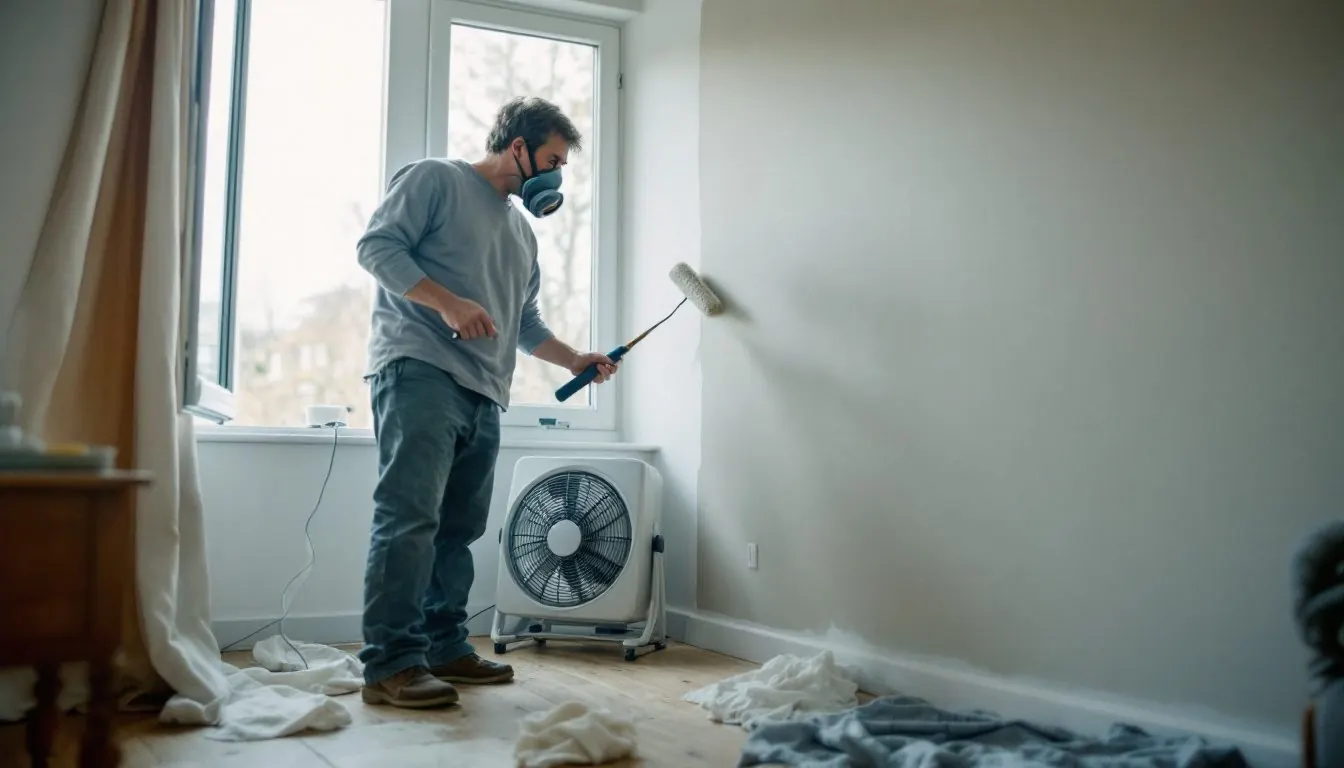
What are volatile organic compounds? Volatile organic compounds (VOCs) are carbon-based chemicals that evaporate at room temperature from paints, cleaners, furnishings, fuels and gas stoves. EPA found about a dozen common ones 2 to 5 times higher inside homes than outside, and no federal standard limits them in home air.
Key Takeaways
- EPA’s TEAM study, completed in 1985, found about a dozen common organic pollutants 2 to 5 times higher inside homes than outside (EPA).
- During and for several hours after paint stripping, EPA says levels may reach 1,000 times background outdoor levels (EPA).
- The federal smog definition, 40 CFR 51.100(s), exempts methylene chloride and perchloroethylene, which EPA warns about indoors (eCFR).
- ATSDR’s draft chronic screening level for benzene in air is 0.002 ppm, 500 times below OSHA’s 1 ppm workplace limit (ATSDR).
- Benzene turned up in 99% of 185 unburned natural gas samples from 159 California stoves (Lebel et al., 2022).
- To remove VOCs, EPA says a portable air cleaner needs an activated carbon or other gas filter; CADR ratings cover particles only (EPA guide).
What are volatile organic compounds?
Volatile organic compounds are carbon-containing chemicals that evaporate under normal indoor temperatures and pressures. EPA’s technical overview says that for indoor air, volatility is the only test: no other criteria are used to define VOCs indoors.
The European Union draws its line at an initial boiling point of 250 °C (482 °F) or less. EPA also reprints a World Health Organization scheme that sorts indoor organics into three bands by boiling point.
| WHO class | Boiling point range | Examples EPA lists |
|---|---|---|
| Very volatile organic compounds (VVOC) | Below 0 up to 50 to 100 °C | Propane, butane, methyl chloride |
| Volatile organic compounds (VOC) | 50 to 100 up to 240 to 260 °C | Formaldehyde, d-limonene, toluene, acetone, ethanol, hexanal |
| Semi-volatile organic compounds (SVOC) | 240 to 260 up to 380 to 400 °C | Pesticides, phthalate plasticizers, PCBs |
Why does the legal definition of volatile organic compounds leave out paint stripper?
Because the federal definition was written to control smog, not indoor exposure. 40 CFR 51.100(s) counts only carbon compounds that participate in atmospheric photochemical reactions, and it exempts a long list judged to have negligible photochemical reactivity.
That list includes methane, acetone, methylene chloride and perchloroethylene. Methylene chloride (paint stripper) and perchloroethylene (dry cleaning fluid) are exempt outdoors, yet EPA says they “could pose serious health risks” indoors.
Correction: “low VOC” can mean the outdoor definition
EPA says many manufacturers and certifiers apply the outdoor regulatory definition indoors. For indoor air, EPA says ALL organic compounds able to evaporate under normal conditions should count. Read the hazard section, not only the front label.
Where do volatile organic compounds come from in a home?
From thousands of products. EPA’s VOC page lists paints, strippers and solvents, wood preservatives, aerosol sprays, cleansers, air fresheners, stored fuels, hobby supplies, dry-cleaned clothing and pesticides.
Building materials, furnishings, printers and glues add more, and products emit even while stored. For benzene, a known human carcinogen, EPA names tobacco smoke, stored fuels, paint supplies and car exhaust in attached garages as the main indoor sources, which is why sealing and venting an attached garage matters.
Combustion and fuel gas add more. In a peer-reviewed study, Lebel and colleagues analyzed 185 unburned gas samples from 159 California stoves and detected benzene in 99% of samples. Leakage from stoves and ovens while off could push indoor benzene above California’s 8-hour reference level of 0.94 ppbv.
How much higher are VOC levels indoors than outdoors?
Typically 2 to 5 times higher, and far more during some tasks. EPA’s Total Exposure Assessment Methodology (TEAM) study, completed in 1985, found about a dozen common organic pollutants 2 to 5 times higher inside homes than outside, whether the homes were rural or in highly industrial areas.
The same page says many VOCs run “up to ten times higher” indoors, an upper bound, and up to 1,000 times background outdoor levels during and after paint stripping. The TEAM data are four decades old; EPA cites no newer national survey.
New homes run highest. A 2012 Lawrence Berkeley National Laboratory (LBNL) briefing, drawing on a 108-home California study, reported formaldehyde is highest in new homes and decreases with age. Our sick building syndrome evidence review covers building-wide complaints.
What are the health effects of volatile organic compounds?
It depends on the chemical, the dose and the duration. EPA lists eye, nose and throat irritation; headaches, loss of coordination and nausea; and damage to the liver, kidney and central nervous system. Some organics are suspected or known to cause cancer in humans.
EPA names benzene a known human carcinogen and says methylene chloride is converted to carbon monoxide in the body. EPA is candid about the gap: “At present, not much is known about what health effects occur from the levels of organics usually found in homes.”
EPA adds that indoor VOCs react with ozone, even below public health standards, to form sub-micron particles and harmful byproducts, one more reason an ozone generator sold as an air cleaner is the wrong tool for odors.
Which volatile organic compounds have exposure limits?
No federal limit applies to VOCs in home air: EPA states “No federally enforceable standards have been set for VOCs in non-industrial settings.” What exists are OSHA workplace limits, ATSDR screening levels and EPA product standards.
| Compound | Value | Type | Agency and citation |
|---|---|---|---|
| Benzene | 1 ppm, 8-hour average | Workplace legal limit | OSHA, 29 CFR 1910.1028 |
| Benzene | 0.002 ppm, chronic (draft) | Health screening level | ATSDR MRL, 10/2024 |
| Formaldehyde | 0.75 ppm (750 ppb), 8-hour average | Workplace legal limit | OSHA, 29 CFR 1910.1048 |
| Formaldehyde | 0.04 ppm acute; 0.008 ppm (8 ppb) chronic | Health screening level | ATSDR MRL, 07/1999 |
| Tetrachloroethylene | 0.006 ppm, chronic | Health screening level | ATSDR MRL, 06/2019 |
| Hardwood plywood panels | 0.05 ppm formaldehyde | Product emission standard | EPA, 40 CFR 770.10 |
| Particleboard; MDF; thin MDF | 0.09 ppm; 0.11 ppm; 0.13 ppm | Product emission standard | EPA, 40 CFR 770.10 |
ATSDR defines an MRL as an estimate of daily exposure “likely to be without appreciable risk of adverse noncancer health effects,” and chronic means 1 year or longer. By our arithmetic, OSHA’s benzene limit is 500 times the draft chronic MRL and its formaldehyde limit about 94 times. Workplace limits are not home targets.
The composite wood limits in 40 CFR 770.10 apply to panels and finished goods sold in the US on or after June 1, 2018, and LBNL notes they were based on California’s 2007 Air Toxic Control Measure.
Formaldehyde values span a 100-fold range, from OSHA’s 750 ppb to 7.5 ppb. LBNL’s 2012 compilation: 400 ppb (US HUD, 8-hour), 100 ppb (Germany), 80 ppb (WHO and Japan, 30-minute), 40 ppb (Canada), 27 ppb (California ARB), 16 ppb (US NIOSH) and 7.5 ppb (California OEHHA, chronic). It puts the odor threshold at about 800 ppb, so smell is no guide.
Can a TVOC sensor tell you whether your air is safe?
Not reliably. Consumer monitors use metal oxide (MOX) sensors that react to many gases at once and report a TVOC “equivalent.” Sensor maker Sensirion says that output may deviate from the true value by a factor of two (minus 50 to plus 100 percent) or more.
Sensirion’s own note concludes that current MOX sensors “can only work as semiquantitative VOC indicators, not as true tVOC detectors.” Treat a reading as a trend, as our indoor air quality monitor accuracy review explains.
EPA calls formaldehyde “one of the few indoor air pollutants that can be readily measured,” so test it by itself. Unlike carbon dioxide readings, a TVOC figure does not map to a ventilation rate.

How do you reduce volatile organic compounds at home?
Control the source first, then ventilate, then filter with carbon. EPA’s steps include removing the source where possible and buying only what you will use right away.
- Remove and store less. EPA says to throw away partially full containers of old chemicals safely, because gases can leak even from closed containers.
- Buy low-emitting materials. Composite wood must meet the 40 CFR 770.10 limits. A 2019 meta-analysis by Holøs and colleagues found that low-emitting materials or a bake-out before occupancy both have a significant impact on TVOC emission rates.
- Ventilate during and after the job. EPA says to go outdoors, use an exhaust fan or open windows. Our guides to what ventilation really means and to ERV and HRV systems cover the equipment.
- Run the hood with the burners. Gas stoves add benzene and formaldehyde, so run a ducted range hood vented outside whenever the burners are on.
- Ventilate a new house harder. LBNL found more ventilation can reduce near-term formaldehyde concentrations. Holøs et al. found ventilation controls concentrations but does not noticeably change emission rates. Size it with air changes per hour.
- Filter gases with carbon, not HEPA alone. EPA says activated carbon works with a large amount of material, “the thicker the better,” and research has not shown plasma, photocatalytic oxidation or UV remove gases effectively. Our air purifier evidence review covers sizing.
How we researched this
Researched October 31, 2026. We opened 21 sources and cite 13: EPA pages updated in 2026, eCFR regulation text (October 1, 2026 versions), ATSDR’s October 2026 MRL list, two peer-reviewed papers, LBNL slides and a Sensirion note. Purifier and sensor maker blogs were excluded for numbers. California OEHHA’s site blocked our fetch, so OEHHA values appear only as quoted by LBNL and Lebel. Reddit was skipped because this is a health topic.
Frequently asked questions
Are VOCs harmful at normal household levels?
Nobody knows precisely. EPA says not much is known about health effects at the levels usually found in homes, and effects depend on the chemical, dose and duration. Single compounds are better understood: EPA calls benzene a known human carcinogen, and ATSDR’s chronic screening level for formaldehyde is 0.008 ppm.
What is a safe TVOC level?
There is no federal one. EPA says no federally enforceable standards exist for VOCs in non-industrial settings. Consumer sensors report an equivalent that Sensirion says can be off by a factor of two or more, so compare single compounds with ATSDR screening levels.
Do HEPA air purifiers remove VOCs?
No. HEPA filters capture particles, and EPA’s air cleaner guide says the CADR rating is for particles only. For VOCs, EPA advises an activated carbon or other gas filter, which can work when the filter holds a large amount of material.
How long do new homes and furniture off-gas VOCs?
There is no single number. A 2019 meta-analysis by Holøs and colleagues found TVOC emission rates follow a multi-exponential decay after a building is completed. LBNL reported formaldehyde is highest in new homes and decreases with age, and that more ventilation lowers near-term concentrations.
Do gas stoves emit VOCs?
Yes. EPA lists unvented fuel-burning appliances such as gas stoves as a formaldehyde source. Lebel and colleagues found benzene in 99% of 185 unburned gas samples from California stoves, and leaks while off could push indoor benzene above California’s 0.94 ppbv 8-hour reference level.
Is acetone a VOC?
Indoors, yes; legally, no. Acetone evaporates easily, and EPA’s technical overview lists it as a VOC for indoor air. But 40 CFR 51.100(s) exempts acetone from the federal smog definition for negligible photochemical reactivity, so a product can be labeled low VOC and still emit it.
Sources
- US EPA. “Volatile Organic Compounds’ Impact on Indoor Air Quality.” https://www.epa.gov/indoor-air-quality-iaq/volatile-organic-compounds-impact-indoor-air-quality. Accessed October 2026.
- US EPA. “Technical Overview of Volatile Organic Compounds.” https://www.epa.gov/indoor-air-quality-iaq/technical-overview-volatile-organic-compounds. Accessed October 2026.
- US EPA. “40 CFR 51.100 Definitions.” https://www.ecfr.gov/current/title-40/section-51.100. Accessed October 2026.
- US EPA. “40 CFR 770.10 Formaldehyde emission standards.” https://www.ecfr.gov/current/title-40/section-770.10. Accessed October 2026.
- US OSHA. “29 CFR 1910.1028 Benzene.” https://www.ecfr.gov/current/title-29/section-1910.1028. Accessed October 2026.
- US OSHA. “29 CFR 1910.1048 Formaldehyde.” https://www.ecfr.gov/current/title-29/section-1910.1048. Accessed October 2026.
- ATSDR. “Minimal Risk Levels (MRLs), October 2026.” https://wwwn.cdc.gov/TSP/MRLS/mrlsListing.aspx. Accessed October 2026.
- US EPA. “Facts About Formaldehyde.” https://www.epa.gov/formaldehyde/facts-about-formaldehyde. Accessed October 2026.
- US EPA. “Guide to Air Cleaners in the Home.” https://www.epa.gov/sites/default/files/2018-07/documents/guide_to_air_cleaners_in_the_home_2nd_edition.pdf. Accessed October 2026.
- Lebel, E.D. et al. “Hazardous Air Pollutants in Unburned Natural Gas from Residential Stoves in California.” Environ. Sci. Technol., 2022. https://escholarship.org/uc/item/3fp9c0qx. Accessed October 2026.
- Singer, B.C. and Willem, H., LBNL. “Formaldehyde in New Homes.” 2012. https://www.energy.gov/sites/default/files/2013/12/f6/formaldehyde_new_homes.pdf. Accessed October 2026.
- Holøs, S.B. et al. “VOC emission rates in newly built and renovated buildings.” Int. J. Ventilation, 2019. https://doi.org/10.1080/14733315.2018.1435026. Accessed October 2026.
- Sensirion AG. “Is it possible to map the output of a MOX sensor to a norm?” https://asset.conrad.com/media10/add/160267/c1/-/en/003533329DS06/podatkovna-tablica-3533329-sensirion-3000384-sgp40-d-r4-1-st.pdf. Accessed October 2026.
Leave a Reply