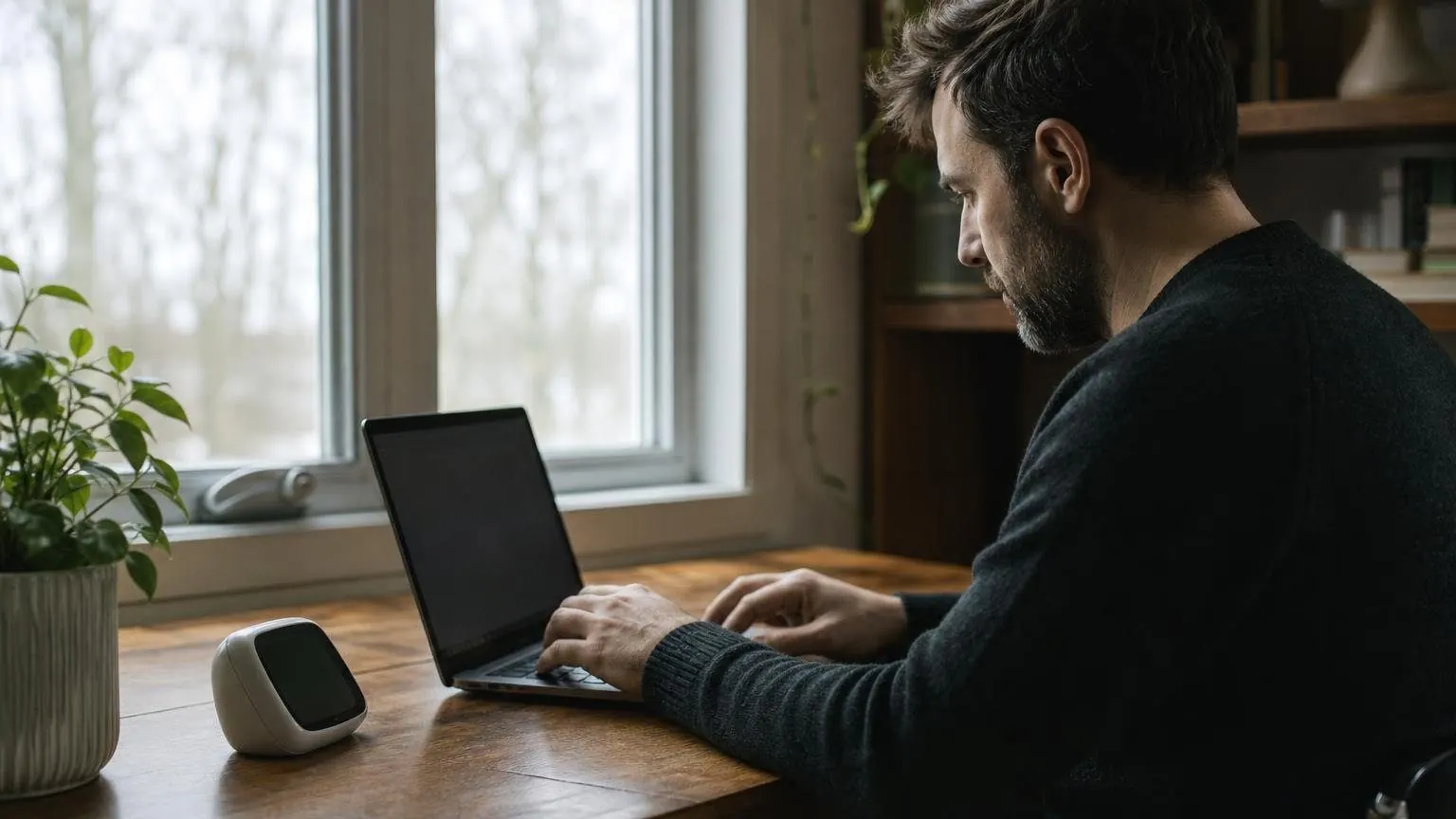
What are safe indoor CO2 levels? Indoor CO2 levels start at the outdoor baseline, about 426 ppm in 2025, and the US workplace limit is 5,000 ppm over 8 hours. The familiar 1,000 ppm figure is a ventilation marker, not a toxic threshold.
Key Takeaways
- Outdoor air averaged 425.62 ppm CO2 worldwide in 2025, per NOAA’s global annual mean.
- OSHA’s Table Z-1 sets the workplace limit at 5,000 ppm as an 8-hour average (29 CFR 1910.1000).
- NIOSH adds a 30,000 ppm 15-minute limit and lists 40,000 ppm as immediately dangerous to life or health.
- Health Canada’s residential guideline is 1,000 ppm averaged over 24 hours.
- ASHRAE’s 2022 position document says Standard 62.1 sets no CO2 limit; the 1,000 ppm limit in the 1989 edition was later removed.
- The thinking studies split: Satish (2012) and Allen (2016) found effects; Zhang (2017) and Rodeheffer (2018) found none.
What are normal indoor CO2 levels?
Normal indoor CO2 levels run from the outdoor baseline to about 1,000 ppm in an office ventilated to Standard 62.1, and above 2,500 ppm in a full conference room, per ASHRAE. People are the main source: Health Canada names breathing first, then smoking and unvented fuel-burning appliances, and it advises cooking under a range hood vented outdoors.
The floor keeps rising. NOAA’s Global Monitoring Laboratory puts the 2025 global annual mean at 425.62 ppm, measured at marine surface sites. ASHRAE’s 2022 position document notes outdoor air passed 400 ppm in 2013, and that air in some urban spots can run hundreds of ppm higher, approaching or exceeding 600 ppm.
| CO2 level | What it means | Source |
|---|---|---|
| 425.62 ppm | Global outdoor annual mean, 2025 | NOAA GML |
| About 1,000 ppm | Steady state at Standard 62.1 rates in offices and classrooms with younger students | ASHRAE, 2022 |
| 1,000 ppm, 24 hours | Canada’s long-term residential exposure limit | Health Canada, 2021 |
| 1,500 to 2,000 ppm | Steady state at 62.1 rates in restaurants, lecture classrooms and retail | ASHRAE, 2022 |
| Above 2,500 ppm | Steady state at 62.1 rates in conference rooms and auditoriums | ASHRAE, 2022 |
| 5,000 ppm, 8 hours | OSHA permissible exposure limit and NIOSH REL | 29 CFR 1910.1000; NIOSH |
| 30,000 ppm, 15 minutes | NIOSH short-term exposure limit | NIOSH Pocket Guide |
| 40,000 ppm | Immediately dangerous to life or health (IDLH) | NIOSH Pocket Guide |
Notice that a conference room run exactly to code can sit above 2,500 ppm. A high reading tells you about ventilation per person, which our explainer on what ventilation does in an HVAC system covers in depth.

What indoor CO2 level is safe, and where are the legal limits?
For workers, the US limit is 5,000 ppm averaged over an 8-hour shift. OSHA’s Table Z-1 lists carbon dioxide at 5,000 ppm (9,000 mg/m³), and the NIOSH Pocket Guide gives the same 8-hour figure plus a 30,000 ppm short-term limit.
No US federal rule caps CO2 in homes. ASHRAE notes that national indoor limits elsewhere “tend to be on the order of 1000 ppmv but range as high as about 1500 ppmv,” and Health Canada’s guideline is 1,000 ppm on a 24-hour average. ASHRAE also calls CO2 “nontoxic at concentrations up to 5000 ppmv.”
Does ASHRAE set a 1,000 ppm CO2 limit?
No. ASHRAE’s 2022 position document states that Standard 62.1 “does not provide a limit value for indoor CO2.” The 1989 edition had a 1,000 ppm limit, removed from later editions “due to its common misinterpretation.”
Myth check: “ASHRAE says keep CO2 under 1,000 ppm”
The position document (archived copy) says misreading older editions continues “to lead many to incorrectly attribute a 1000 ppmv limit to ASHRAE.” Its own reading: 1,000 ppm corresponds to about 16 cfm of outdoor air per person, a number rooted in body odor perception. The idea dates to Pettenkofer, who proposed 1,000 ppm as a ventilation marker in the nineteenth century.
The document’s lead position is blunt: indoor CO2 “does not provide an overall indication of IAQ.” Formaldehyde, particles and other pollutants from materials or outdoor air do not track occupancy, so a low reading does not clear a room. To size airflow itself, use our air changes per hour method.
Do indoor CO2 levels affect thinking?
Maybe, at levels common indoors, but the evidence conflicts. ASHRAE’s review counts five studies reporting lower cognitive scores near 1,000 ppm, one equivocal, and others showing no effect. It concludes the evidence “is inconsistent” and does not yet justify changing ventilation standards.
| Study | Who and what dose | Finding |
|---|---|---|
| Satish et al. 2012 (LBNL) | 22 participants; 600, 1,000 and 2,500 ppm pure CO2 | Six of nine scales down at 1,000 ppm; seven down at 2,500 ppm |
| Allen et al. 2016 (Harvard) | 24 office workers, 6 full work days; VOCs, ventilation and added CO2 varied | Scores 61% higher on the Green day and 101% higher on Green+ days |
| Zhang et al. 2017 (DTU) | 25 subjects, 255 minutes per condition; pure CO2 vs bioeffluents | Pure CO2: no significant effects. Bioeffluents at 3,000 ppm: worse air ratings and some slower tasks |
| Rodeheffer et al. 2018 (US Navy) | 36 submarine-qualified sailors; 600, 2,500 or 15,000 ppm | No significant differences on any of nine decision measures |
Satish’s team called for confirmation of its own findings. Allen’s study changed ventilation and VOCs as well as CO2, so its headline gain is not a pure CO2 effect.
The replications cut the other way. Zhang and colleagues concluded that “moderate concentrations of bioeffluents, but not pure CO2” cause the problems. The Navy study could not reproduce the decision-making drop at more than ten times the earlier doses. The practical reading: a stuffy room is a ventilation problem, whatever the mechanism. Stuffy air paired with headaches and irritation that ease once people leave the building is the pattern known as sick building syndrome.
Is CO2 the same as carbon monoxide?
No. Carbon dioxide (CO2) is what people exhale; carbon monoxide (CO) is a toxic gas from burning fuel in furnaces, generators and vehicles. OSHA’s Table Z-1 shows the gap: 5,000 ppm for CO2 against 50 ppm for carbon monoxide, a limit one hundred times lower.
A CO2 monitor is a ventilation gauge, not a life-safety alarm. In many jurisdictions, homes with fuel-burning appliances or an attached garage must have CO alarms; see our guide to where to install carbon monoxide detectors.
How do you measure indoor CO2 levels accurately?
Use a monitor with a nondispersive infrared (NDIR) sensor, place it where people breathe, and check it against outdoor air. ASHRAE’s position document says sensor “accuracy, location, and calibration are all critical” for drawing conclusions from a reading. Many consumer indoor air quality monitors pair an NDIR carbon dioxide sensor with particle and VOC readings of very uneven accuracy.
Field accuracy is the weak point. An LBNL pilot study tested 44 sensors in nine California commercial buildings, all nondispersive infrared, and found errors that “were sometimes hundreds of parts per million.” Some models correct drift by assuming the lowest reading equals a reference value such as 400 ppm.
A practical routine that follows from those two points:
- Set the monitor at seated head height, away from windows, supply registers and anyone’s face.
- Take it outdoors for a few minutes; it should read close to the outdoor mean.
- Log a full night in the bedroom and a full evening in the living room.
- Compare rooms and times, not single spikes.
How do you lower high CO2 levels at home?
Bring in more outdoor air per person. ASHRAE says CO2 can be removed only by sorption-type air cleaners, which “will not necessarily improve overall IAQ,” so filters and UV and purifier add-ons will not lower it.
- Open bedroom doors at night, or crack a window when weather allows.
- Run bath and kitchen exhaust fans while those rooms are in use.
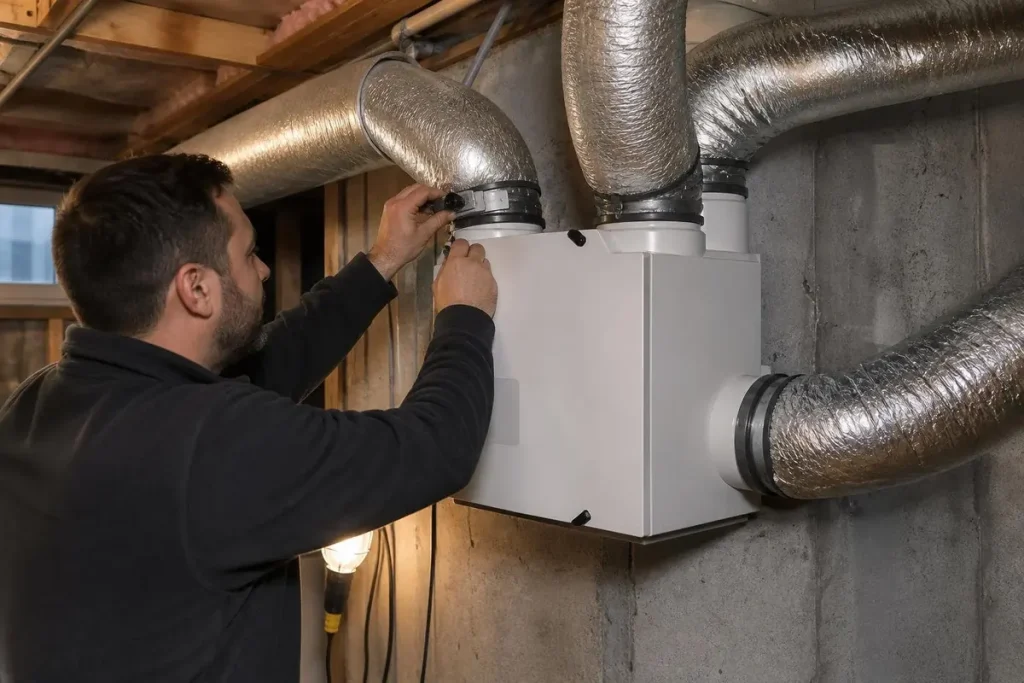
- Add balanced mechanical ventilation that supplies outdoor air and recovers heat.
- Check how tight the house is before buying equipment.
Our guide to ventilating with windows covers when step one works, and the bath fan sizing guide covers step two.
For step three, compare an ERV or HRV. For step four, a blower door test shows how much air a house trades on its own.
Commercial buildings often run demand-controlled ventilation, which ASHRAE notes is required by energy standards such as Standard 90.1. A dedicated outdoor air system is one way to deliver it.
How we researched this
Researched October 28 to 29, 2026. We reviewed the top-ranking pages for “indoor co2 levels” and traced every number to OSHA’s eCFR text, the NIOSH Pocket Guide, NOAA GML data, ASHRAE’s 2022 position document (archived copy; its cover lists a February 2025 expiry and ASHRAE’s own link returned a 404 when we checked), Health Canada, LBNL, and four papers read on PubMed or PMC. Excluded: vendor ppm charts that cite no source, and Reddit. No testing was done by us.
Frequently asked questions
What is a safe CO2 level indoors?
For workers, OSHA’s limit is 5,000 ppm averaged over 8 hours. For homes there is no US limit; Health Canada’s guideline is 1,000 ppm averaged over 24 hours. Readings above 1,000 ppm mainly signal that the room gets little outdoor air per person.
How do you know if your room has too much CO2?
Measure it. A nondispersive infrared monitor at head height, logged through a night, shows the pattern. Rooms ventilated to ASHRAE 62.1 rates can sit near 1,000 ppm in offices and above 2,500 ppm in conference rooms, per ASHRAE’s 2022 position document.
When should you worry about carbon dioxide levels?
Worry about danger near federal limits: NIOSH lists 30,000 ppm as a 15-minute limit and 40,000 ppm as immediately dangerous to life or health. ASHRAE’s steady-state examples for occupied rooms top out above 2,500 ppm. Everyday readings of 1,000 to 2,500 ppm are a ventilation question.
Is 2,000 ppm CO2 bad in a bedroom?
It is well under OSHA’s 5,000 ppm limit but twice Health Canada’s 1,000 ppm 24-hour guideline. It means the bedroom gets little outdoor air for its occupants. An open door, a cracked window or balanced mechanical ventilation usually brings it down.
Does a CO2 monitor detect carbon monoxide?
No. CO2 and carbon monoxide are different gases with very different limits: OSHA allows 5,000 ppm of CO2 but 50 ppm of carbon monoxide over 8 hours. Homes with fuel-burning appliances need dedicated CO alarms installed to code.
Why is my outdoor CO2 reading above 400 ppm?
Because the atmosphere is above 400 ppm. NOAA’s 2025 global annual mean was 425.62 ppm, and ASHRAE notes air in some urban locations can run hundreds of ppm higher. Use your own outdoor reading as the baseline when judging indoor numbers.
Sources
- NOAA Global Monitoring Laboratory. “Global annual mean CO2 (co2_annmean_gl.txt).” https://gml.noaa.gov/webdata/ccgg/trends/co2/co2_annmean_gl.txt. Accessed October 2026.
- OSHA. “29 CFR 1910.1000, Table Z-1.” https://www.ecfr.gov/current/title-29/subtitle-B/chapter-XVII/part-1910/subpart-Z/section-1910.1000. Accessed October 2026.
- NIOSH. “Pocket Guide to Chemical Hazards: Carbon dioxide.” https://www.cdc.gov/niosh/npg/npgd0103.html. Accessed October 2026.
- ASHRAE. “Position Document on Indoor Carbon Dioxide” (2022, archived copy). https://web.archive.org/web/2024id_/https://www.ashrae.org/file%20library/about/position%20documents/pd_indoorcarbondioxide_2022.pdf. Accessed October 2026.
- Health Canada. “Carbon dioxide in your home.” https://www.canada.ca/en/health-canada/services/publications/healthy-living/carbon-dioxide-home.html. Accessed October 2026.
- Satish U. et al. “Is CO2 an Indoor Pollutant?” Environmental Health Perspectives, 2012. https://pmc.ncbi.nlm.nih.gov/articles/PMC3548274/. Accessed October 2026.
- Allen J.G. et al. “Associations of Cognitive Function Scores with Carbon Dioxide, Ventilation, and Volatile Organic Compound Exposures in Office Workers.” Environmental Health Perspectives, 2016. https://pmc.ncbi.nlm.nih.gov/articles/PMC4892924/. Accessed October 2026.
- Zhang X. et al. “Effects of exposure to carbon dioxide and bioeffluents.” Indoor Air, 2017. https://pubmed.ncbi.nlm.nih.gov/26825447/. Accessed October 2026.
- Rodeheffer C.D. et al. “Acute Exposure to Low-to-Moderate Carbon Dioxide Levels and Submariner Decision Making.” Aerospace Medicine and Human Performance, 2018. https://pubmed.ncbi.nlm.nih.gov/29789085/. Accessed October 2026.
- Fisk W.J., Faulkner D., Sullivan D.P. “A Pilot Study of the Accuracy of CO2 Sensors in Commercial Buildings.” LBNL, 2007. https://escholarship.org/uc/item/78t0t90v. Accessed October 2026.
Leave a Reply