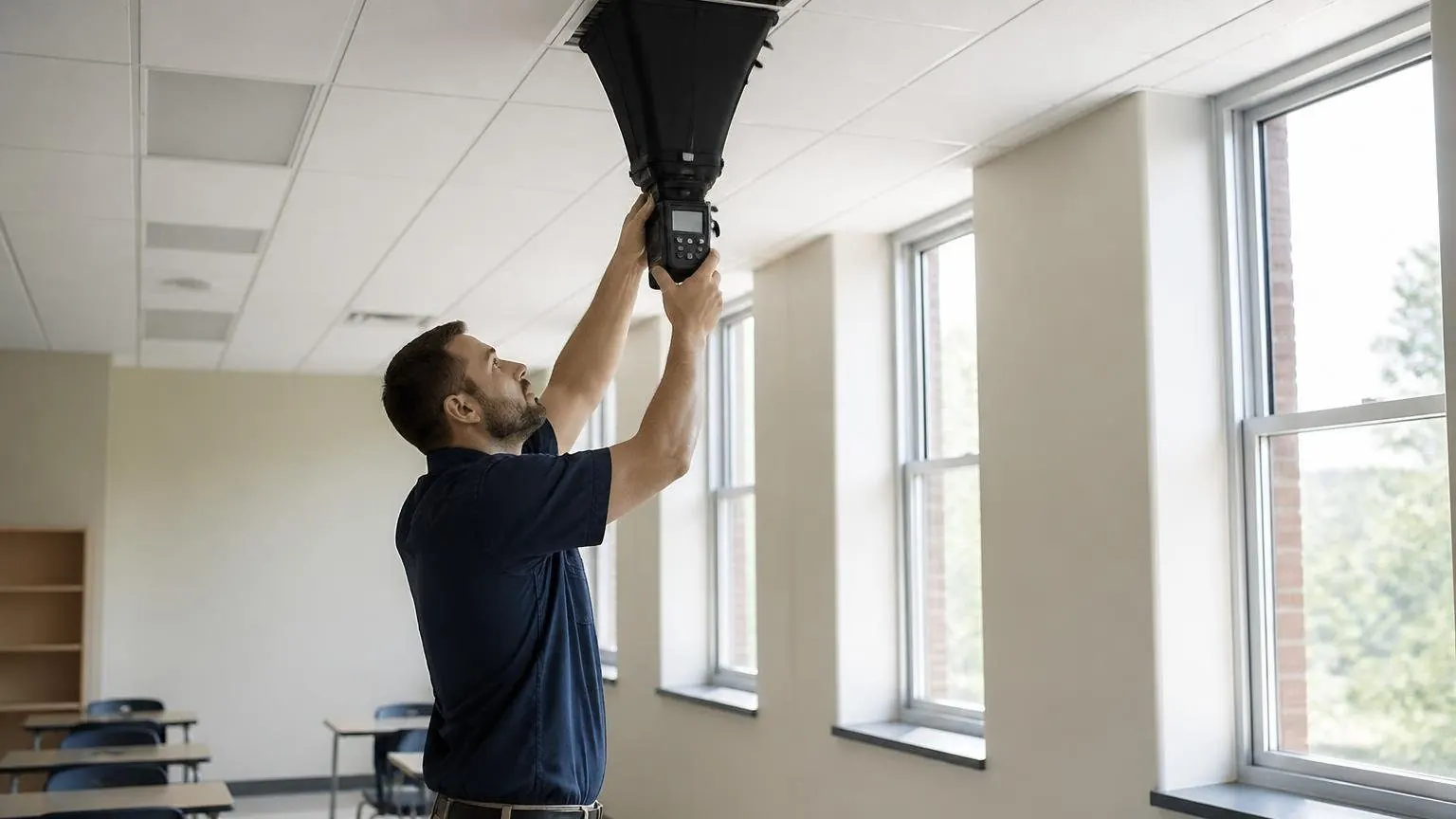
What are air changes per hour? Air changes per hour (ACH) is how many times a room’s full volume of air is supplied or exhausted in one hour: ACH = CFM × 60 ÷ room volume in cubic feet. CDC’s NIOSH suggests aiming for 5 or more ACH of clean air.
Key Takeaways
- ACH = CFM × 60 ÷ room volume, the method CDC’s NIOSH uses for its 5 ACH goal.
- NIOSH says ventilation ACH and filtration “equivalent” ACH (eACH) can be added together and compared with that goal.
- ASHRAE 62.2 sizes home ventilation as 0.03 × floor area + 7.5 × (bedrooms + 1) CFM, per a DOE Building America profile, not as a flat 0.35 ACH.
- In CDC’s Table B.1, removing 99% of airborne contaminants takes 138 minutes at 2 ACH and 23 minutes at 12 ACH, assuming perfect mixing.
- CDC’s Table B.2 lists 12 ACH for airborne infection isolation rooms and 15 ACH for operating rooms (2001 AIA values).
- ACH50 is a blower door leakage number: 2012 code section R402.4.1.2 caps it at 3 ACH50 in Climate Zones 3 through 8, as reprinted by Pima County.
What does air changes per hour mean?
Air changes per hour counts how many room volumes of air move through a space in an hour. NIOSH defines one air change as supplying or exhausting an amount of air equal to all the air in the space, using “the larger of the two values but do not add them together.”
ACH is a rate, not a guarantee of fresh air: outdoor air, filtered recirculated air and purifiers all count. For the bigger picture, see our explainer on what ventilation actually does in an HVAC system.
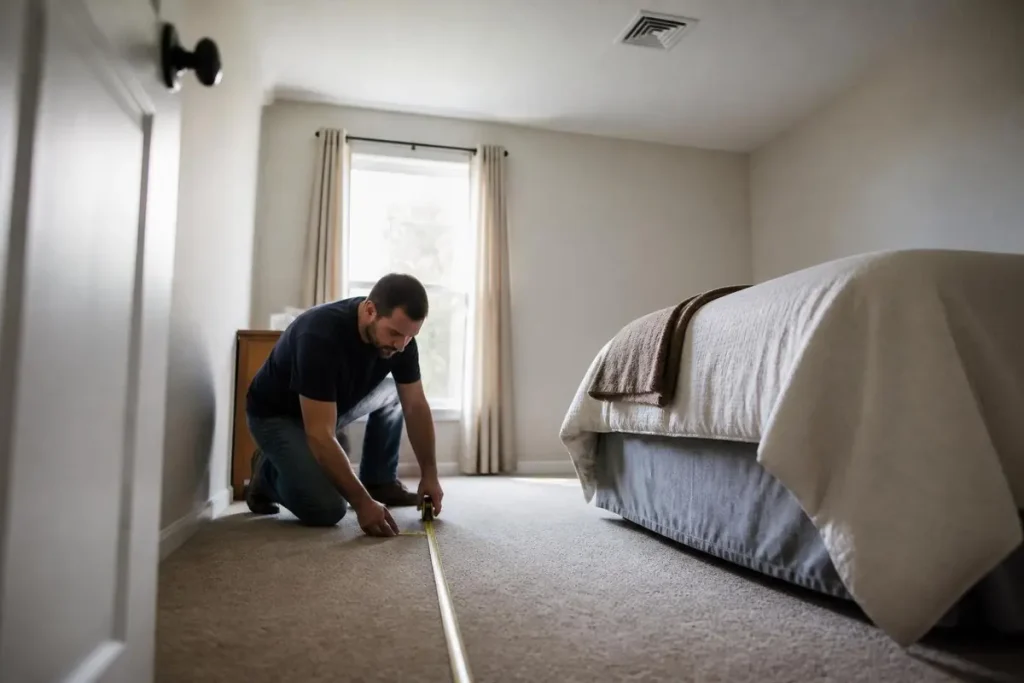
How do you calculate air changes per hour?
Multiply airflow in cubic feet per minute by 60, then divide by room volume in cubic feet. NIOSH publishes the same method on its “How Much Ventilation Is Enough?” page.
- Measure length, width and ceiling height in feet.
- Multiply them to get volume in cubic feet.
- Find the airflow in CFM (fan rating or measured flow).
- Multiply CFM by 60 to get cubic feet per hour.
- Divide by the volume. With several systems, add each result.
| Worked example | Volume | Airflow | Math | Result |
|---|---|---|---|---|
| Bedroom, 12 × 15 ft, 8 ft ceiling | 1,440 cu ft | 120 CFM | 120 × 60 = 7,200; 7,200 ÷ 1,440 | 5.0 ACH |
| Classroom, 900 sq ft, 10 ft ceiling | 9,000 cu ft | 300 CFM | 300 × 60 = 18,000; 18,000 ÷ 9,000 | 2.0 ACH |
| House, 2,000 sq ft, 8 ft ceilings, 3 bedrooms | 16,000 cu ft | 90 CFM | 90 × 60 = 5,400; 5,400 ÷ 16,000 | 0.34 ACH |
The house row uses the ASHRAE 62.2 rate worked out below. All three assume evenly mixed air.
How much airflow do you need for a target ACH?
Flip the formula: CFM = target ACH × room volume ÷ 60. To bring that 9,000 cu ft classroom to 5 ACH, you need 5 × 9,000 ÷ 60 = 750 CFM of clean air from all sources combined. Schools short of purifiers have added clean air with a DIY box fan filter built from furnace filters and tape.
With 300 CFM already supplied, a purifier or added ventilation must cover the other 450 CFM. Open windows also count, though natural ventilation varies with wind and temperature. AC airflow is a separate question; see our guide to airflow per ton of cooling.
What is a good air changes per hour rate for a home?
For whole-house ventilation, ASHRAE 62.2 sets a CFM rate, not an ACH number. DOE’s Building America program reprints the 62.2 equation as Qfan = 0.03Afloor + 7.5 (BR + 1), where floor area stands in for material sources and bedrooms stand in for people.
For the 2,000 sq ft, 3-bedroom house: 0.03 × 2,000 = 60, plus 7.5 × (3 + 1) = 30, for 90 CFM, or 0.34 ACH with 8 ft ceilings. A 3,000 sq ft, 4-bedroom house with 9 ft ceilings needs 0.03 × 3,000 + 7.5 × 5 = 127.5 CFM, which is 127.5 × 60 ÷ 27,000 = 0.28 ACH. These are fan rates before the standard’s infiltration credit.
The PNNL Building America Solution Center notes that 62.2-2010 used 0.01A and that editions from 2013 through 2019 use 0.03A. Under 0.01A, the 2,000 sq ft house needed 50 CFM, or 0.19 ACH. Our ERV and HRV guide covers the equipment that delivers this air.
Myth check: “ASHRAE says 0.35 ACH”
EPA’s indoor air FAQ still says ASHRAE 62.2-2016 recommends “0.35 air changes per hour but not less than 15 cfm per person.” The equation DOE reprints does not produce a fixed ACH: our examples give 0.34 and 0.28, so 0.35 ACH over-ventilates a big house against 62.2 and can shortchange a small one.
Kitchens and baths are handled separately as local exhaust. The DOE profile lists 100 cfm on demand or 5 ACH continuous for kitchens, and 50 cfm on demand or 20 cfm continuous for a full bath. See our bathroom fan sizing guide and range hood airflow guide.
What ACH do health and hospital standards set?
NIOSH recommends 5 or more ACH of clean air where possible, and CDC’s infection control guideline lists 6 to 15 total ACH for the patient care rooms below. Oregon’s hospital rule asks 20 for a general surgery operating room. Isolation rooms for airborne infections add a pressure rule, and a negative pressure room keeps air flowing in from the corridor rather than out.
| Space or test | Requirement | Source |
|---|---|---|
| Whole dwelling (ASHRAE 62.2) | 0.03 × floor area + 7.5 × (bedrooms + 1) CFM | DOE Building America, 2014 |
| Kitchen exhaust (ASHRAE 62.2) | 100 cfm on demand or 5 ACH continuous | DOE Building America, 2014 |
| Occupied rooms (guidance) | 5 or more ACH of clean air | CDC NIOSH |
| Hospital patient room | 6 total ACH, 2 outdoor | CDC Table B.2 (AIA 2001) |
| Airborne infection isolation room | 12 total ACH, 2 outdoor, air moves in | CDC Table B.2 (AIA 2001) |
| Protective environment room | 12 total ACH, 2 outdoor, air moves out | CDC Table B.2 (AIA 2001) |
| Operating room | 15 total ACH, 3 outdoor | CDC Table B.2 (AIA 2001) |
| Operating room, general surgery | 20 total ACH, 4 outdoor | Oregon OAR 333-535-0300, Table 2 |
CDC notes its Table B.2 is Table 7.2 of the 2001 AIA guidelines. New hospital projects follow the state-adopted edition of ASHRAE 170 and the FGI guidelines; see the Oregon table for one example. Workplace contaminant exhaust is covered in our industrial ventilation explainer.
How fast do more air changes per hour clear the air?
More air changes per hour purge airborne contaminants faster. CDC’s Table B.1 shows 99% removal taking 138 minutes at 2 ACH, 69 at 4, and 23 at 12, in an empty room with perfectly mixed air.
| ACH | Minutes for 99% removal | Minutes for 99.9% removal |
|---|---|---|
| 2 | 138 | 207 |
| 4 | 69 | 104 |
| 6 | 46 | 69 |
| 8 | 35 | 52 |
| 10 | 28 | 41 |
| 12 | 23 | 35 |
| 15 | 18 | 28 |
| 20 | 14 | 21 |
| 50 | 6 | 8 |
CDC’s footnote says the values “apply to an empty room with no aerosol-generating source” and assume perfect mixing; removal takes longer where air stagnates. The table skips 5 ACH; plugging 5 into CDC’s own formula, t = ln(C1/C2) ÷ ACH × 60, gives about 55 minutes for 99% and 83 minutes for 99.9%.
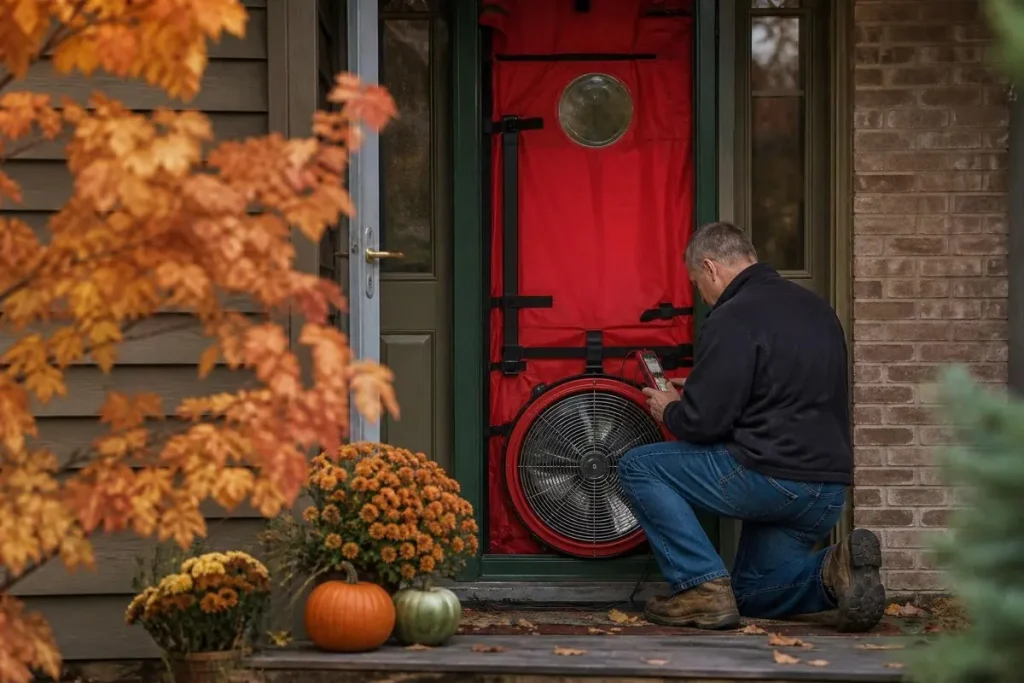
What does ACH50 mean on a blower door test?
ACH50 is not ventilation. It is air leakage measured while a blower door holds the house at 50 pascals, which exaggerates leaks for comparison.
Section R402.4.1.2 of the 2012 energy code, as reprinted by Pima County, Arizona, caps leakage at 5 ACH50 in Climate Zones 1 and 2 and 3 ACH50 in Climate Zones 3 through 8. DOE’s Building America profile says the 2009 IECC allowed 7 ACH50 and the Passive House program sets 0.6 ACH50. The Building America Solution Center says the IRC now requires 5 ACH50 or less in all climate zones, so the limit depends on the edition your jurisdiction adopted.
The math is unchanged. A blower door reading of 1,600 CFM50 in a 16,000 cu ft house is 1,600 × 60 ÷ 16,000 = 6.0 ACH50; passing a 3 ACH50 limit would take 3 × 16,000 ÷ 60 = 800 CFM50 or less. Our blower door and energy audit guide explains the test.
How many air changes per hour should an air purifier give?
A purifier sized by EPA’s rule delivers about 5 equivalent air changes per hour in a room with an 8 ft ceiling. EPA’s cleaner air room factsheet says to choose a tobacco smoke CADR “at least two-thirds of the room area in square feet.”
The math: CADR = 2/3 × floor area and volume = 8 × floor area, so eACH = 60 × (2/3) ÷ 8 = 5. An ASHRAE Journal article hosted by EPA confirms AHAM ratings assume a ceiling “no higher than 8 ft.” NIOSH notes that eACH depends on the contaminant, and a particle filter does not remove gases such as carbon dioxide; see our review of indoor CO2 levels. Central filtration can count too, as our HVAC filter guide explains.
How we researched this
Researched October 28, 2026. We reviewed the top-ranking pages for “air changes per hour” and traced every number to CDC, NIOSH, EPA, DOE, PNNL, a county code page or an Oregon rule; nine sources are cited. Excluded: vendor ACH tables naming no standard, a vendor claim that ASHRAE recommends 6 ACH for classrooms (no ASHRAE source found), and Reddit. ASHRAE text is paywalled, so its figures come from DOE and state reprints. Worked examples are our arithmetic.
Frequently asked questions
What does 4 air changes per hour mean?
It means airflow equal to four times the room’s volume moves through it each hour. In a 1,440 cu ft bedroom that is 96 CFM. CDC’s Table B.1 says 4 ACH removes 99% of airborne contaminants in 69 minutes, in an empty room with perfect mixing.
How many CFM gives 5 air changes per hour in a 12 by 12 room?
With an 8 ft ceiling the room holds 12 × 12 × 8 = 1,152 cu ft, so you need 5 × 1,152 ÷ 60 = 96 CFM of clean air. NIOSH says ventilation and purifier airflow can be added toward that 5 ACH goal.
Is ACH50 the same as air changes per hour?
No. ACH50 is leakage measured with a blower door holding the house at 50 pascals, while ACH describes ventilation under normal conditions. Section R402.4.1.2 of the 2012 energy code caps leakage at 3 ACH50 in Climate Zones 3 through 8 and 5 ACH50 in Zones 1 and 2.
Does ASHRAE 62.2 require 0.35 air changes per hour?
Not as written in recent editions. DOE’s Building America profile reprints the 62.2 rate as 0.03 × floor area + 7.5 × (bedrooms + 1) CFM. EPA’s FAQ still cites 0.35 ACH, but the formula gives 0.34 ACH for one 2,000 sq ft house and 0.28 for a larger one.
How many air changes per hour does a hospital isolation room need?
CDC’s Table B.2 lists 12 total ACH for an airborne infection isolation room, including 2 outdoor air changes, with air moving into the room. The table reproduces 2001 AIA guidelines; new projects follow the state-adopted ASHRAE 170 and FGI editions.
Is a higher air changes per hour rate always better?
Not always. NIOSH says a warehouse with few occupants may not need 5 ACH, while crowded or higher-risk spaces may need more. It says the benefits of more ventilation should be weighed against the upfront, maintenance and energy costs that may be incurred.
Sources
- CDC NIOSH. “How Much Ventilation Is Enough?” https://www.cdc.gov/niosh/ventilation/prevention/Aim-for-5.html. Accessed October 2026.
- CDC. “Appendix B. Air,” Guidelines for Environmental Infection Control in Health-Care Facilities. https://www.cdc.gov/infection-control/hcp/environmental-control/appendix-b-air.html. Accessed October 2026.
- EPA. “How much ventilation do I need in my home to improve indoor air quality?” https://www.epa.gov/indoor-air-quality-iaq/how-much-ventilation-do-i-need-my-home-improve-indoor-air-quality. Accessed October 2026.
- DOE Building America. “ASHRAE Standard 62.2,” Top Innovations 2014 profile. https://www.energy.gov/sites/prod/files/2014/12/f19/ba_innovations_2014_ASHRAE%2062_2.pdf. Accessed October 2026.
- PNNL Building America Solution Center. “Whole-House Ventilation Strategies for New Homes.” https://basc.pnnl.gov/resource-guides/whole-house-ventilation-strategies-new-homes. Accessed October 2026.
- Pima County, Arizona. “Residential Energy Testing.” https://www.pima.gov/1058/Residential-Energy-Testing. Accessed October 2026.
- Oregon Health Authority. “Table 2 (OAR 333-535-0300), Ventilation Requirements for Hospital Areas Affecting Patient Care.” https://www.oregon.gov/oha/PH/PROVIDERPARTNERRESOURCES/HEALTHCAREPROVIDERSFACILITIES/FACILITIESPLANNINGSAFETY/Documents/OARPermanentRulesHospitalTable2.pdf. Accessed October 2026.
- EPA. “Steps to Create a Cleaner Air Room at Home.” https://www.epa.gov/system/files/documents/2026-06/cleaner-air-room-factsheet.pdf. Accessed October 2026.
- Harriman, Stephens and Brennan. “New Guidance for Residential Air Cleaners,” ASHRAE Journal, September 2019 (EPA-hosted copy). https://www.epa.gov/sites/default/files/2019-09/documents/harriman_stephens_brennan_-_new_guidance_for_residential_air_cleaners_-_ashrae_journal_sept-2019._web_version.pdf. Accessed October 2026.
Leave a Reply