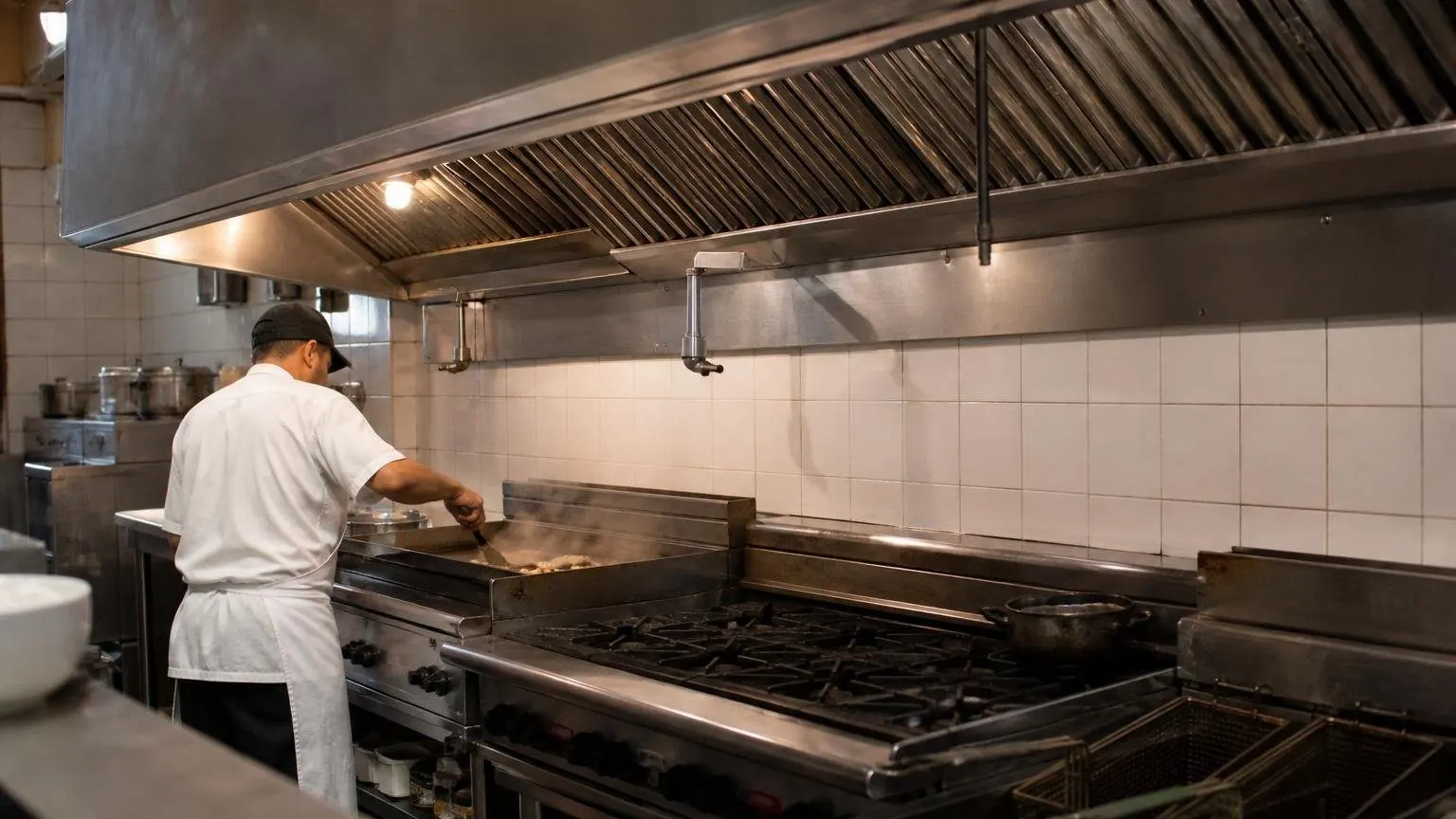
What is a commercial kitchen hood? A commercial kitchen hood is the code-required canopy that captures cooking effluent: a Type I hood for grease and smoke, with fire suppression and a welded grease duct, or a Type II hood for heat and steam. Seattle’s 2021 code sets exhaust minimums of 200 to 700 cfm per linear foot.
Key Takeaways
- Type I hoods go wherever appliances “produce grease or smoke” (2021 Seattle Mechanical Code 507.2).
- Unlisted wall-mounted canopies need at least 200 cfm per linear foot over light-duty cooking and 550 over solid fuel (SMC 507.5).
- Above 2,000 cfm of total hood exhaust, Washington caps listed hoods, for example at 280 cfm per foot on a heavy-duty wall canopy (WAC 51-11C-40377).
- Seattle requires makeup air of not less than 90 percent of exhaust, never through doors or windows (SMC 508.1).
- Grease duct: 0.0575 inch (No. 16 gage) steel, continuous liquid-tight welds, at least 500 feet per minute (SMC 506.3).
- Inspection runs from 1 month for solid fuel to 12 months for low-volume kitchens (2021 Seattle Fire Code Table 606.3.3.1).
What is a commercial kitchen hood, and how do Type I and Type II differ?
A commercial kitchen hood is an exhaust intake that must “capture and confine cooking vapors and residues” (2021 SMC 507.1). The 2021 Seattle Mechanical Code adopts the 2021 International Mechanical Code (IMC) with local amendments and recognizes two kinds.
Its Chapter 2 definitions call a Type I hood one “for collecting and removing grease vapors and smoke” that is “equipped with a fire suppression system.” A Type II hood removes “steam, vapor, heat, odors and products of combustion.” Home units follow different rules; see our range hood ventilation guide.
Once a Type I hood goes in, SMC 507.1 says “the entire system, including the hood, ducts, exhaust equipment and makeup air system” must meet Sections 506 through 509. Type I hood steel is 0.0466 inch (No. 18 gage); Type II steel is 0.0296 inch (No. 22 gage).
Duty class sets the exhaust rate:
- Light duty: ovens up to 6 kW or 20,000 Btu/h, kettles, pasta cookers, steamers.
- Medium duty: griddles, fryers, conveyor pizza ovens, tilting skillets.
- Heavy duty: underfired broilers, gas open-burner ranges, wok ranges, smokers.
- Extra-heavy duty: appliances “utilizing open flame combustion of solid fuel at any time.”
Which appliances need a Type I commercial kitchen hood?
Under SMC 507.2, Type I hoods “shall be installed where cooking appliances produce grease or smoke,” and always over medium-, heavy- and extra-heavy-duty appliances. Seattle’s Table 507.2.1 lists appliances individually, often with 6 kW as the Type II line.
| Appliance | Type I | Type II | No hood |
|---|---|---|---|
| Charbroiler | All sizes | ||
| Deep-fat fryer | All sizes | ||
| Pizza oven | Solid fuel | Over 6 kW | 6 kW or less |
| Convection oven (electric) | Over 6 kW | 6 kW or less | |
| Dishwasher | Over 140°F | 140°F or less | |
| Microwave oven | All sizes |
That is Seattle’s answer, not a national one. Its footnote leaves unlisted appliances to “the code official,” and Minnesota’s Rule 1346.0507 deletes IMC Sections 507.2 to 507.6.1 outright, substituting NFPA 96 and ASHRAE 154. Confirm the adopted code first; see our HVAC permit guide.
Correction: ventless is not automatically code compliant
Retail guides say ventless hoods keep any kitchen “up to code.” SMC 507.1 allows recirculating systems only when listed to UL 710B, and the room is then ventilated as a kitchen, counting each appliance as at least 100 square feet.
How many cfm does a commercial kitchen hood need?
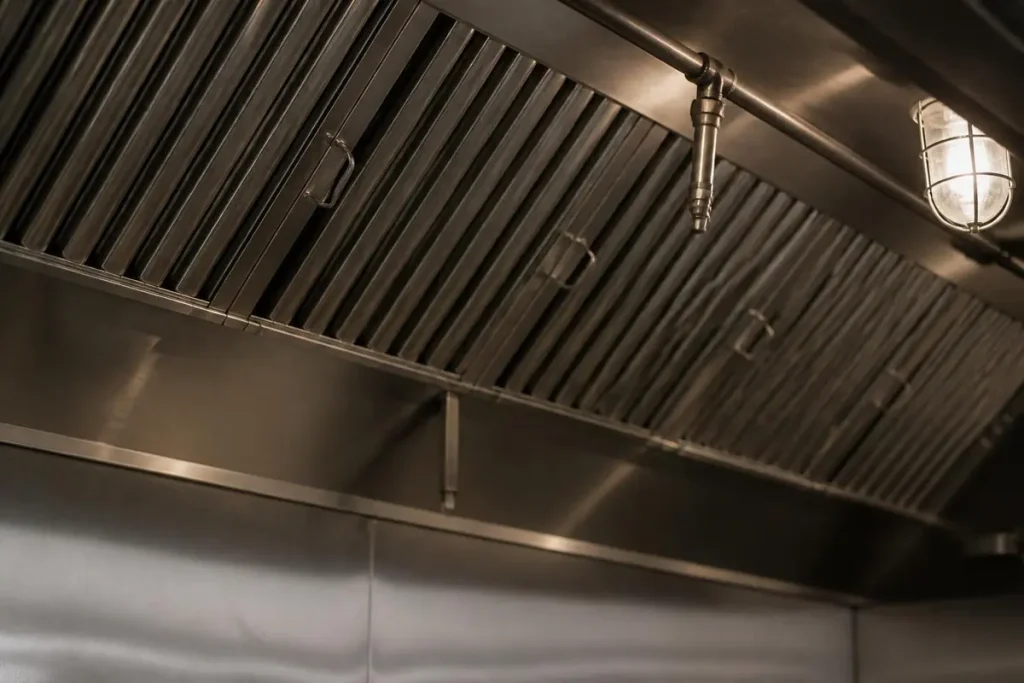
Multiply hood length by the rate for the hood style and the heaviest appliance under it. SMC 507.5 sets minimum net exhaust from 200 cfm per linear foot (light-duty wall canopy) to 700 (extra-heavy single island). A UL 710 listed hood follows its listing instead.
| Hood style (cfm per linear foot, minimum / maximum) | Light | Medium | Heavy | Extra-heavy |
|---|---|---|---|---|
| Wall-mounted canopy | 200 / 140 | 300 / 210 | 400 / 280 | 550 / 385 |
| Single island canopy | 400 / 280 | 500 / 350 | 600 / 420 | 700 / 490 |
| Double island (per side) | 250 / 175 | 300 / 210 | 400 / 280 | 550 / 385 |
| Eyebrow | 250 / 175 | 250 / 175 | Not allowed | Not allowed |
| Backshelf/pass-over | 250 / 210 | 300 / 210 | 400 / 280 | Not allowed |
Minimums are 2021 SMC 507.5.1 to 507.5.4; maximums are Washington State Energy Code Table C403.7.7.1.2. Dishwashing Type II hoods need 100 cfm per linear foot (SMC 507.5.5).
Take a 12-foot wall canopy over fryers: at 300 cfm per foot, the unlisted minimum is 3,600 cfm. Above 2,000 cfm total, Washington requires a UL 710 listed hood capped at 210 cfm per foot, or 2,520 cfm. Seattle’s permit worksheet applies the 507.5 table only to unlisted systems of 2,000 cfm or less.
When is demand control kitchen ventilation required?
In Washington, Type I systems in kitchens over 2,000 cfm of hood exhaust need demand control kitchen ventilation (DCKV) that cuts exhaust and replacement air at least 50 percent. Exceptions cover listed hoods of 250 cfm per foot or less in kitchens under 5,000 cfm, and energy recovery of at least 40 percent sensible effectiveness. DCKV often reports to a building automation system.
How much makeup air does a kitchen hood need?
In Seattle, a separate kitchen makeup air system must be “capable of providing not less than 90 percent of the air to be exhausted,” and must start automatically with the exhaust (SMC 508.1). Systems under 400 cfm are exempt; other jurisdictions may word the ratio differently. An open back door is no part of that supply, and where one stays open for deliveries the FDA Food Code instead accepts a properly designed air curtain to keep insects out.
Where makeup air exceeds 2,500 cfm per space, it may differ from room air by no more than 10°F unless the HVAC system can absorb the load (SMC 508.1.1). Plans must show replacement air equal to exhaust plus net exfiltration (SMC 508.1.2).
Our make up air explainer covers residential rules; a dedicated outdoor air system can supply transfer air.
At final, SMC 507.6 requires testing exhaust and makeup airflow plus a smoke capture check, typical air balancing work.
Code point: the back door is not makeup air
SMC 508.1 says “Exterior windows and doors shall not be used to provide commercial kitchen makeup air.” Makeup air also “shall not reduce the effectiveness of the exhaust system.”
What does code require for a kitchen hood grease duct?
A Type I grease duct is welded, sloped, cleanable steel, independent of other exhaust and nothing like ordinary spiral duct. 2021 SMC Section 506.3 requires:
- Material: steel at least 0.0575 inch (No. 16 gage) or stainless at least 0.0450 inch (No. 18 gage), unless factory-built to UL 1978. One retailer guide prints the stainless figure as “1.045” inch.
- Joints: “continuous liquid-tight weld or braze made on the external surface.”
- Testing: a light test with a lamp of at least 100 watts before concealment.
- Velocity: at least 500 feet per minute in the duct.
- Slope: 1/4 unit vertical in 12 horizontal toward the hood or a reservoir; 1 in 12 where horizontal runs exceed 75 feet.
- Cleanouts: not more than 20 feet apart and within 10 feet of turns over 45 degrees, with gaskets rated for 1,500°F.
- Clearance: 18 inches to combustibles and 3 inches to noncombustible construction where no enclosure is required.
A grease duct penetrating a ceiling, wall or floor needs a rated enclosure to the outlet (SMC 506.3.11), the compartment logic behind a fire damper.
Does a commercial kitchen hood need fire suppression?
Yes. SMC 509.1 requires automatic fire suppression for every appliance that needs a Type I hood. The 2021 Seattle Fire Code Section 904.13 requires pre-engineered dry- and wet-chemical systems to be “tested in accordance with UL 300.”
It places a manual pull at or near an exit, 10 to 20 feet from the exhaust system and 42 to 48 inches high. Discharge must shut off fuel or power, with manual reset, and service is due at least every six months.
SMC 507.1.1 requires the Type I fan to start when any appliance needing the hood turns on, or an interlock that blocks cooking while the fan is off; temperature sensors must start it within 15 minutes. Because suppression service sits in the fire code, schedule it separately from routine commercial HVAC service.
How often must a commercial kitchen hood be inspected and cleaned?
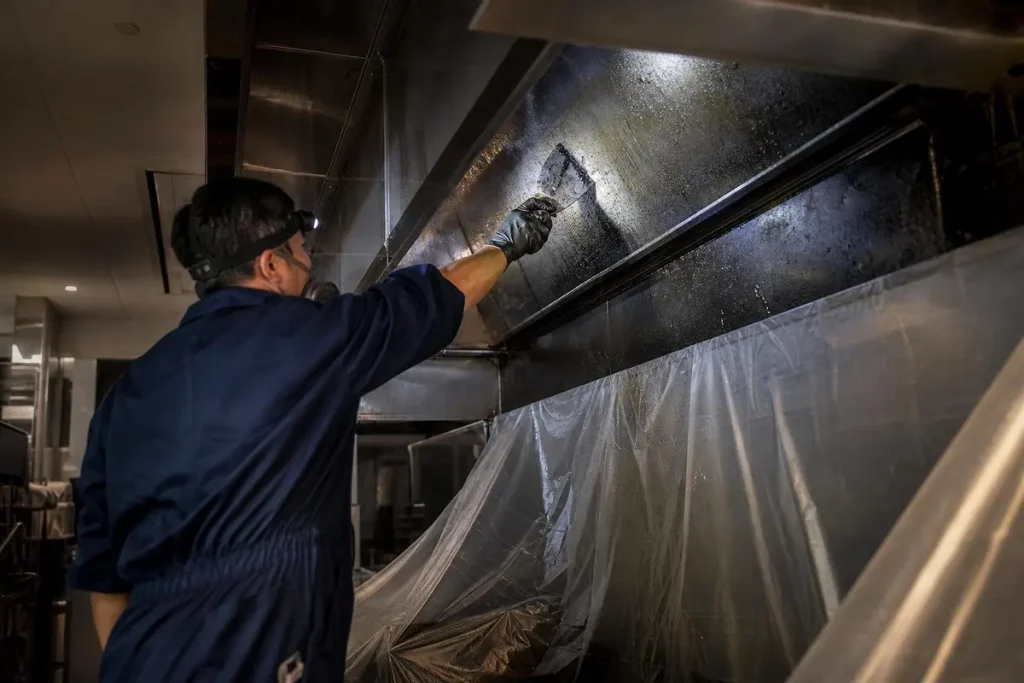
By cooking volume: 1 month for solid fuel, 3 months for high-volume kitchens, 6 months for most others and 12 months for low-volume ones under 2021 Seattle Fire Code Table 606.3.3.1. NFPA 96 (2017) Table 11.4 uses the same four tiers.
| Cooking operation | 2021 Seattle Fire Code | NFPA 96 (2017) |
|---|---|---|
| Solid fuel | 1 month | Monthly |
| High volume: 24-hour, charbroiling, wok | 3 months | Quarterly |
| Moderate or all other | 6 months | Semi-annually |
| Low volume: worship, seasonal, senior centers | 12 months | Annually |
The NFPA column is as summarized by the Village of New Paltz, New York, fire inspector, which adds a six-month check for listed hoods with dampers or wash systems (Section 11.5). Where grease has accumulated, Seattle requires cleaning to ANSI/IKECA C10, plus records and a dated tag.
How we researched this
Researched October 28, 2026. After reading the ranking retailer and contractor pages, we quoted Seattle’s 2021 Mechanical and Fire Codes, which reprint the IMC and IFC with amendments marked (codes.iccsafe.org and nfpa.org block fetches). Energy limits are from the Washington Administrative Code; NFPA 96 intervals from a New York municipal summary. Excluded: installed prices (no federal series) and Reddit (fire safety topic).
Frequently asked questions
What is the difference between a Type 1 and Type 2 hood?
A Type I hood collects grease vapors and smoke, carries fire suppression and connects to a welded grease duct. A Type II hood removes steam, heat, odors and combustion products from appliances that make no grease or smoke. In Seattle’s 2021 code, Type I hood steel is 0.0466 inch versus 0.0296 inch for Type II.
How many cfm does a 10-foot commercial kitchen hood need?
It depends on hood style and the heaviest appliance under it. Under Seattle’s 2021 code, an unlisted 10-foot wall canopy over fryers or griddles (medium duty) needs at least 3,000 cfm at 300 cfm per foot. A UL 710 listed hood uses its listed rate, which Washington caps at 210 cfm per foot.
How much does a commercial kitchen hood cost?
We publish no installed prices because no federal or national-lab series tracks them. Scope drives cost: hood type and length, UL 300 suppression, makeup air of at least 90 percent of exhaust in Seattle, welded 16-gage grease duct and, above 2,000 cfm in Washington, DCKV controls.
Does a pizza oven need a hood?
Under Seattle’s Table 507.2.1, a solid-fuel pizza oven needs a Type I hood on its own independent exhaust system. Other pizza ovens over 6 kW need a Type II hood; at 6 kW or less, none. Conveyor pizza ovens are medium duty, which requires a Type I hood.
Can a residential range hood be used in a commercial kitchen?
Only in limited cases. Seattle’s Table 507.1.2 lets office lunch rooms, day cares and apartment party rooms use a vented residential hood (Type II above 6 kW combined) for boiling, steaming and warming food. Roasting and frying there require a Type I hood.
How often should a restaurant hood be cleaned?
Codes set inspection intervals; cleaning follows when inspectors find grease. The 2021 Seattle Fire Code sets 1 month for solid fuel, 3 months for 24-hour, charbroil or wok kitchens, 6 months for most others and 12 months for low-volume operations, matching NFPA 96 (2017) Table 11.4.
Sources
- Seattle SDCI. “2021 Seattle Mechanical Code, Chapter 5: Exhaust Systems.” https://www.seattle.gov/documents/Departments/SDCI/Codes/MechanicalCode/2021SMCChapter5.pdf. Accessed October 2026.
- Seattle SDCI. “2021 Seattle Mechanical Code, Chapter 2: Definitions.” https://www.seattle.gov/documents/Departments/SDCI/Codes/MechanicalCode/2021SMCChapter2.pdf. Accessed October 2026.
- Seattle SDCI. “Commercial Kitchen Hood Worksheet, 2021 SMC.” https://www.seattle.gov/documents/Departments/SDCI/Forms/CommKitchenHoodWorksheet.pdf. Accessed October 2026.
- Washington State Legislature. “WAC 51-11C-40377, Section C403.7.7 Exhaust systems.” https://lawfilesext.leg.wa.gov/Law/WAC/WAC%20%2051%20%20TITLE/WAC%20%2051%20-%2011C%20CHAPTER/WAC%20%2051%20-%2011C-40377.htm. Accessed October 2026.
- Seattle SDCI. “2021 Seattle Fire Code, Chapter 6: Building Services and Systems.” https://www.seattle.gov/documents/Departments/SDCI/Codes/SeattleFireCode/2021SFCChapter6.pdf. Accessed October 2026.
- Seattle SDCI. “2021 Seattle Fire Code, Chapter 9: Fire Protection and Life Safety Systems.” https://www.seattle.gov/documents/Departments/SDCI/Codes/SeattleFireCode/2021SFCChapter9.pdf. Accessed October 2026.
- Minnesota Office of the Revisor of Statutes. “Minnesota Rules 1346.0507, Section 507 Commercial Kitchen Hoods.” https://www.revisor.mn.gov/rules/1346.0507/. Accessed October 2026.
- Village of New Paltz, New York. “Kitchen Hood Cleaning Requirements.” https://www.villageofnewpaltz.gov/wp-content/uploads/2019/10/191022-Kitchen-Hood-Cleaning-Requirements.pdf. Accessed October 2026.
Leave a Reply