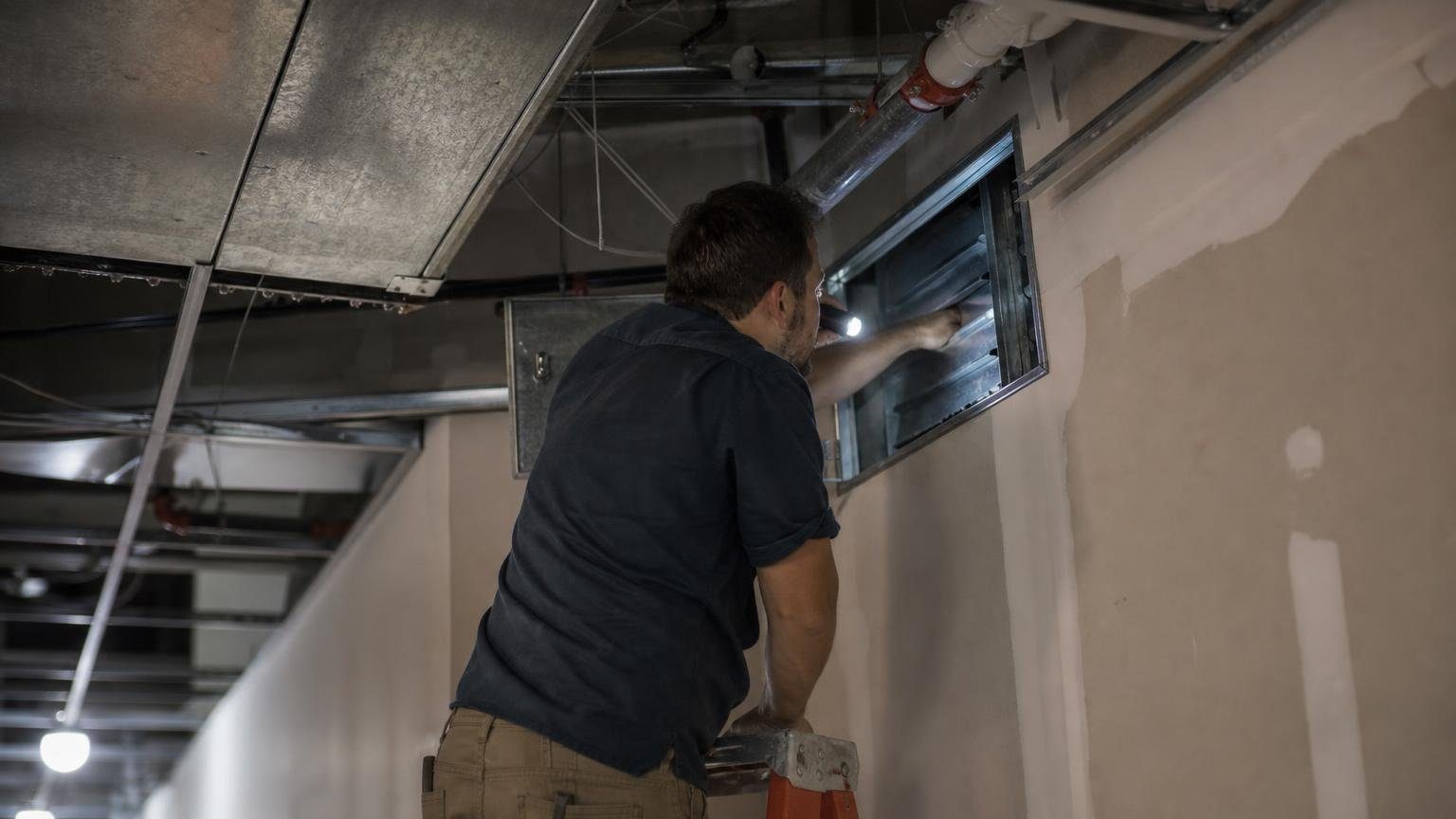
What is a fire damper? A fire damper is a listed, heat-actuated shutter inside a duct that closes where the duct passes through a fire-rated wall or floor, restoring the barrier. The 2021 IBC requires UL 555 listing; NFPA 80 requires a test 1 year after installation, then every 4 years.
Key Takeaways
- IBC Section 717 requires fire dampers at fire walls, fire barriers, shafts, fire partitions and some rated exterior walls, with listed exceptions (2021 IBC).
- Assemblies rated under 3 hours need a 1.5 hour fire damper; 3 hour assemblies need a 3 hour damper (IBC Table 717.3.2.1).
- The heat link must operate about 50°F above normal duct temperature and not below 160°F (IBC 717.3.3.1).
- NFPA 80 and NFPA 105 call for a test 1 year after installation, then every 4 years, or every 6 years in hospitals (Minnesota Department of Health).
- Ruskin ships its IBD2 curtain damper with a 165°F link as standard and 212°F as an option (Ruskin product sheet).
- Single-family houses generally need none: at the garage wall the IRC asks for No. 26 gage steel ducts with no openings into the garage (IRC R302.5.2).
What is a fire damper?
A fire damper is a listed device in a duct or air transfer opening that closes automatically on heat and restricts the passage of flame. So says the ICC’s CodeNotes on damper fundamentals, which summarizes the 2021 IBC and IMC.
A duct is a hole through a wall built to hold back fire for hours. NFPA’s damper basics article notes that a duct may collapse or deform in a severe fire and open the barrier; the damper closes that opening.
Fire dampers come in two classes. Static dampers may be installed only in systems that shut down automatically in a fire (IBC 717.2.3). Dynamic dampers close against moving air; NFPA says a damper must close against the maximum calculated airflow where it sits. For balancing and zoning dampers, see our guide to HVAC damper types.
Fire damper vs smoke damper: what is the difference?
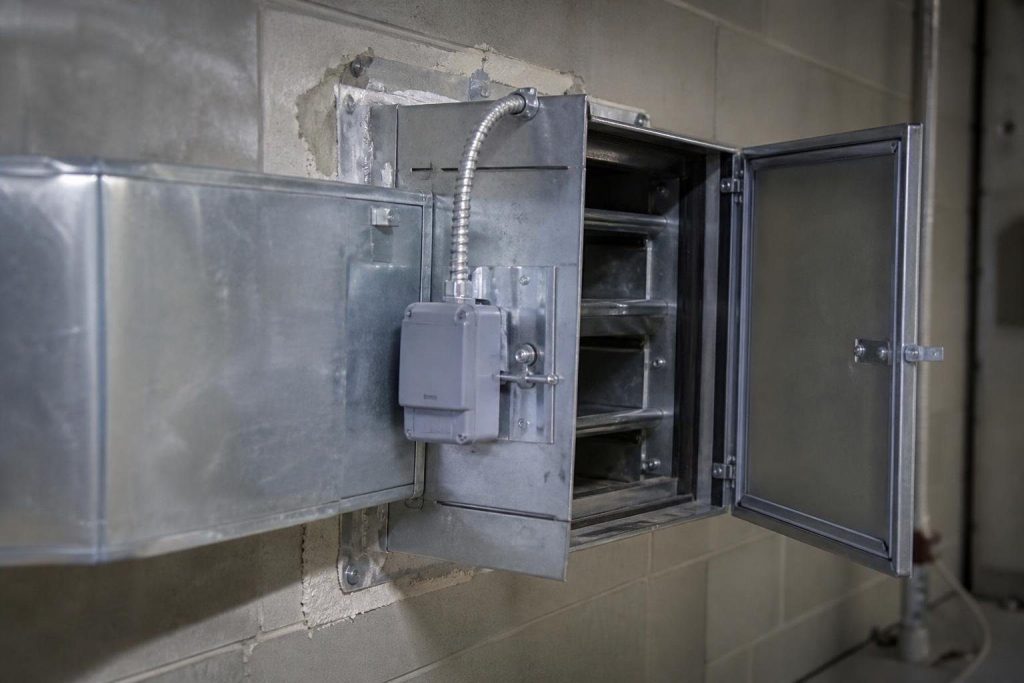
A fire damper stops flame and closes on heat; a smoke damper limits smoke leakage and closes on a smoke detector signal. A combination damper does both and must pass UL 555 and UL 555S. The 2021 IBC lists five types:
| Damper type | Closes on | Listing standard | Minimum rating | Typical location |
|---|---|---|---|---|
| Fire damper | Heat (fusible link or heat responsive device) | UL 555 | 1.5 hour, or 3 hour in 3 hour assemblies | Fire walls, fire barriers, shafts, fire partitions |
| Smoke damper | Listed smoke detector | UL 555S | Leakage Class I or II; at least 250°F | Smoke barriers, smoke partitions, corridor enclosures |
| Combination fire/smoke damper | Heat and smoke detection | UL 555 and UL 555S | Both of the above | Fire-rated barriers that also resist smoke |
| Ceiling radiation damper | Heat, at least 160°F | UL 555C, or tested with the assembly | Tested for the assembly | Grilles in rated floor/ceiling or roof/ceiling membranes |
| Corridor damper | Heat and smoke detection | UL 555 and UL 555S; must close at 150 feet per minute | 1 hour; Class I or II | Penetrations of rated corridor ceilings |
Source: 2021 IBC Sections 717.3.1 to 717.3.3. Under UL 555S, a Class I damper may leak no more than 8 cfm per square foot at 4 inches of water gauge, Class II 20 cfm, per the UL Solutions damper guide.
IBC 717.3.3.2 puts a smoke damper’s duct detector or sampling tubes within 5 feet of the damper; our page on the duct smoke detector rules covers the detector itself.
Where are fire dampers required?
Under IBC Section 717.5, fire dampers are required where ducts and air transfer openings penetrate rated assemblies, unless a listed exception applies. The text below is from Seattle’s adoption of the 2021 IBC, which reprints model language. Local amendments can change any item, and the building official decides, usually at permit and plan review.
- Fire walls (717.5.1): listed fire dampers in every permitted duct opening.
- Fire barriers (717.5.2): fire dampers, except where the wall is rated 1 hour or less, the building is fully sprinklered, the area is not Group H and the HVAC system is fully ducted in No. 26 gage steel.
- Shaft enclosures (717.5.3): fire and smoke dampers, with exceptions for steel exhaust subducts and approved smoke control systems.
- Fire partitions (717.5.4): fire dampers, with exceptions such as sprinklered corridor walls and small steel ducts up to 100 square inches.
- Rated exterior walls (717.5.6): where Section 705.10 requires protected openings.
- Floors (717.6.1): a duct through a rated floor connecting not more than two stories may skip the shaft if a listed fire damper sits at the floor line.
Dampers are not required in kitchen and clothes dryer exhaust where the IMC prohibits them; see our notes on dryer exhaust code rules. Where both fire and smoke dampers are required, a combination damper or a pair satisfies 717.5.
How does a fire damper fusible link work?
A fire damper fusible link is a heat-sensitive link that holds the blades or curtain open; when duct air gets hot enough it separates and the damper closes. IBC 717.3.3.1 says the link must operate about 50°F above the normal duct temperature, but not below 160°F, and not above 350°F in a smoke control system.
Correction
“Fire dampers close at 165°F” is a product default, not a code number. The code minimum is 160°F, and a warm duct needs a link about 50°F above its normal temperature, which is why makers sell hotter links.
Dynamic dampers carry airflow and pressure ratings: ICC CodeNotes says UL 555 marks them from a minimum of 2,000 fpm and 4 inches of water gauge. Greenheck rates its standard dynamic models up to 4,000 fpm and 4 in. wg on its fire damper product page; that is maker data, checked by the designer against worst-case airflow.
How often does a fire damper need inspection and testing?
A fire damper needs an operational test at installation, a test and inspection 1 year after installation, and then one every 4 years. Hospitals may stretch the cycle to every 6 years. Those intervals come from NFPA 80 (fire and combination dampers) and NFPA 105 (smoke dampers), as restated by the Minnesota Department of Health.
The fire code is what makes the clock enforceable. Minnesota’s fire code Section 706.1, for example, requires openings protected by fire dampers to be maintained under NFPA 80. Ruskin’s maintenance sheet repeats the intervals from the 2019 editions. Owners usually contract this out as part of commercial HVAC service.
What does a fire damper inspection check?
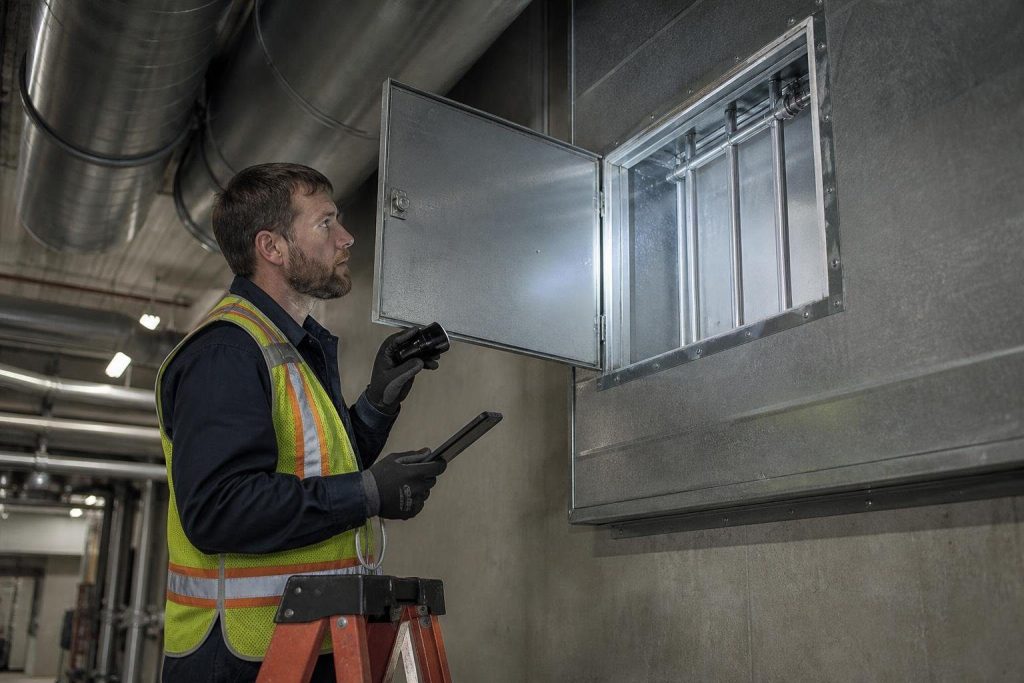
A fire damper inspection proves the damper closes fully and latches, then puts it back in service. It is a life safety test, not the equipment check in our HVAC inspection explainer. Minnesota’s health department restates the NFPA 80 steps:
- Verify full, unobstructed access to the damper, and correct it if blocked.
- Remove the fusible link and let the damper close fully and lock in place, if so equipped.
- Check for rusted, bent, misaligned or damaged frames or blades, defective hinges, and foreign objects through the frame.
- Dry lubricate exposed moving parts as the manufacturer requires.
- Reinstall the link; replace a damaged or painted link with one of the same size, temperature and load rating.
- Document the location, date, inspector and deficiencies, with space for how each was fixed.
Common failures follow from that list: no access, a painted link, a bent frame, or cable run through the damper. IBC 717.4.1 requires an access door at least 12 inches square for fusible link dampers, labeled in letters at least 1/2 inch high; NFPA 90A annex guidance cited by Minnesota suggests 18 by 16 inches where the duct permits and 24 by 16 inches where a worker must enter the duct.
Ruskin says motorized dampers are tested by cutting power or air and confirming closure, and on variable volume systems acceptance testing waits until the system is balanced at maximum airflow; see how air balancing works and our VAV box explainer. Where space limits access, IBC 717.4.1.2 requires a single or multi-blade damper that meets the NFPA 80 or NFPA 105 remote inspection rules.
Do houses have fire dampers?
Single-family houses built under the International Residential Code generally do not need fire dampers. At the attached garage, the one fire separation most houses have, IRC R302.5.2 calls for steel duct rather than a damper: ducts must be at least No. 26 gage sheet steel with no openings into the garage, per Seattle’s adoption of the 2021 IRC.
So a supply register in the garage fed from the house system is a code problem; our garage ventilation guide covers the options. Fire dampers belong to buildings with rated corridors, shafts and tenant separations, one of the real splits between commercial and residential HVAC. A fireplace “damper” is a different device that closes the chimney flue.
How we researched this
Researched October 11, 2026. After reading the ranking pages, we quoted code text from Seattle’s 2021 Building and Residential Codes, which reprint the IBC and IRC with amendments marked (codes.iccsafe.org blocks fetches). NFPA 80 and NFPA 105 intervals come from a Minnesota Department of Health restatement that cites section numbers. Link and airflow ratings are Ruskin and Greenheck maker data. We consulted 16 documents and cite 9. Excluded: a CMS hospital damper waiver page (blocked), vendor prices (no federal series) and Reddit (life safety topic).
Frequently asked questions
What is the purpose of a fire damper?
A fire damper keeps a duct from becoming a path for fire through a rated wall, floor or shaft. NFPA notes a duct can collapse or deform in a severe fire, opening the barrier; the damper closes on heat and holds for its 1.5 hour or 3 hour rating.
What temperature does a fire damper fusible link melt at?
IBC 717.3.3.1 says about 50°F above normal duct temperature, not below 160°F, and not above 350°F in a smoke control system. Ruskin’s standard link is 165°F, with 212°F as an option; Greenheck offers links up to 286°F on standard dynamic models.
Who is allowed to test fire dampers?
Ruskin’s maintenance sheet, restating NFPA 80 and NFPA 105, says acceptance testing must be done by a qualified person who understands the damper and its system. Some jurisdictions add licensing rules. Every test is documented with location, date, inspector and deficiencies.
What is a ceiling radiation damper?
A listed device in the ceiling membrane of a fire-rated floor/ceiling or roof/ceiling assembly that limits radiant heat through a grille. The 2021 IBC requires UL 555C listing or testing with the assembly, and actuation 50°F above normal duct temperature, at least 160°F.
Can a fire damper be painted?
Not the link. NFPA 80, as restated by the Minnesota Department of Health, requires a damaged or painted fusible link to be replaced with a link of the same size, temperature and load rating. Inspectors also check for bent, rusted or blocked blades and frames.
Do fire dampers need power or a smoke detector?
A fire damper with a fusible link needs neither; heat releases it. Smoke and combination dampers close on a listed smoke detector under IBC 717.3.3.2, with the duct detector or its tubes within 5 feet. Motorized dampers are tested by removing power or air.
Sources
- City of Seattle SDCI. “2021 Seattle Building Code, Chapter 7 (Section 717).” https://www.seattle.gov/documents/Departments/SDCI/Codes/SeattleBuildingCode/2021SBCChapter7.pdf Accessed October 2026.
- International Code Council. “CodeNotes: Fire, Smoke, and Combination Fire/Smoke Damper Fundamentals in the I-Codes.” https://www.iccsafe.org/wp-content/uploads/22-21439_CodeNotes_2021_Fire_Damper_Fundamentals_FINAL.pdf Accessed October 2026.
- NFPA. “Basics of Fire and Smoke Damper Installations.” https://www.nfpa.org/news-blogs-and-articles/blogs/2021/08/12/basics-of-fire-and-smoke-damper-installations Accessed October 2026.
- Minnesota Department of Health. “Maintenance and Testing of Fire/Smoke Dampers.” https://www.health.state.mn.us/facilities/regulation/engineering/lscmaintestdamper24.pdf Accessed October 2026.
- UL Solutions. “Duct Fire Dampers Guide.” https://www.ul.com/thecodeauthority/knowledge/duct-fire-dampers-guide Accessed October 2026.
- Ruskin. “IBD2 Curtain Type Static Fire Dampers.” https://www.ruskin.com/doc/Id/3251 Accessed October 2026.
- Ruskin. “Smoke and Combination Fire Smoke Damper O&M.” https://www.ruskin.com/doc/Id/9274 Accessed October 2026.
- Greenheck. “Fire Dampers.” https://www.greenheck.com/products/dampers/fire Accessed October 2026.
- City of Seattle SDCI. “2021 Seattle Residential Code, Chapter 3.” https://www.seattle.gov/documents/Departments/SDCI/Codes/SeattleResidentialCode/2021SRCChapter3.pdf Accessed October 2026.
Leave a Reply