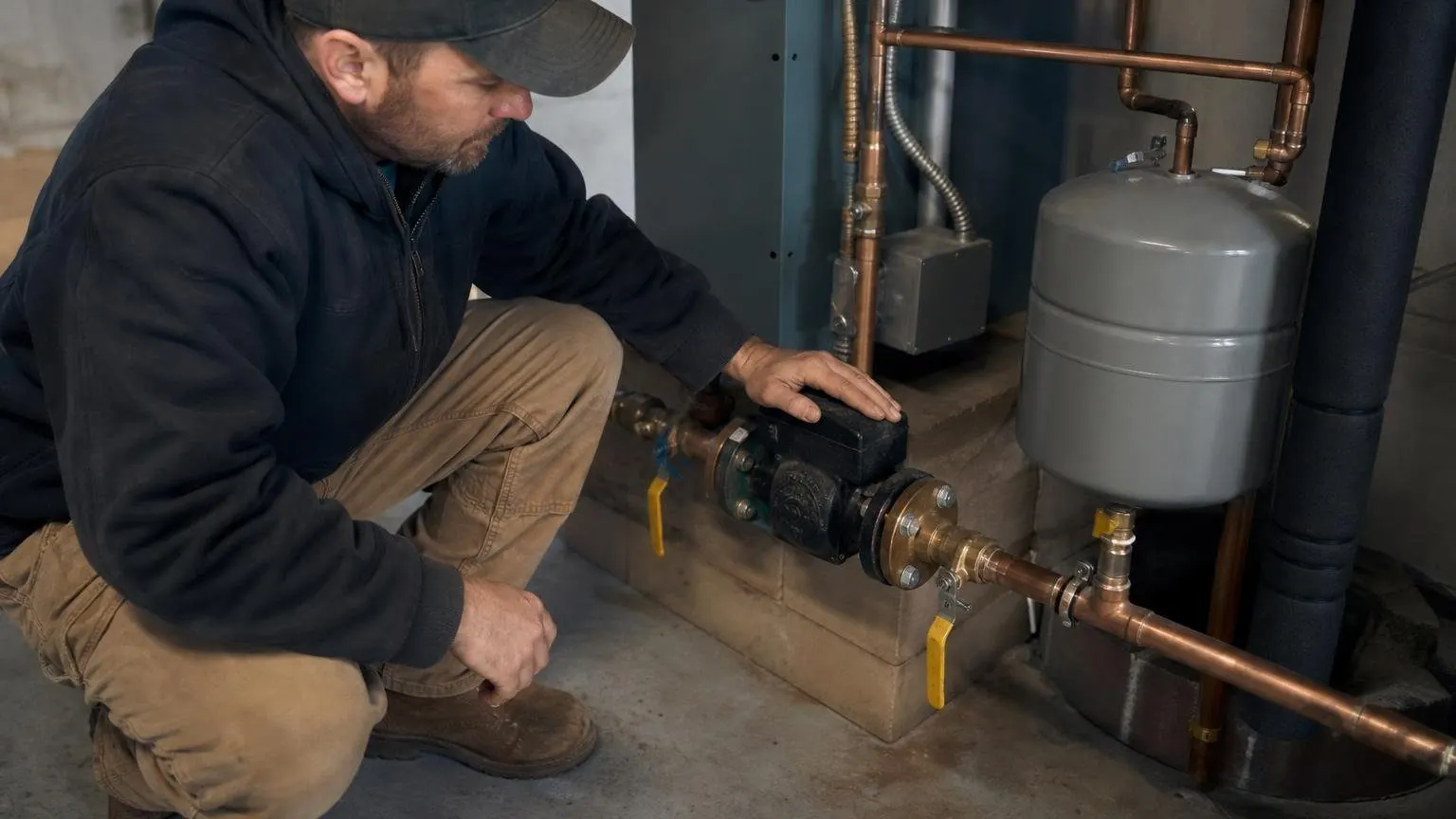
A circulator pump is the small pump that pushes boiler water through baseboard, radiators or radiant tubing and back. In a closed loop it only overcomes pipe friction, so size it by flow (GPM = Btu/h ÷ 500 × ΔT) and head (feet of friction loss). Replacement cast iron circulators listed from $176.95 to $439.64 at US distributors on November 12, 2026, before labor.
What is a circulator pump?
A circulator pump is a low-head pump that keeps water moving around a closed heating loop. Federal rules (10 CFR 431.462) recognize wet rotor, dry rotor two-piece and dry rotor three-piece types, and define the wet rotor kind, CP1 in the trade, as a single stage, close-coupled pump.
System water surrounds a wet rotor and lubricates its bushings. Caleffi credits Taco with the first North American wet rotor circulator in 1958; by 1980 wet rotors dominated new residential systems. Our hot water heating system explainer covers the whole loop.
DOE found two main jobs, hydronic heating and domestic hot water recirculation, and counted 73.7% of circulator buyers as residential.
Pump vs circulator: what’s the difference?
Every circulator is a pump, but a circulator is a pump built for one job: moving water around a closed, filled loop where the water it sends out comes back to its inlet. Caleffi’s idronics 16 says a circulator in such a loop is not responsible for lifting the water, because the water rising in one pipe is balanced by water falling in the other.
That changes what the pump has to deliver. idronics shows that the head loss curve of a closed, fluid-filled circuit starts at zero head at zero flow, so the circulator only has to supply friction loss: a few feet to about 20 feet of head in the residential models below. A pump that moves water from a well, a sump or a cistern up to a higher outlet must also overcome that height, which is why those pumps are rated and sold differently.
| Question | Circulator (closed hydronic loop) | Pump lifting water (open system) |
|---|---|---|
| Where does the water go? | Around the loop and back to the inlet | From a source to a higher or distant outlet |
| Head it must supply | Friction only; zero head at zero flow (idronics 16, section 4) | Friction plus the height lifted |
| Typical residential head | 10 to 20 ft maximum on the maker sheets in this article | Rated for the lift of the job |
| Federal category | Circulator pump: wet rotor (CP1), dry rotor two-piece (CP2) or three-piece (CP3), 10 CFR 431.462 | Other pump classes in 10 CFR 431 subpart Y |
Compiled by The HVAC Brief from Caleffi idronics 16 and 10 CFR 431.462.
How does a boiler circulator pump work?
A boiler circulator pump spins an impeller in a volute, adding just enough pressure, measured in feet of head, to push water against pipe friction. Because the loop is full, rising water is balanced by falling water, so Caleffi says a small circulator can keep flow going even when the top of the loop is several stories up. In a hydro air system the circulator sends that boiler water to a coil inside an air handler, and a blower turns it into forced warm air.
Caleffi advises connecting the expansion tank near the circulator inlet so the pump will “pump away” from the point of no pressure change, raising loop pressure. Grundfos and Caleffi both require a horizontal motor shaft.
The pump starts when the boiler control, a relay or a zone valve end switch closes on a call for heat. Caleffi notes homes of the 1960s to early 1980s typically had one to three zones run by zone circulators or zone valves, a pattern many boiler and baseboard homes keep.
Wet rotor vs dry rotor circulators: which do you have?
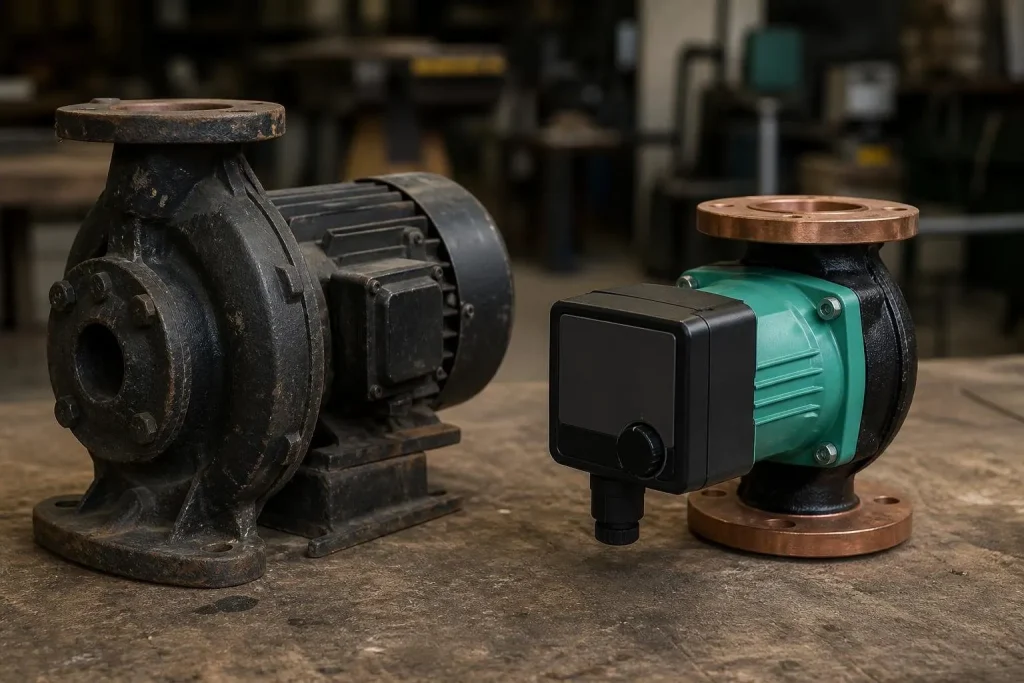
A wet rotor circulator has its motor rotor running in the system water, which lubricates and cools it; a dry rotor circulator keeps the rotor out of the water, which federal rules define as “a pump in which the motor rotor is not immersed in the pumped fluid.” Nearly every small home boiler circulator sold today is a wet rotor; the older three-piece “booster” pump is the common dry rotor type.
idronics 16 says the classic three-piece booster common in the 1950s and 1960s largely gave way to wet rotors. Bell & Gossett’s manual for its three-piece Series 100 booster shows what the older design asks of an owner: oil lubricated sleeve bearings, a carbon/ceramic shaft seal and a spring coupler between motor and pump.
| Feature | Wet rotor (CP1) | Dry rotor, three-piece (CP3) |
|---|---|---|
| Federal definition | “Single stage, rotodynamic, close-coupled, wet rotor pump” | Mechanically coupled dry rotor pump, 5 hp hydraulic or less, horizontal motor |
| Where the rotor runs | In system water, which lubricates the bushings (Caleffi) | Outside the water, “not immersed in the pumped fluid” |
| Oiling | None: B&G calls its NRF line “maintenance free”; Taco says the same of the 007 | B&G Series 100: about 1 oz of oil at installation, 1 teaspoon at the start of each heating season |
| Shaft seal and coupler | Close-coupled, no coupler | Carbon/ceramic seal and spring coupler; B&G warns that running the pump dry can damage the seal |
| Examples | Taco 007 and 007e, Grundfos UPS15-58 and ALPHA, B&G NRF-22 and ecocirc 20-18, Armstrong Astro 230 | B&G Series 100 booster |
| Main failure to watch | Rotor stuck after a summer off; running dry (Grundfos) | Leaking seal, worn coupler, missed oiling |
Compiled by The HVAC Brief from 10 CFR 431.462, Caleffi idronics 16, the B&G NRF catalog page and Series 100 instruction manual, and the Taco 007 submittal. A dry rotor two-piece (CP2) type also exists in the federal rules: close-coupled like a wet rotor, but with the rotor kept dry.
Fixed-speed vs ECM circulator pump: what changes?
A fixed-speed circulator runs a permanent split capacitor (PSC) induction motor at one or a few set speeds. An ECM circulator uses a permanent magnet, electronically commutated motor that draws less power and can vary speed. Caleffi cites simulations predicting electrical savings of 60% or more for ECM variable-speed pumps versus PSC wet rotors of equal peak duty. Savings like those assume the pump rests between calls, and boiler pump running constantly prices what a circulator that never stops adds to the electric bill and explains when nonstop circulation is a deliberate design.
The table uses each maker’s published figures, not independent tests, and now covers all four big residential brands. Our single-speed vs variable-speed guide covers the same idea for blowers.
| Model (maker document) | Motor | Max flow | Max head | Power draw |
|---|---|---|---|---|
| Taco 007-F5 (submittal 101-029) | Fixed speed, 1/25 hp, 3,250 rpm | 23 gpm | 10 feet | 0.71 A at 115 V |
| B&G NRF-22 (B&G NRF catalog page) | Fixed speed, 2,940 rpm | curve only | curve only | 92 W, 0.80 A |
| Armstrong Astro 230CI (submittal 10.584) | 3 speeds | curve only | curve only | 97 W nominal, 0.45 to 0.81 A by speed |
| Grundfos UPS15-58 FC (UP data booklet) | Capacitor run, 3 speeds | 17 gpm | 19.5 ft | 60 / 80 / 87 W |
| Taco 007e (submittal 101-177) | ECM, permanent magnet | 16 gpm | 10 feet | 44 W max |
| B&G ecocirc 20-18 (submittal A-ECO20-18) | ECM, 3 control modes | about 18 gpm (max curve) | about 20 ft (max curve) | 0-70 W |
| Grundfos ALPHA2 15-55 (2024 leaflet) | ECM, AUTOADAPT | 21 gpm | 19 ft | 5-45 W |
| Grundfos ALPHA 15-58 (installation guide) | ECM | 13.6 gpm | 19 ft | 3 to 38 W |
Taco calls the 007e’s performance “equivalent to the legendary 007,” and its submittal sheet lists 44 W against 87 W for the UPS15-58 on speed 3. Grundfos claims the ALPHA2 cuts consumption by up to 85% in AUTOADAPT mode, a maker claim. The 007 sheet lists amps, not watts, so we leave it unconverted. B&G and Armstrong publish the NRF-22 and Astro 230 maximums only as curves, so we leave those cells blank; the ecocirc 20-18 figures are where its printed max curve meets each axis.
One model note: distributors now list the cast iron ALPHA2 15-55F (part 99163903) as discontinued, and one names the ALPHA 15-58F (92603115) as its replacement. That newer pump has a lower maximum flow, 13.6 gpm against 21 gpm, so check the duty point before treating it as a drop-in.
How do you size a hydronic circulator pump?
To size a hydronic circulator pump, find the flow the load needs, find the head that flow creates in your piping, then pick a pump whose curve crosses that point. Caleffi’s water formula is q = 500 × f × ΔT (500 rounds 8.33 × 60), so GPM = Btu/h ÷ (500 × ΔT).
Caleffi’s check: 50,000 Btu/h at 4 gpm gives a 25ºF drop. Radiant floors use a 10º to 15ºF drop, which raises flow, as our radiant floor heating guide explains. The loads below are worked examples.
| Design load | Design ΔT | Flow (Btu/h ÷ 500 × ΔT) | Velocity in 3/4 in copper (0.62 × gpm) |
|---|---|---|---|
| 40,000 Btu/h baseboard | 20ºF | 4.0 gpm | 2.5 ft/s |
| 60,000 Btu/h baseboard | 20ºF | 6.0 gpm | 3.7 ft/s |
| 80,000 Btu/h baseboard | 20ºF | 8.0 gpm | 5.0 ft/s, over the 4 ft/s limit |
| 30,000 Btu/h radiant floor | 10ºF | 6.0 gpm | 3.7 ft/s |
| 30,000 Btu/h radiant floor | 15ºF | 4.0 gpm | 2.5 ft/s |
Caleffi keeps average velocity under 4 feet per second to limit pipe noise, and calls 2 feet per second enough to carry air along. At 0.62 ft/s per gpm, 3/4 in copper tops out near 6.5 gpm. Too little flow causes a different noise inside the boiler, the rumble of boiler kettling, when water touching the heat exchanger flashes to steam. Too little flow also lets the boiler water reach its limit quickly, another cause of boiler short cycling that changing the settings alone will not fix.
Head is the friction of pipe, fittings and boiler at design flow. idronics 16 gives a shortcut for smooth tubing (copper, PEX, PEX-AL-PEX): head loss HL = a × c × L × f1.75, where a is a fluid factor (0.0475 for 140ºF water), c is a tube-size constant, L is the circuit’s total equivalent length in feet and f is the flow in gpm. Where that head loss curve crosses the pump curve is the operating point. Caleffi advises an operating point in the middle third of the pump curve, and warns that too much flow brings noise, component damage and wasted electricity. In a baseboard loop that excess flow is a common cause of hot water baseboard noise, heard as a steady whoosh or hum whenever the pump runs.
Circulator sizing calculator: flow (GPM) and head (feet)
For one closed water circuit: the zone or loop with the longest run. Uses the idronics 16 method shown under the tool.
Fittings (copper only; idronics gives equivalent lengths for soldered copper):
Water only. No glycol correction is applied. Smooth tubing only: idronics says not to use this formula for iron or steel pipe. This sizes the duty point; pick the actual circulator from its maker’s curve.
How the calculator works: flow is Btu/h ÷ (500 × ΔT), idronics 16 Formula 3-2. Head is Formula 4-2, HL = a × c × L × f1.75, with c from idronics Figure 4-3 and copper fitting equivalent lengths from Figure 4-4 (soldered fittings; idronics says to double the values for threaded fittings). The a value of 0.0475 for 140ºF water is the one idronics uses in its worked example; 0.0495 at 120ºF and 0.0611 at 50ºF are our results from idronics Formula 4-3, a = (D/µ)-0.25, using the density and viscosity idronics gives for those temperatures. For a 180ºF baseboard loop the curve in idronics Figure 4-2 keeps falling, so the 140ºF value slightly overstates head, which errs on the safe side. The class bands use the middle-third rule: a 10 ft shutoff pump is flagged above 6.7 ft of head and a 19 to 20 ft pump above 12.7 ft.
Hand checks against idronics 16: its Figure 4-7 circuit (100.2 equivalent feet of 3/4 in copper, 140ºF water, 5 gpm) returns 4.93 ft in the calculator, matching the 4.93 ft idronics computes. Its Figure 3-13 text puts 3.2 gpm of 120ºF water through 100 ft of 1/2 in copper at about 12.7 ft and 39.6 gpm through 100 ft of 2 in copper at about 2.6 ft; the calculator returns 12.64 ft and 2.58 ft.
| Tube (idronics Figure 4-3) | c value | Head loss per 100 ft at 4 gpm, 140ºF water | at 8 gpm |
|---|---|---|---|
| 1/2″ type M copper | 0.33352 | 17.9 ft | 60.3 ft |
| 3/4″ type M copper | 0.061957 | 3.3 ft | 11.2 ft |
| 1″ type M copper | 0.01776 | 1.0 ft | 3.2 ft |
| 1-1/4″ type M copper | 0.0068082 | 0.4 ft | 1.2 ft |
| 1/2″ PEX | 0.71213 | 38.3 ft | 128.7 ft |
| 3/4″ PEX | 0.14203 | 7.6 ft | 25.7 ft |
| 1″ PEX | 0.04318 | 2.3 ft | 7.8 ft |
HVAC Brief calculation: 0.0475 × c × 100 × f1.75, from idronics 16 Formula 4-2 and Figure 4-3.
| Copper fitting (soldered), equivalent feet | 1/2″ | 3/4″ | 1″ | 1-1/4″ |
|---|---|---|---|---|
| 90-degree elbow | 1.0 | 2.0 | 2.5 | 3.0 |
| Tee, straight run | 0.3 | 0.4 | 0.45 | 0.6 |
| Tee, side port | 2.0 | 3.0 | 4.5 | 5.5 |
| Ball valve, standard port | 1.9 | 2.2 | 4.3 | 7.0 |
| Swing check valve | 2.0 | 3.0 | 4.5 | 5.5 |
| Globe valve | 15.0 | 20 | 25 | 36 |
Source: Caleffi idronics 16, Figure 4-4 (copper tube sizes). The globe valve is not a calculator input; add it, and any boiler or emitter loss from its maker’s data, in the equivalent-feet box.
Heating circulator vs hot water recirculation pump: are they the same?
No. Both are small wet rotor pumps, often from the same maker’s line, but a heating circulator moves the same sealed boiler water around and over and is usually cast iron, while a hot water recirculation pump moves fresh drinking water and must have a stainless steel or lead-free bronze body. A “circulating pump” query can mean either one.
The makers say so directly. Taco’s 007e submittal lists the cast iron casing as “suitable for closed loop systems only” and the stainless steel casing for “potable water and open loop systems.” B&G’s ecocirc 20-18 submittal says: “Where potable water is pumped, use a stainless steel circulator.” Armstrong builds the Astro 2 in cast iron for closed systems and in stainless steel or lead-free bronze for open systems, certified to NSF 372, and recommends keeping open potable systems below 150°F to avoid calcium precipitation.
| Question | Heating circulator | Hot water recirculation pump |
|---|---|---|
| Water it moves | Closed boiler loop, same water reused | Potable water from the water heater, back through the fixtures’ supply line |
| Body material | Cast iron is allowed for closed loops (Taco, B&G, Armstrong) | Stainless steel or lead-free bronze (Taco, B&G, Armstrong) |
| What starts it | Thermostat, zone relay or boiler control on a call for heat | Timer, aquastat or demand control (Armstrong sells a timer and aquastat accessory for the Astro 2) |
| Federal standard | Both fall under the circulator pump rule, 10 CFR 431.465(i) | Same rule |
Compiled by The HVAC Brief from Taco submittal 101-177, B&G submittal A-ECO20-18 and Armstrong Astro 2 literature. Controls, energy use and plumbing code for the potable side are in our water heater recirculation pump guide. A cast iron heating circulator should not be swapped into a potable loop.
What does the DOE circulator pump standard require?
The DOE circulator pump standard requires covered circulators manufactured starting May 22, 2028 to rate a circulator energy index (CEI) of 1.00 or lower, tested in their least consumptive control mode. It is codified at 10 CFR 431.465(i) in the October 2026 eCFR, and the Federal Register shows no later delay.
It covers clean water circulators of all three types, excluding submersible and header pumps. DOE published the final rule May 20, 2024 (89 FR 44464), effective August 5, 2024, choosing a level that “is set to correspond approximately to single-speed ECMs.” DOE’s baseline was a PSC pump, and it expected the level would likely require ECMs, though some variable speed induction pumps remain.
What the rule does not do. It keys on manufacture date. Nothing in 431.465(i) requires replacing a working PSC circulator. Large warehouse ceiling fans follow the same manufacture date logic, since the federal efficiency floor for an HVLS fan applies to fans made after the DOE rule took effect.
How do you know if a circulator pump is bad?
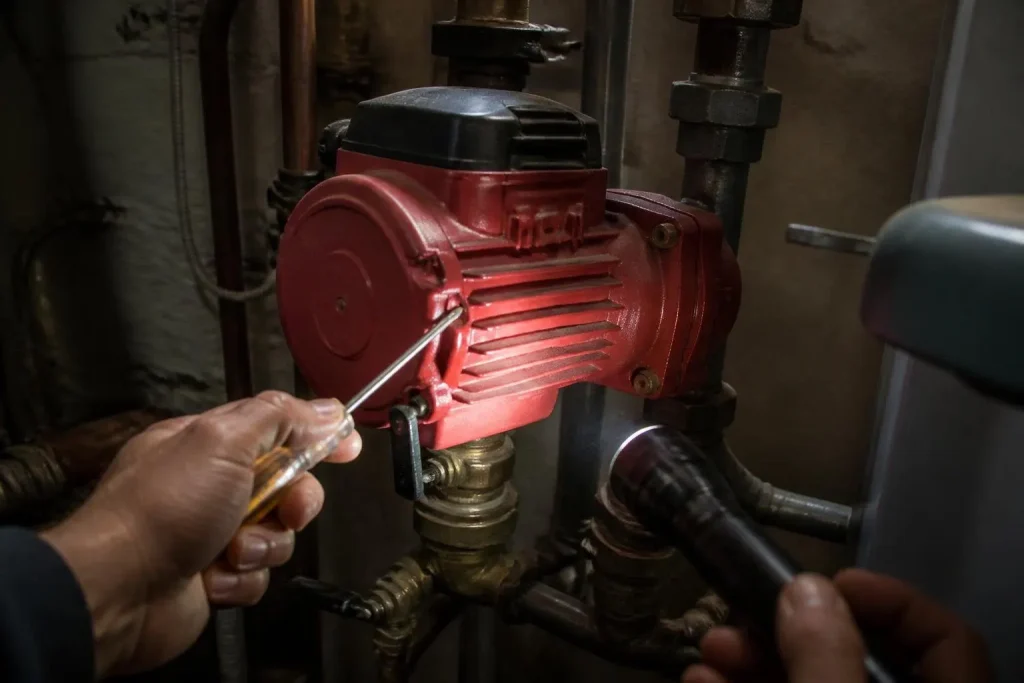
A circulator pump is likely bad if it has power on a call for heat but moves no water, hums without turning, or rattles with system pressure in range. Check in order, since control, air and pressure faults mimic a dead pump. A quick sort helps before any meter comes out, because a boiler circulator pump not working is either silent, humming or running while the baseboards stay cold, and each state points to a different group of faults. Kill power at the service switch first; Grundfos says electrical work belongs to a qualified person.
- Not turning on. Confirm a call for heat and voltage at the pump. A relay or end switch that never closes idles a good pump, and our boiler not working checklist covers those control faults.
- Hums but does not spin. The rotor may be stuck after summer. The Grundfos UP instructions say: cut power, close the isolation valves, remove the indicator plug, turn the shaft with a flat screwdriver, reopen the valves and wait 2 to 3 minutes before restarting.
- Runs, but rooms stay cold or pipes gurgle. Suspect air. Grundfos says to vent at the system’s high points, never through the pump.
- Rattling or gravel noise. Possible cavitation, which Caleffi ties to low inlet pressure. Grundfos lists a minimum inlet pressure of 4.0 psi at 190ºF and 15.6 psi at 230ºF, so check boiler pressure first.
- Very hot motor. A warm casing is normal because the wet rotor motor sheds heat through its surface; Caleffi says never insulate it. Hot plus no flow may mean a locked rotor.
- Runs all the time. Usually a stuck relay or end switch, not the pump.
How long does a circulator pump last?
DOE estimates the average circulator pump lifetime at 10.5 years. Caleffi notes some late-1970s wet rotors were still running with zero maintenance almost four decades on. Dry running, a vertical shaft or an insulated motor shortens life.
Maker warranties are far shorter than that average life, and they run from the date of manufacture, not the day the pump went in. Taco covers the 007e for three years from the date code. B&G covers the NRF line for three years from manufacture or 18 months from installation, whichever comes first. Armstrong lists a 30 month warranty on the Astro 2, and Grundfos’s US consumer warranty on the ALPHA 15-58 runs 30 months from the date of manufacture on the nameplate. For fit, Grundfos’s cross-reference lists the UPS 15-58 FC and ALPHA2 15-55 as replacements for the Taco 007-F5 (6 1/2 in port-to-port versus 6 3/8 in). If the boiler is aging too, read our boiler replacement guide, and have the pump checked at annual boiler service.
How much does it cost to replace a circulator pump?
The pump itself listed at $176.95 to $439.64 for the common cast iron heating models at US online distributors on November 12, 2026: about $177 to $246 for fixed-speed and three-speed models and Taco’s ECM 007e, about $319 for B&G’s ECM ecocirc 20-18, and about $440 for Grundfos’s ECM ALPHA 15-58F. Labor is extra and is not covered by any federal price series.
| Model (part number) | Type | Listed price | Where listed, Nov 12, 2026 | Maker warranty |
|---|---|---|---|---|
| Taco 007-F5 | Fixed speed, cast iron | $176.95 | National Pump Supply | not checked |
| Armstrong Astro 230CI (110223-305) | 3-speed, cast iron | $204.95 | National Pump Supply | 30 months |
| Taco 007e-2F2 | ECM, cast iron | $244.95 | National Pump Supply | 3 years from date code |
| B&G NRF-22 (103251) | Fixed speed, cast iron | $245.95 | National Pump Supply | 3 years from manufacture or 18 months from install |
| B&G ecocirc 20-18 (60B0B1000) | ECM, cast iron | $318.95 | National Pump Supply | not checked |
| Grundfos ALPHA 15-58F (92603115) | ECM, cast iron | $439.64 | F.W. Webb | 30 months from manufacture (US consumer) |
| Grundfos ALPHA2 15-55F (99163903) | ECM, cast iron | $250.68, out of stock | 24hr Supply, marked “DISCONTINUED: USE GR92603115” | n/a |
Compiled by The HVAC Brief from distributor product pages viewed November 12, 2026, and maker warranty statements (Taco 101-177, B&G NRF catalog page, Armstrong Astro 2 outline 10.125, Grundfos ALPHA 15-58 installation guide). Prices are one retailer’s listing on one day, before tax and shipping, and change often. Flanges are sold separately for some models.
On labor, the federal data cover what the technician earns, not what a shop bills. BLS puts the May 2025 median wage at $29.33 an hour for HVAC mechanics and installers and $30.67 an hour for plumbers, pipefitters and steamfitters; a contractor’s billed rate adds overhead, the truck and the call itself. The size of the job turns on isolation valves: idronics 16 says to “always install isolation flanges or isolating valves on both sides of every circulator,” and Armstrong’s Astro 2 manual asks for them on both sides “to facilitate service.” Where they exist, the swap stays local to the pump; where they do not, the water has to be drained below the pump first, and the loop refilled and purged of air afterward. A wet pump flange does not always mean a new pump, and boiler leaking water covers when a leaking flange or drain valve can be fixed without replacing the boiler.
How we researched this
We read DOE’s final rule (89 FR 44464), pulled 10 CFR 431.462 and 431.465 from the eCFR versioner API (October 1, 2026) and searched the Federal Register for later delays; none exist. Pump data come from Taco submittals 101-029 and 101-177, Grundfos’s UP booklet, ALPHA2 leaflet, UP instructions and ALPHA 15-58 installation guide, Bell & Gossett’s NRF catalog page, ecocirc 20-18 submittal and Series 100 manual, and Armstrong’s Astro 2 submittal, outline and manual. Sizing and installation rules, the head loss formula, c values and fitting equivalent lengths come from Caleffi idronics 16. Wages come from the BLS Occupational Outlook Handbook.
November 2026 update: we added the pump vs circulator, wet vs dry rotor, recirculation and cost sections, B&G and Armstrong data, the sizing calculator, and dated distributor prices. Prices were read on distributor pages on November 12, 2026; SupplyHouse and the Xylem (B&G) site blocked automated access, so B&G documents were read from distributor-hosted copies. Excluded: contractor installed-price pages, UK pump guides, and Reddit, which we skip on a boiler safety topic. Maker efficiency claims are labeled. Research date: November 12, 2026.
Frequently asked questions
What is the purpose of a circulator pump?
It moves heated water from the boiler through baseboard, radiators or radiant tubing and back. DOE names two main uses: hydronic heating and domestic hot water recirculation. In a filled loop it only replaces friction loss; Caleffi says it is not responsible for lifting the water.
How long does a circulator pump last?
DOE estimates the average circulator pump lifetime at 10.5 years in its 2024 final rule. Caleffi describes late-1970s wet rotor units still running almost four decades later. Dry running, a vertical motor shaft and an insulated motor all shorten life.
How much does it cost to replace a boiler circulator pump?
For the pump alone, common cast iron models listed from $176.95 (Taco 007-F5) to $439.64 (Grundfos ALPHA 15-58F) at US distributors on November 12, 2026, with Taco’s ECM 007e at $244.95. Labor is extra; BLS puts the May 2025 median HVAC technician wage at $29.33 an hour, before the shop’s overhead.
What size circulator pump do I need?
Work out flow first: Btu/h ÷ (500 × ΔT), so a 60,000 Btu/h zone at a 20ºF drop needs 6 gpm. Then add up the longest circuit’s tubing and fitting equivalent feet and apply idronics 16’s head loss formula. Choose a circulator whose curve passes that flow and head in the middle third.
Can a circulator pump run without water?
No. Grundfos instructions say never let the pump run dry or start it before the system is filled. Caleffi explains that a wet rotor circulator needs system water both to lubricate its bushings and to carry heat away from the motor.
Do I have to switch to an ECM circulator pump?
Not for an existing system. Under 10 CFR 431.465(i), circulators manufactured starting May 22, 2028 must rate a CEI of 1.00 or lower, a level DOE ties approximately to single-speed ECMs. The rule does not require replacing a working pump.
Does a circulator pump have a check valve?
Only some versions. Grundfos sells the UPS15-58 as the FC without a check valve and the FRC with a removable one, and its 2024 ALPHA2 leaflet says that pump has an integrated check valve. Confirm which version a replacement includes before ordering.
Sources
- U.S. Department of Energy, Federal Register. “Energy Conservation Program: Energy Conservation Standards for Circulator Pumps, 89 FR 44464 (May 20, 2024).” https://www.federalregister.gov/documents/2024/05/20/2024-07873/energy-conservation-program-energy-conservation-standards-for-circulator-pumps. Accessed October 2026.
- Electronic Code of Federal Regulations. “10 CFR 431.465, Pumps energy conservation standards and their compliance dates.” https://www.ecfr.gov/current/title-10/chapter-II/subchapter-D/part-431/subpart-Y/section-431.465. Accessed October 2026.
- Electronic Code of Federal Regulations. “10 CFR 431.462, Definitions.” https://www.ecfr.gov/current/title-10/chapter-II/subchapter-D/part-431/subpart-Y/section-431.462. Accessed November 2026.
- Caleffi. “idronics 16: Circulation in Hydronic Systems.” https://www.caleffi.com/sites/default/files/media/file/idronics_16_na.pdf. Accessed November 2026.
- Taco. “Submittal Data Information 101-029, Model 007 Cartridge Circulators (retailer-hosted copy).” https://images.homedepot-static.com/catalog/pdfImages/5d/5da08932-5b59-42c7-ba0c-a0bcd5d5d1a8.pdf. Accessed October 2026.
- Taco. “Submittal Data Information 101-177, 007e ECM High-Efficiency Circulator (distributor-hosted copy).” https://www.firstsupply.com/UserFiles/Documents/inRiver/Original/200867_TAC007e_Submittal.pdf. Accessed October 2026.
- Taco. “Submittal Data Information 101-177, 007e ECM High-Efficiency Circulator (Taco copy, warranty and casing notes).” https://www.tacocomfort.com/documents/FileLibrary/007e_Submittal_101-177.pdf. Accessed November 2026.
- Grundfos. “UP Series Circulator Pumps 60 Hz Data Booklet.” https://api.grundfos.com/literature/Grundfosliterature-5235400.pdf. Accessed October 2026.
- Grundfos. “Grundfos ALPHA2 leaflet.” https://api.grundfos.com/literature/Grundfosliterature-6511597.pdf. Accessed October 2026.
- Grundfos. “UP Series Circulators Installation and Operating Instructions (distributor-hosted copy).” https://res.cloudinary.com/dzhpkjoqj/Grundfos/UP-I-O.pdf. Accessed October 2026.
- Grundfos. “ALPHA 15-58 Installation and operating instructions.” https://api.grundfos.com/literature/Grundfosliterature-6859663.pdf. Accessed November 2026.
- Bell & Gossett. “Cast Iron Wet Rotor Circulators / NRF,” catalog pages (distributor-hosted copy). https://wh2only.com/media/documents/NRF-NBF-dimensions-pump-curves-695d2173b973a.pdf/6610d04ad5e479da7fd84bbf30d66936/NRF-NBF-dimensions-pump-curves.pdf. Accessed November 2026.
- Bell & Gossett. “ecocirc 20-18 submittal, A-ECO20-18” (distributor-hosted copy). https://www.nationalpumpsupply.com/content/pdf/bell-&-gossett-ecocirc-20-18-pump-submittal-sheet.pdf. Accessed November 2026.
- Bell & Gossett. “Series 100 Iron and Bronze Booster Pumps Instruction Manual” (distributor-hosted copy). https://www.nationalpumpsupply.com/content/pdf/bell-&-gossett-series-100-iron-bronze-instruction-manual.pdf. Accessed November 2026.
- Armstrong Fluid Technology. “Astro 2 3-speed circulator models, submittal 10.584.” https://armstrongfluidtechnology.com/~/media/documents/specifications/submittal-data/astro-2-circulators/10_584_astro2_3speed_submittal.pdf?la=en. Accessed November 2026.
- Armstrong Fluid Technology. “Astro 2 Series solution outline 10.125” (distributor-hosted copy). https://www.nationalpumpsupply.com/content/pdf/armstrong-astro-2-pump-brochure.pdf. Accessed November 2026.
- Armstrong Fluid Technology. “Astro 2 Installation and operating instructions 10.89.” https://armstrongfluidtechnology.com/~/media/documents/installation_maintenance_parts/installation-and-operating-instructions/10-89_astro2_io.pdf?la=en. Accessed November 2026.
- National Pump Supply. Product pages for Taco 007 series, Taco 007e, B&G NRF-22, B&G ecocirc 20-18 and Armstrong Astro 230CI. https://www.nationalpumpsupply.com/taco-007-circulators/, https://www.nationalpumpsupply.com/103251-bell-gossett-nrf-22-pump-1-25hp-red-fox-circulator/, https://www.nationalpumpsupply.com/60b0b1001-ecocirc-20-18-stainless-steel-flanged-high-efficiency-circulator/, https://www.nationalpumpsupply.com/110223-305-armstrong-astro-230ci-cast-iron-circulating-pump/. Prices viewed November 12, 2026.
- F.W. Webb. “Grundfos 92603115 Circulator Pump.” https://www.fwwebb.com/product/Grundfos/Alpha-Circulator-Pump/92603115/1195037. Price viewed November 12, 2026.
- 24hr Supply. “Grundfos 99163903 ALPHA2 15-55F Cast Iron Circulator Pump With Terminal Box.” https://24hr.supply/alpha2-15-55f-cast-iron-circulator-pump-w-terminal-box/. Viewed November 12, 2026.
- U.S. Bureau of Labor Statistics. “Occupational Outlook Handbook: Heating, Air Conditioning, and Refrigeration Mechanics and Installers” and “Plumbers, Pipefitters, and Steamfitters.” https://www.bls.gov/ooh/installation-maintenance-and-repair/heating-air-conditioning-and-refrigeration-mechanics-and-installers.htm. Accessed November 2026.
Leave a Reply