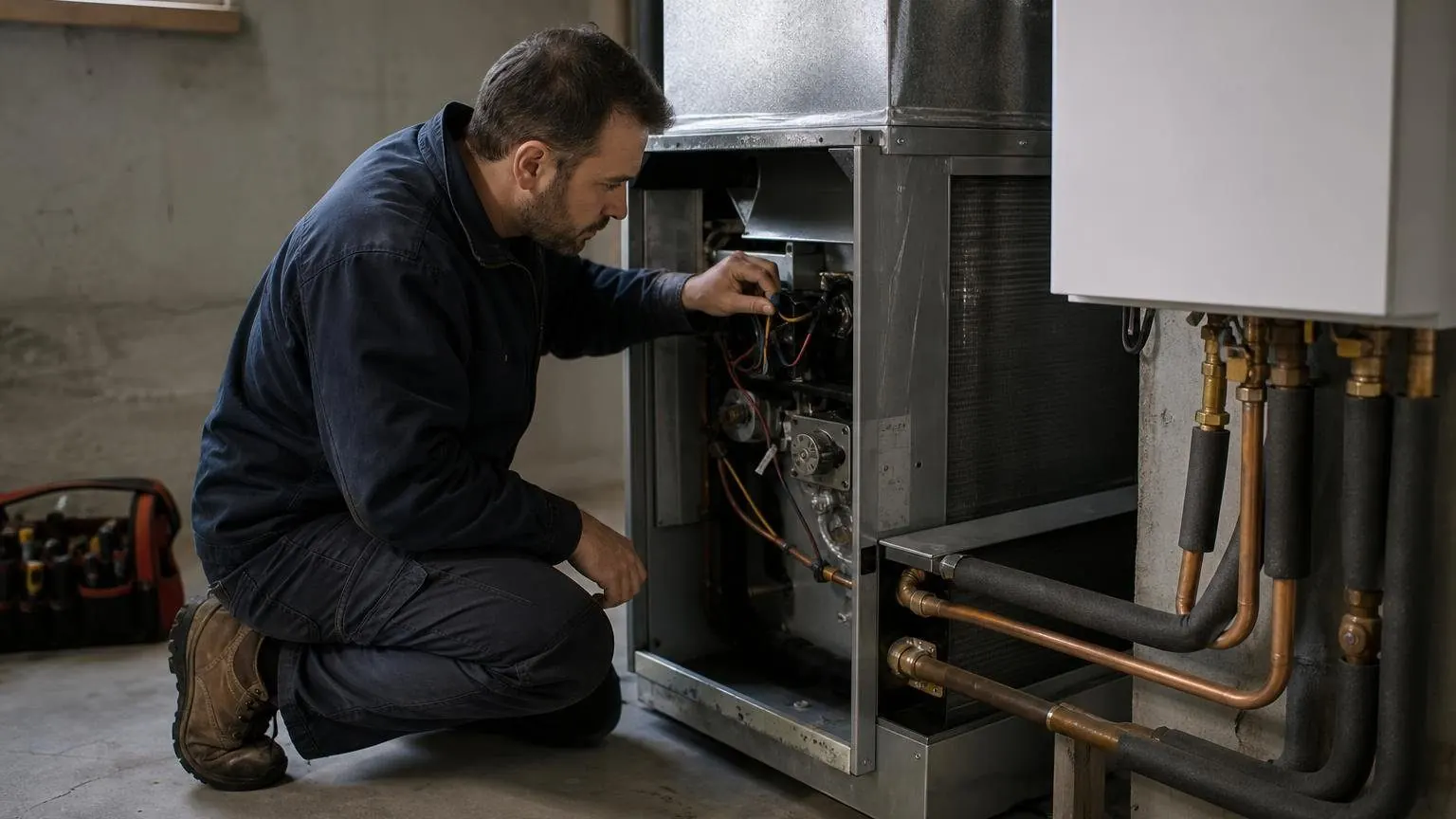
What is a hydro air system? A hydro air system is forced-air heat made from hot water: a boiler or water heater pumps water to a coil inside an air handler, and a blower pushes that heat through the ducts. The same air handler can also hold an AC coil.
Key Takeaways
- First Co. rates its FWA60-HW at 109,200 BTUH with 180°F water but 69,500 BTUH with 140°F water, per its 2025 spec sheet.
- SpacePak’s AC-WPAK-90 coil shows the same slope at 6 GPM: 87.0 MBH at 180°F and 54.9 MBH at 140°F, per its coil data sheet.
- A 30% propylene glycol mix freezes at 4°F, per SpacePak’s glycol table.
- GSA’s Green Proving Ground found condensing boiler efficiency “hinges on return water temperature below 130°F,” per its 2017 outbrief.
- Gas hot water boilers made since January 15, 2021 must reach 84% AFUE and adjust water temperature automatically, per 10 CFR 430.32.
- A DOE field test could not prove hydronic coil backup beat a propane furnace, per a 2014 case study.
What is a hydro air system?
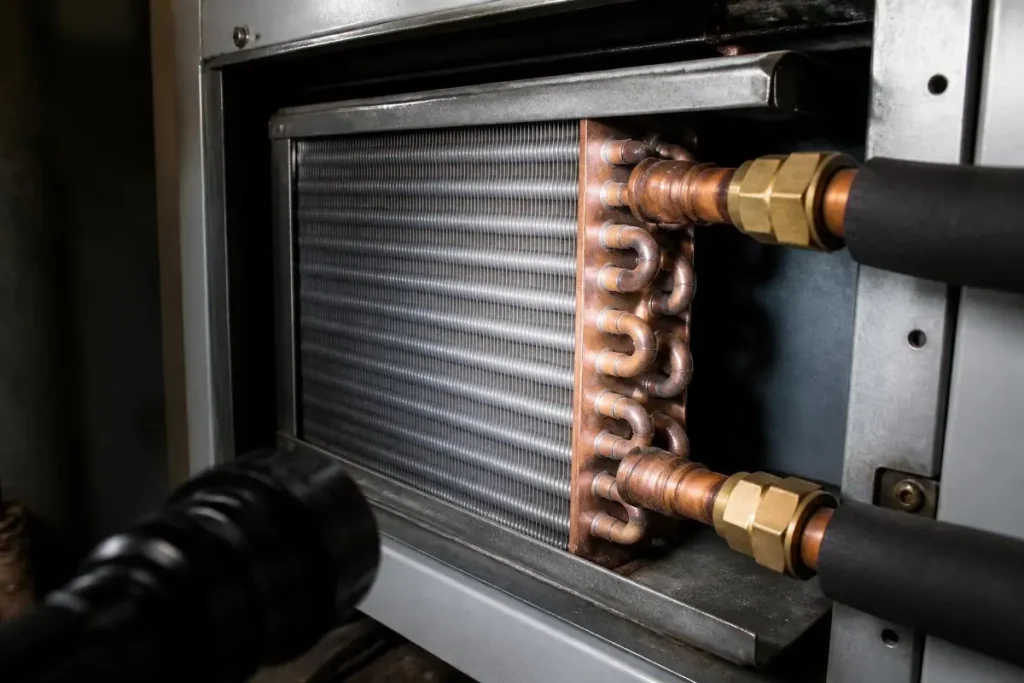
A hydro air system (also called hydro-air or a hydronic air handler) heats a house with ducted warm air, but the heat comes from hot water, not a burner in the air stream. A boiler or water heater heats the water, a pump moves it to a finned coil in the air handler, and the blower carries the heat to the registers.
It is forced-air convection, not radiant heat. First Co. says its HBXBX-HW air handlers work with “hot water boilers, and Tankless Water Heaters,” and that “multiple air handlers can be connected to a single boiler.” The water side follows the same rules as any hydronic heating loop, which we cover separately.
- Heat source: a boiler, combi boiler or water heater.
- Water side: a circulator, plus a zone valve or pump for each air handler.
- Air side: an air handler with a hot water coil, blower, filter and often an AC coil.
How does a hydro-air system work?
A thermostat call sends hot water through the coil, and the blower starts once the coil is warm. First Co.’s control board sequences it:
- A zone thermostat calls for heat.
- The zone valve opens or the zone circulator starts, and the boiler fires.
- The board holds the blower for 45 seconds to preheat the hot water coil.
- The blower pushes return air across the coil and into the supply ducts.
- When the thermostat is satisfied, the blower runs 45 more seconds.
The board can power 120V or 24V zone valves, so each air handler can be a zone. Our zone valve and the boiler circulator guides cover wiring and pump sizing.
What water temperature does a hydro air system need?
Most hydro air coils are rated at 180°F entering water, and output falls fast below that. In First Co.’s and SpacePak’s tables, 140°F water delivers about 63% to 64% of the 180°F rating, and 120°F water delivers about 45%.
| Coil or air handler (maker data) | Rating basis | 120°F | 140°F | 160°F | 180°F |
|---|---|---|---|---|---|
| First Co. FWA60-HW | 6 GPM, 1,385 CFM, 70°F air | 49.6 | 69.5 | not listed | 109.2 |
| SpacePak AC-WPAK-90 | 6 GPM, 850 CFM, 70°F air | 39.0 | 54.9 | 70.9 | 87.0 |
| First Co. 60HBXBX-HW | 20°F water drop, 1,980 CFM, 65°F air | not listed | 83.8 | 107.8 | 131.7 |
| Rinnai CAH | 3 GPM, 1,200 CFM | 33.6 | 48.3 | 62.1 | not listed |
Output in MBH (1,000 BTU per hour). Maker data from First Co., SpacePak and Rinnai spec sheets, not independent tests.
Supply air temperature is the comfort test. Using SpacePak’s leaving-air formula, LAT = BTUH ÷ (1.08 × CFM) + 70, the FWA60-HW ratings work out to about 143°F supply air with 180°F water, 116°F with 140°F water and 103°F with 120°F water (our calculation). A Building America measure guideline (BA-1206) says reaching supply air of 105°F or more generally takes water hotter than domestic hot water alone needs.
Flow matters too: at 180°F, the FWA60-HW drops from 109.2 MBH at 6 GPM to 85.3 MBH at 2 GPM.
Hot coils also fight condensing boilers. GSA found efficiency “hinges on return water temperature below 130°F.” First Co. rates its HBXBX-HW coils at a 20°F water drop, so 180°F supply returns near 160°F, too hot to condense, while 140°F supply returns near 120°F. Federal rules already require gas hot water boilers to lower supply temperature automatically as load falls.
Can a hydro air system cool and make hot water?
Yes. Cooling comes from a refrigerant coil in the same air handler; hot water comes from the same boiler or water heater. First Co. sells the HBXBX-HW as “Cooling or Heat Pump / HW Heat,” with cooling “up to 15 SEER, depending on the outdoor unit.”
With a boiler, hot water usually comes from an indirect tank, or the whole plant is a combi boiler. An air-to-water heat pump can feed the coil too, but at the lower water temperatures shown above; our air to water heat pump explainer covers that pairing.
Water heater systems run drinking water through the coil, so the coil must be potable-rated and the loop cannot sit stagnant. Rinnai’s CAH coil is NSF 372 approved and runs its pump for 1 minute every 24 hours by default. First Co. notes that Massachusetts code 248 CMR requires a pump timer running 60 seconds every 6 hours; check your local plumbing code. Our tankless water heater guide covers the heater side.
How do you keep a hydro-air coil from freezing?
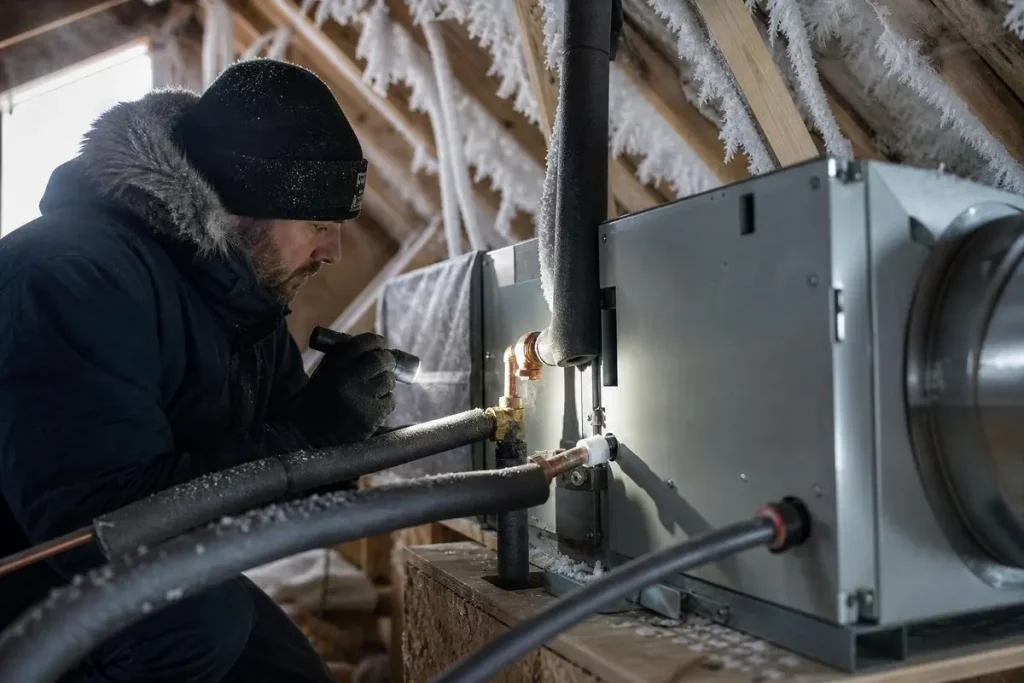
Any hydro-air coil in a space that can drop below 32°F needs freeze protection: glycol, continuous circulation, a freeze sensor or a drained coil. SpacePak’s installation instructions say its coil “may be used in an attic or crawl space but must be protected against possible freeze-up.”
SpacePak lists propylene glycol freezing at 4°F in a 30% mix, minus 13°F at 40% and minus 28°F at 50%. The penalty: at 180°F, a 50% propylene glycol solution moves 0.90 of plain water’s heat and needs 110% of the flow. First Co. sells a freeze protector kit (941-1) that switches the unit to heating “if the water temperature is nearing a freezing condition.”
Myth check: “glycol harms the system”
Not as a rule. Glycol is a trade-off with published correction factors, not a defect. Pipe insulation is a code point too: Washington’s adopted 2021 energy code requires R-6 on piping carrying fluid above 105°F, with a 1/2 inch exception for up to 200 feet inside conditioned space. Rules vary by jurisdiction.
Hydro-air vs furnace vs radiant: which fits?
Hydro-air fits a house that already needs a boiler and wants ducted heat and AC. A furnace is simpler when nothing else needs hot water; radiant floors skip ducts but need separate cooling.
| Feature | Hydro-air | Gas furnace | Hydronic radiant floor |
|---|---|---|---|
| Heat delivered by | Warm air through ducts | Warm air through ducts | Warm floor surface |
| Central AC on same system | Yes, refrigerant coil in the air handler | Yes, coil on the furnace | No, separate system |
| Domestic hot water from same plant | Yes, indirect tank or combi | No | Yes, indirect tank or combi |
| Federal efficiency floor | 84% AFUE (gas hot water boiler) | 80% AFUE; 95% from Dec. 18, 2028 | 84% AFUE (gas hot water boiler) |
Floors come from 10 CFR 430.32 for non-weatherized gas furnaces and gas hot water boilers. Our boiler vs furnace comparison covers the trade-offs.
Efficiency claims need care. In a 2014 DOE Building America case study of two identical 1,715 ft² Delaware homes, a heat pump with a hydronic coil backup posted a calculated COP of 2.67 against 2.04 for a heat pump with a propane furnace. But the team “was unable to conclude which backup heating system is more efficient.” For the furnace-backup version, see our dual fuel heat pump guide.
What goes wrong with a hydro-air system?
Most hydro-air complaints are water-side: air in the coil, a stuck zone valve, too little flow or a frozen coil. The blower side fails like any air handler.
- Blower runs, air is cool: no hot water at the coil. Check the zone valve, circulator and boiler temperature.
- Gurgling or a cold coil top: trapped air. Bleed the coil’s manual vent; SpacePak says air should be purged “at least once a year.”
- Weak heat on cold days: water temperature or flow below the coil’s rating.
- Low airflow: a dirty filter or coil. SpacePak says the coil surface “should be cleaned at least once a year.”
- Leak after a cold snap: likely freeze damage; check the glycol or freeze control.
If the boiler will not fire, start with our boiler troubleshooting checklist. For coil placement and duct connections, see our air handler installation guide.
How we researched this
Research date: October 28 to 29, 2026. We read maker literature from First Co. (FWA-HW, HBXBX-HW), SpacePak (WPAK data sheet and installation instructions) and Rinnai (CAH), plus 10 CFR 430.32, Washington’s 2021 energy code text, a GSA Green Proving Ground outbrief, DOE Building America reports and BA-1206. We also read the top three ranking articles.
Excluded: contractor cost ranges and lifespan claims (no federal series), Reddit, and a Massachusetts guidance PDF we could not open. Coil figures are maker ratings, not our tests.
Frequently asked questions
Is a hydro air system the same as radiant heat?
No. A hydro air system heats air that a blower pushes through ducts, which is forced-air convection. Radiant systems heat a floor or panel that warms the room directly. Both can share one boiler; First Co. says several of its air handlers can run from a single boiler.
Can a hydro air system run on a tankless water heater?
Yes, with the right parts. First Co. says a flow control module (#940-2CV) is required when its HBXBX-HW connects to an individual tankless water heater. Rinnai specifies its CAH air handler at a nominal 50,000 BTU/hr with 140°F water, 3 GPM and 1,200 CFM.
How hot should boiler water be for a hydro air coil?
Most coils are rated at 180°F. First Co. says its fan coils suit any hot water source that “doesn’t exceed 180°” and is certified for domestic water. Its FWA60-HW gives 109,200 BTUH at 180°F and 69,500 BTUH at 140°F. Cooler water helps a condensing boiler but needs a bigger coil.
Can a hydro air handler go in the attic?
Yes, if it is protected from freezing. SpacePak says its coil may be used in an attic or crawl space but must be protected against freeze-up, for example by continuously circulating the water or draining the coil. Glycol is the other route: a 30% propylene glycol mix freezes at 4°F, per SpacePak’s table.
How long does a hydronic air handler last?
No federal data series tracks hydro-air lifespan, so we publish no number. Makers do specify upkeep. SpacePak calls for cleaning the coil surface at least once a year and purging air from the piping at least once a year. It also recommends 1/2 inch foam pipe insulation rated for 220°F.
Can a heat pump work with a hydro air system?
Yes. In a 2014 Building America case study in Delaware, a heat pump used a hydronic coil on a condensing tankless water heater as backup heat. It posted a calculated COP of 2.67, but the team could not conclude it beat the propane furnace backup in the matching house.
Sources
- First Co. “FWA-HW Spec” (August 2025). https://firstco.com/wp-content/uploads/2022/11/FWA_HW_08_01_2025.pdf. Accessed October 2026.
- First Co. “HBXBX-HW Series Hydronic Air Handler.” https://firstco.com/wp-content/uploads/2021/08/HBXBX-HW420.pdf. Accessed October 2026.
- SpacePak. “Water Pak Hydronic Coils” (WPAKI-109). https://resource.gemaire.com/is/content/Watscocom/Gemaire/spacepak_45ac-wpak-120_article_1403693661284_en_ss.pdf?fmt=pdf. Accessed October 2026.
- SpacePak. “Model WPAK Hydronic Coil Installation Instructions.” https://resource.gemaire.com/is/content/Watscocom/Gemaire/spacepak_45ac-wpak-120_article_1403693661284_en_ii.pdf?fmt=pdf. Accessed October 2026.
- Rinnai. “CAH Engineering Specifications” (January 2022). https://media.rinnai.us/salsify_asset/s-ba2e065f-2caf-4c1b-8a55-b23310983d45/600000027%20CAH%20Engineering%20Spec%20Sheet.pdf. Accessed October 2026.
- eCFR. “10 CFR 430.32, Energy and water conservation standards.” https://www.ecfr.gov/current/title-10/chapter-II/subchapter-D/part-430/subpart-C/section-430.32. Accessed October 2026.
- U.S. General Services Administration. “GPG Outbrief 04: Condensing Boilers” (July 13, 2017). https://origin-www.gsa.gov/system/files/04-Condensing%20Boilers.pdf. Accessed October 2026.
- Washington State Legislature. “WAC 51-11R-40330 (R403.4).” https://lawfilesext.leg.wa.gov/Law/WAC/WAC%20%2051%20%20TITLE/WAC%20%2051%20-%2011R%20CHAPTER/WAC%20%2051%20-%2011R-40330.htm. Accessed October 2026.
- U.S. DOE Building America. “Hydronic Heating Coil Versus Propane Furnace, Rehoboth Beach, Delaware” (January 2014). https://www.energy.gov/sites/prod/files/2014/01/f7/case_study_hydronic_coil_vs_propane.pdf. Accessed October 2026.
- Building Science Corporation. “BA-1206: Measure Guideline, Combination Forced-Air Space and Tankless DHW Systems” (2012). https://www.buildingscience.com/documents/bareports/ba-1206-measure-guideline-combination-forced-air-space-tankless-domestic-hot-water-heating-systems/view. Accessed October 2026.
Leave a Reply