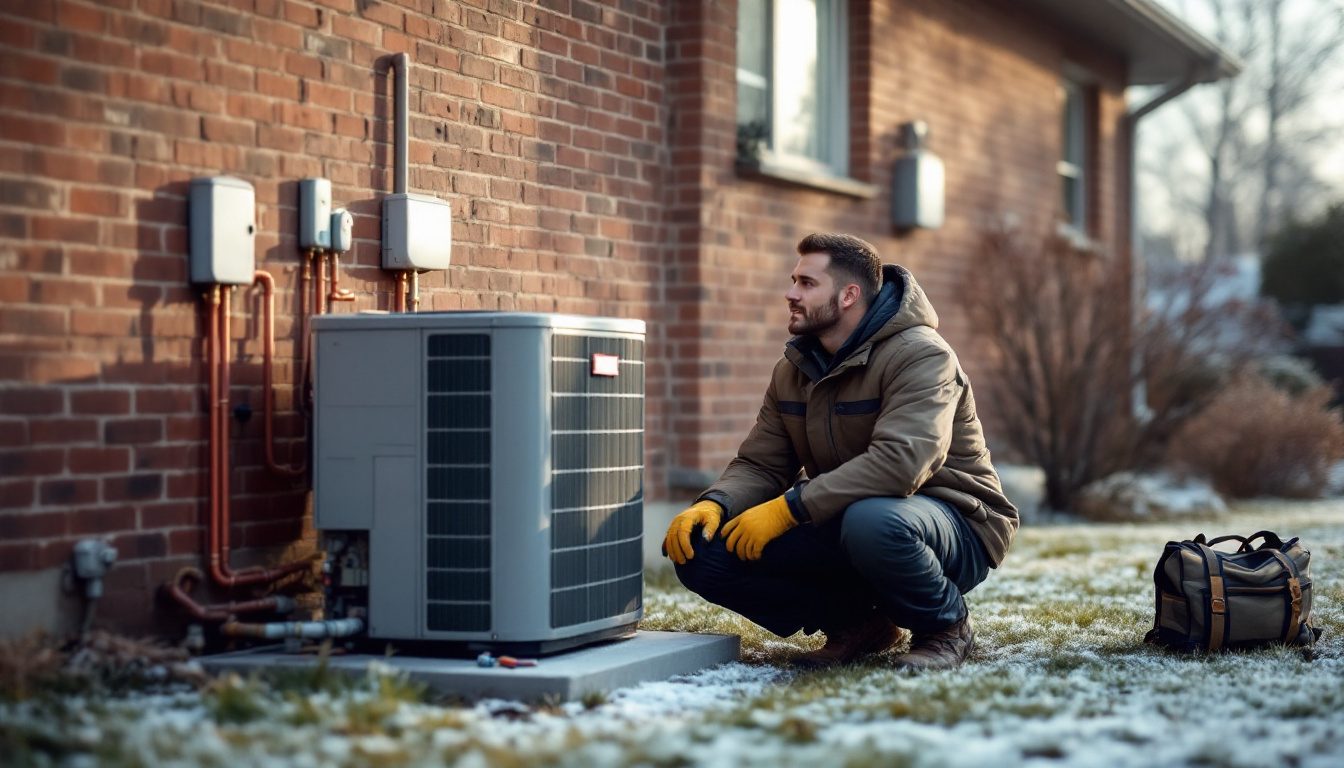
What is a dual fuel heating system? A dual fuel heating system pairs an electric heat pump with a gas or propane furnace and switches between them by outdoor temperature. The right switchover is set by local energy prices, not a fixed 32°F: at 2025/26 EIA prices it ran from below 5°F in Arkansas to above 47°F in Michigan.
Key Takeaways
- Breakeven heat pump COP = electricity cost per million Btu over gas cost per million Btu, times furnace AFUE, as in NEEA’s March 2026 analysis.
- At EIA’s forecast for October 2026 to March 2027, a heat pump needs a COP above 3.68 to undercut a 95% AFUE gas furnace (our arithmetic on the Short-Term Energy Outlook).
- The median of 2,379 ducted outdoor units on the NEEP heat pump list is rated COP 3.38 at 47°F, 2.46 at 17°F and 1.92 at 5°F.
- Across 40 states and DC with complete 2025/26 EIA price data, the breakeven COP against a 95% furnace ranged from 1.57 in Arkansas to 5.71 in Alaska.
- Against propane the breakeven COP is only 1.85, so the median listed heat pump beats a 95% propane furnace down to 5°F.
- No federal 25C credit applies to systems placed in service after December 31, 2025, per the IRS.
What is a dual fuel heating system?
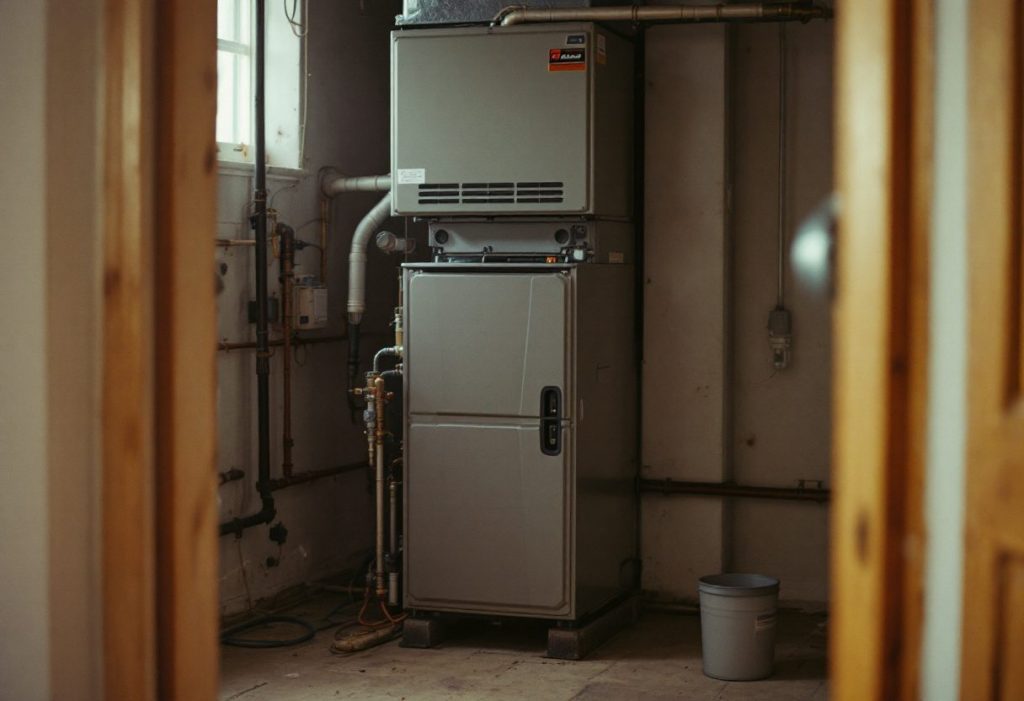
A dual fuel heating system is a ducted heat pump paired with a gas or propane furnace that shares its blower and ducts. The heat pump heats in mild weather and the furnace takes over in the cold, replacing the electric resistance strips that back up an all-electric heat pump.
It is also sold as a hybrid heating system; the outdoor unit is a normal heat pump (see how a heat pump moves heat). A control with an outdoor sensor picks the side that runs. NEEA notes both can run in a day but never in the same hour, unlike the auxiliary strip heat that runs alongside a compressor.
How does a dual fuel heating system decide when to switch?
A dual fuel heating system switches at the higher of two temperatures: the balance point, where the heat pump can no longer keep up, and the economic switchover, where its heat costs more than the furnace’s.
DOE puts the balance point usually well below 40°F for code-built homes. NEEA calls the switchover temperature “the largest lever” on gas use. The economic switchover takes four steps:
- Electricity in dollars per million Btu (MMBtu): cents per kWh divided by 100, then by 0.003412 (one kWh is 3,412 Btu).
- Gas: dollars per thousand cubic feet (Mcf) divided by 1.036 (one cubic foot is 1,036 Btu, per EIA’s Btu table).
- Breakeven COP = electricity cost per MMBtu divided by gas cost per MMBtu, times furnace AFUE.
- Find the outdoor temperature where your heat pump’s COP falls to that number. Above it, the heat pump is cheaper.
At this winter’s national forecast, 18.28 cents per kWh is $53.56 per MMBtu and $14.32 per Mcf is $13.82. Electricity costs 3.88 times as much per Btu, so the breakeven COP is 3.68 against a 95% furnace and 3.10 against an 80% one.
Correction: there is no standard 32°F switchover
Manufacturer and contractor pages ranking for this topic give 32°F, 35°F or minus 13°F, a 48 degree spread, with no price arithmetic. The right setting comes from the formula, and it moves when prices move.
What switchover temperature makes sense in your state?
At last winter’s prices the economic switchover ran from below 5°F in Arkansas to above 47°F in New York, Illinois and Michigan. In 22 of 41 jurisdictions with complete EIA data (40 states and DC), the median heat pump at full output cost more than a 95% furnace at every rated temperature.
Prices are October 2025 to March 2026: electricity is EIA-861M residential revenue over sales, gas the average of EIA’s monthly residential prices. The switchover column reads it against the median NEEP ducted heat pump at lowest, then full, output. We track electricity rates and gas rates by state.
| State | Electricity, cents/kWh | Gas, per Mcf | Breakeven COP, 95% furnace | Economic switchover |
|---|---|---|---|---|
| Arkansas | 12.85 | $23.54 | 1.57 | below 5°F |
| Texas | 15.90 | $22.61 | 2.03 | below 5°F to 7°F |
| Georgia | 14.34 | $19.38 | 2.13 | 6 to 10°F |
| Arizona | 15.64 | $19.36 | 2.33 | 10 to 14°F |
| Alabama | 16.32 | $18.55 | 2.54 | 15 to 20°F |
| Oregon | 15.08 | $16.61 | 2.62 | 17 to 22°F |
| Virginia | 15.99 | $17.44 | 2.64 | 18 to 23°F |
| Tennessee | 13.31 | $14.13 | 2.72 | 19 to 25°F |
| Kansas | 14.85 | $14.59 | 2.94 | 23 to 33°F |
| Massachusetts | 30.85 | $24.98 | 3.56 | 33°F to above 47°F |
| Ohio | 17.74 | $14.19 | 3.61 | 34°F to above 47°F |
| Pennsylvania | 20.33 | $15.50 | 3.78 | 37°F to above 47°F |
| Minnesota | 15.36 | $10.65 | 4.16 | 43°F to above 47°F |
| New York | 28.07 | $18.20 | 4.45 | above 47°F |
| Illinois | 17.74 | $11.44 | 4.47 | above 47°F |
| Michigan | 20.06 | $10.87 | 5.32 | above 47°F |
| US forecast, winter 2026/27 | 18.28 | $14.32 | 3.68 | 35°F to above 47°F |
Two cautions: averages include fixed charges, so use the energy rates on your bill, and the straight line from 47°F to 17°F ignores defrost losses, so set the switchover a few degrees higher. Our heat pump vs gas furnace comparison gives season-average costs by state.
How efficient is the heat pump half of a hybrid heating system?
The heat pump in a hybrid heating system loses efficiency as it gets colder. The median ducted outdoor unit on the NEEP list delivers 3.38 units of heat per unit of electricity at 47°F, 2.46 at 17°F and 1.92 at 5°F at full output, and 4.37, 2.61 and 2.10 at lowest output.
Of those 2,379 units, 2,359 are variable capacity. Under 10 CFR 430.32 a split heat pump must reach 7.5 HSPF2 and a gas furnace 80% AFUE, rising to 95% for units made from December 18, 2028.
The ENERGY STAR Cold Climate label needs a COP of at least 1.75 at 5°F and 70% of 47°F capacity at 5°F, per the Version 6.2 specification. On the certified list, the median split-system outdoor model is rated COP 2.00 at 5°F.
With gas backup that rating matters less: NEEA concluded performance below 30°F “is not important because gas heating will run then”. A cold climate heat pump matters more with propane, where NEEA advised sizing to a 20°F balance point or lower. See our cold weather data for how the median unit holds capacity.
Does a dual fuel heating system actually save money?
A dual fuel heating system saves money where electricity is cheap relative to the backup fuel. In NEEA’s 2026 modelling, adding a single-speed heat pump with a 35°F switchover cut a Portland home’s annual operating cost from $1,093 to $842; in Bozeman it went from $1,645 to $1,652.
NEEA used 2023 EIA rates. In Portland a 30°F switchover cost $821 a year and a 40°F one $912. With propane in Missoula, the furnace alone cost $3,324 against $2,294 with a heat pump sized to a 20°F balance point.
Cost of one million Btu delivered, at this winter’s national forecast:
| Heat source | Efficiency used | Cost per MMBtu delivered | Role in a dual fuel system |
|---|---|---|---|
| Heat pump at 47°F, lowest output | COP 4.37 | $12.26 | Mild-weather heating |
| Gas furnace, 95% AFUE | 0.95 | $14.54 | Backup below the switchover |
| Heat pump at 47°F, full output | COP 3.38 | $15.85 | Mild-weather heating |
| Gas furnace, 80% AFUE | 0.80 | $17.27 | Common existing backup |
| Heat pump at 17°F, full output | COP 2.46 | $21.77 | Beats gas only in low-ratio states |
| Heat pump at 5°F, full output | COP 1.92 | $27.90 | Still beats propane |
| Propane furnace, 95% AFUE | 0.95 | $28.98 | Backup in propane homes |
| Electric resistance strips | COP 1.0 | $53.56 | What the furnace replaces |
The last row is the case for dual fuel: in a cold snap the furnace replaces resistance heat costing about 3.7 times as much as 95% gas heat. The types of home heating systems guide compares other fuels.
Who should choose a dual fuel heat pump, and who should not?
A dual fuel heat pump fits best where a home has a gas or propane furnace and needs a new air conditioner, since the heat pump cools too. It fits worst where gas is cheap.
- Propane homes: the strongest case. NEEA put the propane breakeven COP in Idaho and Montana at only 1.3; the national forecast gives 1.85. See our propane heating guide.
- Low-ratio states (Arkansas, Texas, Georgia): the furnace may barely run; compare all-electric.
- High-ratio states (Michigan, Illinois, New York): savings are small or negative unless a variable-speed unit runs mostly at low output.
The 25C credit, worth up to $2,000 for a qualifying heat pump, ended for anything placed in service after December 31, 2025; see the expired 25C credit. A gas furnace made from December 18, 2028 must reach 95% AFUE under the new furnace rule.
To commission one, confirm the control is dual fuel capable with an outdoor sensor, set the switchover from your bill rates and the heat pump’s NEEP COP figures, and recheck yearly.
How we researched this
Researched October 8, 2026. Ranking vendor pages were read only for claims to test. Figures come from NEEA, EIA price files, the NEEP list (2,379 ducted outdoor units), ENERGY STAR’s 284,866 certified combinations (deduplicated by outdoor model), 10 CFR 430.32 and the IRS. Medians, breakeven COPs and switchovers are our arithmetic. Excluded: installed prices (no federal series), manufacturer savings claims, ten states with withheld EIA gas data, and Reddit (gas combustion topic).
Frequently asked questions
Is a dual fuel heating system worth it?
Where electricity is cheap relative to gas, or propane is the backup, yes. NEEA’s 2026 modelling cut a Portland home’s operating cost from $1,093 to $842 a year but found no saving in Bozeman, where gas is cheaper. Work out your breakeven COP first.
What temperature should a dual fuel system switch to gas?
The higher of the balance point and the economic switchover. Divide electricity cost per MMBtu by gas cost per MMBtu, times furnace AFUE, and find where the heat pump’s COP falls to that figure. At 2025/26 prices that ran from below 5°F in Arkansas to above 47°F in Michigan.
How much does a dual fuel HVAC system cost?
No federal series publishes installed dual fuel prices, so we quote none. NEEA’s 2026 analysis put the extra cost over a furnace and air conditioner at “multiple thousands” of dollars, as a rough estimate. The 25C credit ended for systems placed in service after December 31, 2025.
Can I add a heat pump to an existing gas furnace?
Usually, yes. The heat pump replaces the outdoor air conditioner, its coil sits on the furnace, and a dual fuel capable control is added. NEEA found that sizing for cooling in most Northwest climates lands close to a 30°F balance point, big enough for dual fuel heating.
Does a dual fuel system run the heat pump and furnace together?
Normally not. NEEA notes that under switchover control both can run in one day but never in the same hour; simultaneous operation needs special designs not yet commonplace. Electric auxiliary heat runs alongside the compressor, at about $53.56 per MMBtu this winter.
Do I need a cold climate heat pump for dual fuel?
Not with gas backup: NEEA concluded performance below 30°F “is not important because gas heating will run then”. Propane changes that: the national breakeven COP against a 95% propane furnace is 1.85, and the median NEEP ducted unit still delivers 1.92 at 5°F.
Sources
- Northwest Energy Efficiency Alliance (presented by Ben Larson). “Dual-Fuel Gas Furnace + Heat Pump System Control Analysis.” March 10, 2026. https://neea.org/wp-content/uploads/2026/03/Dual-Fuel-Gas-Furnace-and-Heat-Pump-System-Control.pdf Accessed October 2026.
- U.S. Energy Information Administration. “Short-Term Energy Outlook, October 2026, Table 2.” https://www.eia.gov/outlooks/steo/xls/STEO_m.xlsx Accessed October 2026.
- U.S. Energy Information Administration. “Form EIA-861M sales and revenue by state.” https://www.eia.gov/electricity/data/eia861m/xls/sales_revenue.xlsx Accessed October 2026.
- U.S. Energy Information Administration. “Average residential price of natural gas by state.” https://www.eia.gov/dnav/ng/xls/NG_PRI_SUM_A_EPG0_PRS_DMCF_M.xls Accessed October 2026.
- U.S. Energy Information Administration. “British thermal units (Btu).” https://www.eia.gov/energyexplained/units-and-calculators/british-thermal-units.php Accessed October 2026.
- NEEP. “Air source heat pump product list.” https://ashp.neep.org/ Accessed October 2026.
- ENERGY STAR. “Version 6.2 heat pump specification.” https://www.energystar.gov/sites/default/files/2025-04/ENERGY%20STAR%20Version%206.2%20Heat%20Pump%20Specification%20Rev.%20March%202025.pdf Accessed October 2026.
- ENERGY STAR. “Certified air-source heat pumps.” https://data.energystar.gov/Active-Specifications/ENERGY-STAR-Certified-Air-Source-Heat-Pumps/w7cv-9xjt Accessed October 2026.
- eCFR. “10 CFR 430.32.” https://www.ecfr.gov/current/title-10/chapter-II/subchapter-D/part-430/subpart-C/section-430.32 Accessed October 2026.
- U.S. Department of Energy. “Air-Source Heat Pumps” (archived copy). https://web.archive.org/web/2025id_/https://www.energy.gov/energysaver/air-source-heat-pumps Accessed October 2026.
- Internal Revenue Service. “Energy efficient home improvement credit.” https://www.irs.gov/credits-deductions/energy-efficient-home-improvement-credit Accessed October 2026.
Leave a Reply