
What are the types of home heating systems? Four families cover nearly every US home: furnaces that blow warm air through ducts, heat pumps that move outdoor heat indoors, boilers that circulate hot water or steam, and room heaters. Furnaces are the main heat in 60% of US homes.
Key Takeaways
- Central furnaces were the main heat in 74.42 million of 123.53 million US homes in 2020 (60.2%), per EIA RECS table HC6.1.
- Heat pumps heated 16.13 million homes (13.1%) and boilers 9.29 million (7.5%), per the same RECS 2020 table.
- New gas furnaces need 80% AFUE now and 95% from December 18, 2028, under 10 CFR 430.32.
- Split heat pumps need 7.5 HSPF2, about 2.2 units of heat per unit of electricity, under the same federal rule.
- This winter, heat costs about $14.54 per million Btu from a 95% gas furnace, $24.37 from a heat pump and $53.56 from electric resistance (our arithmetic on EIA forecasts).
What are the main types of home heating systems, and how common is each?
The main types of home heating systems are central furnaces, heat pumps, boilers, built-in electric units, gas or oil room heaters, portable electric heaters, wood stoves and ductless mini-splits. These are the categories in EIA’s Residential Energy Consumption Survey (RECS).
The table ranks each type by its 2020 share of 123.53 million homes (our arithmetic on EIA table HC6.1), with minimums from 10 CFR 430.32.
| System type | Fuels | How heat reaches rooms | Rating and federal minimum | Main heat in (2020) |
|---|---|---|---|---|
| Central furnace | Gas, electric, propane, oil | Ducted warm air | AFUE: 80% gas, 83% oil, 78% electric | 74.42 million (60.2%) |
| Heat pump (ducted) | Electricity | Ducted warm air | HSPF2: 7.5 split, 6.7 packaged | 16.13 million (13.1%) |
| Boiler (steam or hot water) | Natural gas, oil, electricity | Radiators, convectors, floor tubing | AFUE: 84% gas hot water, 82% gas steam, 86% oil hot water | 9.29 million (7.5%) |
| Built-in electric units | Electricity | Baseboard or wall unit per room | No federal minimum | 7.65 million (6.2%) |
| Built-in gas or oil room heater | Natural gas, propane, oil | Wall furnace or room heater | AFUE: 75% for small gas wall fan units | 3.49 million (2.8%) |
| Portable electric heaters | Electricity | Plug-in unit | No federal minimum | 3.03 million (2.5%) |
| Wood stove | Wood | Stove in a room | Not covered by 10 CFR 430.32 | 1.94 million (1.6%) |
| Ductless mini-split | Electricity | Indoor heads, no ducts | HSPF2: 7.5 as a split system | 1.06 million (0.9%) |
Another 5.79 million homes (4.7%) used no heating equipment and 0.74 million (0.6%) other equipment. Natural gas was the main fuel in 62.71 million homes (50.8%), electricity in 42.57 million (34.5%), propane in 5.21 million and oil or kerosene in 4.93 million; our breakdown of the national fuel and equipment mix splits it by region.
Furnaces: the most common home heating systems
A furnace heats air with a burner or electric elements, and a blower pushes it through ducts to every room. Gas furnaces were the main heat in 53.26 million homes in 2020, electric 13.82 million, propane 4.03 million and oil 3.10 million, per EIA RECS.
Efficiency is rated in AFUE, the share of fuel energy that becomes heat over a year. DOE’s Energy Saver guide (archived copy) puts old natural-draft units at 56% to 70% AFUE and condensing models at 90% to 98.5%. Federal minimums are 80% for gas (95% from December 18, 2028), 83% for oil and 78% for electric.
AFUE stops at the cabinet. DOE says duct losses can reach 35% of output when ducts run through an attic, garage or other unconditioned space; our explainer on how central heating works covers the blower and return side.
How do heat pumps differ from furnaces?
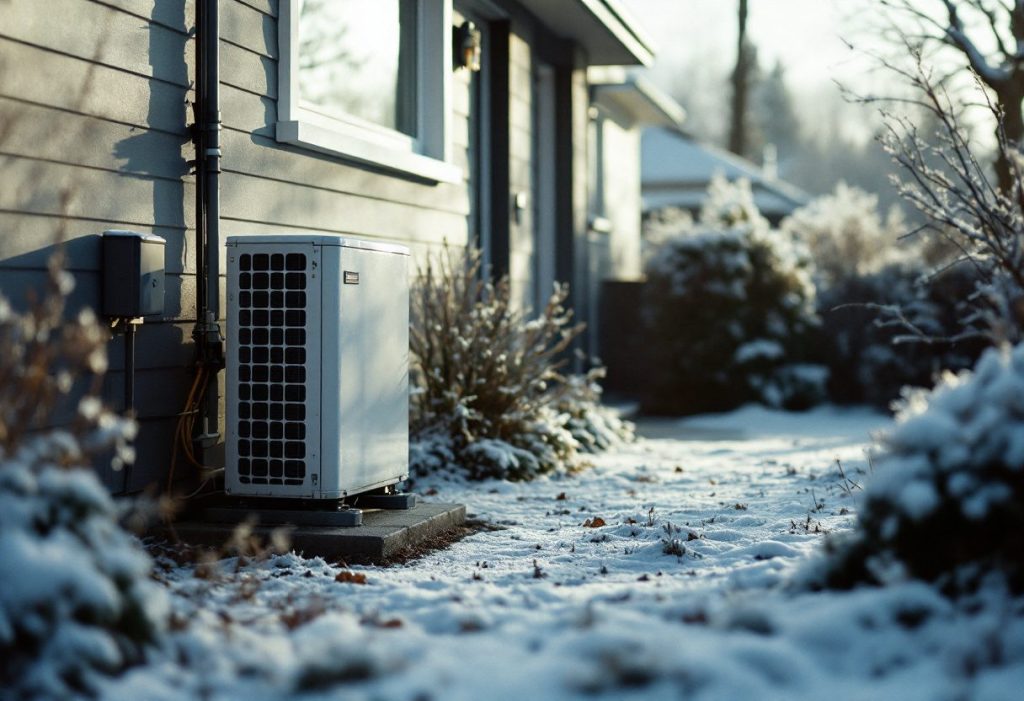
A heat pump moves heat rather than making it: a refrigerant circuit pulls heat from outdoor air, the ground or water and releases it indoors. RECS 2020 counted 16.13 million homes heated mainly by a ducted heat pump and 1.06 million by a ductless mini-split.
DOE’s heat pump guide (archived copy) defines HSPF as Btu of heat per kWh, so a 10.3 HSPF unit gives 10,300 Btu per kWh, and says 8.8 HSPF equals 7.5 HSPF2. Dividing the 7.5 HSPF2 floor by 3,412 Btu per kWh gives a seasonal coefficient of performance (COP) of about 2.2.
Mini-splits suit additions and houses without ducts; our guide to how the refrigerant cycle moves heat explains defrost and the reversing valve.
DOE estimates ground-source system life at up to 24 years indoors and 50+ years for the ground loop; our geothermal heat pump guide compares loops. A dual fuel setup adds a gas or propane furnace for deep cold.
What are boilers and hydronic heating systems?
A boiler heats water or makes steam, and pipes carry it to radiators, baseboard convectors or floor tubing. Steam and hot water systems were the main heat in 9.29 million homes in 2020: 6.51 million on natural gas and 1.62 million on fuel oil or kerosene, per EIA RECS.
Boilers made since January 15, 2021 must meet 84% AFUE for gas hot water, 82% for gas steam and 86% for oil hot water. Our hydronic heating explainer covers pumps and zoning; our guide to older steam heat covers radiators.
Radiant floors run on boiler water or electric cables. DOE’s radiant heating page (archived copy) says radiant heat eliminates duct losses, which makes it usually more efficient than forced air. Our radiant floor heating comparison sets hydronic against electric.

When do room heaters, baseboards and stoves make sense?
Room heaters fit homes without ducts or pipes, mild climates, or a single cold room. Built-in electric units, gas or oil room heaters, portable electric heaters and wood stoves were together the main heat in about 16.1 million homes in 2020, roughly 13% (our sum of the RECS rows).
Built-in electric units, mostly baseboards and in-wall heaters, led at 7.65 million homes. Every kWh yields only 3,412 Btu, as our electric baseboard heater guide shows against a heat pump.
Gas or oil room heaters heated 3.49 million homes; a gas wall fan-type unit up to 42,000 Btu/h must meet 75% AFUE, and our wall heater guide separates gas from electric. Wood stoves were the main heat in 1.94 million homes; our wood and pellet stove guide covers EPA certification.
Which types of home heating systems cost least to run?
On national average prices, a condensing gas furnace is the cheapest of the types of home heating systems to run this winter, followed by a heat pump, propane, oil and electric resistance. Figures are cost per million Btu delivered, October 2026 through March 2027.
Method: we averaged EIA’s monthly Short-Term Energy Outlook residential price forecasts, converted them with EIA heat content factors (1,036 Btu per cubic foot of gas, 138,500 Btu per gallon of heating oil, 91,452 Btu per gallon of propane, 3,412 Btu per kWh) and divided by the efficiency shown. Duct and pipe losses are excluded.
| System | Forecast fuel price | Efficiency assumed | Cost per million Btu delivered |
|---|---|---|---|
| Gas furnace, condensing | $14.32 per thousand cubic feet | 95% AFUE | $14.54 |
| Gas boiler, hot water | $14.32 per thousand cubic feet | 84% AFUE | $16.45 |
| Gas furnace, minimum today | $14.32 per thousand cubic feet | 80% AFUE | $17.27 |
| Heat pump at federal minimum | 18.28 cents per kWh | 7.5 HSPF2 (COP about 2.2) | $24.37 |
| Propane furnace, condensing | $2.52 per gallon | 95% AFUE | $28.98 |
| Oil boiler, hot water | $5.43 per gallon | 86% AFUE | $45.55 |
| Oil furnace | $5.43 per gallon | 83% AFUE | $47.20 |
| Electric resistance (baseboard, electric furnace) | 18.28 cents per kWh | 100% | $53.56 |
Most efficient is not the same as cheapest
A heat pump at the federal minimum turns one unit of electricity into about 2.2 units of heat, yet costs more per Btu than gas because electricity costs about 3.9 times as much as gas per Btu bought. At the forecast gas price it beats a 95% gas furnace only where power costs under about 10.9 cents per kWh; a seasonal COP of 3 breaks even near 14.9 cents.
HSPF2 is rated for one reference climate (Region IV in the federal rule), so colder places see lower seasonal output. Our analysis of what heat costs by fuel shows where heat pumps overtake gas.
How do you choose among the types of home heating systems?
Start with the distribution the house already has, because it is the costly part to change: ducts favor a furnace or heat pump, hot water pipes favor a boiler, and neither points to mini-splits or room heaters. Fuel access, climate and cooling needs narrow it further.
- Map the distribution: ducts, hot water or steam pipes, or neither.
- Check fuel access: piped gas changes the math; propane and oil were the costliest fuel-fired options above.
- Weigh climate: in mild climates one heat pump heats and cools; in cold ones, consider a cold-rated heat pump or dual fuel.
- Price the heat: divide your local fuel price by Btu content and efficiency before comparing quotes.
- Size it: ask for a written room-by-room heat loss calculation.
RECS 2020 found 23.54 million homes, about one in five, with main heating equipment 20 or more years old. Choosing a type before the old unit fails leaves time to compare.
How we researched this
Research date: October 8, 2026. We consulted 12 sources and cited 8. Equipment counts are from EIA RECS 2020 table HC6.1 (final release March 2023), which does not break out geothermal or dual fuel systems. Minimums were read from the current eCFR text of 10 CFR 430.32.
Installed prices were excluded because no federal series covers every type. Reddit was not used because the topic includes gas combustion. We read the top three ranking pages for gaps only and took no figures from them.
Frequently asked questions
What is the most common type of home heating system?
The central furnace. EIA’s 2020 RECS counted 74.42 million US homes, about 60.2%, using a central warm-air furnace as main heating equipment. Most of those furnaces burn natural gas: gas furnaces alone were the main heat in 53.26 million homes that year.
What is the cheapest type of heating system to run?
On national average prices, a condensing gas furnace. At EIA’s October 2026 winter forecasts, a 95% AFUE gas furnace delivers heat for about $14.54 per million Btu, against $24.37 for a heat pump at the federal minimum and $53.56 for electric resistance. Local rates can flip that order.
What is the most efficient type of heating system?
Heat pumps, because they move heat instead of making it. A split heat pump at the federal floor of 7.5 HSPF2 delivers about 2.2 units of heat per unit of electricity over a season. The best condensing furnaces reach 98.5% AFUE, per DOE, just under one unit per unit of fuel.
What are the three main types of heating systems?
Furnaces, heat pumps and boilers. Together they were the main heating equipment in 99.84 million of 123.53 million US homes in 2020, or 80.8%, per EIA RECS. Furnaces and heat pumps usually share ducts; boilers send hot water or steam through pipes.
How long do home heating systems last?
Federal sources give few lifespan figures. DOE estimates geothermal heat pump life at up to 24 years for indoor parts and 50+ years for the ground loop. EIA’s RECS 2020 found 23.54 million homes whose main heating equipment was 20 or more years old.
Do you need ductwork for central heat?
No. Boilers heat through pipes, and they were the main heat in 9.29 million US homes in 2020, per EIA RECS. Ductless mini-splits heated another 1.06 million and built-in electric units such as baseboards 7.65 million. Only furnaces and ducted heat pumps need ducts.
Sources
- U.S. Energy Information Administration. “RECS 2020, Table HC6.1: Space heating in U.S. homes.” https://www.eia.gov/consumption/residential/data/2020/hc/xls/HC%206.1.xlsx Accessed October 2026.
- Electronic Code of Federal Regulations. “10 CFR 430.32: Energy conservation standards.” https://www.ecfr.gov/current/title-10/chapter-II/subchapter-D/part-430/subpart-C/section-430.32 Accessed October 2026.
- U.S. Energy Information Administration. “Short-Term Energy Outlook, October 2026, Table 2.” https://www.eia.gov/outlooks/steo/xls/STEO_m.xlsx Accessed October 2026.
- U.S. Energy Information Administration. “British thermal units (Btu),” Energy Explained. https://www.eia.gov/energyexplained/units-and-calculators/british-thermal-units.php Accessed October 2026.
- U.S. Department of Energy, Energy Saver. “Furnaces and Boilers” (archived copy). https://web.archive.org/web/2025id_/https://www.energy.gov/energysaver/furnaces-and-boilers Accessed October 2026.
- U.S. Department of Energy, Energy Saver. “Air-Source Heat Pumps” (archived copy). https://web.archive.org/web/2025id_/https://www.energy.gov/energysaver/air-source-heat-pumps Accessed October 2026.
- U.S. Department of Energy, Energy Saver. “Geothermal Heat Pumps” (archived copy). https://web.archive.org/web/2025id_/https://www.energy.gov/energysaver/geothermal-heat-pumps Accessed October 2026.
- U.S. Department of Energy, Energy Saver. “Radiant Heating” (archived copy). https://web.archive.org/web/2025id_/https://www.energy.gov/energysaver/radiant-heating Accessed October 2026.
Leave a Reply