Last reviewed: September 2026 · By the HVAC Brief Editorial Team · Our sourcing and editorial standards
Radiant floor heating warms a room from the floor up, using hot water tubing or electric cables under the surface. The Department of Energy’s guidance says radiant heating “is more efficient than baseboard heating and usually more efficient than forced-air heating because it eliminates duct losses.”
Running cost depends on the heat source. A hydronic floor fed by a minimum-efficiency gas boiler delivered heat for about $17.92 per million Btu at 2025/26 prices; an electric floor is resistance heat, at about $52.10.
How radiant floor heating works
Heat passes from a warm floor surface directly to people and objects in the room, rather than being carried by moving air. There are no ducts to lose heat along the way.
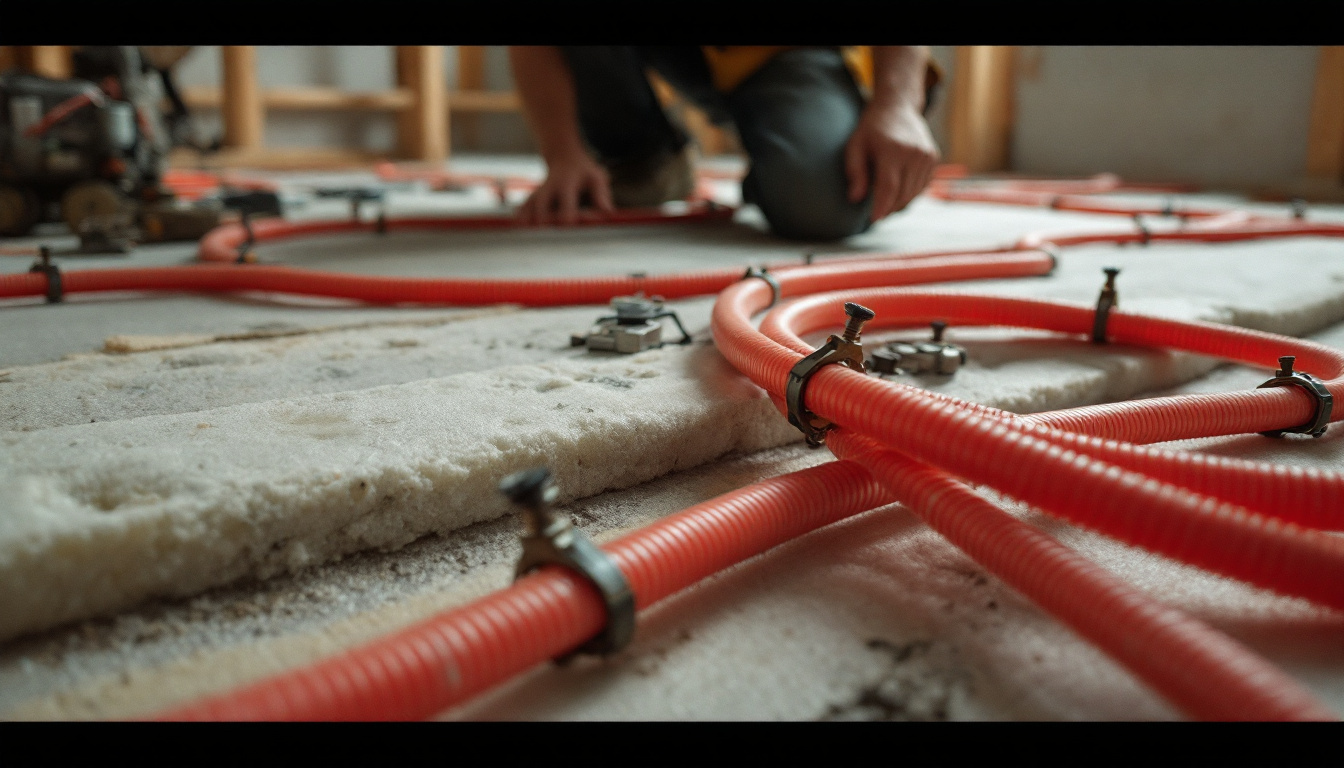
DOE separates installations into two kinds. “Wet” installations embed tubing or cables in a concrete slab or lightweight concrete, using its thermal mass. “Dry” installations run them in an air space under the floor, which is faster and cheaper to build but needs the system to run at a higher temperature.
Hydronic, electric and radiant air floors
Of the three types, DOE calls hydronic systems “the most popular and cost-effective radiant heating systems for heating-dominated climates.”
| Type | How it heats | DOE’s assessment |
|---|---|---|
| Hydronic | Pumps heated water from a boiler through tubing under the floor | Most popular and cost-effective in heating-dominated climates |
| Electric | Heating cables or mats built into the floor | Usually cost-effective only with significant thermal mass and time-of-use electricity rates |
| Radiant air | Pumps heated air through the floor | Not cost-effective in homes and seldom installed |
Hydronic systems can heat the water with gas or oil boilers, wood-fired boilers or solar water heaters. Our guide to boilers and baseboard heating covers the boiler side.
What radiant floor heating costs to run
The floor only distributes heat; the source sets the running cost. At 2025/26 season prices and federal minimum efficiencies:
| Heat source | Federal minimum | Cost per million Btu delivered |
|---|---|---|
| Gas hot water boiler | 84% AFUE | $17.92 |
| Oil hot water boiler | 86% AFUE | $33.68 |
| Electric cables or mats | Resistance, 100% | $52.10 |
Federal AFUE minimums for hot water boilers are 84% for gas and 86% for oil under 10 CFR 430.32(e)(2); electric hot water boilers have no AFUE minimum. For how these compare with furnaces and heat pumps, see what heat costs by fuel.
DOE’s guidance explains that with a thick concrete floor and time-of-use rates, you can “charge” the slab with heat during off-peak hours, approximately 9 p.m. to 6 a.m. If the thermal mass is large enough, the stored heat “will keep the house comfortable for eight to ten hours without any further electrical input.” Without both conditions, an electric floor is simply expensive heat.
Which floor coverings work
DOE says ceramic tile “is the most common and effective floor covering for radiant floor heating, because it conducts heat well and adds thermal storage.” Anything that insulates the floor from the room lowers efficiency.
- Tile and stone: the best match.
- Carpet: use thin carpet with dense padding, and as little as possible.
- Wood: DOE recommends laminated wood flooring over solid wood, to reduce shrinking and cracking.
- Mixed rooms: rooms with a different covering should have their own tubing loop, because water under a covered floor has to run hotter.
The disadvantages
The main drawbacks are slow response, no cooling, and cost and disruption to install in an existing home.
- Slow response. DOE notes thick slabs have a “slow thermal response time, which makes strategies such as night or daytime setbacks difficult if not impossible,” and most experts recommend a constant temperature.
- No cooling. A radiant floor heats only. Cooling needs a separate system, such as a ductless mini-split.
- Installation cost. DOE says hydronic installation cost varies with location, home size, installation type, floor covering, site remoteness and labour. No federal series measures it.
- Floor limits. Coverings and floor build-up are constrained, especially in retrofits.
How many homes use it
EIA does not count radiant floors separately. Its Residential Energy Consumption Survey reports that 9.29 million homes, 7.9% of those that heat, use a steam or hot water system as their main heating equipment, a group that includes radiators, baseboards and radiant floors. Forced air is far more common; see what central heating is.
Frequently asked questions
Is radiant floor heating efficient?
DOE’s guidance says radiant heating is more efficient than baseboard heating and usually more efficient than forced-air heating because it eliminates duct losses. Running cost still depends on the heat source: about $17.92 per million Btu from an 84% gas boiler against $52.10 for electric floors at 2025/26 prices.
Is electric radiant floor heating expensive to run?
Usually, because it is resistance heat. At the 2025/26 heating season average electricity price it cost about $52.10 per million Btu delivered. DOE says electric floors are usually cost-effective only with significant thermal mass and time-of-use rates, or in additions where extending the main system is impractical.
What is the best flooring for radiant heat?
Ceramic tile, which DOE calls the most common and effective covering because it conducts heat well and adds thermal storage. Carpet should be thin with dense padding, and laminated wood is preferred over solid wood to limit shrinking and cracking.
What are the disadvantages of radiant floor heating?
Slow response in thick slabs, which makes thermostat setbacks difficult; no cooling, so a separate system is needed; limits on floor coverings; and an installation cost that DOE says varies widely with home size, installation type and labour.
Methodology and limitations
DOE statements are quoted from its Energy Saver guidance on radiant heating, which no longer resolves at energy.gov; we cite the archived copy. Running costs use EIA 2025/26 season average prices and federal minimum efficiencies, documented on our fuel cost page.
- We publish no installed prices, because no federal series measures them.
- Costs exclude distribution pumps, boiler standby losses and fixed utility charges.
- RECS 2020 does not separate radiant floors from other hot water systems.
Sources
- US Department of Energy, Energy Saver: Radiant Heating, archived copy.
- Code of Federal Regulations, 10 CFR 430.32(e)(2), residential boiler standards.
- US Energy Information Administration, Residential Energy Consumption Survey 2020, table HC6.1.
The HVAC Brief is an independent trade publication. We do not sell equipment, take manufacturer advertising, or accept payment for placement in our research. Corrections welcome.
Leave a Reply