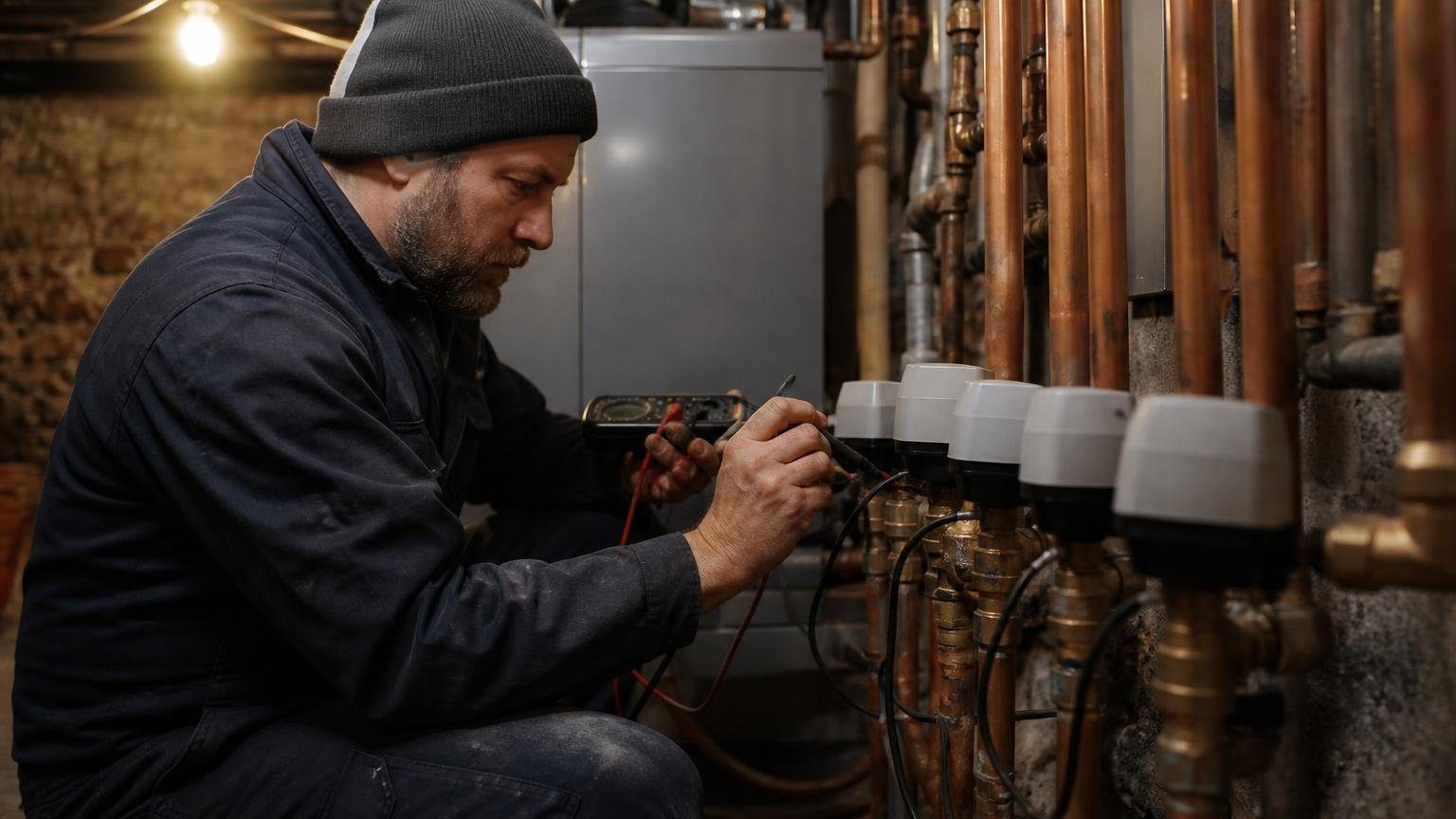
What is a zone valve? A zone valve is a motorized valve that opens one hot water heating loop when that zone’s thermostat calls for heat. Once it is fully open, its end switch tells the boiler and circulator to run. Most residential models run on 24 volts.
Key Takeaways
- A Resideo (Honeywell) V8043 draws 6 W and opens in 15 seconds; four share one 40 VA transformer (Resideo 95C-10002EF).
- Taco allows up to 12 Zone Sentry valves on one 40 VA transformer (Taco submittal 101-140).
- A Taco 571 heat motor draws 0.9 A at 24 V, or 21.6 VA (Taco 100-3.3).
- The end switch closes at full open to start the circulator; it does not stop the motor (Caleffi idronics 36).
- On manual open, a Resideo end switch stays off but a 24 V Caleffi switch trips (Caleffi NA10073).
- 9.29 million US homes heated mainly with steam or hot water in 2020 (EIA RECS Table HC6.1).
What is a zone valve and what does it do?
A zone valve lets one boiler heat separately controlled areas. Each loop gets its own valve and thermostat, and one pump moves water through whichever valves are open. Resideo calls its V8043 two-position (open-close) control for baseboard, convectors and fan coils.
It is the switching point of a hot water heating loop. EIA counted 9.29 million US homes heated mainly by steam or hot water in 2020. Our guide to boiler and baseboard systems covers the rest of the loop.
How does a zone valve work?
A zone valve works in five steps: the thermostat closes, 24 VAC reaches the actuator, the actuator opens the valve, the end switch closes at full open, and the boiler control starts the circulator. When the thermostat is satisfied, a return spring closes the valve and the end switch opens again.
The actuator, or head, is where designs differ. The V8043 uses a motor powerhead with spring return. The Caleffi Z-one uses a synchronous motor that winds its return spring. Taco’s 571 heats a wax-filled element that pushes the valve stem. The Taco Zone Sentry charges a capacitor, then turns a ball in approx. 5 seconds.
Myth: the end switch stops the motor
It does not. The end switch is a separate contact that closes at full open to signal the circulator and heat source, per Caleffi’s idronics 36. In Taco’s heat motor, a separate heater switch cycles the element to hold the valve open.
Honeywell, Taco and Caleffi zone valves: how do the designs compare?
Honeywell (Resideo), Taco and Caleffi zone valves differ most in power draw, opening time and end switch rating. Every figure below is printed in the maker’s own sheet.
| Valve | Actuator | Power | Open / close time | End switch rating |
|---|---|---|---|---|
| Resideo (Honeywell) V8043F and G | Motor powerhead, spring return, ball | 6 W nominal at 24 V | 15 s open, 4 to 5 s close | G: 50 VA pilot duty at 24 Vac. F: 4.4 A at 120 Vac |
| Taco Zone Sentry | Capacitor plus gear-driven ball | 11.4 W charging, 1.44 W powered | Up to 35 s first charge, then approx. 5 s | 1 amp at 24 VAC |
| Taco 571 heat motor | Wax element, globe valve | 0.9 A at 24 V | Not stated | Isolated, dry contact |
| Caleffi Z-one (24 V) | Synchronous motor winds spring, paddle | 5.0 W, 7 VA | Under 60 s on, 6 s off | 0.4 A max at 24 V |
Two differences matter in the field. Opening times run from about 5 seconds to under a minute, so slow is not failed. And a heat motor head draws far more current, which limits valves per transformer.
2 wire vs 3 wire zone valve: what does each wire do?
A 2 wire zone valve has motor leads only; a 3 wire valve shares one terminal between motor and end switch; a 4 wire valve gives the end switch its own pair. Read the head’s terminal labels before assuming.
- 2 wire: the V8043C and D have 2 leads and no end switch, so something else has to start the pump.
- 3 wire: on the Taco 571 the motor uses terminals 1 and 2 and the end switch terminals 2 and 3; Taco says the two circuits, each with its own transformer, do not interfere.
- 4 wire: the V8043G has 4 low voltage leads and a low voltage end switch. The V8043F has a 5 screw terminal board and a line voltage end switch.
Resideo specifies a two-wire, 24-volt circuit and an SPST thermostat for the V8043; our thermostat wiring guide covers that end.
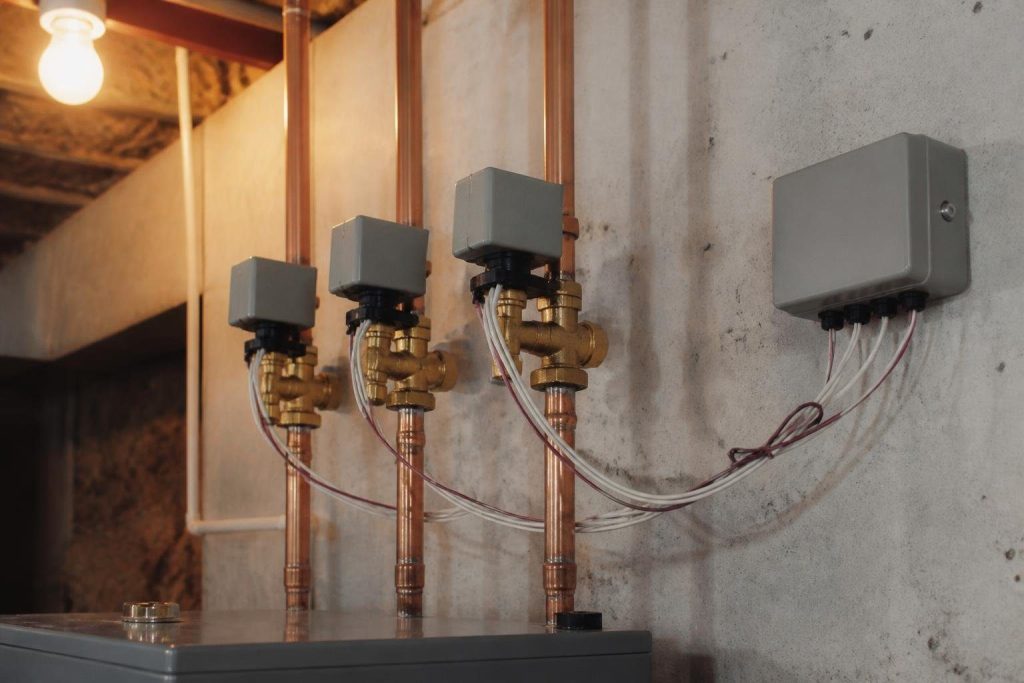
Where is a zone valve located?
A zone valve sits on the piping of the loop it controls, often grouped near the boiler. Caleffi allows two-way valves on supply or return, following the flow arrow. Resideo says the V8043 fits under most baseboard covers.
On a horizontal pipe, Resideo requires the powerhead even with or above the center line; Caleffi allows any position except upside down. Taco lists radiant floor loops among Zone Sentry applications.
Zone valve not opening: what should you check, in order?
When a zone valve is not opening, confirm the call, measure 24 VAC at the head, wait the rated time, then try the manual lever. That order separates a control fault from a failed head. If the whole boiler is dead, start with our boiler troubleshooting checks instead.
- Confirm the call. An unlit Zone Sentry LED means no call or no power. For thermostat faults, see our thermostat fault guide.
- Measure 24 VAC at the motor terminals with the zone calling. No voltage means the fault is upstream.
- Wait the rated time. A V8043 needs 15 seconds; a new Zone Sentry can take up to 35 seconds to charge; a Z-one can take nearly 60.
- Try the manual lever. If heat flows, the body is fine and the head is suspect.
- Check the transformer load. Compare total valve draw with the transformer’s VA.
Resideo and Taco both warn never to jumper the motor terminals, even briefly; it can damage the thermostat. Line voltage end switches are a job for a licensed technician.
Volts times amps equals VA. A Taco 571 draws 21.6 VA, so two (43.2 VA) exceed a 40 VA transformer; five 7 VA Caleffi heads total 35 VA. That is our arithmetic, before thermostats or relays on the same HVAC transformer. A Zone Sentry slow blink, once every 5 seconds, means not enough VA.
Why does a zone valve not close or not turn on the circulator?
A valve that opens but does not start the circulator usually has an end switch problem; one that will not close usually has debris, a lever left in manual, or too much pressure across the seat.
Not turning on the circulator. At full open the end switch should show continuity. Resideo’s switch is not energized when the valve is opened by hand, so a hand-opened Resideo valve will not start the pump; a 24 V Caleffi switch is tripped.
Not closing. Check the lever is in AUTO. A Zone Sentry double blink (twice every 5 seconds) points to an obstruction or failed actuator. Close-off ratings matter too: a 3.5 Cv V8043 closes against 20 psi, and Caleffi lists 12 to 75 psid by model. That is pressure across the valve, not the boiler gauge; our boiler pressure reference covers fill pressure.
Zone valves or circulator zoning: which is better?
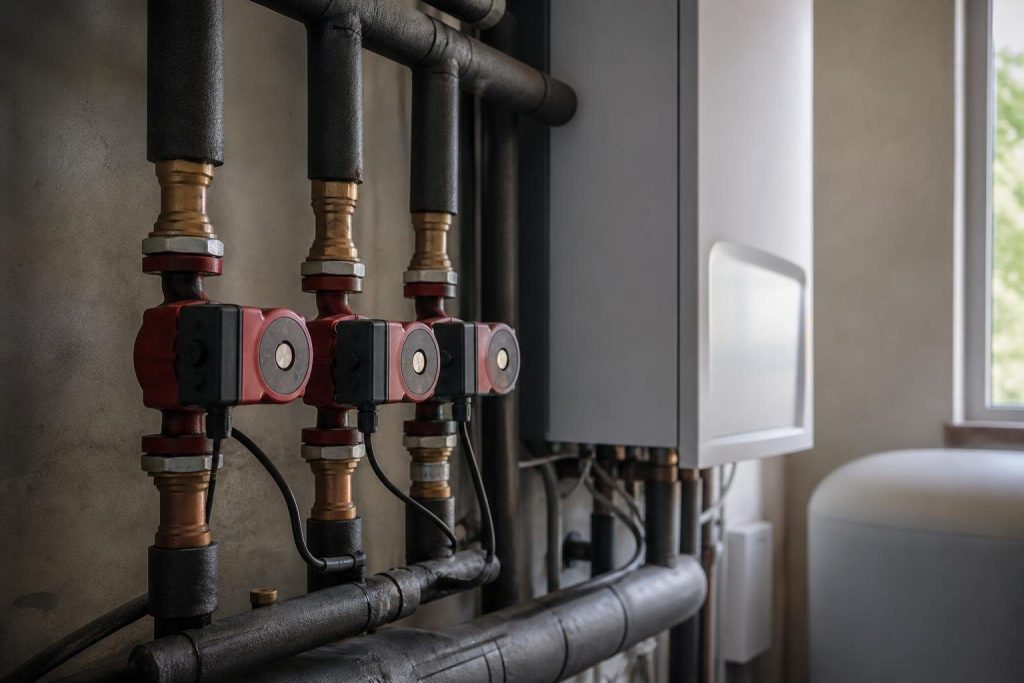
Neither wins everywhere. Valve zoning uses one pump and a valve per loop; circulator zoning uses a pump per loop. Caleffi notes valve zoning needs a single circulator, which can run on lower input power than zone circulators.
The trade-off: as zones close, differential pressure across the pump climbs, so Caleffi pairs valve systems with a bypass valve or a variable-speed circulator pump. Forced air homes use dampers; see our guide to zoning systems.
When is zone valve replacement the right fix?
Zone valve replacement is usually a head swap. Resideo, Taco and Caleffi heads all lift off a body that stays in the pipe, by powerhead swap, release clip or push button.
A new body means draining and soldering; Taco wants the actuator off and solder melting below 600°F. Taco also warns against zone valves on indirect water heaters without a tempering device.
We publish no price: no federal source tracks zone valve repair costs. Ask for a quote naming the part, head or full valve.
How we researched this
Researched October 2026. We read the full Resideo V8043, Taco Zone Sentry, Taco 571 and Caleffi Z-one documents, Caleffi idronics 36 and EIA RECS 2020; all seven are cited. Maker figures are maker specifications, not our tests. Excluded: prices (no federal series), contractor blogs, and Reddit, because boiler controls are a safety topic. VA totals are our arithmetic.
Frequently asked questions
How do I know if a zone valve is bad?
One zone stays cold while others heat, or heats when it should be off. With the zone calling, check for 24 VAC at the head. Voltage but no movement after the rated time, 15 seconds on a V8043, points to the head.
What does it cost to replace a zone valve?
We publish no figure, because no federal or national lab source tracks zone valve repair prices. The main cost driver is head versus body: heads come off without cutting pipe, while a new body means draining the loop and soldering. Ask for a quote that names the part.
Can I open a zone valve manually?
Yes. Resideo, Taco and Caleffi valves all have a manual lever or button. Resideo says the V8043 returns to automatic when energized again, and its auxiliary switch is not energized when manually opened, so the circulator may not start from that zone.
Can a zone valve get stuck open?
Yes. A lever left in manual, debris on the seat or a failed actuator can keep a zone heating. Taco’s Zone Sentry signals obstruction or a failed actuator with a double LED blink; its reset is removing power for 5 seconds.
How many zone valves can one transformer run?
It depends on the head. Resideo allows four V8043 valves on a 40 VA transformer, and Taco allows up to 12 Zone Sentry valves. A Taco 571 heat motor draws 0.9 A at 24 V, or 21.6 VA, so a 40 VA transformer carries one with headroom but not two.
Can I replace a Honeywell zone valve with a Taco?
Usually, yes. Taco’s Zone Sentry instruction sheet 102-410 includes wiring diagrams for replacing Honeywell, Erie, Sparco, White-Rodgers and Taco 3-wire valves. Match the end switch wiring and check the new head’s VA draw against the existing transformer before wiring it in.
Do zone valves work on steam heat?
Not the standard ones. Resideo says its standard V8043 is not recommended for steam and steam needs special ball plugs. Caleffi lists low pressure steam as suitable for Z-one bodies, at 15 psi maximum static pressure. Have steam zoning specified for the exact system.
Sources
- Resideo. “V8043C, D, F and G Motorized Zone Valves, 95C-10002EF.” https://res.cloudinary.com/dzhpkjoqj/Resideo/95C-10002EF.pdf. Accessed October 2026.
- Taco. “Zone Sentry Instruction Sheet 102-410.” Distributor copy. https://4665334.app.netsuite.com/c.4665334/site/images/Technical%20Data%20Sheets/01066551_Taco-Z050C2-1-Install-Instructions.pdf. Accessed October 2026.
- Taco. “Zone Sentry Submittal 101-140.” Distributor copy. https://4665334.app.netsuite.com/c.4665334/site/images/Technical%20Data%20Sheets/01066551_Taco-Z050C2-1-Brochure.pdf. Accessed October 2026.
- Taco. “Heat Motor Zone Valves, Submittal 100-3.3.” https://res.cloudinary.com/dzhpkjoqj/image/upload/Taco/Taco571-2-Spec_100-3.1. Accessed October 2026.
- Caleffi. “Z-one Motorized Zone Valve, NA10073.” https://www.caleffi.com/sites/default/files/media/external-file/NA10073.pdf. Accessed October 2026.
- Caleffi. “idronics 36, Section 3: Zoning with Motorized Valves.” https://www.caleffi.com/en-us/node/13814. Accessed October 2026.
- U.S. EIA. “RECS 2020 Table HC6.1.” https://www.eia.gov/consumption/residential/data/2020/hc/pdf/HC%206.1.pdf. Accessed October 2026.
Leave a Reply