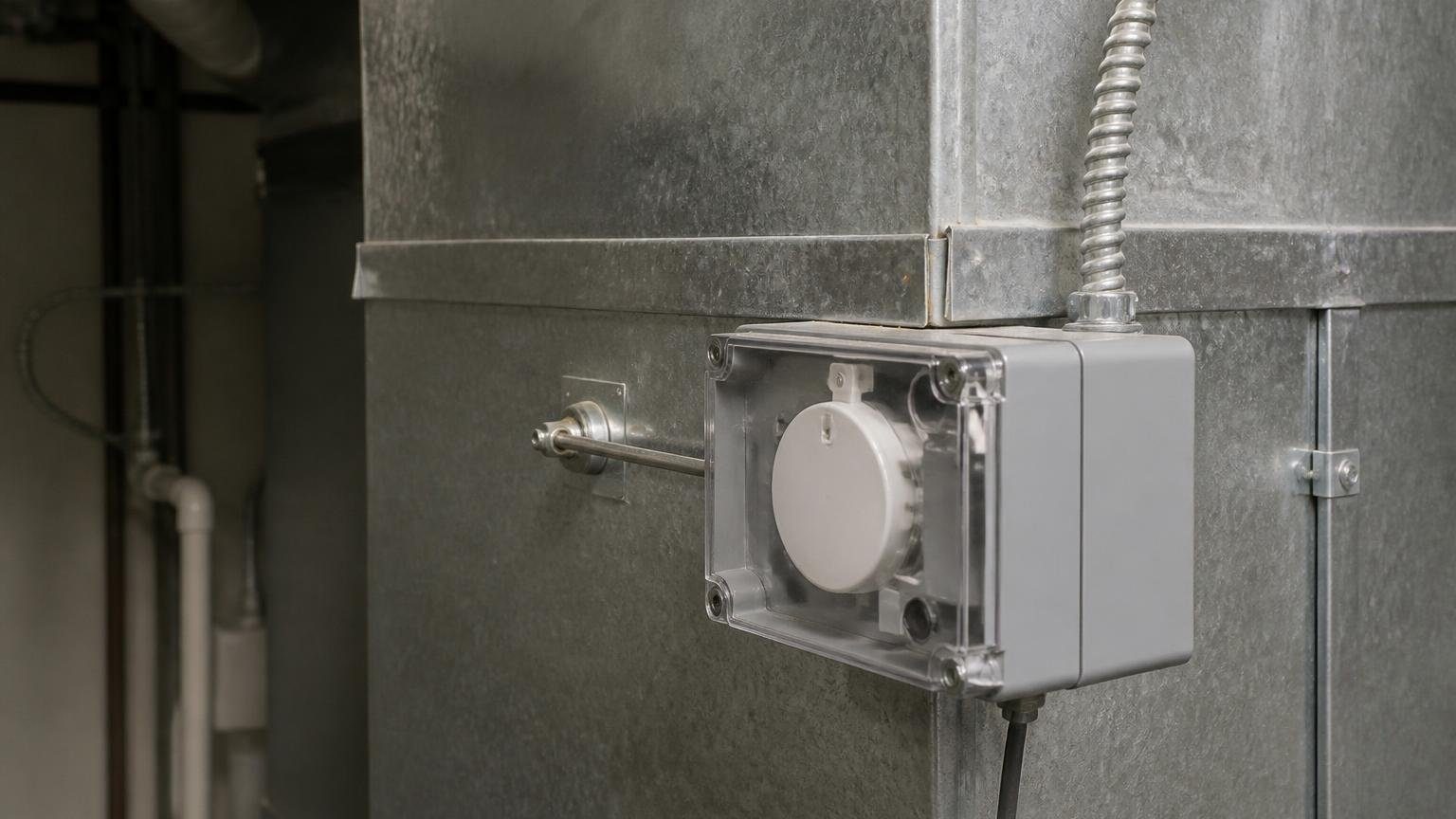
What is a duct smoke detector? A duct smoke detector is a UL 268A listed detector that samples air moving through a duct and shuts the fan down when it sees smoke. The International Mechanical Code requires one in return air systems over 2,000 cfm. It does not replace room smoke detectors.
Key Takeaways
- IMC 606.2.1 requires a detector in return air systems over 2,000 cfm, upstream of filters (2024 IMC Section 606).
- Return risers serving two or more stories on systems over 15,000 cfm need a detector at each story (IMC 606.2.3).
- NFPA 90A puts it in the supply instead, downstream of the filters, above 2,000 cfm (Florida Building Commission excerpt).
- NFPA 72 says detectors in ducts shall not be used as a substitute for open area detectors.
- A 100% outside air unit over 2,000 cfm needs no duct detector under minimum code, says North Carolina’s fire marshal (NC OSFM interpretation).
- System Sensor rates its D4120 for 100 to 4,000 ft/min of duct air (D4120 manual).
What is a duct smoke detector?
A duct smoke detector watches the air inside an HVAC duct, not a room. The 2024 IMC requires duct detectors to comply with UL 268A; room detectors comply with UL 268. Its job is to stop an air handler spreading smoke to every space it serves.
NFPA 72 Section 17.7.5.5.3, quoted by the Prosper, Texas fire marshal, allows four mountings: inside the duct, on the duct wall with the sensor protruding, outside with sampling tubes, or a projected beam. The sampling tube type is the familiar housing with a perforated tube across the airstream.
When is a duct smoke detector required?
Under the 2024 IMC, a duct smoke detector is required in return air systems over 2,000 cfm (606.2.1), in shared systems whose combined capacity tops 2,000 cfm (606.2.2), and at each story of a return riser on systems over 15,000 cfm (606.2.3).
Which rulebook applies depends on your jurisdiction. Where NFPA 101 is enforced, its Section 9.2.1 sends ductwork to NFPA 90A, which sets different trigger points.
| Situation | 2024 IMC Section 606 | NFPA 90A (2012 text) |
|---|---|---|
| Single air handler over 2,000 cfm | Detector in the return, upstream of filters and outdoor air (606.2.1) | Detector in the supply, downstream of filters, ahead of branches (6.4.2.1(1)) |
| Several units sharing ducts or a plenum, combined over 2,000 cfm | Return detectors required (606.2.2) | No separate common duct rule in the 6.4.2.1 text; ask the authority having jurisdiction |
| Multistory return over 15,000 cfm | Detector at each story, upstream of the riser connection (606.2.3) | Detector at each story, before the common return (6.4.2.1(2)) |
| Area smoke detection covers the whole space served | Return detector waived (606.2.1 exception) | Return detector waived (6.4.2.2) |
| Exhaust only fan | Not a return air system, so 606.2.1 does not reach it | Exempt (6.4.2.3) |
Where does 2,000 cfm sit? Federal test rules assume 400 scfm per 12,000 Btu/h when no airflow is certified (10 CFR 430, Appendix M). So a 5 ton (60,000 Btu/h) unit moves about 2,000 cfm, not “greater than” 2,000. A residential central air conditioner is rated below 65,000 Btu/h (10 CFR 430.2), or about 2,167 cfm at that ratio. See our airflow per ton explainer for why real systems vary.
Does a duct smoke detector go in the supply or the return?
Under the IMC, the duct smoke detector goes in the return, upstream of filters and outdoor air connections, reading air from occupied rooms before it is diluted. NFPA 90A puts it in the supply, downstream of the filters, where it also sees a fire in the filters or fan.
North Carolina’s State Fire Marshal wrote in 2019 that NFPA 90A placement “is a design choice and not minimum code” there. Consultant Thomas Hammerberg notes in Electrical Contractor that return placement avoids false alarms from dust burning off heat strips, worth knowing during air handler commissioning.
Which systems are exempt?
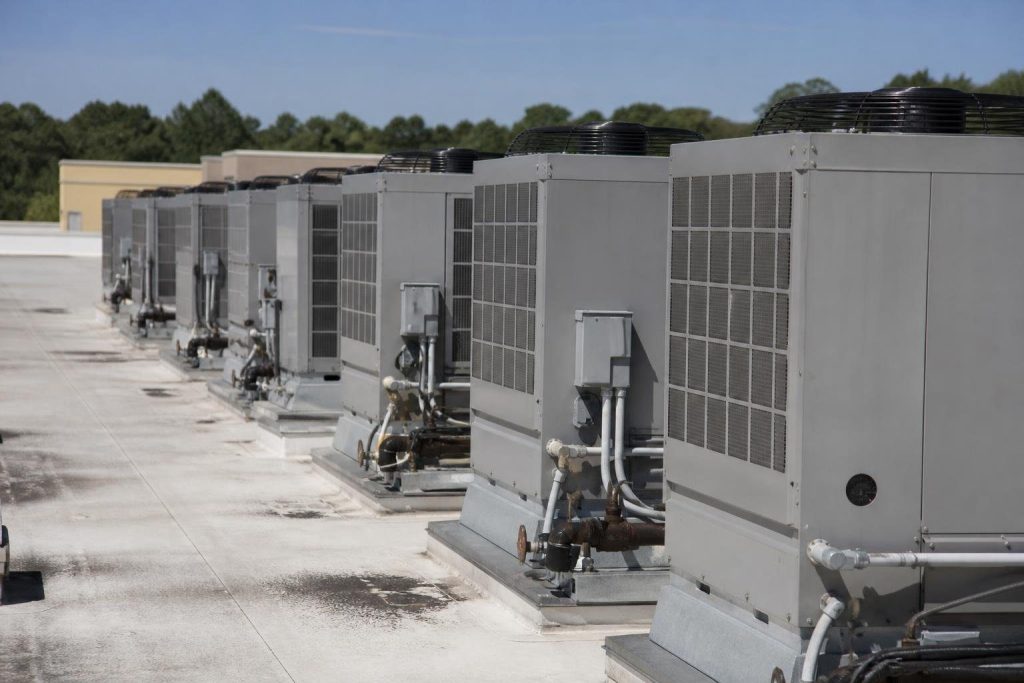
Five situations can take a system out of the IMC requirement. The plans examiner applies each to the actual duct layout.
- One room, one space. No detector where the system cannot spread smoke beyond its room (606.2 exception). NC OSFM’s example: a big-box rooftop unit with stub ducts into one sales floor, even above 2,000 cfm.
- Full area detection. Waived when every area served has area smoke detectors on a fire alarm system that shuts the unit down.
- No return at all. A 100% outside air unit, such as a dedicated make up air unit, has no return, so NC OSFM says none is required.
- Small units with separate ducts. Fully ducted systems of 2,000 cfm or less sharing no ducts or plenums need none, even if the aggregate exceeds 2,000 cfm (NC OSFM).
- Fan powered terminal units. Units of 2,000 cfm or less, such as a fan powered VAV box, need no individual detector if another detector shuts them down (606.2.2 exception).
Is a duct detector the same as an area smoke detector?
No. A duct detector is an equipment control, not life safety coverage for the rooms it serves. NFPA 72 (2010) Section 17.7.4.2.2 states that detectors placed in air ducts or plenums “shall not be used as a substitute for open area detectors.”
The NFPA handbook commentary, reproduced by the Florida Building Commission, explains why: clean air from other rooms dilutes the smoke, and nothing is drawn in when the fan is off (17.7.5.2.1).
Correction
“The building has duct detectors, so the rooms are covered” is wrong; the NFPA handbook says designers try it “all too often”. A duct detector only sees smoke while the fan runs. Room protection comes from area smoke detectors, and fuel burning appliances need their own carbon monoxide detector placement.
What happens when a duct smoke detector trips?
When a duct smoke detector trips, IMC 606.4 requires it to shut down the air distribution system, or switch a smoke control system into smoke control mode. NFPA 72 A.17.7.5.3 also lists closing dampers among its uses, so a trip can drive motorized dampers shut.
Where a fire alarm system is required, the detector connects to it; under supervising station monitoring it reports only as a supervisory signal, not a fire alarm (IMC 606.4.1). NFPA 101 Section 9.6.3.2.2 likewise spares shutdown-only detectors from sounding the evacuation alarm. A combination fire and smoke damper follows its own rules.
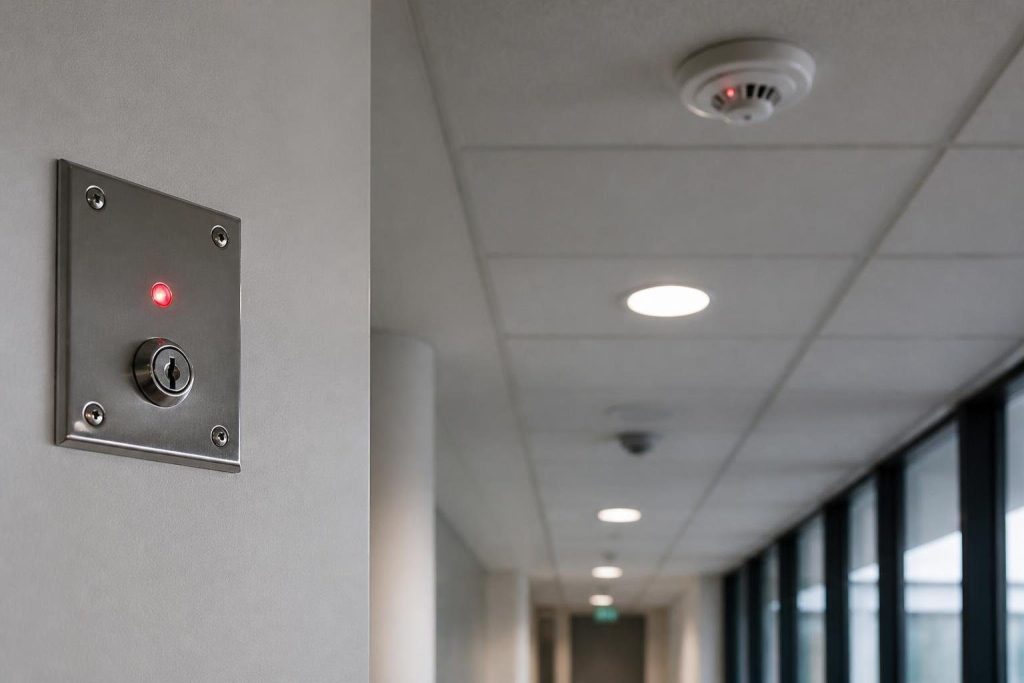
Without a fire alarm system, activation must trigger a visible and audible signal in an approved location, with trouble shown as “air duct detector trouble”. Las Vegas Fire & Rescue wants a three-light (green, yellow, red) annunciator with a buzzer and reset key, and bars horn strobes.
How is a duct smoke detector installed and wired?
A duct smoke detector is installed per NFPA 72 and the maker’s instructions, with access for inspection (IMC 606.3). Figures below are maker data from the System Sensor D4120 manual, not code; other models differ.
- Confirm duct air speed of 100 to 4,000 ft/min with an anemometer.
- Mount on the return, upstream of the filter bank and outdoor air.
- Size the sampling tube to the duct (DST1 up to 1 foot, DST10 for 8 to 12 feet); it must span at least 2/3 of the width, holes facing the airflow.
- Cap the tube and confirm 0.01 to 1.11 inches of water column across the ports with a manometer.
- Wire the alarm initiation contact to the panel and the 10A auxiliary contacts to fan shutdown, never the reverse.
The D4120 runs on 24 VAC, 24 VDC or 120 VAC; at 24 VAC it draws up to 135 mA in alarm, which the control transformer must have room for. Up to 50 units can interconnect for multiple fan shutdown, and an RTS451 remote test station tests and resets a detector above a ceiling.
How often is duct detector testing required?
Duct detector testing is required at least annually: NFPA 90A Section 6.4.1, restated by Las Vegas Fire & Rescue, says all automatic shutdown devices shall be tested at least annually. NFPA 72 Chapter 14 sets what the test must prove.
The NFPA 72 (2019) Table 14.4.3.2 excerpts from Prosper, Texas list three checks: a functional test with smoke or listed aerosol, a sensitivity test against the listed range, and, for sampling tube units, proof the tube samples the airstream.
System Sensor says to clean the D4120 at least once a year; for low airflow ducts it drills a hole 3 feet upstream, confirms at least 100 FPM and sprays aerosol smoke. Each test should prove the fan stops. Check whether your commercial HVAC service agreement covers it.
How we researched this
Researched October 11, 2026. We read the 2024 IMC Section 606 text, NFPA 90A, 72 and 101 excerpts reproduced by the Florida Building Commission, fire marshal documents from North Carolina, Las Vegas and Prosper, two federal regulations and the System Sensor D4120 manual. Thirteen documents were opened; nine are cited.
Excluded: shop prices (no federal series), a System Sensor guide citing 1996 NFPA editions, an NFPA 72 sensitivity interval we could not confirm officially, and Reddit (life safety topic). The NFPA excerpts are 2010 to 2019 editions; later ones may renumber.
Frequently asked questions
Are smoke detectors required in ductwork?
Only above set sizes. The 2024 IMC requires duct smoke detectors in return air systems over 2,000 cfm, in shared systems whose combined capacity is over 2,000 cfm, and at each story of return risers on systems over 15,000 cfm. Local amendments can change any threshold.
Where should a duct smoke detector be installed?
Under IMC 606.2.1, in the return air duct or plenum upstream of any filters, exhaust air connections and outdoor air connections. NFPA 90A instead puts it in the supply, downstream of the filters and ahead of any branch connections. IMC 606.3 requires access for maintenance.
Are duct detectors the same as smoke detectors?
No. Duct detectors are listed to UL 268A for moving air; room detectors to UL 268. NFPA 72 says duct detectors shall not be used as a substitute for open area detectors, because they only sample air while the fan runs.
Do 100% outside air units need a duct smoke detector?
Not under minimum IMC rules, according to North Carolina’s State Fire Marshal: a 100% outside air unit over 2,000 cfm has no return, and the requirement applies to return air systems. Designers may still specify one for smoke pulled in from outside.
Should a duct detector trip the fire alarm?
Usually not as a fire alarm. IMC 606.4.1 says that in buildings monitored by a supervising station, duct smoke detectors report only as a supervisory signal. Where a fire alarm is required, activation must produce a visible and audible supervisory signal at a constantly attended location.
What air speed does a duct smoke detector need?
It depends on the listing. System Sensor rates its D4120 for 100 to 4,000 ft/min and requires 0.01 to 1.11 inches of water column across the sampling ports. NFPA 72 requires detectors listed for the full range of air velocity, temperature and humidity expected when the system runs.
Sources
- UpCodes. “Section 606 Smoke Detection Systems Control, Illinois Mechanical Code 2024.” https://up.codes/s/smoke-detection-systems-control. Accessed October 2026.
- Florida Building Commission, Fire TAC. “FMC Section 606 and FFPC 101:9.2 comparison (NFPA 90A 2012, NFPA 72 2010, NFPA 101 excerpts).” https://floridabuilding.org/fbc/commission/fbc_0815/Fire_TAC/FMC_SECTION_606.htm. Accessed October 2026.
- North Carolina Department of Insurance, Office of the State Fire Marshal. “Smoke Detector for Common Supply and Return Air Systems” (2019). https://www.ncosfm.gov/mechanical/060622-smoke-detector-common-supply-and-return-air-systems-0/open. Accessed October 2026.
- Las Vegas Fire & Rescue. “Duct Detectors” information sheet (2014). https://files.lasvegasnevada.gov/building-safety/Duct-Area-Test-Data-Information-Sheet.pdf. Accessed October 2026.
- Prosper Fire Rescue. “Guidelines for Duct Detector Testing” (NFPA 72 2019 excerpts). https://prospertx.gov/DocumentCenter/View/1756/Guidelines-for-Duct-Detector-Testing-PDF. Accessed October 2026.
- System Sensor. “D4120 Installation and Maintenance Instructions” (I56-2967). https://s3.amazonaws.com/sdepot.com/lit/BRK001/D4120_II.pdf. Accessed October 2026.
- Electronic Code of Federal Regulations. “10 CFR Part 430, Subpart B, Appendix M.” https://www.ecfr.gov/current/title-10/chapter-II/subchapter-D/part-430/subpart-B/appendix-Appendix%20M%20to%20Subpart%20B%20of%20Part%20430. Accessed October 2026.
- Electronic Code of Federal Regulations. “10 CFR 430.2 Definitions.” https://www.ecfr.gov/current/title-10/chapter-II/subchapter-D/part-430/subpart-A/section-430.2. Accessed October 2026.
- Electrical Contractor (Thomas P. Hammerberg). “Duct Detectors: The Smoke Detectors Everyone Loves to Hate.” https://www.ecmag.com/magazine/articles/article-detail/integrated-systems-duct-detectors-smoke-detectors-everyone-loves-hate. Accessed October 2026.
Leave a Reply