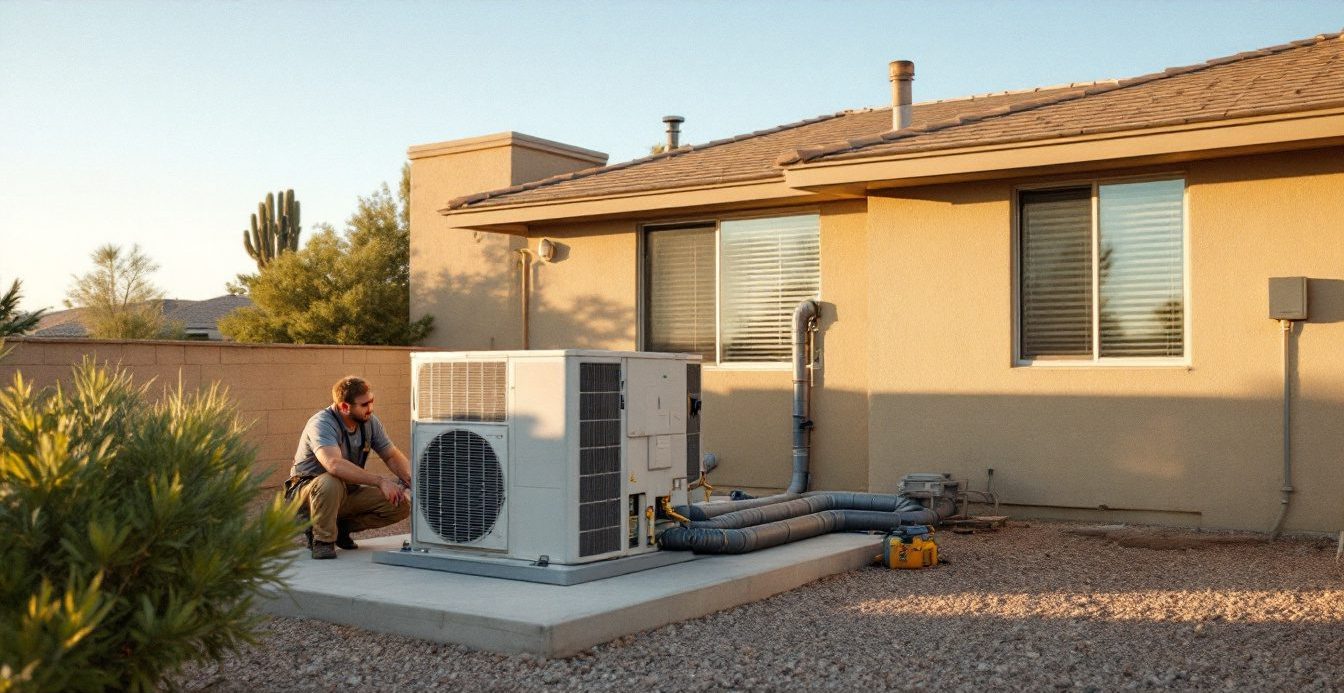
Packaged unit vs split system, which should you buy? A packaged unit puts the compressor, both coils, the blower and usually the heat source in one outdoor cabinet; a split system divides them between an outdoor unit and an indoor air handler or furnace. Federal minimums differ: packaged heat pumps need only 6.7 HSPF2, against 7.5 for split.
Key Takeaways
- The FTC energy labeling rule defines a single package unit as a central air conditioner with all major assemblies enclosed in one cabinet.
- Under 10 CFR 430.32(c), packaged and split air conditioners share a 13.4 SEER2 national floor, but packaged heat pumps need 13.4 SEER2 and 6.7 HSPF2 against 14.3 and 7.5 for split.
- Only split air conditioners face the 14.3 SEER2 regional floor in the Southeast and Southwest; under 430.32(c)(6), packaged air conditioners add just a 10.6 EER2 floor in the Southwest.
- A gas pack’s furnace sits outdoors, and outdoor (weatherized) gas furnaces need 81.0% AFUE; the 95.0% floor from December 18, 2028 lists only non-weatherized and mobile home furnaces.
- A 2017 DOE rule left packaged standards unchanged because raising them to 15 SEER would have saved about 0.1 quads.
- ENERGY STAR sets lower heat pump bars for single package equipment: 7.2 HSPF2 and 10.0 EER2, against 7.8 and 11.0 for split.
What is a packaged unit, and how is it different from a split system?
The difference is where the parts live. In a split system, an outdoor condensing unit holds the compressor and outdoor coil, and an indoor air handler or furnace holds the indoor coil and blower, joined by a refrigerant line set. A packaged unit builds all of it into one outdoor cabinet and connects to the house only through supply and return ducts.
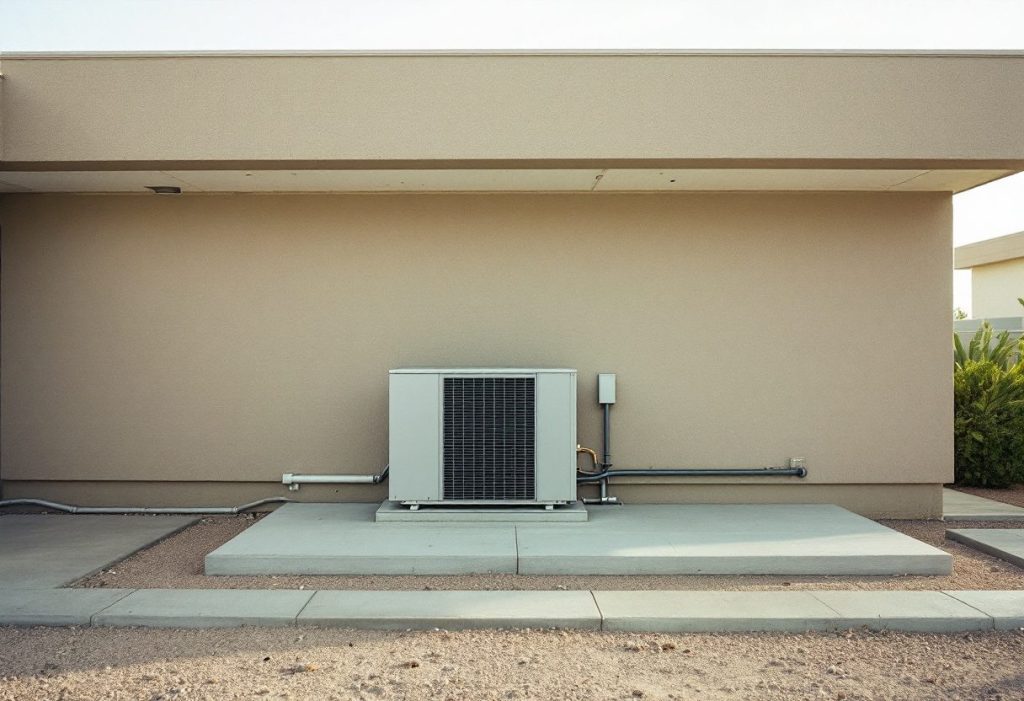
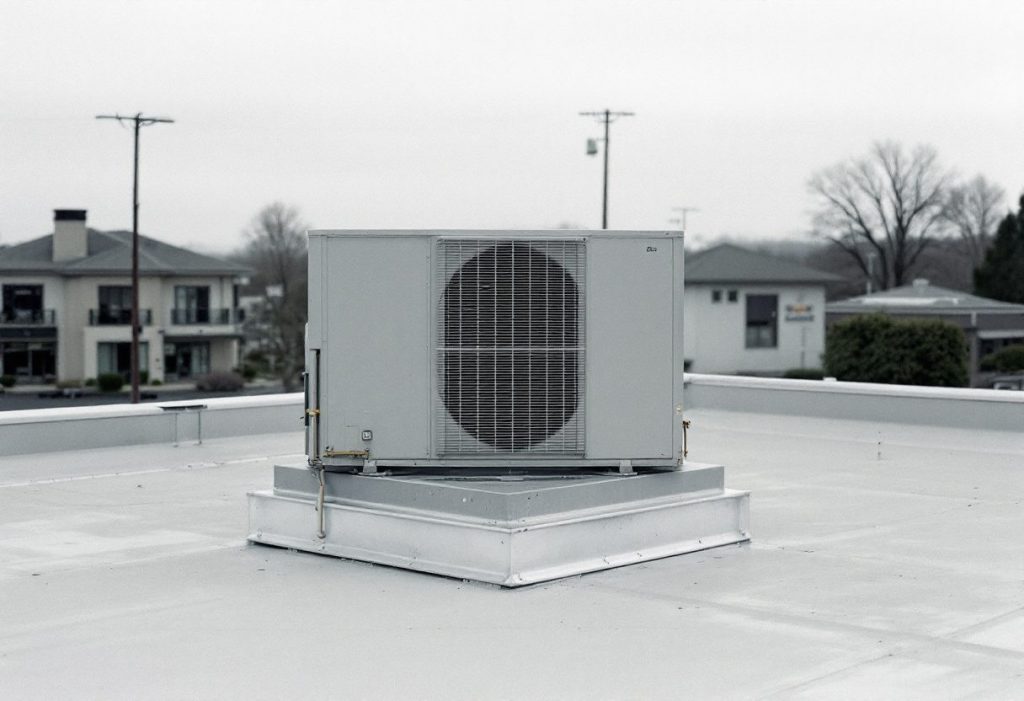
The DOE Energy Saver guide (archived copy, January 2026) says the packaged cabinet typically sits on a roof or a concrete slab next to the foundation. Federal law treats both as one product: a central air conditioner, rated below 65,000 Btu per hour, that may consist of a single-package unit or an outdoor unit with indoor units, per 10 CFR 430.2. Our guide to the main air conditioning types places both in the wider family.
What are the four types of packaged HVAC unit?
Packaged units are sorted by what heats the house, which is why buyers search for “combination heating and air conditioning units”. DOE Energy Saver lists three heat sources inside the cabinet: electric heating coils, heat pump heating, or a natural gas furnace. A fourth pairs a heat pump with a gas burner, the packaged version of a dual fuel heating system.
| Type | Cools with | Heats with | Federal floor that applies |
|---|---|---|---|
| Gas pack (gas/electric) | Air conditioner | Gas furnace in the cabinet | 13.4 SEER2; furnace 81.0% AFUE (weatherized) |
| Packaged heat pump | Heat pump | Heat pump, electric backup | 13.4 SEER2 and 6.7 HSPF2 |
| Packaged AC with heat strips | Air conditioner | Electric resistance coils | 13.4 SEER2 |
| Dual fuel pack | Heat pump | Heat pump, then gas furnace | 13.4 SEER2, 6.7 HSPF2, furnace AFUE |
| Split system (for contrast) | Outdoor condenser | Indoor furnace, air handler strips or heat pump | 13.4 SEER2 AC; 14.3 SEER2 and 7.5 HSPF2 heat pump |
Source: eCFR, 10 CFR 430.32(c) and (e), current text read October 2026. ENERGY STAR’s heat pump criteria name “gas/electric package units” as single package equipment.
How do federal efficiency rules treat a packaged unit vs split system?
As separate product classes with separate floors. Since January 1, 2023, 10 CFR 430.32(c)(5) sets 13.4 SEER2 for both split and single-package air conditioners, but splits heat pumps apart: 14.3 SEER2 and 7.5 HSPF2 for split, 13.4 SEER2 and 6.7 HSPF2 for single-package.
The regional rule in 430.32(c)(6) widens the gap. Split air conditioners under 45,000 Btu/hr installed in the Southeast or Southwest must reach 14.3 SEER2. The single-package row leaves both regional SEER2 cells blank and adds only a 10.6 EER2 floor in the Southwest: Arizona, California, Nevada and New Mexico. Our page on national and regional SEER2 floors lists the Southeast states.
| Federal requirement | Split system | Packaged unit |
|---|---|---|
| Air conditioner, national SEER2 | 13.4 | 13.4 |
| Air conditioner, Southeast SEER2 (under 45,000 Btu/hr) | 14.3 | No increase |
| Air conditioner, Southwest EER2 | 11.7, or 9.8 at 15.2 SEER2 and above | 10.6 |
| Heat pump, SEER2 | 14.3 | 13.4 |
| Heat pump, HSPF2 | 7.5 | 6.7 |
| Off mode power, AC / heat pump | 30 / 33 watts | 30 / 33 watts |
| ENERGY STAR heat pump | 7.8 HSPF2, 15.2 SEER2, 11.0 EER2 | 7.2 HSPF2, 15.2 SEER2, 10.0 EER2 |
Sources: eCFR, 10 CFR 430.32(c)(4) to (c)(6); ENERGY STAR Heat Pump Equipment Key Product Criteria, read October 2026.
Is a packaged unit less efficient or shorter lived than a split system?
On cooling floors, no; on heat pump floors and top-end choice, yes. Packaged and split air conditioners share the 13.4 SEER2 national minimum, so a new packaged air conditioner is not less efficient by law. Packaged heat pumps may legally sit lower, at 6.7 HSPF2 against 7.5, a gap our heat pump vs air conditioner comparison also notes.
The top of the range is thinner. In DOE’s 2017 direct final rule, the working group declined to raise single-package standards because full product lines reached only about 15 SEER against a 14 SEER standard, and a 15 SEER floor would have saved about 0.1 quads nationally. ENERGY STAR still certifies packaged models: single package heat pumps can earn the cold climate designation at 8.1 HSPF2.
Lifespan claims have no federal basis
Contractor pages say split systems outlast packaged units. No federal series we found separates the two. EIA’s equipment cost study prices and dates only split, 3-ton, coil-only central air conditioners, so treat any packaged-versus-split lifespan figure as an opinion.
Where does a packaged unit beat a split system?
Where there is no indoor room for equipment. Because the cabinet holds the furnace or heat source too, DOE Energy Saver notes a packaged unit eliminates the need for a separate furnace, which suits slab homes without a basement, attic or closet. DOE’s 2017 rule adds that single-package equipment is concentrated in 3-ton and 5-ton sizes.
Manufactured homes are the other fit. The HUD Code at 24 CFR 3280.714 requires every “combination air conditioning and heating unit” to be listed for its application. Heat pumps there must lock out resistance heat above 40°F, except for defrost.
The gas pack also sits outside a looming rule. Under 10 CFR 430.32(e), a weatherized gas furnace, one located out-of-doors, needs 81.0% AFUE. The 95% AFUE furnace standard from December 18, 2028 lists only non-weatherized and mobile home gas furnaces, as the text reads today.
A split system wins where ducts and equipment can sit indoors, or where the buyer wants the widest efficiency range. Homes without ducts have a third route: a ductless mini split.
How are PTACs and rooftop units related to packaged units?
They are commercial cousins regulated under a different part of the code. 10 CFR 431.92 defines a packaged terminal air conditioner (PTAC) as a wall sleeve and a separate combination of heating and cooling assemblies “intended for mounting through the wall”; a PTHP adds reverse cycle refrigeration.
EIA’s equipment cost study calls PTACs self-contained, ductless systems for commercial applications. It models a typical 9,000 Btu/h unit at 11.3 EER and $1,740 installed in 2022 dollars, with an average life of 8 years. Its rooftop analysis uses a 7.5 tons packaged unit, above the 65,000 Btu per hour ceiling for residential central air. Our piece on commercial versus residential HVAC covers that boundary, and our wall air conditioner guide compares a PTAC with a through-wall unit.
How do you choose between a packaged unit and a split system?
Start from what the house already has, then check the federal floor for your region. Replacing like for like is usually the simpler job, because switching type means new ducts or a new indoor location.
- Find the existing setup: one cabinet on the roof or slab means packaged; an outdoor unit plus an indoor furnace or air handler means split.
- Look for indoor space. No basement, attic or closet that can hold an air handler favors packaged.
- Pick the heat source: gas pack, packaged heat pump, heat strips or dual fuel, as in the table above.
- Check your region. In the Southeast or Southwest, a split air conditioner under 45,000 Btu/hr must reach 14.3 SEER2.
- Compare ratings, not labels. Ask for the SEER2, HSPF2 and EER2 of the exact model, and for ENERGY STAR status if rebates require it.
- Size from a load calculation, not the old unit.
Our guide on sizing an HVAC system explains the load calculation step. For the wider choice of heat source, see our rundown of home heating system types.
How we researched this
Research date: October 8, 2026. We read the current eCFR text of 10 CFR 430.2, 430.32 and 431.92, 16 CFR 305.4 and 24 CFR 3280.714, plus DOE’s 2017 rule, ENERGY STAR criteria, EIA’s 2023 cost study and an archived DOE Energy Saver page. We cite nine sources.
Excluded: contractor installed price ranges and lifespan claims (no federal series prices or dates residential packaged units separately), and an ENERGY STAR cover letter superseded by the live criteria. No Reddit material was used.
Frequently asked questions
Which is better, a packaged unit or a split system?
Neither in general. A packaged unit suits homes with no indoor room for equipment; a split system offers the wider efficiency range. Federal floors match for air conditioners at 13.4 SEER2, but split heat pumps must reach 7.5 HSPF2 against 6.7 for packaged, under 10 CFR 430.32(c)(5).
Which lasts longer, a packaged unit or a split system?
No federal data answers this. EIA’s equipment cost study, the main federal source for equipment life, covers only split, 3-ton, coil-only central air conditioners. Claims that one type outlasts the other come from contractors, not measured data, so weigh installation quality and maintenance instead.
What is a gas pack?
A gas pack is a packaged unit that combines an air conditioner and a natural gas furnace in one outdoor cabinet. The cooling side needs 13.4 SEER2. The furnace, located out-of-doors, falls in DOE’s weatherized class, which has needed 81.0% AFUE since January 1, 2015.
Can a packaged unit go on the roof?
Yes. DOE Energy Saver says the packaged cabinet is typically placed on a roof or on a concrete slab next to the house’s foundation. Whether a given roof can carry one depends on the structure and, in many jurisdictions, on a permit and local code review.
Is a PTAC a packaged unit?
Not in the residential sense. A PTAC is commercial equipment under 10 CFR 431.92: a wall sleeve and heating and cooling assemblies mounted through the wall, with no ducts. EIA models a typical 9,000 Btu/h PTAC at $1,740 installed in 2022 dollars.
Can I replace a packaged unit with a split system?
Yes, if the house can take an indoor air handler or furnace and a refrigerant line set. The ducts that ran to the outdoor cabinet must be reconnected to the new indoor unit. In the Southeast and Southwest, the new split air conditioner must also meet the 14.3 SEER2 regional floor.
Sources
- US Office of the Federal Register. “10 CFR 430.32 Energy and water conservation standards and their compliance dates.” https://www.ecfr.gov/current/title-10/chapter-II/subchapter-D/part-430/subpart-C/section-430.32. Accessed October 2026.
- US Office of the Federal Register. “10 CFR 430.2 Definitions.” https://www.ecfr.gov/current/title-10/chapter-II/subchapter-D/part-430/subpart-A/section-430.2. Accessed October 2026.
- US Office of the Federal Register. “16 CFR 305.4 Definitions.” https://www.ecfr.gov/current/title-16/part-305/section-305.4. Accessed October 2026.
- US Office of the Federal Register. “10 CFR 431.92 Definitions.” https://www.ecfr.gov/current/title-10/chapter-II/subchapter-D/part-431/subpart-F/section-431.92. Accessed October 2026.
- US Office of the Federal Register. “24 CFR 3280.714 Appliances, cooling.” https://www.ecfr.gov/current/title-24/subtitle-B/chapter-XX/part-3280/subpart-H/section-3280.714. Accessed October 2026.
- US Department of Energy. “Energy Conservation Standards for Residential Central Air Conditioners and Heat Pumps, direct final rule.” 82 FR 1786. https://www.govinfo.gov/content/pkg/FR-2017-01-06/pdf/2016-29992.pdf. Accessed October 2026.
- ENERGY STAR. “Heat Pump Equipment Key Product Criteria.” https://www.energystar.gov/products/air_source_heat_pumps/key-product-criteria. Accessed October 2026.
- US Energy Information Administration. “Updated Buildings Sector Appliance and Equipment Costs and Efficiencies.” https://www.eia.gov/analysis/studies/buildings/equipcosts/pdf/full.pdf. Accessed October 2026.
- US Department of Energy, Energy Saver. “Central Air Conditioning” (archived copy, January 1, 2026). https://web.archive.org/web/20260101014402/https://www.energy.gov/energysaver/central-air-conditioning. Accessed October 2026.
Leave a Reply